Adam Carlson Profile picture
May 17 1 tweets 2 min read Read on X
Pretty much every data point shows the same thing — by and large, Americans don’t like the Democratic Party or their approach, they’re just extremely angry with the Republican Party at the moment.

This will likely lead to a good midterm outcome for Dems. Maybe they’ll even flip the Senate.

This will lead many to think they don’t need to make any major strategic adjustments heading into 2028. They will be wrong.

In the 2022 midterms, Democrats did better than expected — partially due to backlash to the Dobbs decision, partially due to the fact that midterm electorates are just demographically better for Democrats these days (more college educated, more politically engaged, etc.).

That, among other things, gave Democrats a false sense of confidence — “look, we bucked the historical trend of getting our shit rocked in a midterm in which we held the White House!” — and they didn’t do any of the course correction that was necessary ahead of 2024. Maybe it wouldn’t have mattered in terms of the 2024 outcome, but it was a mistake nonetheless.

We cannot make that same mistake with 2026 and 2028. The massive swings that we may see toward Democrats among less party-loyal groups like young voters and Latinos will not be permanent, nor even last in the medium-term. Maybe it’ll carry over into 2028 if voters are still super pissed at Trump, but — as @madrid_mike calls it — it’s more of a “dealignment” than a realignment among these types of party-fluid groups.

So don’t let Ken Martin or establishment Democrats or even leftists tell you that we don’t need to course correct as a party if we do well in November. That voters are buying wha we are selling. On most issues, including inflation, they’re not. They’re punishing Republicans, the party in power.

If we want to build a durable connection with more voters than we currently have in our coalition, we have to have hard conversations and take some (smart) risks.

Complacency will get us back to where we are now, sooner or later.

Now I’m gonna go outside it’s beautiful out.

• • •

Missing some Tweet in this thread? You can try to force a refresh

 

Keep Current with Adam Carlson

Adam Carlson Profile picture

Stay in touch and get notified when new unrolls are available from this author!

Read all threads

This Thread may be Removed Anytime!

PDF

Twitter may remove this content at anytime! Save it as PDF for later use!

Try unrolling a thread yourself!

how to unroll video
  1. Follow @ThreadReaderApp to mention us!

  2. From a Twitter thread mention us with a keyword "unroll"
@threadreaderapp unroll

Practice here first or read more on our help page!

More from @admcrlsn

Jun 18
🚨 A new poll from Zenith Research — on behalf of Common Defense, fielded from 6/11-14 among n=602 likely general election voters in Michigan — finds Democrat Abdul El-Sayed in a strong position in a matchup against Republican Mike Rogers.

In addition to having a higher vote share vs. Rogers than McMorrow or Stevens, El-Sayed brings unique coalitional advantages to the general election — and Stevens brings unique vulnerabilities.

🧵Image
The difference between El-Sayed and Stevens’ vote shares — 45% and 43%, respectively — appears to be due to Stevens’ relative unpopularity among voters who self-identify as “very progressive or liberal.”

31% of progressive/liberal voters hold a “strongly unfavorable” view of Stevens, with several saying they would stay home or vote third party if she was the Democratic nominee — including some citing her ties to AIPAC as the driving cause, which coincides with AIPAC taking a more active role in the campaign in recent weeks.

26% of very progressive/liberal voters say they would be undecided if Stevens was the nominee (4% of these voters say they would be undecided if El-Sayed was the nominee).
In matchups against Rogers, El-Sayed outperforms McMorrow & Stevens among very progressive/liberal voters, voters ages 18-29, renters & those who say they are more of a supporter of progressive causes/the progressive movement than the Democratic Party.

El-Sayed & McMorrow both outperform Stevens in “college counties” (Washtenaw, Ingham & Kalamazoo — home to UMich, Michigan State & WMU, respectively) and among independents.

McMorrow outperforms El-Sayed & Stevens among those who say healthcare is one of the two most important issues to their vote.

Stevens outperforms El-Sayed & McMorrow among Black voters and those who say they are more of a supporter of the Democratic Party than progressive causes/the progressive movement.Image
Read 9 tweets
Mar 15
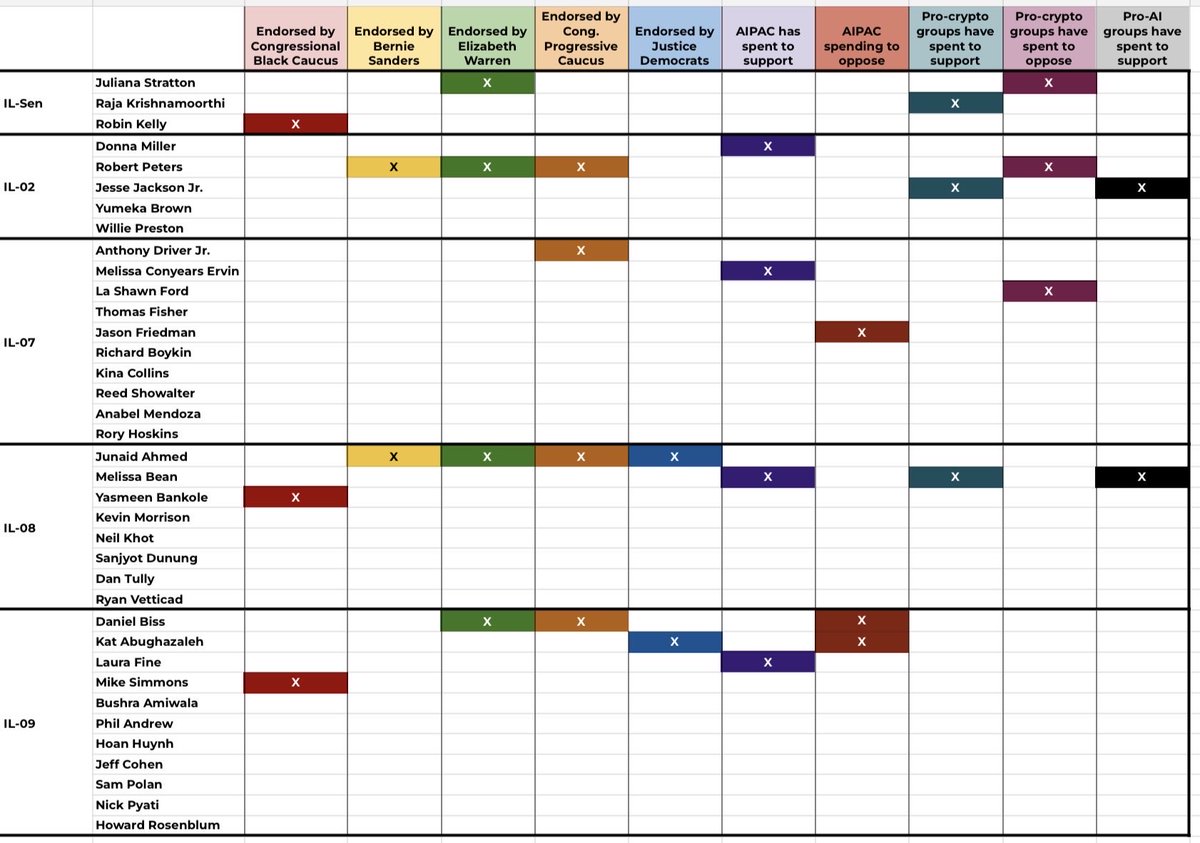
There’s been a dizzying amount of interest group super PAC spending & endorsements in this Tuesday’s 5 competitive Illinois congressional primaries — it’s been hard to keep track of

So here’s a cheat sheet for which notable groups & individuals are supporting (or opposing) whom: Image
Groups and individuals included in the chart:

— AIPAC shadow groups (United Democracy Project, Elect Chicago Women, Chicago Progressive Partnership, Affordable Chicago Now!)

— Pro-crypto super PACs (Fairshake/Protect Progress)

— Pro-AI super PACs (Leading the Future/Think Big)

— Congressional Progressive Caucus

— Justice Democrats

— Bernie Sanders

— Elizabeth Warren

— Congressional Black Caucus
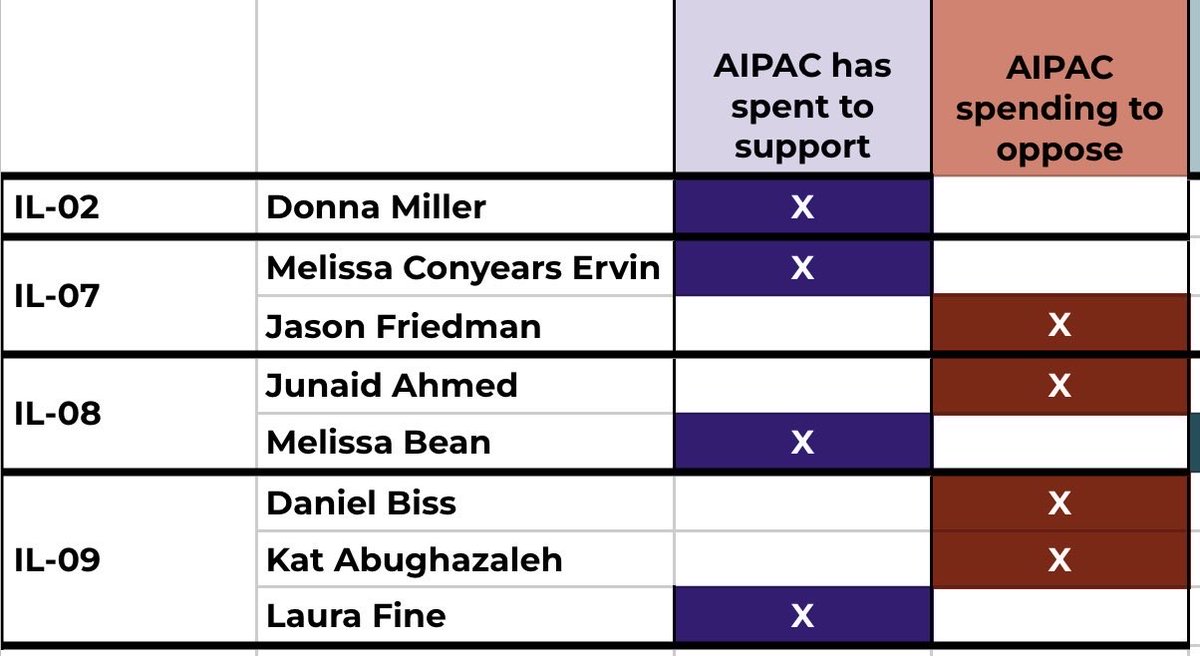
For the people that (understandably) don’t want to zoom in, let’s break this out by category.

First, the candidates that AIPAC is spending for and against: Image
Read 6 tweets
Feb 1
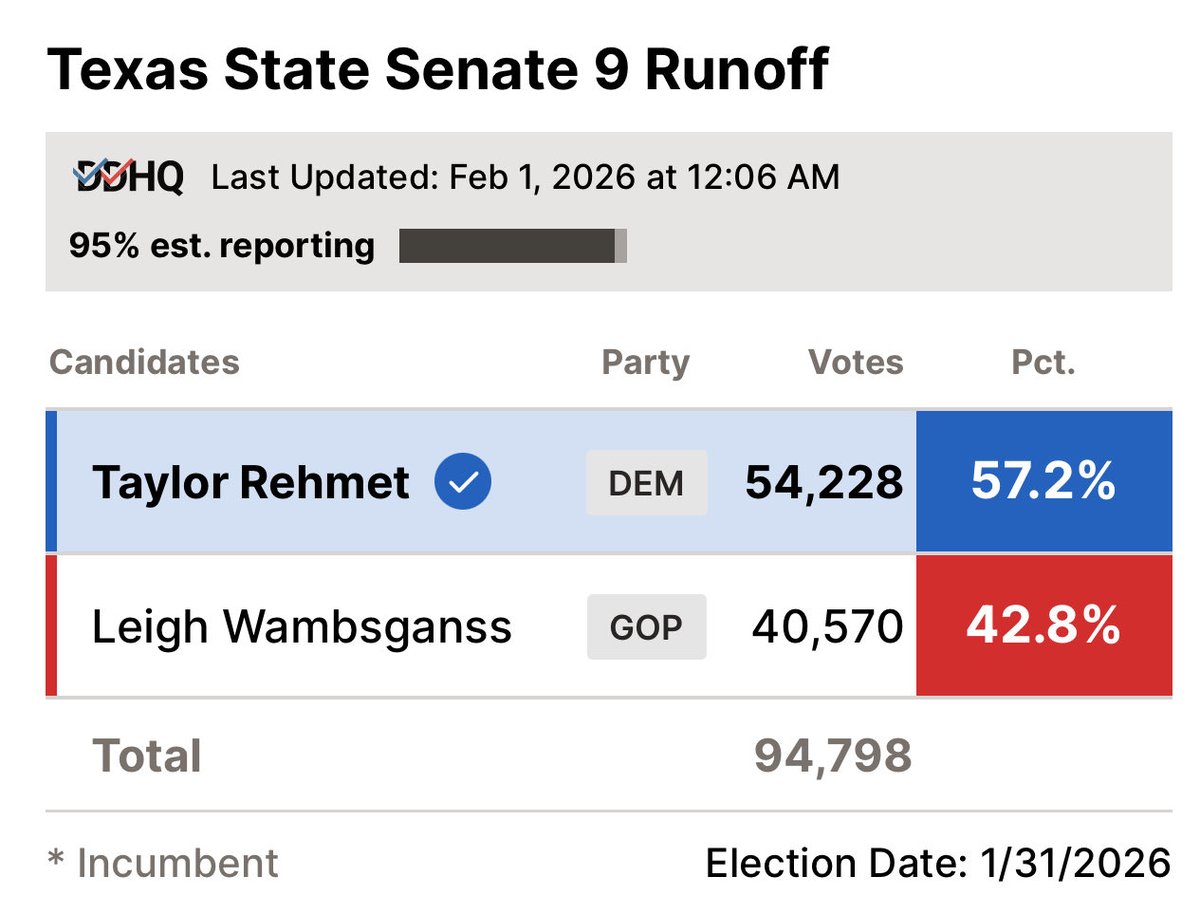
Demorat Taylor Rehmet just flipped a Trump +17 Texas Senate seat (Ft. Worth/Arlington area).

The recent high water mark for Dems in the district was 43.6% (Beto 2018).

Rehmet’s likely to exceed 55%.

The heavily Latino parts of the district shifted sharply to the left from 2024 Image
This is despite being outspent by nearly $2.2M by the Republican candidate.
Simply astounding.

It’s a special election so caveats obviously apply — and Texas has been such a tease for Democrats for so long that I dare not venture to hope — but 2026 Blexas is on the table if Latinos shift anywhere near this much.
Read 4 tweets
Dec 21, 2025
🔴 75% grade economy as a C, D, or F

🔴 73% say Trump admin isn’t focusing enough on lowering price of goods & services

🔴 68% say his new tariffs increased prices they paid in 2025

🔴 66% disapprove of his handling of inflation

🔴 65% say his policies most favor the wealthy
🔴 63% disapprove of his handling of the economy

🔴 61% say he’s making things sound better than they really are on prices & inflation

🔴 61% say his policies are making health insurance costs go up

🔴 51% say his policies have decreased peace & stability in the world
🔴 50% say his policies are making them financially worse off & 45% expect them to make them worse off in 2026

🔴 50% say Trump’s policies are causing job losses

🔴 49% say Trump doesn’t care at all about the needs & problems of people like them (plus 13% that say “not much”)
Read 4 tweets
Nov 6, 2025
Ok time for a geographic and demographic *deep* dive mega thread on the NYC mayor’s race.

Here I’ll be using the New York Times’ excellent categorical precinct mapping tool (link at bottom).

Let’s nerd out.

🧵 Image
BIG PICTURE:

Mamdani currently leads Cuomo 50.4% to 41.6%, with 93% of precincts reporting.

That margin may shift slightly with late arriving mail ballots & affidavit ballots.

Sliwa’s support collapsed in the home stretch, giving Cuomo a better than expected performance. Image
BOROUGH:

Unsurprisingly, Brooklyn was Mamdani’s strongest borough.

What was surprising was that the Bronx — Mamdani’s worst borough in the primary — was his second best borough in the GE. More on that later.

Cuomo handily won Staten Island (due to said Sliwa collapse). Image
Read 18 tweets
Oct 24, 2025
Muslims make up ~9-12% of NYC

They flexed their political power for the first time in the June primary

A key reason those polls were so off was because Muslims were under-polled (difficult to get to take polls, due in part to post-9/11 wariness of giving away any personal info)
My likely voter model estimates them to make up 8% of the likely electorate (they make up 7% of registered voters).

I have not seen other pollsters release their weights of Muslim voters in NYC. They should. They are the sleeping giant of NYC electoral politics.
@amitsinghbagga and I spent extra time & money targeting sample in Muslim-heavy zipcodes in our July poll of the mayoral race, and we still struggled to reach even the bare minimum of a readable sample size (n=50) for a crosstab subgroup.
Read 4 tweets

Did Thread Reader help you today?

Support us! We are indie developers!


This site is made by just two indie developers on a laptop doing marketing, support and development! Read more about the story.

Become a Premium Member ($3/month or $30/year) and get exclusive features!

Become Premium

Don't want to be a Premium member but still want to support us?

Make a small donation by buying us coffee ($5) or help with server cost ($10)

Donate via Paypal

Or Donate anonymously using crypto!

Ethereum

0xfe58350B80634f60Fa6Dc149a72b4DFbc17D341E copy

Bitcoin

3ATGMxNzCUFzxpMCHL5sWSt4DVtS8UqXpi copy

Thank you for your support!

Follow Us!

:(