The @nytimes recently published a story about Dan Bishop's investigation into Bexar County's recent Republican primary, and a mysterious file that surfaced during that election.
They attribute the creation of the file to a drag and drop error in Excel--something that is easy to do. In this context, they may as well have said that a train crashing into a Volkswagen creates a Maserati instead of a crushed Volkswagen.
Here's why they're wrong /1
A glitch, a crash, a drag-and-drop error — these all share one property: they damage or degrade what's already there. A train hitting a Volkswagen leaves recognizable Volkswagen parts. It does not manufacture a Maserati from the wreckage. Glitches destroy structure. They do not create it. Keep that in mind. /2
Here's the math the NYT didn't mention. The 4,110 suspicious records in the file obtained by @WestonMartinez and @LorionaFarm span a precise range of voter ID numbers. That span, divided by the gap between consecutive records, equals exactly 4,109 — a perfect integer with zero remainder. A drag-and-drop error cannot produce a perfect integer quotient. Only deliberate computation does. /3
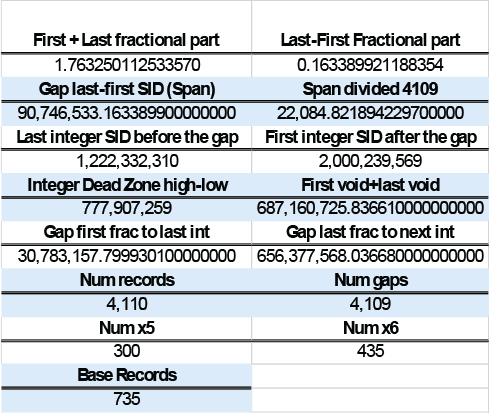
The 4,110 fake IDs were placed inside a void in the Texas statewide voter ID space — a gap of 778 million consecutive ID numbers where no Texas voter exists. Not in #BexarCounty. Not anywhere in #Texas. Finding that void required querying all 18.3 million voter records across all 254 Texas counties. A drag-and-drop error does not perform statewide database reconnaissance. /4
At full decimal precision, the gaps between consecutive fake records resolve into exactly four distinct values, cycling in a palindromic pattern that repeats throughout the entire sequence. This is the floating-point fingerprint of a specific algorithm executing in a compiled programming language. It is not the fingerprint of Excel. It is not the fingerprint of a glitch. It is the fingerprint of purpose-written code. /5
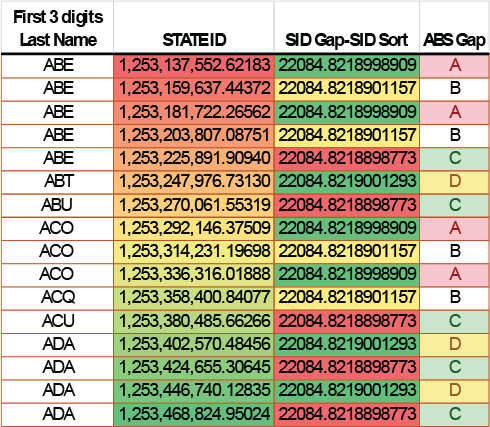
The algorithm had to solve a problem: how do you give fake copies of a real voter a believable address? If two real voters share a household, incrementing both of their house numbers creates a collision — two fake records with identical fabricated addresses, which would be a visible anomaly. So the algorithm applied a rule: if your address is unique among the 735 anchor voters, your fake copies get incrementing house numbers (+1, +2, +3). If you share an address with another anchor voter, all your fake copies get the exact same address as the real one — no increment. Two different strategies, one coherent logic. A drag-and-drop error does not make design decisions. /6
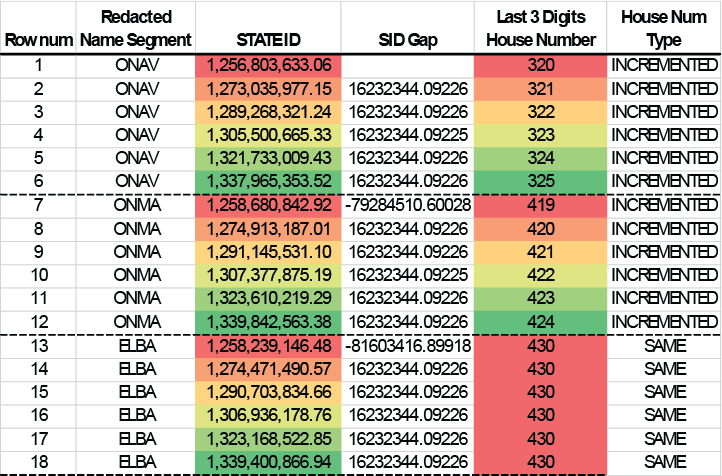
The fake records were distributed across precincts in a structured way consistent with the algorithm processing the check-in data precinct by precinct. Every precinct. Every synthetic record. Every structural property consistent across the entire file. This is not what random damage looks like. This is what a specification looks like. /7
One correction for the record: the NYT attributed this analysis to Dr. Walter Daugherity (@ZoomWalter). Dr. Daugherity is a valued collaborator. However, the Substack the Times appears to have been reading is mine. Dr. Daugherity does not have a Substack. /8
The NYT article I am responding to, for those who want to read it directly: [] /endnytimes.com/2026/05/15/us/…
• • •
Missing some Tweet in this thread? You can try to
force a refresh

[1/3]
Did Hochul really win New York?
New York's voter rolls contain nearly twice as many illegal duplicate registrations — skewed Democratic — as votes that separated Hochul from Zeldin in 2022.
Did the clones vote?
I tried to find out. Here's what I found. 🧵
[2/3]
The rolls carry 2.2 million clone registrations — one in ten records. Illegal by definition. Same person, two or more different state IDs.
In the four suburban counties that decide every statewide race —
Nassau, Suffolk, Rockland, Westchester — the clones run 6–7 points more Democratic than the legitimate voters around them.
Statewide clone DEM surplus: 646,000 registrations.
Hochul's margin: 327,000 votes.
The surplus is 1.98× the margin. In the right direction.
[3/3]
You might say: check the voter history. See if the clones voted.
That field cannot be trusted.
In NYC alone, 254,713 people appear in county records as having voted in 2020 — but the identical state IDs show no vote in the statewide records. Same people. Opposite answer.
I wanted to know if clone records specifically had reliable voter history. The AG shut down the investigation before it was complete — then opened a criminal probe against the investigators under the Ku Klux Klan Act.
That retaliation is now the subject of a federal lawsuit. NY Citizens Audit v. Letitia James, Case 1:25-cv-01447, NDNY.
The records that would tell us whether the clones voted are broken. The investigation that was finding out was stopped. Draw your own conclusions.
Arizona's voter database has a problem.
590,529 duplicate registrations. A hidden algorithm running in all 15 counties. And the federal law designed to fix it made things worse.
🧵
This is Pima County's voter registration database.
Each dot is a voter ID plotted against a registration ID. In a normal database these form a clean diagonal line.
This is not a normal database.
Maricopa County is stranger still.
At a precise boundary — VRAZ 3,615,000 — the entire ID assignment pattern changes abruptly. Two completely different algorithms, one county, one hard cutoff.
No standard database operation produces this. Someone designed it this way.
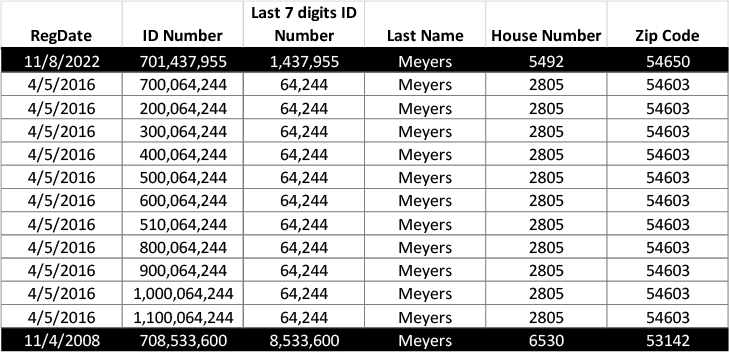
1/This is a table of voters named Meyers in Wisconsin.
Same last name. Same address. Same registration date.
Ten different ID numbers — ranging from 200 million to 1.1 billion.
One person. Ten identities. In an official government database.
2/That alone should be disqualifying.
But it gets stranger. Because those ten IDs are not random. They are part of a mathematical structure running through millions of Wisconsin voter records.
A structure that has no business being there.
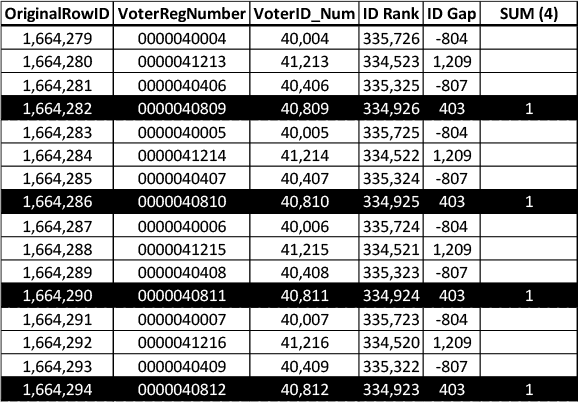
3/Here is what I found buried in Wisconsin's voter registration database.
Every few records, the ID numbers follow a precise mathematical rule. The gaps between them — positive and negative — sum to exactly 1.
Every time. Across millions of records.
New York's voter ID system contains a hidden algorithm. I reverse-engineered it. The complete solution is in this thread. 🧵
The Spiral maps County Voter IDs (CIDs) to State Board of Elections IDs (SBOEIDs) using a deterministic, reversible structure — predictable and built for data retrieval. Reversing it yields a serial marker I call the Algorithm ID (AID).
STEP 1 — Establish the county range.
Take the maximum SBOEID, subtract the minimum, add 1. That is your total range. Everything else is derived from this number.
HAVA was supposed to help Americans vote. The data suggests it helped Boards of Elections generate millions of illegal registrations instead. A thread. 🧵
In New York — where I have done the deepest forensic work — clone records were 0.25% of the voter roll in 1990. By 2022: 17.36%. One in six records. The inflection begins precisely at HAVA implementation.
This is not a New York problem. Wisconsin peaks at 35.82% (2022). Arizona sustained 14–23% across every election cycle examined. Georgia holds steady at 6–8%. Independent databases. Same algorithm signatures.
When New York Citizens Audit brought evidence of problems in New York's voter rolls to state officials, the State Board of Elections called them "wack jobs."
That word came from a board member. In an official meeting. On the record.
Here is what else happened in that room. 🧵
Board co-chair Peter Kosinski asked a reasonable question: if NYCA has made errors, why not meet with them and explain where they went wrong?
His own staff shot it down.
The reason they gave: NYCA "willfully misconstrues the truth."
No meeting. No rebuttal. No explanation.
Board member Kristen Stavisky said NYCA's claims are "not grounded in reality" and that their findings are "simply not true."
She said this in the building that contained the full NYSBOE database.
She never looked at it to check.