Saskatchewan's residential electricity rate ranks among the highest in Canada. Households pay an average of 20.7 cents per kWh, which is higher than the national average and well above the rates in provinces that rely heavily on low-cost hydroelectricity.
Scott Moe's decision to refurbish coal burning power plants to the tune of $26 billion will drive up costs to consumers even higher. His plan is to eventually transition to nuclear which is, and always will be, the most expensive way to make electricity.
His plan will be undone by the market. The costs of rooftop solar continue to drop and 2026 will be the breakout year for the adoption of sodium-ion storage batteries that are half the cost of current lithium-iron phosphate.
Initially, consumers will purchase them to power their EVs, but the economy will be so obvious that harvesting solar energy will expand.
2026 will also be a breakout year for American manufacturers of combined heat and power fuel cell furnaces of the type that Japan is promoting through their Ene-Farm project. They are fueled with natural gas but carbon emissions are 50-60% less than natural gas fired power plants
...and they are hydrogen ready. The Japanese government’s Strategic Roadmap for Hydrogen and Fuel Cells targets a massive scaling of the Ene-Farm project, aiming for 5.3 million installed systems by 2030 (roughly 10% of all households in Japan).
Scott Moe has said that heat pumps won't be adequate to heat homes in Saskatchewan's winters, so presumably natural gas will continue to flow through the province's 20,000 kilometres of gas lines despite his investment in nuclear generated electricity.
Technically, a home provisioned with rooftop solar, storage batteries and a fuel cell furnace could generate all of its needs for electricity. If it is cheaper than the rates charged to consumers by the state owned electric utility monopoly, then it will happen.
What then, a ban on these technologies? Saskatchewan has a highly regulated energy economy — regulated to suppress the development of renewable electricity generation.
• • •
Missing some Tweet in this thread? You can try to
force a refresh

Descriptions of phenomena are limited. The rubber hits the road once a theory is proposed. That fifty years of climate science is being denied at the highest level of our politics seems absurd,
...and I say this in anticipation of another summer where wildfire smoke is going to ruin many days that we patiently waited for all winter. It's not a case of mass stupidity — it goes deeper into the unconscious.
Google AI does a good job here of summarizing philosopher Slavoj Žižek's psychoanalytic explanation:
Canada's rapid industrialization following its genesis during the Second World War, was largely facilitated by the foreign direct investment of American capital.
The new long wave of economic activity in Canada, based on the industrialization of new technologies, will be similarly financed in large part by foreign direct investment — capital formation being a historical problem always facing Canada —
...but the U.S. is less likely now to be that source of capital. The expectation that Canada will be able to preserve the tariff free structures affecting its automotive industry under CUSMA in the negotiations this year is waning.
The claim from Canadian Conservatives that anthropogenic (man made) climate change is a false hypothesis is not acceptable. It never was.
The idea that the development of oil and gas resources can be continued without consideration of the threat that global warming poses to our immediate communities and the planet at large, is just wrong in every respect.
There is no debate about it. Up to the American Civil War, many Northerners were willing to abide the institution of slavery so as not to disrupt the economy. It wasn't until it became an overwhelming matter of personal conscience that it was eliminated.
The dividing lines in the next election will be clear and will be around issues of Canada's sovereignty. The Conservatives are relentlessly anti-China.
Poilievere seeks to reestablish trade relations with the U.S. by capitulating to Trump's whims. He's already said that he will tariff Chinese EVs at 100%. Trump hates Canada's supply management of the dairy industry and that will be the next to go in Poilievre's platform.
We are in an historical pivot point brought about (largely) by a fracturing of institutions and their supporting systems, like global trade. We were there at the end of WWII.
The latest salvo from the Conservatives is that Liberals are moral hypocrites for not acknowledging what they claim is a Chinese genocide against the Uyghurs of the Xinjiang Autonomous Region. This is the lay of the land:
There are approximately 11.77 million Uyghurs in China, with the majority living in the Xinjiang Uyghur Autonomous Region. Uyghurs constitute roughly 44.96% of Xinjiang's population, making them one of the largest ethnic groups in the region, closely followed by the Han Chinese.
Conservatives cite the American proscription on the importation of goods made with forced labour which they say accounts for about 10% of the aluminum produced in China.
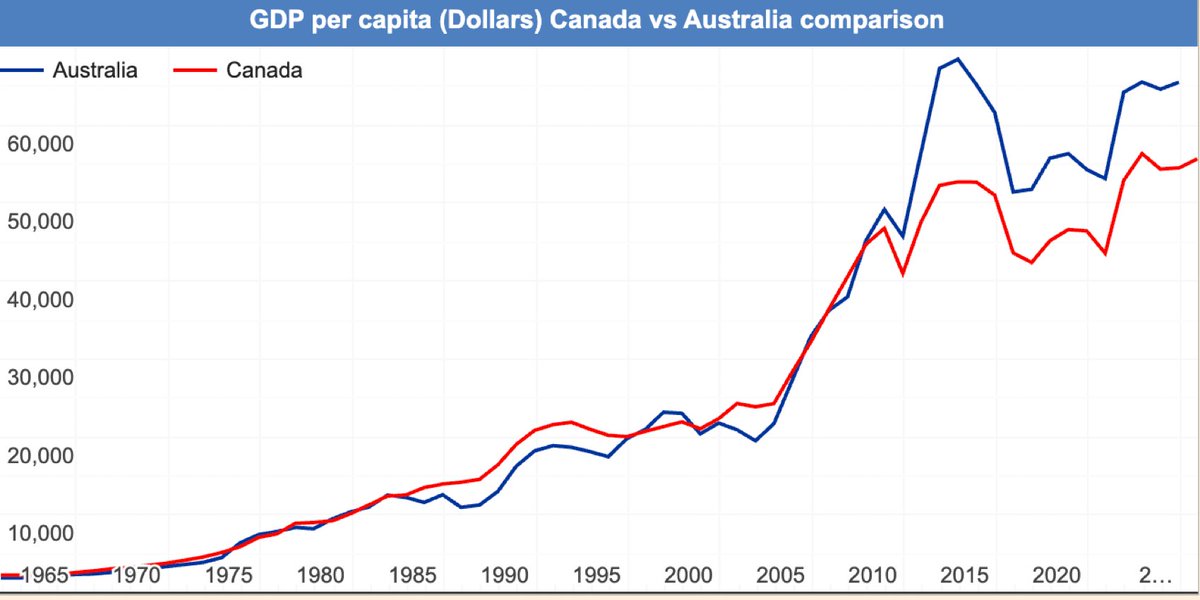
Canada and Australia used to be on par economically. That changed around 2010 when Australia started making hay with their trade with China.
Canadian Conservatives have fully bought into American anti-China dogma. It was a trap we fell into when in his first term, Trump took Huawei's CFO Meng Wanzhou hostage. Trudeau's Liberal government rolled over for the U.S. extradition request and arrested her in Vancouver.
I remember at the time retired members of Canada's diplomatic corp recommending that ministerial prerogative be exercised to release her. They saw through the sham and ultimately the American DOJ did not prosecute her. It ruined our trade relations with China.