Handelsblatt has -- on its front page -- an article summarizing my new paper with Sander Tordoir on Germany's need to find policies to actually fight back against the second China shock
China's industrial structure -- as the ECB and others have noted -- increasingly overlaps with that of Germany ... with autos being the most obvious case.
And the China shock there won't go away on its own; Chinese auto export growth accelerated in the last 12ms
2/
The China shock is also visible in the global data -- an undervalued Chinese currency propelled Chinese exports to grow much faster than global trade. China is now big, so that meant someone else's exports had to grow more slowly than global trade ...
3/
There is a new exportweltmeister -- and it as been eating Germany's lunch.
It should be much more widely known that net exports have been a massive drag on German growth in the years after the pandemic
4/
Sander and I don't just admire the problem -- we have a series of recommendations for German and European policy.
Among other things, we call for a European "301" and suggest using it against Chinese currency policies that suppress the yuan ...
5/
Take a look -- it is a paper meant to shake up the debate in Berlin, and ultimately in Brussels
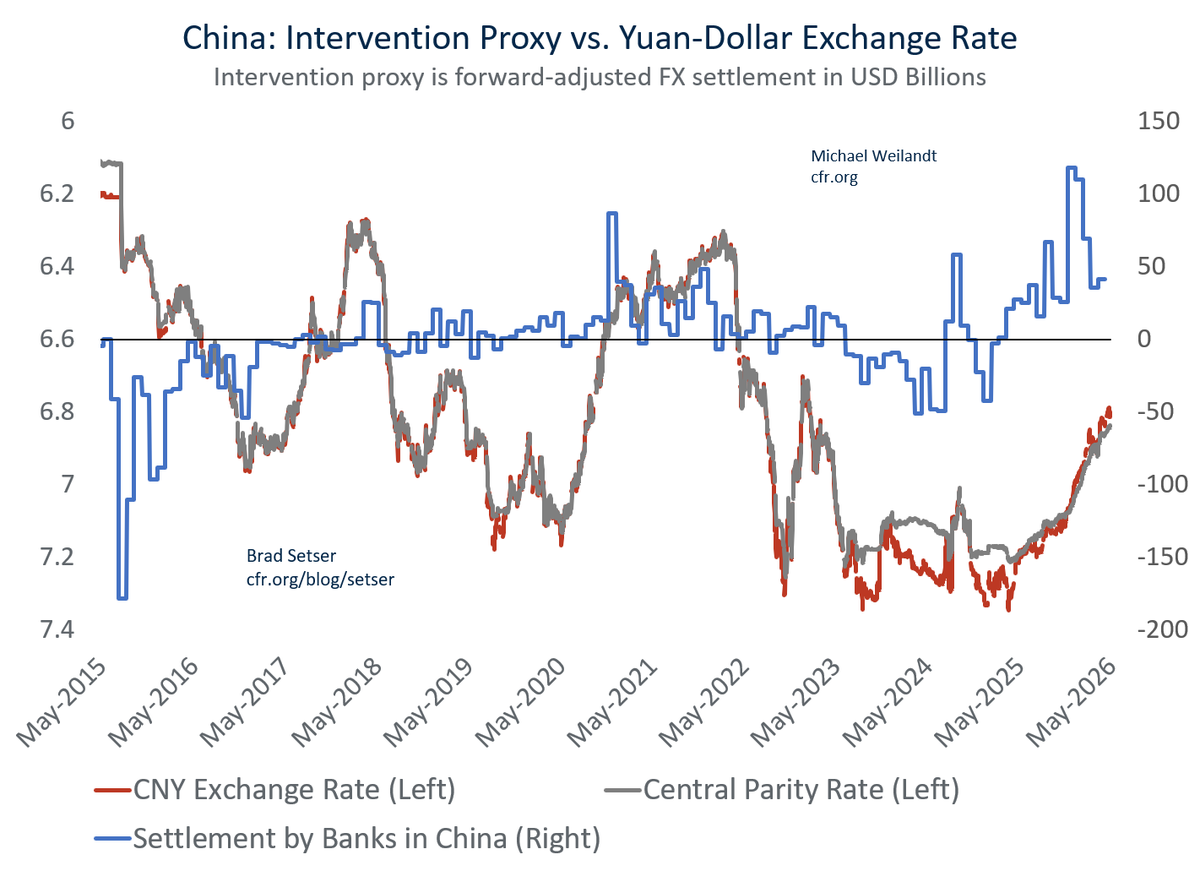
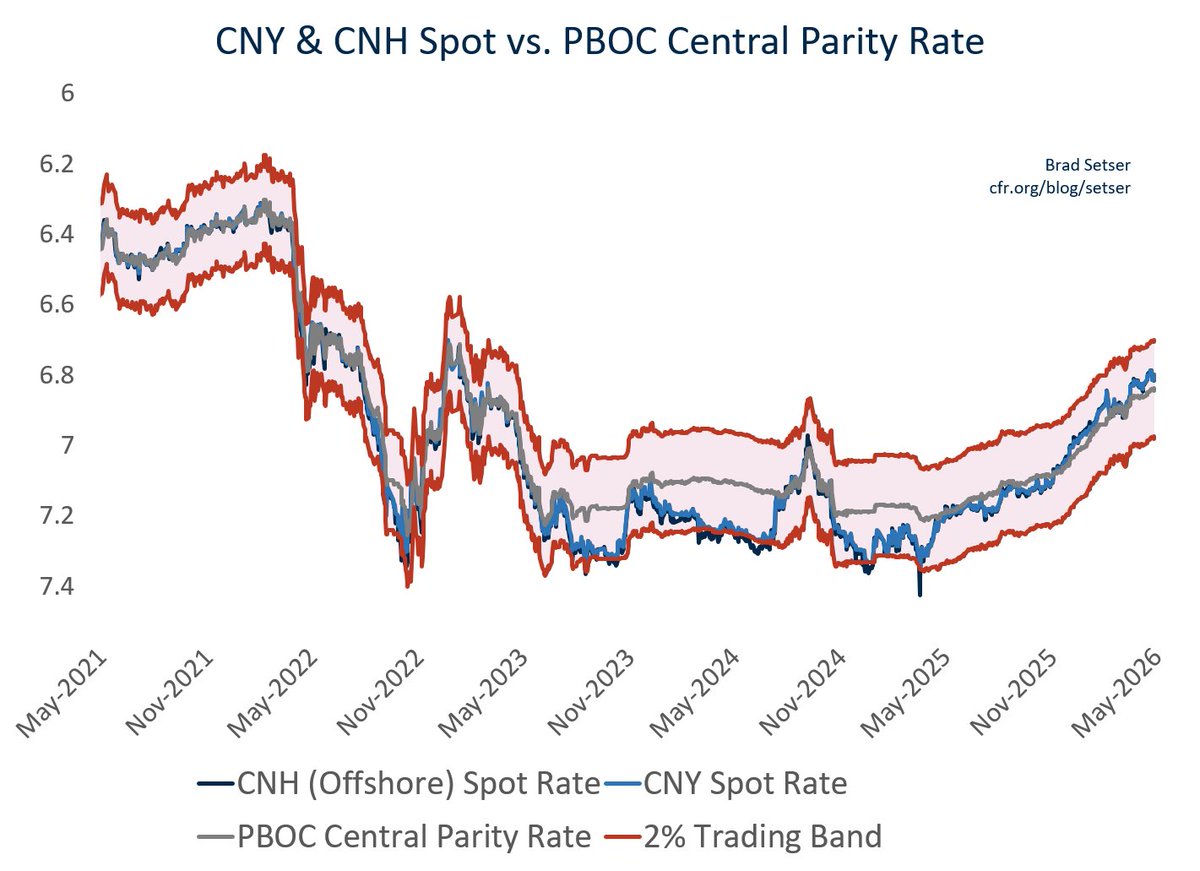
I wanted to highlight this chart, as it is the chart that best illustrates why the available data points to active Chinese state management of the exchange rate. it shows that there is a predictable pattern to fx settlement --
1/
When spot is at the weak edge of the 2% band defined by the PBOC's daily fix, there are predictably sales in settlement (someone is defending the band) and when spot is at the midpoint, there are predictably purchases (esp. when the fix is appreciating)
2/
That is of couse the pattern one would expect from central bank intervention (apart from buying at the mid point not the strong side of the band) -- and for 17 years settlement was basically equal to changes in the PBOC's f. assets
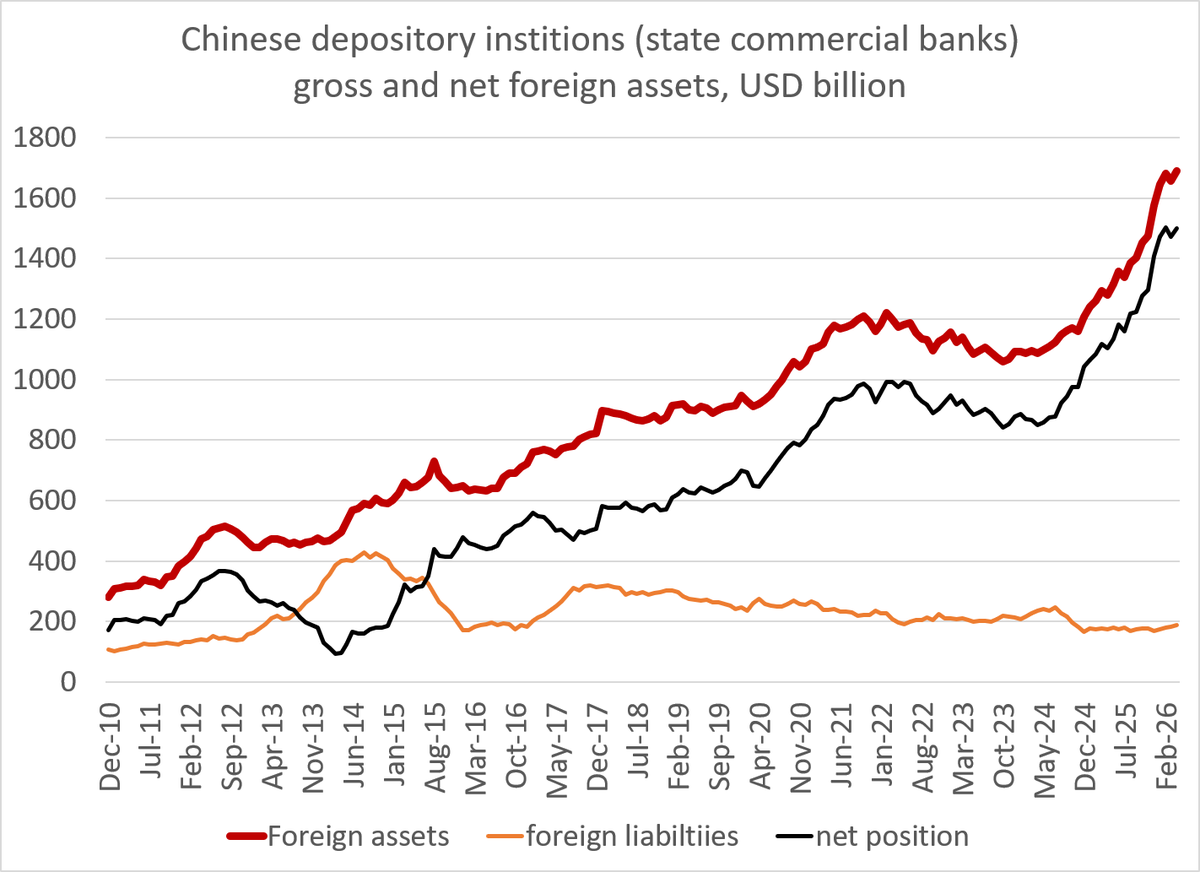
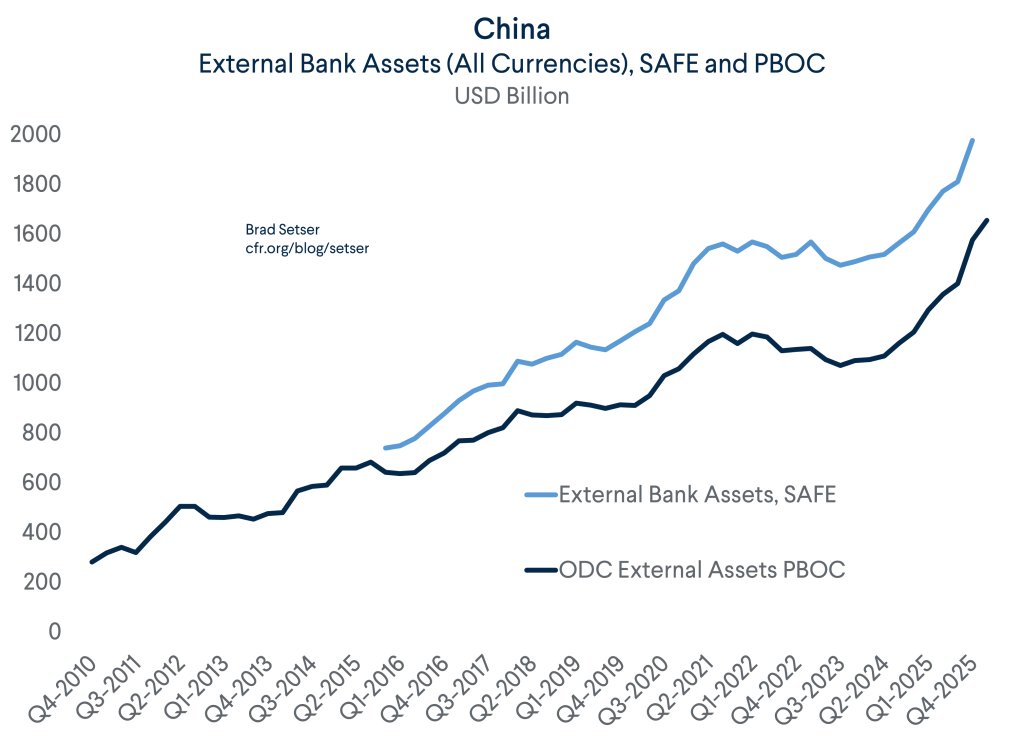
The net foreign asset position of China's state banks (in both dollars and RMB) is now $1.5 trillion -- a rather big sum (close to 1/2 China's formal reserves, a sum bigger than Japan's reserves ... )
1/ many
These are mostly funds that the state commercial banks have raised domestically (whether from real deposits, from "fake" deposits from SoEs helping out the PBOC, or swaps with PBOC). Total foreign assets are $1.7 trillion v $200b of external liabilities
2/
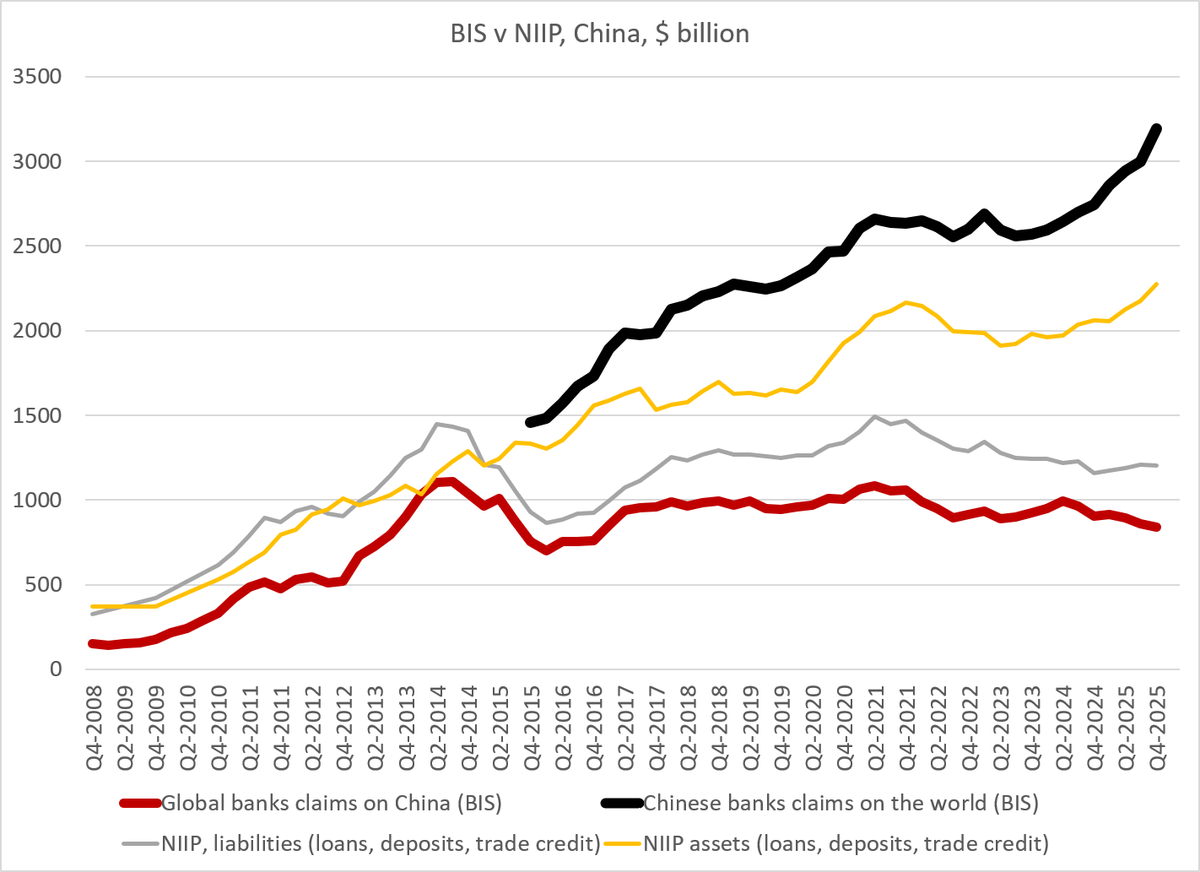
This leaves out the policy banks (CDB, Exim) and the investment banks (CICC etc) -- which is why (I assume) the BIS data shows over $3 trillion in external Chinese bank assets (v under $1 trillion in liabilities) and ~ $2.5 trillion net position
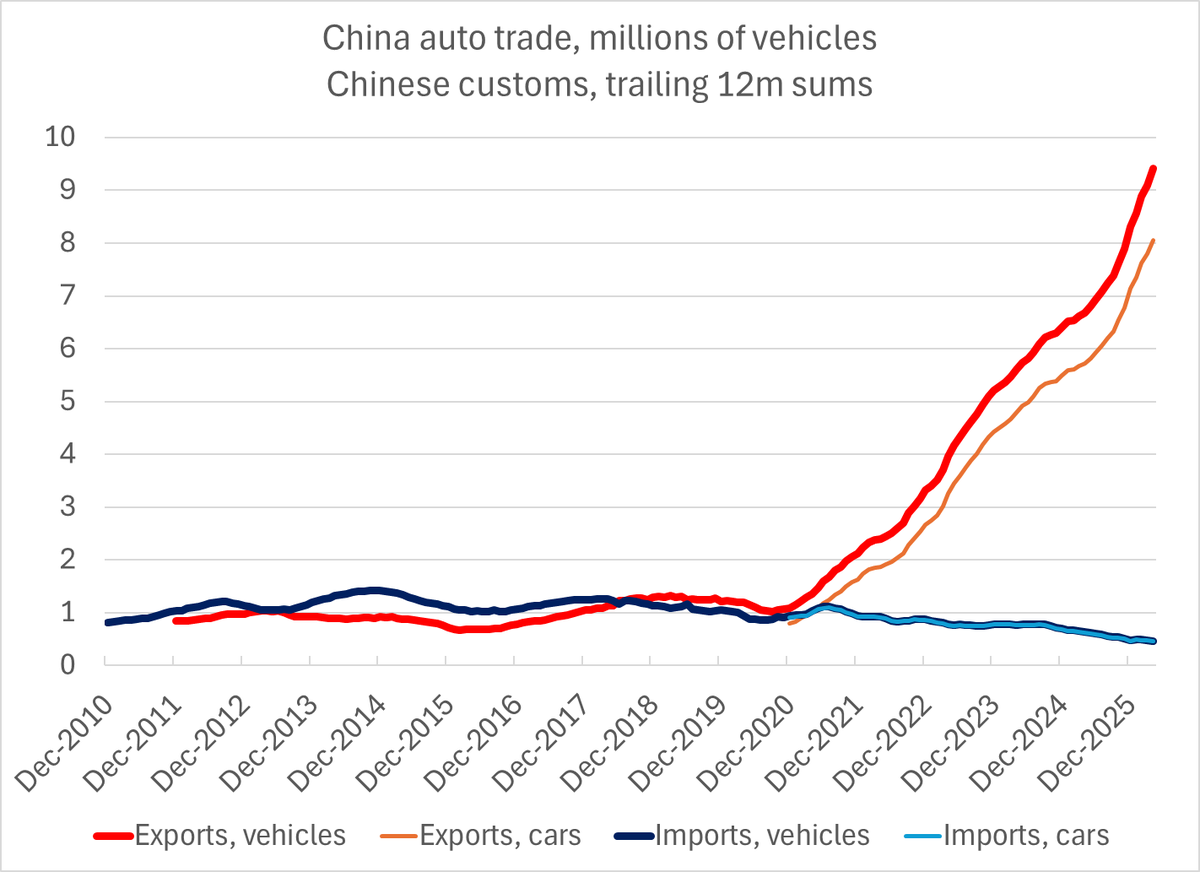
China's auto sector is a near-perfect metaphor for China's economy -- domestic demand is down, quite significantly. But exports are on a rocket ship up -- vehicle exports should come close to reaching 12m this year, car exports 10-11m
1/
Domestic demand for both ICEs and EVs is now shrinking -- and 22m cars, it falls well short of absorbing China's massive auto capacity (widely estimated to be over 50m)
2/
The annual increase in exports (change in 12m rolling sum) is now ~ 2.5m cars. & with import volumes falling, net exports are up even more ...
For scale, peak German net exports were ~ 2m cars. A year. China's growth tops peak German net exports.
Hauge to me and Pettis: "Don't hide behind the language of "imbalances." If you think China is a competitive threat and that wealthy nations should actively use industrial policy to keep it at bay, say so"
I object to the idea that arguing about imbalances is hiding ...
China's imports have grown in volume terms at an annual rate of ~ 1% over the last 5 years. China's exports have grown at a faster rare that world trade. that is a real imbalance, not a fake one ...
China's savings rate is exceptionally high (comparable to Norway which saves its oil and gas proceeds as a matter of policy and Singapore which hides its investment returns from its citizens and the budget) and China's consumption to GDP ratio is incredibly low
Glenn's arrogance is incredible given his long history of clinging stubbornly to inaccurate arguments (no overcapacity in China's exports, China doesn't "really" have a trade surplus, SAFE produces accurate BoP that no one outside China should challenge ....)
Glenn's comment to competence ratio is high -- for various reasons he recycles old work continuously and presents it as new insight (he doesn't seem willing to spring for a real data feed). seems clear domestic margins in China came under pressure in q1. Ask BYD
my comment was riffing on press reporting like that of the FT, which consistently mentions the much fatter margins on exports than on domestic sales
SAFE's quarterly data shows that 70% of the external fx assets of the Chinese state commercial banks are in dollars -- and that almost all of their net external fx assets (external assets funded domestically) are in dollars
2/
I don't love the SAFE quarterly data set -- it shows more external assets and way more external liabilities than the PBOC's data set. But the numbers on external assets at least line up, and the extra external liabilities are in CNY