Hello @JeffBezos, since you question the results of our studies on the unfairness of the US tax system, please allow me to remind you of the main conclusions of our work, the most comprehensive research to date on this issue.
https://twitter.com/JeffBezos/status/2057148900763385950
Your claim that the top 1% pays 40% of taxes and the bottom 50% only 3% is misleading:
It captures just one tax – the federal income tax – and ignores all the rest: payroll taxes, state income taxes, sales taxes, excise duties, etc., many of which are regressive.
It captures just one tax – the federal income tax – and ignores all the rest: payroll taxes, state income taxes, sales taxes, excise duties, etc., many of which are regressive.
If one takes a comprehensive view of taxation in the US, here’s the picture that emerges:
All social groups pay broadly the same effective tax rate today – around 25%-30% of income, all taxes included – with billionaires having the lowest tax rate: 24% on average in 2018–20.
gabriel-zucman.eu/files/SaezZucm…
All social groups pay broadly the same effective tax rate today – around 25%-30% of income, all taxes included – with billionaires having the lowest tax rate: 24% on average in 2018–20.
gabriel-zucman.eu/files/SaezZucm…
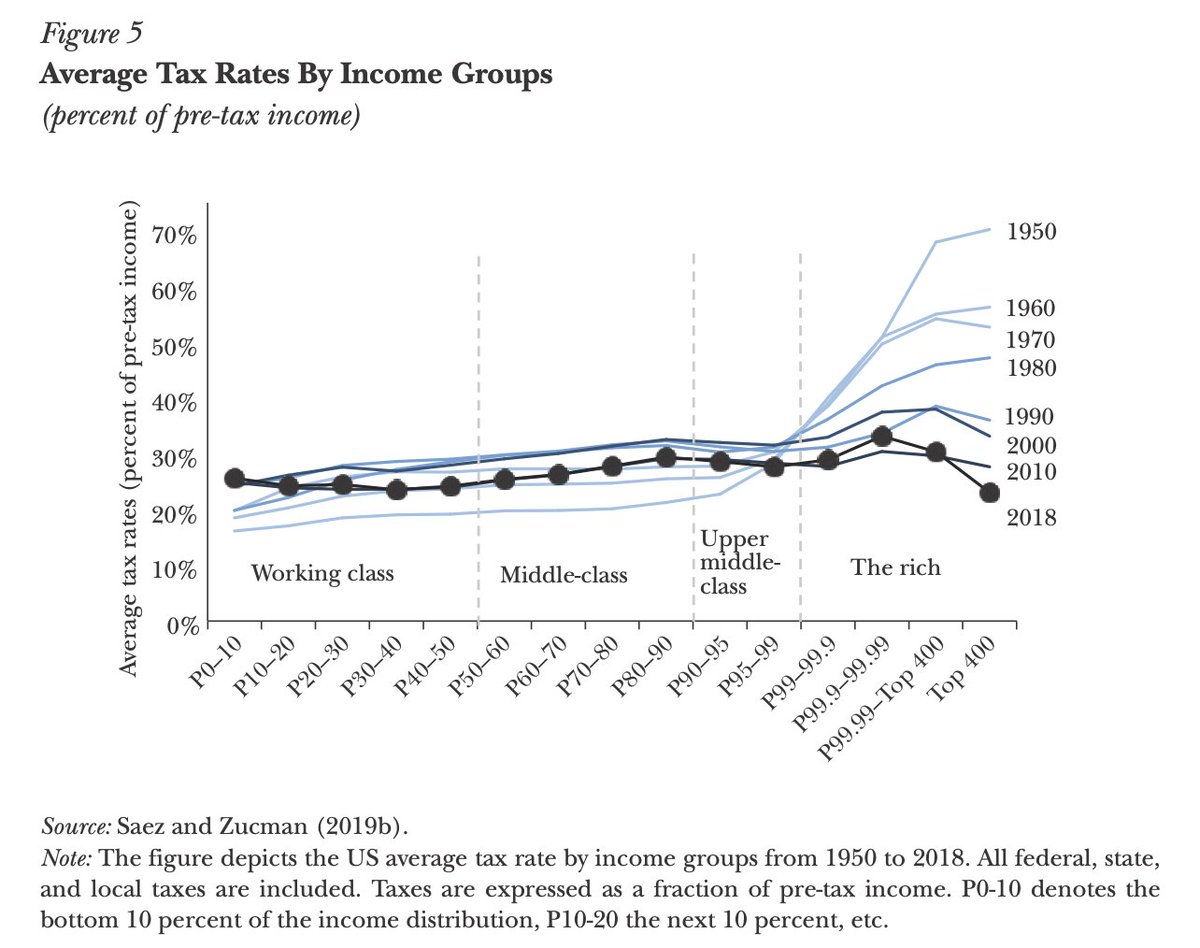
Contrary to what you claim, working-class people contribute significantly to funding American society today. Payroll taxes and consumption taxes absorb a high fraction of their income.
For the middle class, the income tax starts kicking in on top of these.
And for the rich, the corporate tax becomes significant.
For the middle class, the income tax starts kicking in on top of these.
And for the rich, the corporate tax becomes significant.
Of course, low-income Americans also receive government transfers. If you view these transfers as a “negative tax”, then the tax rate of the working class falls.
But the tax rate of the middle-class barely changes.
No matter how one looks at it, billionaires pay much less tax than the average American.
But the tax rate of the middle-class barely changes.
No matter how one looks at it, billionaires pay much less tax than the average American.
Your personal case is a good illustration of the problem with the US tax system.
Based on public data it is possible to estimate your total effective tax rate: the total amount of tax you pay personally plus indirectly through Amazon, relative to your income.
Your total effective tax rate was just 15% in 2018.
Meanwhile, the average person in the US pays around 30% of their income in taxes.
gabriel-zucman.eu/files/SaezZucm…
Based on public data it is possible to estimate your total effective tax rate: the total amount of tax you pay personally plus indirectly through Amazon, relative to your income.
Your total effective tax rate was just 15% in 2018.
Meanwhile, the average person in the US pays around 30% of their income in taxes.
gabriel-zucman.eu/files/SaezZucm…

More broadly, if one looks at the 400 wealthiest Americans, our research shows the billionaires tend to have low individual income tax rates.
Why?
Simply put, the ultra-wealthy can easily structure their wealth so that this wealth generates little – sometimes even no – taxable income. Hence little or no income tax owed.
gabriel-zucman.eu/files/BSYZ2025…
Why?
Simply put, the ultra-wealthy can easily structure their wealth so that this wealth generates little – sometimes even no – taxable income. Hence little or no income tax owed.
gabriel-zucman.eu/files/BSYZ2025…
And things are getting worse:
The effective tax rate of billionaires has fallen sharply after the Tax Cuts and Jobs Act of 2018.
In a context where billionaire wealth is booming, this deprives governments of very significant amounts of revenues.
The effective tax rate of billionaires has fallen sharply after the Tax Cuts and Jobs Act of 2018.
In a context where billionaire wealth is booming, this deprives governments of very significant amounts of revenues.

It is high time we fix this anomaly.
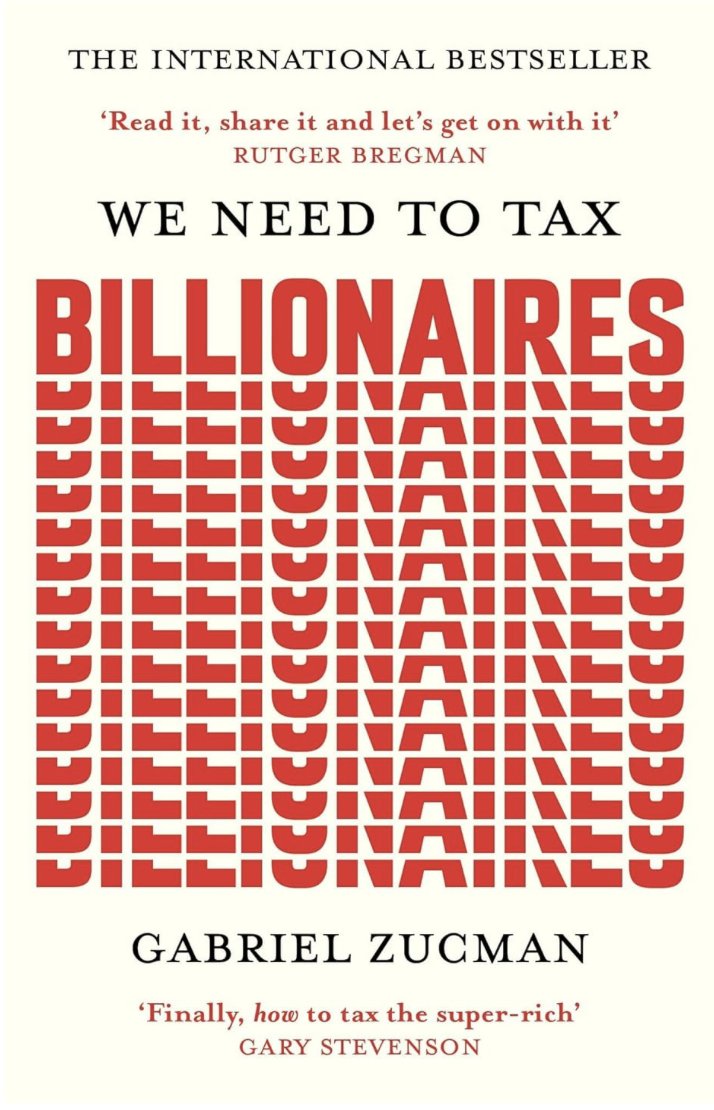
I have made a simple proposal in this book, which is coming out today in the UK and this summer in the US.
I look forward to your reactions.
I have made a simple proposal in this book, which is coming out today in the UK and this summer in the US.
I look forward to your reactions.
• • •
Missing some Tweet in this thread? You can try to
force a refresh