It's Memorial Day, and so I want to remember some of my family that fought for their country.
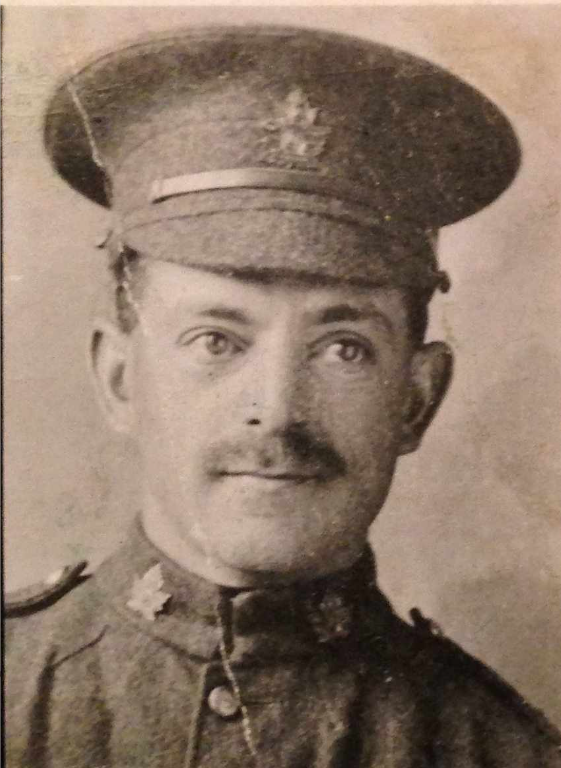
My grandfather, Jack Ousey, emigrated to Canada from Wales, and joined the Canadian Army around 1915. His one and only battle in WW1 was the Somme! He got shot in his arm and leg and lay in a mud puddle for three days. The German Red Cross found him and saved his life. He spent the rest of the war in a prison camp, working on a farm during the summer, and at a lumber camp in the winter.
When he got home, his wife was living with another man. Yes, she knew he was alive - the Red Cross sent letters. So remember, military members. Josey is always waiting, in every time, every age. Eventually they split and he went to Chicago where he found my grandmother. He was an incredible man with many more parts to his story, but today I wanted to focus on just his military career. Also may Douglas Haig rot in the lowest circle of Hell for his arrogance, incompetence, and condemning so many good men to death and crippling. My grandpa did manage to survive his ineptitude, but so many did not.
1/4
My wife's father served in Germany in the 103rd Infantry during World War 2. He was actually part of a so-called tank destroyer battery. I say "so-called" because his unit only ever had towed guns. When they first landed in France they had 37mm and they knew these were worthless. They got upgraded to 57mm pretty quick. Not a lot better. Granddad wasn't on a gun crew though. He carried a rifle and stayed in foxholes.
His unit fought through the Vosges, stormed both the Maginot and the Siegfried Lines, and eventually liberated one of the Dachau camps. As far as I know his unit never encountered a German tank, though they saw StuGs and trucks.
One of his stories was about going through the famous Dragon's Teeth of the Siegfried Line. He said as he was walking, he heard a voice cry out, "Duck!" and he jumped behind a "tooth" just as machine-gun fire spattered the place he stood. No one else was around so he attributed it to heaven warning him.
In another story, they were taking mortar fire so he and a friend jumped under a truck for cover. When the bombardment ended, they crawled out from under the truck, and looked at it. It was an ammunition truck! Worst cover ever.
He said as they advanced, sometimes instead of digging their own, they got to occupy a German foxhole. He said German holes were the best - neatly dug, with shelves for storage cut into the walls. Much better than American foxholes.
2/4

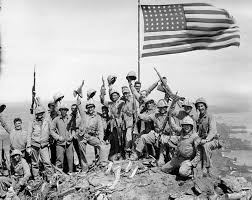
My wife's uncle was a Marine in WW2 and his one and only battle was Iwo Jima! He said that every Marine on the island was able to see the famous flag raising - the island was only 5 miles across and the flag was on the highest point. He said it was exceedingly heartening. He was not on Mount Suribachi - he was down in the ash plains in a hole getting shot at and mortared by the Japanese.
During a banzai charge at night, he shot a sword-waving Japanese officer only a few yards from his hole. When things were still again, he crawled out to the dead officer, and retrieved some of his papers. The officer's paybook had a picture of his wife in a kimono and his child. He couldn't read Japanese of course, but always felt kind of bad about shooting the guy. On the other hand, what could he do? He didn't want to get killed by the sword! He determined he wanted to give the paybook back to the officer's family post-war.
Sadly later he was carrying some coffee up to the front line for his buddies, and a machinegun shot him in both legs, so that was the end of the war for him. In the hospital ship, he lost the Japanese officer's paybook or it was taken away, so he was never able to return it or find the family. So not a Hollywood ending. Just a tragedy, like tens of thousands on Iwo Jima. At least he survived. Thousands didn't.
Curse the Japanese High Command for throwing away their men to preserve their diseased honor.
3/4
I have other tales, as probably do most everyone if they do some research down their family trees. The husband of a German couple who lived next to my house in Utah fought on the Russian Front. A Russian family that lived across from my wife's family home survived both Stalin and Hitler. My dad's brother was in the occupation army of Japan.
I had an ancestor who fought at Lexington. I've not yet uncovered if he participated in any other part of the Revolutionary War. I had another ancestor who was a Union Captain in the Civil War. I had ancestors who survived the Irish Potato Famine and came to the USA.
There is so much amazing history - your people survived it all to create YOU. Remember their fight, and strive to be worthy of them.
And, if you like, share your tale here. 4/4 #MemorialDay
I was boasting to my wife that I had two ancestors who came over on the Mayflower, and she told me she had one that was at Jamestown. The Jamestown ancestor eventually returned to England, which is how she survived. So she won THAT contest.
• • •
Missing some Tweet in this thread? You can try to
force a refresh

What was “Titan”? Ensemble Studios last planned project?
Many of us loved World of Warcraft. (In our defense, this was back in 2007-8, when it was still fun.) We decided to do our own MMO based on our years of experience in MMOs, and our chops in game creation.
We decided to use MicroSoft’s favorite license - Halo.
1/4
But not in the current Halo universe. If you know Halo lore, you know the galaxy’s sentients were wiped out by the Halos tens of thousands of years ago. We set our game BEFORE the Halos fired.
You could play the Forerunners - a mostly-human faction, or the Covenant; a confederation of aliens who opposed the Forerunners because the latter had built a wall to keep out the Flood. And the Covenant was on the wrong side of the line.
We had extra races, such as the Mimics. Our idea was that many Covenant races were wiped by the Halos and only a few were preserved somehow.
2/4
We had gone quite a long way into the game. We had art, models, and we designers had created missions, and even campaigns. We had classes, races, etc. the Forerunners had 4 “races”: cyborgs, humans, sigmas (humans modified to live & work in outer space), and hardlights (humans who’d transferred their intelligence into a device and made bodies out of hard light.)
We were good to go. MicroSoft estimated conservatively it would earn 1.1 billion dollars. A triple-A game made by a triple-A company at the peak of our creative abilities? What a match.
3/4
How I kill players' characters in my roleplaying games (yes, even Call of Cthulhu).
The rule is that I always give them three chances. First, I warn that there IS a threat. I adjust the warning by threat level.
For instance, in the case of a danger the party can readily handle, a local might say, "You know, not everyone who enters the woods during the Teddy Bear's Picnic comes out again."
But if it's something really serious that I want to alert them to, the locals might say, "No one has EVER returned from the Devil's Playground. Not EVER."
Both these examples are from my Runequest campaign. The Teddy Bear Picnic warning discouraged them enough to make better preparations. But they headed right into the Devil's Playground anyway. But that's okay because the goal isn't to warn them away, but to make them aware that there IS peril.
1/4
The players get their second chance once they are at or in the area of the danger. At this point, instead of just a warning, they see actual physical evidence.
Example: "The gnawed corpse of a Pit Fiend is in the clearing. It can't be more than a few hours old."
Or: "Yes, the last person to spend the night in the Falvey house is in this cell." (They see a twisted, scarred ruin of a woman rocking back and forth, obviously insane.)
The idea here is the players know a little more about what they're getting into. They can prep more, find out more information, or bull ahead. It's up to them.
(art Philippe D'Amours)
2/4
The team's third "chance" to survive is after they come into actual contact with the threat, which often means combat. If the enemy is likely to kill them I still provide an escape route.
For instance, the monster might take a breather. I'd say, "The creature seems to be gathering its strength for a final strike." They can run away or heal.
Or a hint, "The dying elf points to a crack in the wall. Is it a secret door? A way out?" One of them can quick check it out.
But if the players stick it through, more power to them. If characters die, my conscience is clear - they had three warnings. Of course, they may win, and if so they deserve to be rightly proud.
The purpose behind all this is so when a character dies, they don't blame ME, the gamemaster. They blame their own choices or bad dice rolls. I rise above recriminations.
3/4
Like anyone else, game companies can be cheated, and I witnessed this several times. In 1993, we at id Software played Doom together over our internal network. Now, you have to realize that at the time, we thought few people would want to play by modem or over the nascent internet. But we wanted that functionality, because it was super fun and we liked it.
Now, John Carmack didn't want to program the internet code. We hired a guy who lived in (IIRC) California to do the code remotely. The deal, as it was explained to me, was that he was finishing a project for his current company, and doing our code in his spare time, with his boss's knowledge. When his project was finished, he'd join us in Texas.
Well, when we were ready for our internet code, we called his company in California and got the guy's boss. He laughed hard at us. He told us, "This guy is a good programmer, but he is a compulsive liar. He knows he can never hold a job anywhere else, and I get he hasn't done a lick of work on your connectivity stuff. He just took your money." Well ... the boss was right. We'd been swindled.
Worse, we didn't have that code. So John Carmack spent 2 weeks quickly hammering together something that mostly worked, and then we released Doom. There was some kind of issue with the way we did it, that if Doom was being played with a lot of people on the same net, even if they weren't playing each other, it multiplied the information packets hugely and crashed the system. Within a month Doom was banned on basically every college campus in the country.
So we hired someone to give us new, robust, code and in a month or two Doom was all it could be. Of course John Carmack's not to blame - his strength was in 3-D, not connectivity. Plus he had only 2 weeks to throw it together. That dude in California was the villain and he can rot.
1/4
In 1999, I made friends with a couple who'd just moved into our church congregation. The husband turned out to be an artist. He was pretty good, and Ensemble was looking for new artists, so I got him an interview. He was hired, and given a $5000 signing bonus.
TWO WEEKS LATER he moved to California, where he had a totally different job waiting for him. He took the job with Ensemble solely to pocket the signing bonus.
I was furious because not only had I recommended him, but the dude was from my church and it reflected on both me and my faith. I don't blame the other Ensemble leads for feeling I should have known, and that was a dark day for me.
2/4
Then there is the sad tale of Rogue Entertainment. They were a brand new studio which was in the same building as id Software. Naturally we were buddies. The owners from Rogue played in my game sessions at home. We were close.
Well Rogue hit it big when they got chosen to do American McGee's Alice for Electronic Arts. They worked hard, and I feel did a pretty good job. The game sold quite well, and my friends at Rogue were excited to get their big payoff. They had been living hand-to-mouth on Electronic Arts' advances, but now by their calculations they were about to get well over $300,000 that they were contractually owed, all at once!
Well they waited and they waited and basically what they told me is that Electronic Arts illegally and bald-facedly simply didn't pay them. They withheld the money with almost no excuse at all. Their plan was that without any source of income, Rogue Entertainment would go bankrupt, and then they wouldn't owe anyone anything.
Sadly their plan worked. Rogue couldn't afford any kind of lawyer who would be able to go up against EA's regiment of shysters, and it fell apart. I still believe this was super-short-sighted of EA, because Alice in Wonderland could have been a terrific IP. They could easily have milked it for at least 1-2 more games, plus then with Rogue on a string, they could have expanded to other children's tales made into shooters. They would have made far more millions than the few hundred thousand they kept by killing Rogue.
The bottom line here is EA is evil, not smart. But they are evil 100% of the time. Never ever trust them.
3/4
Let's talk about horror game & adventure design! As the guy who introduced the game world to Lovecraft & Cthulhu, and helped develop Arkham Horror, Doom, Doom 2, (Cthulhu Wars & Planet Apocalypse), here are four lessons I've learned in the last 46 years. 1/6 #CallofCthulhu #GameDesign
First rule: build dread through the unknown. Jump scares can work in movies, but they do NOT work in games. You need to keep the players unaware of a monster's full potentiality.
Think of the first Alien movie - part of the reason the creature was so fearsome is you literally didn't know what it was doing. It kept changing behavior and shape. In the escape pod it seemed almost passive - Ripley had to stimulate it into action. It seemed to be sealing itself in with mucus, like it had to go on with its life cycle.
In Call of Cthulhu, while I had to stat out the monsters for game purposes, I tried to leave a lot of open-ended material for keepers to work with. For example, in one scenario (The Monster of Macapa), the players discover that the mi-go have developed a form of their fungal nature which is actually able to infect humans like a disease. In another scenario, the players were holding up in an old apartment building, knowing that Dimensional Shamblers were trying to get them. I had frost appear on the windows of the building - etching patterns suddenly, then the frost began moving inside. Neither of these facets of those creatures are spelled out in the game, but never did a player complain about it. I think in part because I wanted the monsters to be mysterious always. (Compare to a D&D game where I heard players arguing loudly whether a Nilbog can cancel out a Power Word Kill as the DM frantically thumbed through the monster book.)
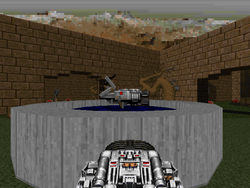
As another example, one of my signature tricks in Doom was to present the player with an empty room. In the center is a pedestal with some useful item on top (BFG, soulsphere, etc.). I may even have a spotlight shining on it. The player KNOWS that if he grabs the goody all hell will literally break loose. He feels trepidation and fear at the unknown. But he grabs it anyway, so all is well from my point of view.
In a game you can't be quite as mysterious and "unknown" as in a book or film, but you can pull it off fairly well.
2/6
Second Rule (note - these rules are not exhaustive): player agency. If the player is being railroaded through an adventure, then he is no longer invested. You, the game designer, are just using him as a prop for your own ideas. He may as well be watching a movie.
But you want the player to be creeped out in your game, not to be an apathetic spectator. So he needs to be involved. This doesn't mean he has to make all correct decisions.
What's more fun in Doom? To correctly kill all monsters with the minimum ammo expenditure? Or to walk into the secret level E2M9 with all the barons of hell, then when you try to escape you run into a mess of cacodemons?! It really pushes you into adrenaline.
The best stories I hear from Call of Cthulhu or Doom players are about near-disasters. Or even actual disasters. The game is about having fun, and even a disastrous game which got your character killed can be super-fun.
This is one reason I usually let players run their own characters who've gone insane in Call of Cthulhu. They always seem to appreciate being allowed to be demented in their own way, and they're off the hook trying to help the party.
What I'm trying to say is that letting players have fun making mistakes is good. Just as you don't necessarily want the heroes in a horror movie to be smart every time, your players shouldn't have to be. This does mean you don't need to kill them for the smallest error. They need to have a chance to get out. Let them tell that story. And then, even if they're killed, they have a better story about "How I almost escaped the cultists".
3/6
Black slavery in the USA was not a product of capitalism. In the United States, the NORTH was capitalist. The South was pre-capitalist, and their economy was very different.
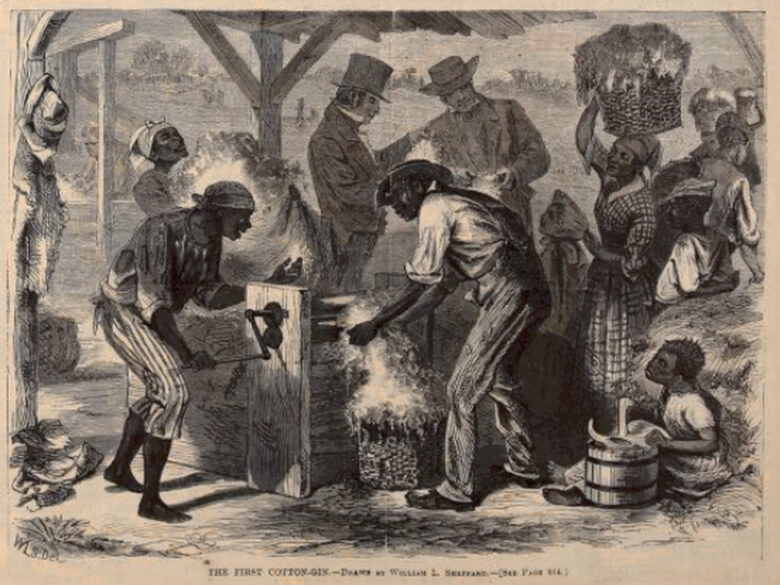
For example, in the antebellum South, if you owned a cloth factory, you yourself were a tailor. Your workers were your apprentices, indentured workers, or slaves. They could not leave your employ to go elsewhere. No one would hire them, and you could legally beat them if they tried to leave.
In the North, what you needed to own a cloth factory was money - capital. You invested your money in a factory, then you hired competent workers to man it. They could leave your employ whenever they wanted.
A northern worker would leave you if he could get a better salary elsewhere, so you had to pay your people enough to keep them around. This is how capitalism benefits the workers - with freedom of labor.
1/3
Of course, business owners hate the "freedom of labor" and "freedom of competition" aspects of capitalism, and they are always looking for ways to lock in their workers so we can't leave. This is where NDAs, signing contracts, not-yet-vested stock options, etc. all come from. Even worse things happened - company towns, strikebreakers, and monopolies, all of which are in fact attempts to stifle capitalism in the business owner's favor.
But back when Capitalism was brand-new just before the American Civil War, it worked pretty good, and here were the results:
in 1860, the average northerner was WORTH only half as much as the average southerner. The southerner owned stuff - he owned land, he owned a house, he owned slaves.
The northern factory worker didn't own land, he lived in a flat or townhouse, he had no slaves. So if the northerner was to cash in his wealth, he would seem much poorer than a southerner.
HOWEVER, the average northern had an income about 3 times as much as the average southerner. This was partly because slaves weren't paid much (most masters gave them a pittance), but also because wages were massively depressed because you literally couldn't change jobs, so why should your boss pay you more?
2/3
When northern armies penetrated the South this was hammered home. Letters from soldiers were appalled at living conditions in the South. The non-capitalist nature of the South affected their farms - the person who bought your cotton & tobacco usually had a monopoly so could pay you whatever he wanted. That same guy often control the local drover's wagonry, and might even have an interest in one of the 100+ teensy tiny railroad companies in the South.
in the North, a farmer could sell to a variety of dealers, and usually negotiate a better deal. The railroad companies were fewer in number, but far larger, so they were never beholden to some local despot. Years later, the railroad companies got big for their britches and started to form their own monopolies of course, but most of this hadn't happened by 1860.
Why didn't the north have slaves? They were making far more money by having actual skilled workers even if those workers didn't have forcible loyalty. The South misinterpreted the Northern men as "wage slaves". Southern propaganda claimed Northern men HAD to stay with their bosses to get their salaries. In the first place, this wasn't true - Northern workers switched jobs all the time. In the second place, even if it had been true, the Southern practice of "you can't switch jobs because massa will hit you with a stick" is hardly morally superior.
The South literally propagandized against the North because they thought capitalism was bad, and they wanted the mercantilist, paternalistic system of the South. (They didn't call capitalism by that name, but it's quite clear what they were talking about in their condemnation of shopkeepers and trusts.)
The Civil War wasn't just slavery vs. freedom. It wasn't just region vs. region. It was the triumph of capitalism over feudalism and I am proud of my ancestors who participated in it and helped to destroy one of the biggest evils in the world.
Sadly, slavery persisted after the American Civil War (it's still around today), but the fact it was crushed in the South was still a huge blessing. Even when the South tried to roll it back after Reconstruction, they weren't able to completely destroy the new system.
3/3
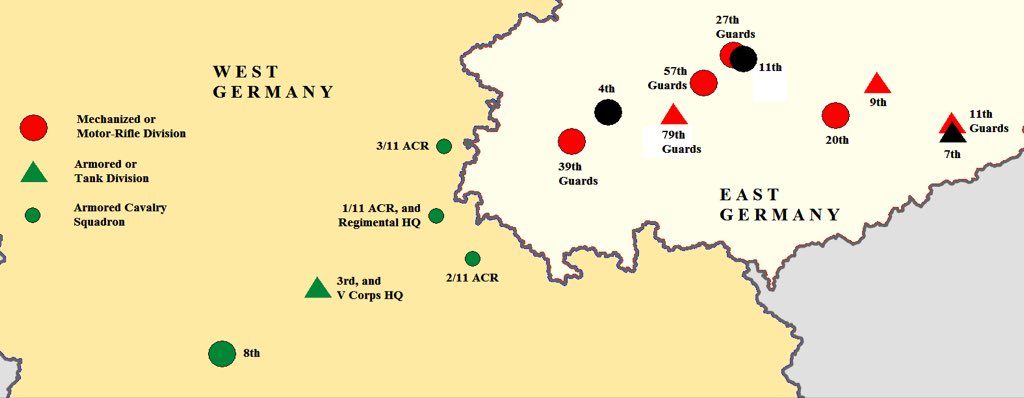
When I was at MicroProse, Sid Meier ran an after hours game that worked like this. We all stayed in our offices, which had terrific intercoms. Sid & a pal were the referees. The rest of us were officers in either NATO or the Warsaw Pact in a division- level action in the Fulda Gap.
Higher commanders had to use the com to tell their underlings what to do. The underlings actually did things, and the refs gave them results or information.
1/
So I would order my cavalry squadron LTC to check out a hill I saw on the map, and then Sid told the squadron what they saw, and the LTC would get back to me with something like, “There’s a whole regiment of T-80s! We’re taking heavy fire, 4 Bradleys KOed, pulling back!” Then I’d have to figure my next action.
Meanwhile the Soviet player with the tank regiment was alerted he’d been spotted by ground units.
You may ask, “what about air recon?” Well, the opening of the battle was about a thousand Scuds hitting our airfields (props to the Russian player for thinking of this).
We still had helicopters but they were busy elsewhere. Also the Scud strike at least meant the Pact didn’t have any more to hit our command posts.
2/
Most of us at MicroProse were pretty hip to modern warfare. We’d done Gunship, Red Storm Rising, F-15 Strike Eagle, F-19x and so forth. So you can imagine we got pretty involved.
I wasn’t our division commander - but I was on his staff, so we were in the same office. It helped to have two of us coordinating our efforts. When I asked for helo recon, he told me he was using our 8 UH-1Hs on something else, so I sent in the cav on my own initiative.
I then asked the commander for artillery on that hill. He called the corps (represented by Sid) and made his case. He got something like 20-30 MLRS targeting the Soviet tanks and Sid said they were wiped out. I don’t know what he told the Russian player.
3/