1/10
Many don't realize it yet:
Trump has ERODED the US' global footprint in a way that will likely shape the world for the next century:
-Ending US aide
-Failing to stand up for Ukraine
-Violating sovereignty in Venezuela
-Weak statements on Taiwan
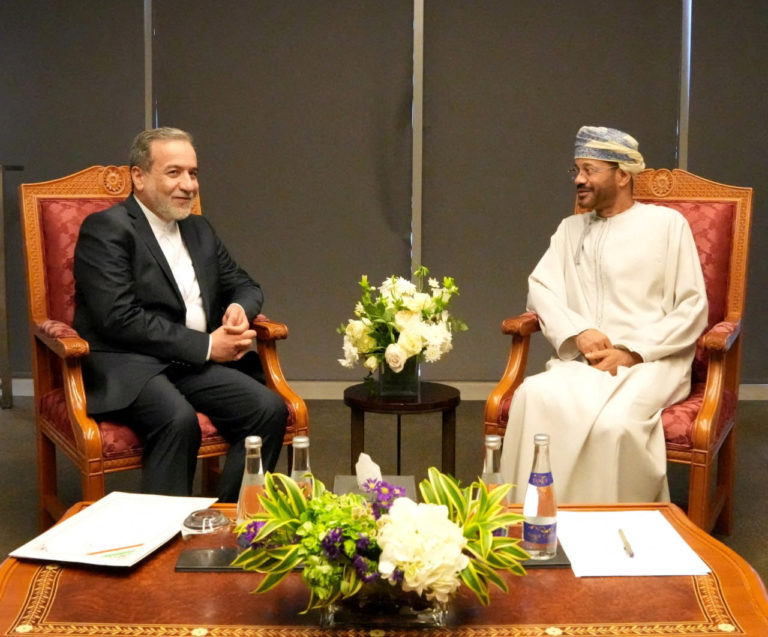
-Folding on Iran
-Having China push Iran to the table
-Ending US development investment in Africa and Latin America
-Trade wars with South East Asia
-Pushing Canada and the EU into deeper trade relations with China
These have all rapidly diminished the US global sphere of influence, to the smallest its EVER been in the modern era.
Many don't realize it yet:
Trump has ERODED the US' global footprint in a way that will likely shape the world for the next century:
-Ending US aide
-Failing to stand up for Ukraine
-Violating sovereignty in Venezuela
-Weak statements on Taiwan
-Folding on Iran
-Having China push Iran to the table
-Ending US development investment in Africa and Latin America
-Trade wars with South East Asia
-Pushing Canada and the EU into deeper trade relations with China
These have all rapidly diminished the US global sphere of influence, to the smallest its EVER been in the modern era.

2/10
The US spent a century building a sphere of influence that was broad and unchallenged.
It triumphed through cultural export that came on the backs of economic development and unwavering defense agreements.
America was a country you could trust, and it's help was of value.
The US spent a century building a sphere of influence that was broad and unchallenged.
It triumphed through cultural export that came on the backs of economic development and unwavering defense agreements.
America was a country you could trust, and it's help was of value.
4/10
Under that doctrine, the US had it's peak global influence around the 2000s, especially as this aligned with EU peak influence and the EU was an unwavering US ally against the China-Russia axis.
Under that doctrine, the US had it's peak global influence around the 2000s, especially as this aligned with EU peak influence and the EU was an unwavering US ally against the China-Russia axis.

5/10
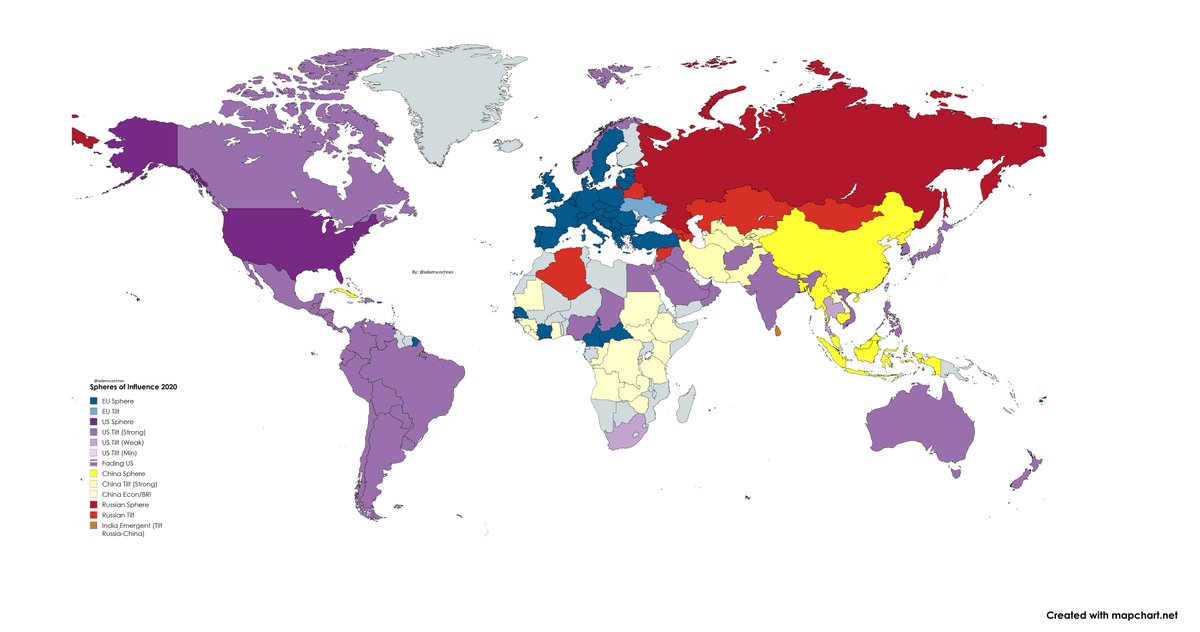
Even as recently as 2020 amid declining EU influence broad, due to weakening economic initiatives, the US held an unwavering global footprint.
China hadn't proven to the world a reliable ally, and Russian influence was in decline.
Even as recently as 2020 amid declining EU influence broad, due to weakening economic initiatives, the US held an unwavering global footprint.
China hadn't proven to the world a reliable ally, and Russian influence was in decline.
6/10
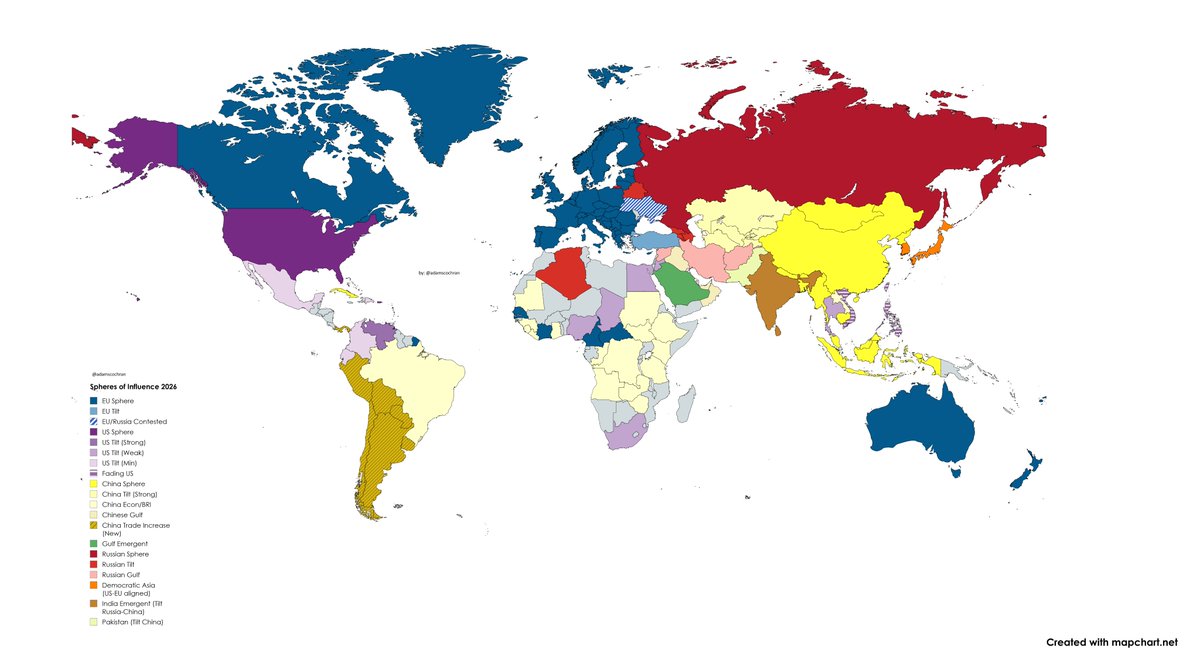
Trump fumbled that immensely.
By 2026 the US direct sphere of influence is weak and almost non-existent.
It exists through influence over weak states, and shared interest with allies who now view the US as secondary.
Trump fumbled that immensely.
By 2026 the US direct sphere of influence is weak and almost non-existent.
It exists through influence over weak states, and shared interest with allies who now view the US as secondary.
7/10
Without USAID, China's Belt and Road Initiative quickly gained influence across Africa, the Middle East and Latin America.
In LATAM, China is now the largest trading partner for nearly every country, the largest investor in public infrastructure, and most of the top apps are owned by Chinese companies.
Without USAID, China's Belt and Road Initiative quickly gained influence across Africa, the Middle East and Latin America.
In LATAM, China is now the largest trading partner for nearly every country, the largest investor in public infrastructure, and most of the top apps are owned by Chinese companies.

8/10
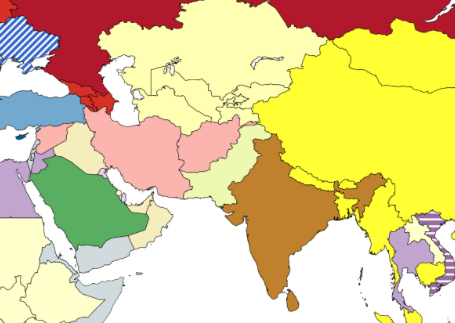
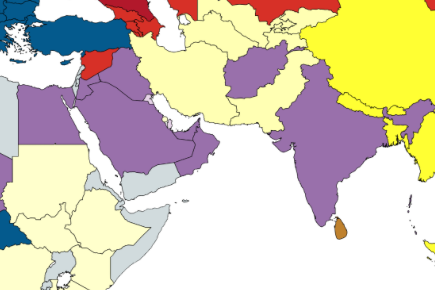
In the Middle East, weakening US influence even before the war with Iran.
It's now led to the emergence of new regional spheres, who heavily tilt towards Chinese influence while being standalone.
A huge hit from just 5 years prior where the region had a heavy US influence.
In the Middle East, weakening US influence even before the war with Iran.
It's now led to the emergence of new regional spheres, who heavily tilt towards Chinese influence while being standalone.
A huge hit from just 5 years prior where the region had a heavy US influence.
9/10
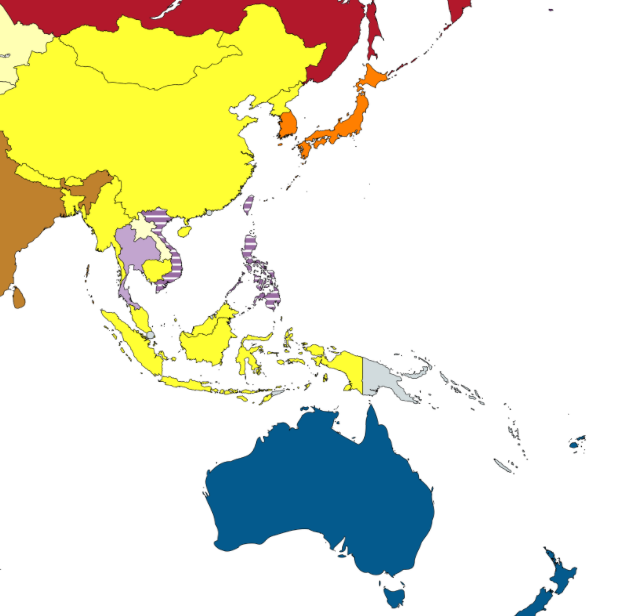
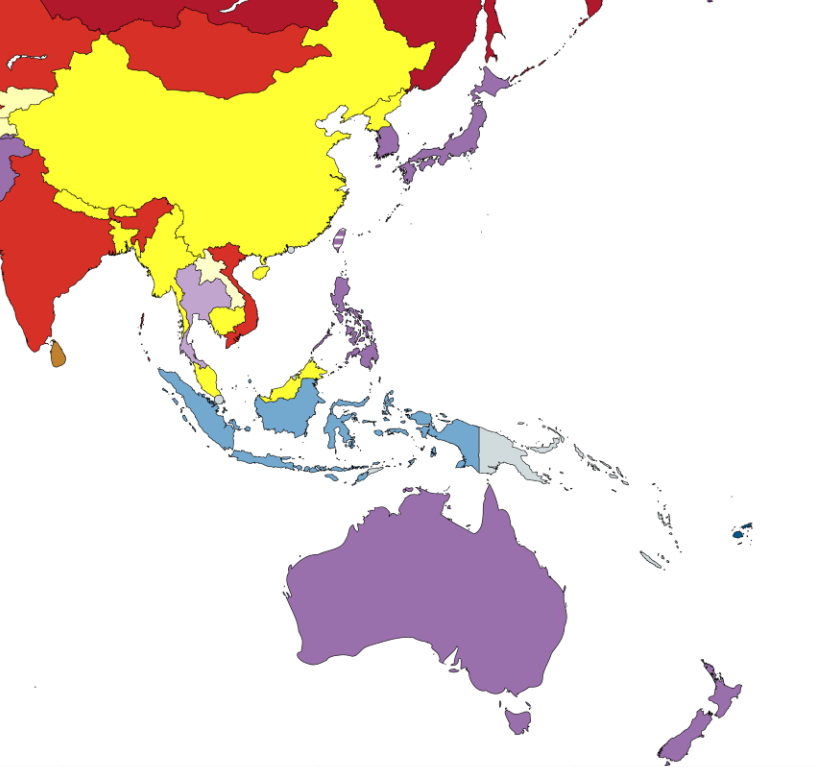
In Asia, the closest US influences are rapidly in decline.
Korea and Japan are now at best fair-weather allies who cannot rely on the US.
And Australia and New Zealand increasingly look to Canada, the EU and Japan before the US.
In Asia, the closest US influences are rapidly in decline.
Korea and Japan are now at best fair-weather allies who cannot rely on the US.
And Australia and New Zealand increasingly look to Canada, the EU and Japan before the US.
10/10
Trump likes to talk a big game about "strength" and influence.
But the reality is the US has never been weaker, less trusted and less respected than in 2026.
Even under a new administration, it will take decades to begin to regain the momentum that was lost, in trust, trade, investment and cultural export to rebuild that influence.
More importantly though, investment, culture and security guarantee influence tend to be impacts that last for at least a generation.
China giving Iran security guarantees with this deal.
Kids in Eastern Europe growing up using a Chinese bank branch.
Schools in central Africa teaching Mandarin-as-a-Second-Language due to all the Chinese companies in the country.
Youth in Brazil ogling the brands in Chinese stores at the local mall.
Gulf states turning to China to protect their borders.
Balkan States wondering if the US will actually show up if Russia comes knocking at their door.
This is influence that is easily lost, and not easily returned.
China and Russia took advantage of Trump, but not just in the obvious ways. They let him think he was getting payoffs to lose at a game of checkers, and they were playing chess.
Trump's ego, xenophobia, insularism, and greed, will shape the spheres of influence we see for the next 50-100 years, unless future administrations 10x their focus on foreign investment and globalism.
The irony is, Trump tweets proudly about his "Donroe Doctrine" but most of the Western Hemisphere wants nothing to do with the US and is more influenced by China or the EU.
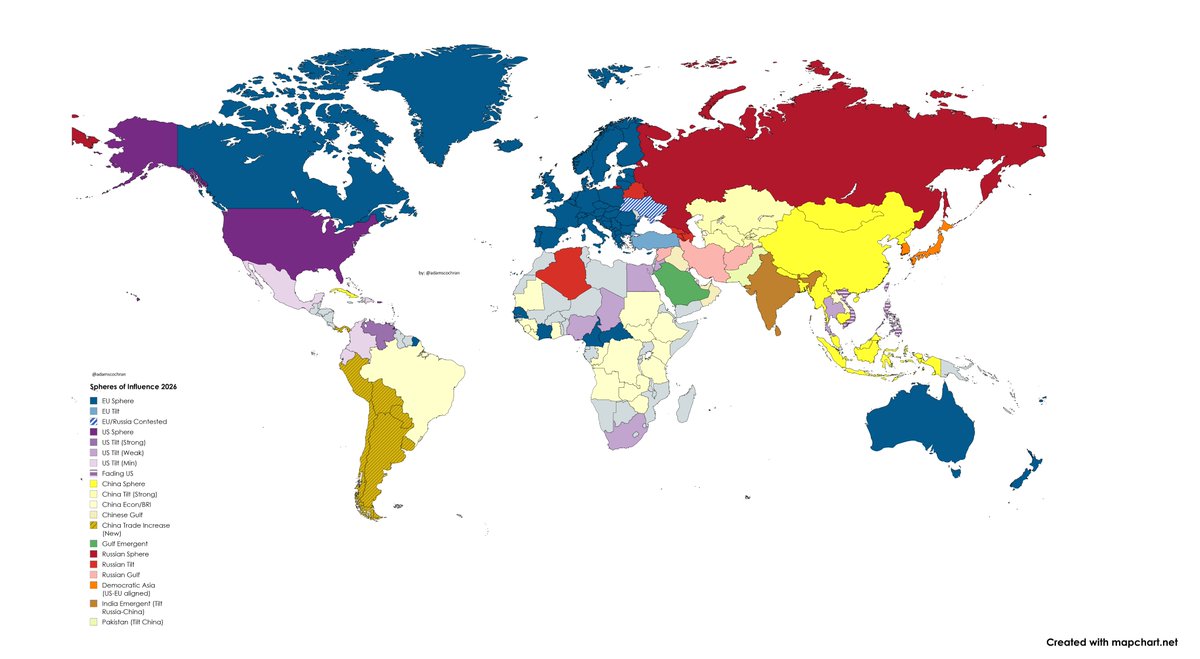
We're only part way in to this administration, and the map looks bleak.
I suspect before 2028 I'll be adding more yellow, red, brown and green here.
Not a lot of purple.
Trump likes to talk a big game about "strength" and influence.
But the reality is the US has never been weaker, less trusted and less respected than in 2026.
Even under a new administration, it will take decades to begin to regain the momentum that was lost, in trust, trade, investment and cultural export to rebuild that influence.
More importantly though, investment, culture and security guarantee influence tend to be impacts that last for at least a generation.
China giving Iran security guarantees with this deal.
Kids in Eastern Europe growing up using a Chinese bank branch.
Schools in central Africa teaching Mandarin-as-a-Second-Language due to all the Chinese companies in the country.
Youth in Brazil ogling the brands in Chinese stores at the local mall.
Gulf states turning to China to protect their borders.
Balkan States wondering if the US will actually show up if Russia comes knocking at their door.
This is influence that is easily lost, and not easily returned.
China and Russia took advantage of Trump, but not just in the obvious ways. They let him think he was getting payoffs to lose at a game of checkers, and they were playing chess.
Trump's ego, xenophobia, insularism, and greed, will shape the spheres of influence we see for the next 50-100 years, unless future administrations 10x their focus on foreign investment and globalism.
The irony is, Trump tweets proudly about his "Donroe Doctrine" but most of the Western Hemisphere wants nothing to do with the US and is more influenced by China or the EU.
We're only part way in to this administration, and the map looks bleak.
I suspect before 2028 I'll be adding more yellow, red, brown and green here.
Not a lot of purple.
(and yes there is a half-decent argument to be made right now that the US is more in an Israeli sphere of influence than its own US one...)
• • •
Missing some Tweet in this thread? You can try to
force a refresh