New research: we have studied the wealth of the 200 Californian billionaires and what they effectively pay in tax.
From Mark Zuckerberg (Meta) to Sergei Brin and Larry Page (Alphabet), the results are edifying. 🧵
nytimes.com/interactive/20…
From Mark Zuckerberg (Meta) to Sergei Brin and Larry Page (Alphabet), the results are edifying. 🧵
nytimes.com/interactive/20…

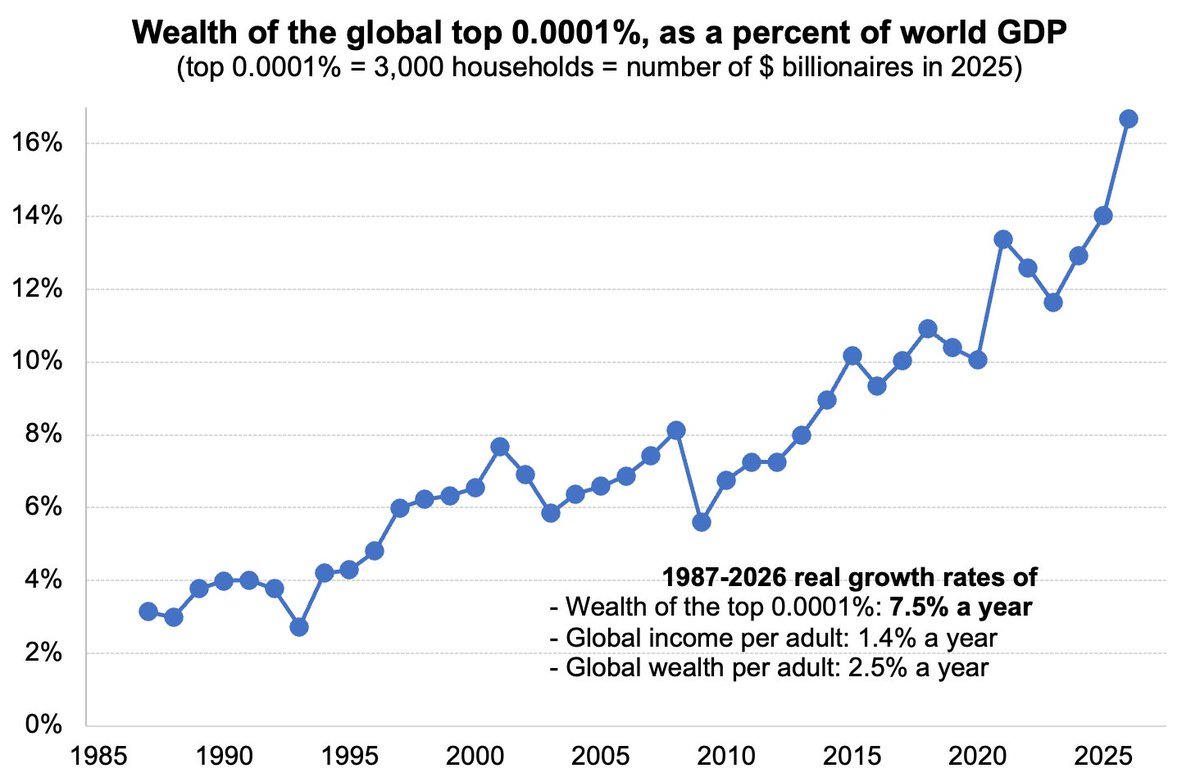
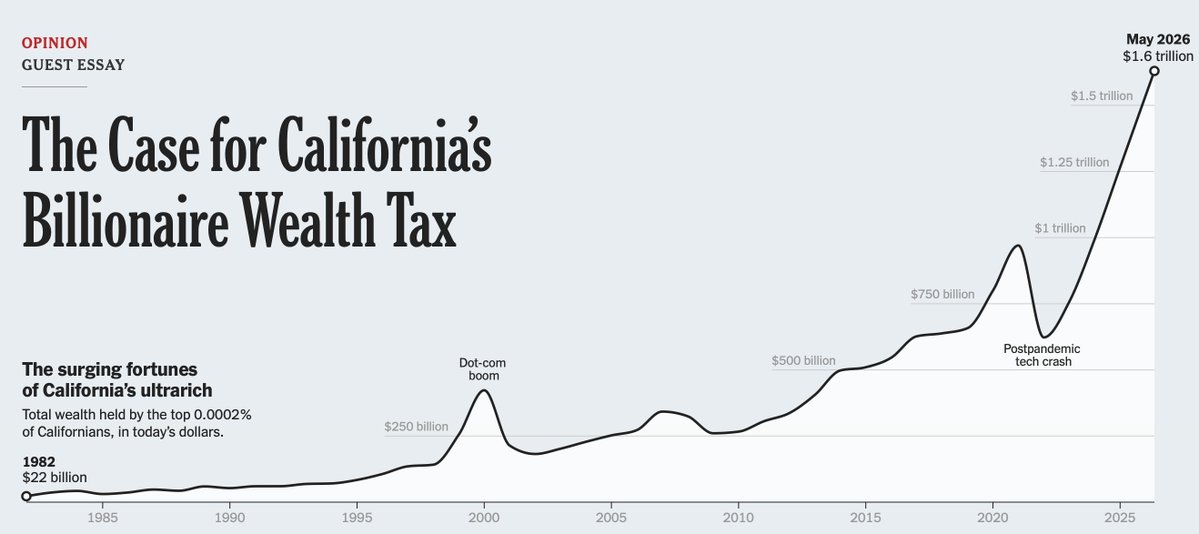
Since 1982, the wealth of California’s billionaire class – the top 0.0002% – has been multiplied by 30.
It has grown by 144% between 2023 and 2025 only.
California’s billionaires now own $2.3 trillion in wealth, equivalent to 50% of California’s GDP and about 10% of California’s total wealth.
It has grown by 144% between 2023 and 2025 only.
California’s billionaires now own $2.3 trillion in wealth, equivalent to 50% of California’s GDP and about 10% of California’s total wealth.
One might think that such enormous wealth translates into sizable tax payments.
It does not.
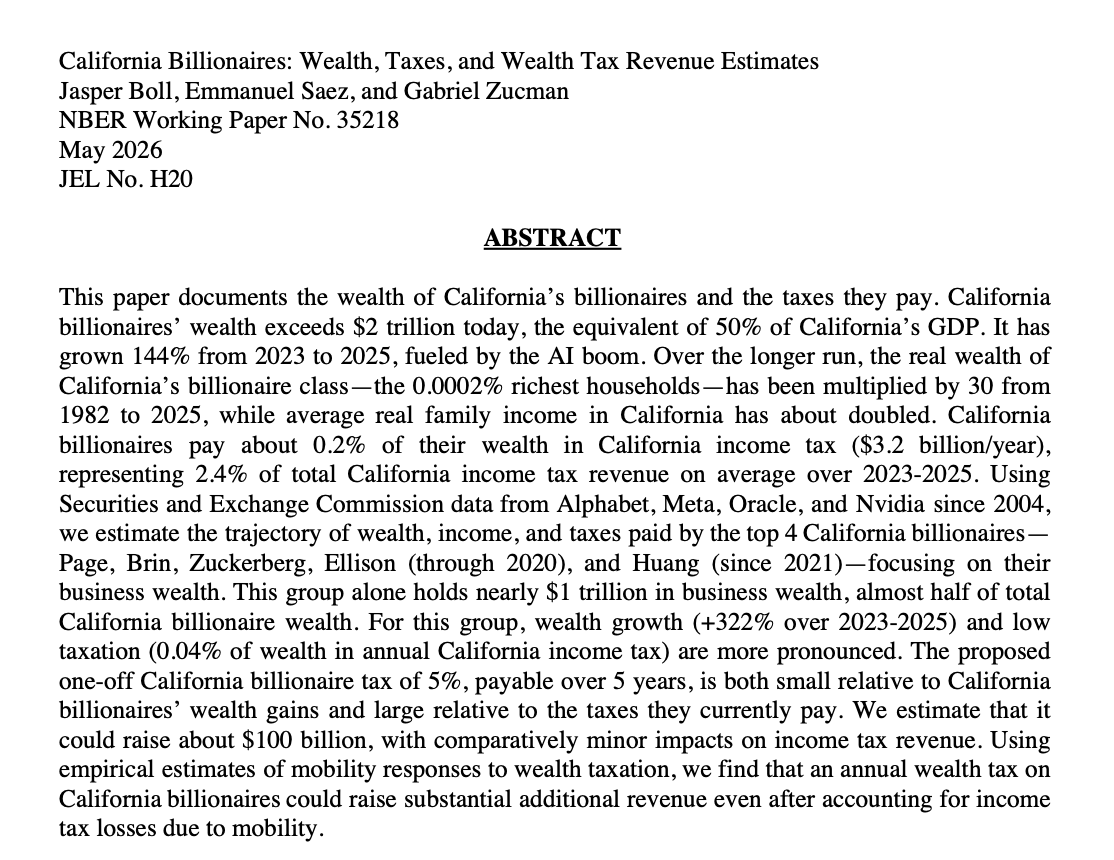
California billionaires pay just 0.2% of their wealth in California income tax (a mere 2.4% of total California income tax revenue) on average over 2023-2025.
It does not.
California billionaires pay just 0.2% of their wealth in California income tax (a mere 2.4% of total California income tax revenue) on average over 2023-2025.
Using Securities and Exchange Commission data from Alphabet, Meta, Oracle, and Nvidia since 2004, we can estimate the taxes paid by the top 4 California billionaires:
Page, Brin, Zuckerberg, Ellison (through 2020), and Huang (since 2021).
This group alone holds nearly $1 trillion in wealth, almost half of total California billionaire wealth.
Page, Brin, Zuckerberg, Ellison (through 2020), and Huang (since 2021).
This group alone holds nearly $1 trillion in wealth, almost half of total California billionaire wealth.
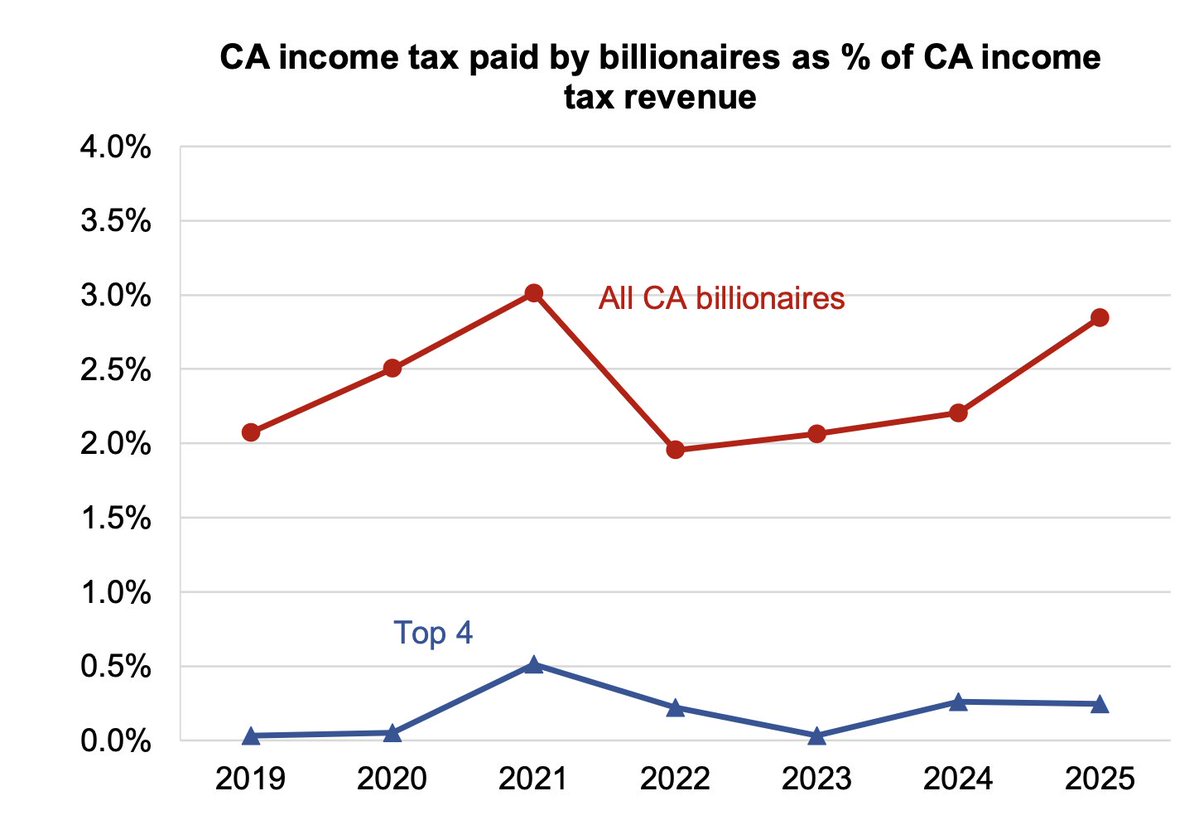
In 2019, 2020 and 2023, Sergei Brin and Larry Page – the 2nd and 3rd richest people in the world today – reported no income and paid no income tax on their Alphabet-derived wealth.
Since 2019 their wealth has grown by more than $400 billion.
Brin is now spending tens of millions to defeat a modest one-off billionaire tax of 5%.
Since 2019 their wealth has grown by more than $400 billion.
Brin is now spending tens of millions to defeat a modest one-off billionaire tax of 5%.
California’s super-billionaires pay only 0.07% of their wealth in California income tax each year, a mere 0.2% of total California income tax revenue.
They pay a pittance in tax to the state that made them rich.
It’s as if they lived in a parallel society.
They pay a pittance in tax to the state that made them rich.
It’s as if they lived in a parallel society.
In November, California will vote on a trailblazing billionaire tax, a one-time tax of 5% on their wealth.
It would be tiny for them – their wealth has grown by 150% just over the last 2 years!
But very big for the state: $100 billion in tax revenue.
It would be tiny for them – their wealth has grown by 150% just over the last 2 years!
But very big for the state: $100 billion in tax revenue.
California’s billionaires currently pay such a low tax rate that even if ALL of them left the state, guess what would happen?
It would take 25 years for the loss of their income tax payments to surpass the amount collected with the 5% one-off wealth tax.
It would take 25 years for the loss of their income tax payments to surpass the amount collected with the 5% one-off wealth tax.
And of course, contrary to the horror stories they keep feeding, they are not moving in any significant number.
We provide a website to track California’s billionaires in real time.
There are even more billionaires in California today than at the beginning of the year.
We provide a website to track California’s billionaires in real time.
There are even more billionaires in California today than at the beginning of the year.

In 1978, California was at the vanguard of the anti-tax movement that would triumph in the United States in the 1980s.
That year, the Golden State passed Proposition 13, which capped property tax increases and foretold the Reagan revolution to come.
Today the Golden State could spearhead another shift, this time in the opposite direction.
That year, the Golden State passed Proposition 13, which capped property tax increases and foretold the Reagan revolution to come.
Today the Golden State could spearhead another shift, this time in the opposite direction.
If the billionaire tax passes, it would be the first ever tax on extreme wealth enacted anywhere in the world.
California, it’s time to lead again!
Link to the paper: gabriel-zucman.eu/files/BSZ2026.…
Link to the tracker: cabillionairetracker.org
California, it’s time to lead again!
Link to the paper: gabriel-zucman.eu/files/BSZ2026.…
Link to the tracker: cabillionairetracker.org
• • •
Missing some Tweet in this thread? You can try to
force a refresh