I have posted six threads in the last month. Over 400,000 views. Thousands of replies.
The same question keeps appearing. Over and over. In every thread.
"What tests should I actually get?"
Here are the five tests. Under $150. No prescription needed at most direct-access labs. Backed by studies published in the New England Journal of Medicine and JAMA Cardiology.
These five tests would have caught my heart disease years before it almost killed me at 52.
Your annual physical does not include a single one of them.
🧵
The same question keeps appearing. Over and over. In every thread.
"What tests should I actually get?"
Here are the five tests. Under $150. No prescription needed at most direct-access labs. Backed by studies published in the New England Journal of Medicine and JAMA Cardiology.
These five tests would have caught my heart disease years before it almost killed me at 52.
Your annual physical does not include a single one of them.
🧵

Your standard annual physical tests three things related to heart disease.
Total cholesterol. LDL cholesterol. Fasting glucose.
That is it. Those are the numbers your doctor uses to decide whether you are healthy or sick. Whether you need medication. Whether you are at risk.
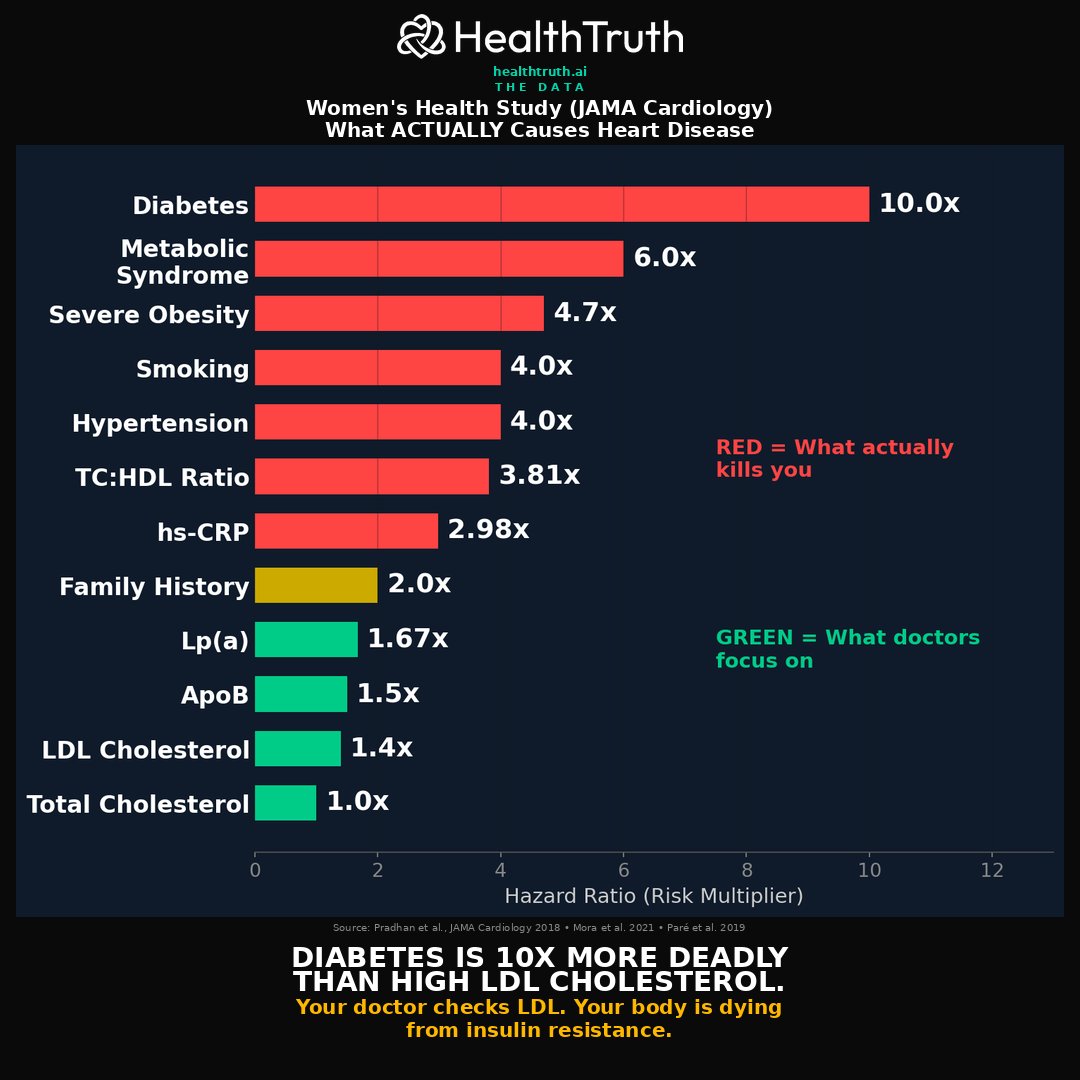
The Women's Health Study ranked LDL cholesterol last at 1.4x. Total cholesterol at 1.0x. Fasting glucose does not move until 10 to 20 years after the disease starts.
Your doctor is testing the weakest predictors. The ones that catch it last. The ones at the bottom of the list.
Total cholesterol. LDL cholesterol. Fasting glucose.
That is it. Those are the numbers your doctor uses to decide whether you are healthy or sick. Whether you need medication. Whether you are at risk.
The Women's Health Study ranked LDL cholesterol last at 1.4x. Total cholesterol at 1.0x. Fasting glucose does not move until 10 to 20 years after the disease starts.
Your doctor is testing the weakest predictors. The ones that catch it last. The ones at the bottom of the list.
Fasting insulin. The earliest marker of insulin resistance. Detectable 10 to 20 years before blood sugar moves.
hs-CRP. Chronic inflammation. The mechanism that actually drives plaque formation. 2.98x risk. More than double LDL.
HOMA-IR. Your insulin resistance score. A free calculation your doctor already has the numbers for but never puts together.
HbA1c. Your 90-day blood sugar average. Shows what fasting glucose hides.
Lp(a). A genetic risk factor that 20% of the population has elevated. Most have never been tested. Cannot be changed with lifestyle. Must be managed.
Five tests. Five markers that actually predict disease. None of them on your standard blood panel.
hs-CRP. Chronic inflammation. The mechanism that actually drives plaque formation. 2.98x risk. More than double LDL.
HOMA-IR. Your insulin resistance score. A free calculation your doctor already has the numbers for but never puts together.
HbA1c. Your 90-day blood sugar average. Shows what fasting glucose hides.
Lp(a). A genetic risk factor that 20% of the population has elevated. Most have never been tested. Cannot be changed with lifestyle. Must be managed.
Five tests. Five markers that actually predict disease. None of them on your standard blood panel.
This is the most important blood test your doctor has never ordered.
In 1975, Joseph Kraft tested 14,384 patients and proved that insulin pathology is detectable 10 to 20 years before blood sugar moves.
Look at the chart. The red line is insulin. Rising for 20 years. The teal line is glucose. Flat. Normal. The entire time.
Your doctor tests the teal line. Glucose. The last domino.
The red line is where Type 2 diabetes, heart disease, Alzheimer's, and metabolic syndrome all begin. In the same place. With the same marker.
A fasting insulin test costs under $30. Target: below 5 µIU/mL.
Your doctor says anything under 25 is normal. Functional medicine says over 5 is a warning. That gap is where disease hides for two decades.
In 1975, Joseph Kraft tested 14,384 patients and proved that insulin pathology is detectable 10 to 20 years before blood sugar moves.
Look at the chart. The red line is insulin. Rising for 20 years. The teal line is glucose. Flat. Normal. The entire time.
Your doctor tests the teal line. Glucose. The last domino.
The red line is where Type 2 diabetes, heart disease, Alzheimer's, and metabolic syndrome all begin. In the same place. With the same marker.
A fasting insulin test costs under $30. Target: below 5 µIU/mL.
Your doctor says anything under 25 is normal. Functional medicine says over 5 is a warning. That gap is where disease hides for two decades.

Take your fasting insulin and your fasting glucose. Multiply them. Divide by 405.
That is your HOMA-IR score. Your insulin resistance number.
Under 1.0: optimal. Your cells are responding to insulin efficiently.
1.0 to 2.0: early resistance. This is where you catch it. This is where you fix it.
Over 2.0: insulin resistant. Your risk for diabetes, heart disease, and metabolic syndrome is elevated.
Over 3.0: significant resistance. Your metabolic system is under serious stress.
This calculation is free. Your doctor already has both numbers from your standard blood work. They just never put them together. Because it is not in the guidelines. Because there is no drug to sell for it.
That is your HOMA-IR score. Your insulin resistance number.
Under 1.0: optimal. Your cells are responding to insulin efficiently.
1.0 to 2.0: early resistance. This is where you catch it. This is where you fix it.
Over 2.0: insulin resistant. Your risk for diabetes, heart disease, and metabolic syndrome is elevated.
Over 3.0: significant resistance. Your metabolic system is under serious stress.
This calculation is free. Your doctor already has both numbers from your standard blood work. They just never put them together. Because it is not in the guidelines. Because there is no drug to sell for it.
High sensitivity C-reactive protein. A marker of systemic inflammation.
The JUPITER trial. 17,802 patients. Harvard. Published in the New England Journal of Medicine. People with normal LDL but elevated CRP had significantly higher cardiovascular risk.
The CANTOS trial proved that reducing inflammation alone, without touching cholesterol, reduced heart attacks by 15%.
The Women's Health Study ranked hs-CRP at 2.98x. More than double the risk of LDL cholesterol.
An hs-CRP test costs under $25. Target: below 1.0 mg/L.
Your doctor tests LDL. Your body is dying from inflammation. This test measures the fire. LDL measures the fire alarm.
The JUPITER trial. 17,802 patients. Harvard. Published in the New England Journal of Medicine. People with normal LDL but elevated CRP had significantly higher cardiovascular risk.
The CANTOS trial proved that reducing inflammation alone, without touching cholesterol, reduced heart attacks by 15%.
The Women's Health Study ranked hs-CRP at 2.98x. More than double the risk of LDL cholesterol.
An hs-CRP test costs under $25. Target: below 1.0 mg/L.
Your doctor tests LDL. Your body is dying from inflammation. This test measures the fire. LDL measures the fire alarm.

Your doctor tests fasting glucose. That is a snapshot. One moment in time. First thing in the morning before you eat.
HbA1c is the movie. It shows your average blood sugar over the last 90 days. Every meal. Every snack. Every spike.
You can wake up with a perfect fasting glucose of 90. Your doctor says fine. But your HbA1c reveals that your blood sugar has been spiking all day. Every meal. Every glass of juice.
A fasting glucose of 90 with an HbA1c of 5.7 means your body is struggling. Your doctor might not flag it until 6.5. By then you are diabetic.
The window between 5.0 and 5.4 is optimal. Between 5.4 and 5.7 is where you catch it. Above 5.7 is where you fix it. Above 6.5 is where your doctor finally notices.
An HbA1c test costs under $30.
HbA1c is the movie. It shows your average blood sugar over the last 90 days. Every meal. Every snack. Every spike.
You can wake up with a perfect fasting glucose of 90. Your doctor says fine. But your HbA1c reveals that your blood sugar has been spiking all day. Every meal. Every glass of juice.
A fasting glucose of 90 with an HbA1c of 5.7 means your body is struggling. Your doctor might not flag it until 6.5. By then you are diabetic.
The window between 5.0 and 5.4 is optimal. Between 5.4 and 5.7 is where you catch it. Above 5.7 is where you fix it. Above 6.5 is where your doctor finally notices.
An HbA1c test costs under $30.
Lipoprotein(a). The genetic one. Pronounced "lipoprotein little a."
20% of the population has elevated Lp(a). Most have never been tested. Most doctors have never ordered it.
If your Lp(a) is high, it does not mean you are doomed. It means you need to be more aggressive about managing every other risk factor. Insulin. Inflammation. Metabolic health. The things you CAN control.
You cannot manage what you do not know about.
An Lp(a) test costs under $40. It only needs to be tested once in your lifetime.
20% of the population has elevated Lp(a). Most have never been tested. Most doctors have never ordered it.
If your Lp(a) is high, it does not mean you are doomed. It means you need to be more aggressive about managing every other risk factor. Insulin. Inflammation. Metabolic health. The things you CAN control.
You cannot manage what you do not know about.
An Lp(a) test costs under $40. It only needs to be tested once in your lifetime.
Screenshot this. Print this. Take it to your next appointment.
Fasting Insulin. Under $30. Target: below 5.
HOMA-IR. Free to calculate. Target: below 1.0.
hs-CRP. Under $25. Target: below 1.0.
HbA1c. Under $30. Target: below 5.4.
Lp(a). Under $40. Test once for life.
Total cost: under $150. No prescription needed at most direct-access labs.
Your annual physical costs more and tells you less.
Fasting Insulin. Under $30. Target: below 5.
HOMA-IR. Free to calculate. Target: below 1.0.
hs-CRP. Under $25. Target: below 1.0.
HbA1c. Under $30. Target: below 5.4.
Lp(a). Under $40. Test once for life.
Total cost: under $150. No prescription needed at most direct-access labs.
Your annual physical costs more and tells you less.

If your doctor says no, say this.
"I am requesting these tests based on published research in the New England Journal of Medicine and JAMA Cardiology. I would like them ordered or I would like a note in my chart explaining why they were declined."
That sentence changes the conversation. A doctor who declines a test and documents why is taking legal responsibility for the decision. Most will order the tests.
If they still say no, go to a direct-access lab. Walk in. Order them yourself. No doctor needed. Results in 48 hours.
"I am requesting these tests based on published research in the New England Journal of Medicine and JAMA Cardiology. I would like them ordered or I would like a note in my chart explaining why they were declined."
That sentence changes the conversation. A doctor who declines a test and documents why is taking legal responsibility for the decision. Most will order the tests.
If they still say no, go to a direct-access lab. Walk in. Order them yourself. No doctor needed. Results in 48 hours.
Look at this chart one more time. The Women's Health Study. 27,939 women. 21 years.
Diabetes: 10x risk.
Metabolic syndrome: 6x.
Inflammation: 2.98x.
LDL cholesterol: 1.4x. Dead last.
The five tests in this thread measure the risk factors at the TOP of that list. Insulin resistance. Inflammation. Metabolic dysfunction.
Your standard physical measures the ones at the BOTTOM.
These five tests would have caught my heart disease years before it almost killed me. They cost less than a dinner out. And your doctor has probably never ordered them.
Diabetes: 10x risk.
Metabolic syndrome: 6x.
Inflammation: 2.98x.
LDL cholesterol: 1.4x. Dead last.
The five tests in this thread measure the risk factors at the TOP of that list. Insulin resistance. Inflammation. Metabolic dysfunction.
Your standard physical measures the ones at the BOTTOM.
These five tests would have caught my heart disease years before it almost killed me. They cost less than a dinner out. And your doctor has probably never ordered them.
In 12 years of annual physicals, not one of my seven doctors tested fasting insulin. Not one tested hs-CRP. Not one calculated HOMA-IR. Not one ordered Lp(a).
They tested cholesterol seven times. Flagged it seven times. Recommended statins seven times.
I said no for 12 years. Then I had a heart attack at 52. Then they put me on a statin anyway.
It took almost dying to learn that the thing they kept measuring was the weakest predictor on the list. And the things that could have saved me were never measured at all.
They tested cholesterol seven times. Flagged it seven times. Recommended statins seven times.
I said no for 12 years. Then I had a heart attack at 52. Then they put me on a statin anyway.
It took almost dying to learn that the thing they kept measuring was the weakest predictor on the list. And the things that could have saved me were never measured at all.
You asked what tests to get. Now you know.
Five tests. Under $150. No prescription. Available at any direct-access lab. Backed by the largest studies published in the most respected journals in the world.
Your doctor will not order them. Not because they are wrong. Because the system was not designed to find the root cause early. It was designed to wait until you are sick enough to need a drug.
Do not wait. Test now. Know your numbers. The earlier you catch it, the easier it is to reverse.
The truth heals
Five tests. Under $150. No prescription. Available at any direct-access lab. Backed by the largest studies published in the most respected journals in the world.
Your doctor will not order them. Not because they are wrong. Because the system was not designed to find the root cause early. It was designed to wait until you are sick enough to need a drug.
Do not wait. Test now. Know your numbers. The earlier you catch it, the easier it is to reverse.
The truth heals
If this reached you, send it to everyone. Not just someone on a statin. Everyone. Every person over 30 should know these five numbers.
Screenshot the cheat sheet. Take it to your doctor. Take it to your parents. Take it to your spouse. Take it to your friends.
The five tests that actually predict disease cost less than your annual physical. And nobody orders them.
Co-founders of HealthTruth:
Dr. Philip Ovadia, Cardiac Surgeon · @ifixhearts
Dr. Aseem Malhotra, Cardiologist · @DrAseemMalhotra
Dr. Robert Cywes, Metabolic Surgeon · @carbaddictiondr
Prof. Tim Noakes @ProfTimNoakes
With thanks to @bigfatsurprise @BillAckman @garytaubes @drjasonfung @DoctorTro @nicknorwitz @LDLSkeptic
Mark Kaplan
Founder, HealthTruth
Screenshot the cheat sheet. Take it to your doctor. Take it to your parents. Take it to your spouse. Take it to your friends.
The five tests that actually predict disease cost less than your annual physical. And nobody orders them.
Co-founders of HealthTruth:
Dr. Philip Ovadia, Cardiac Surgeon · @ifixhearts
Dr. Aseem Malhotra, Cardiologist · @DrAseemMalhotra
Dr. Robert Cywes, Metabolic Surgeon · @carbaddictiondr
Prof. Tim Noakes @ProfTimNoakes
With thanks to @bigfatsurprise @BillAckman @garytaubes @drjasonfung @DoctorTro @nicknorwitz @LDLSkeptic
Mark Kaplan
Founder, HealthTruth

• • •
Missing some Tweet in this thread? You can try to
force a refresh