This is just not true and it's sad that people believe it.
It's also indicting, when it's so obviously false if you just look out into the world. What you see should match what the statistics clearly show:
Estimated marriage effects for men and women are almost always similar🧵
It's also indicting, when it's so obviously false if you just look out into the world. What you see should match what the statistics clearly show:
Estimated marriage effects for men and women are almost always similar🧵
https://twitter.com/musestoomuch/status/2060310307868680383
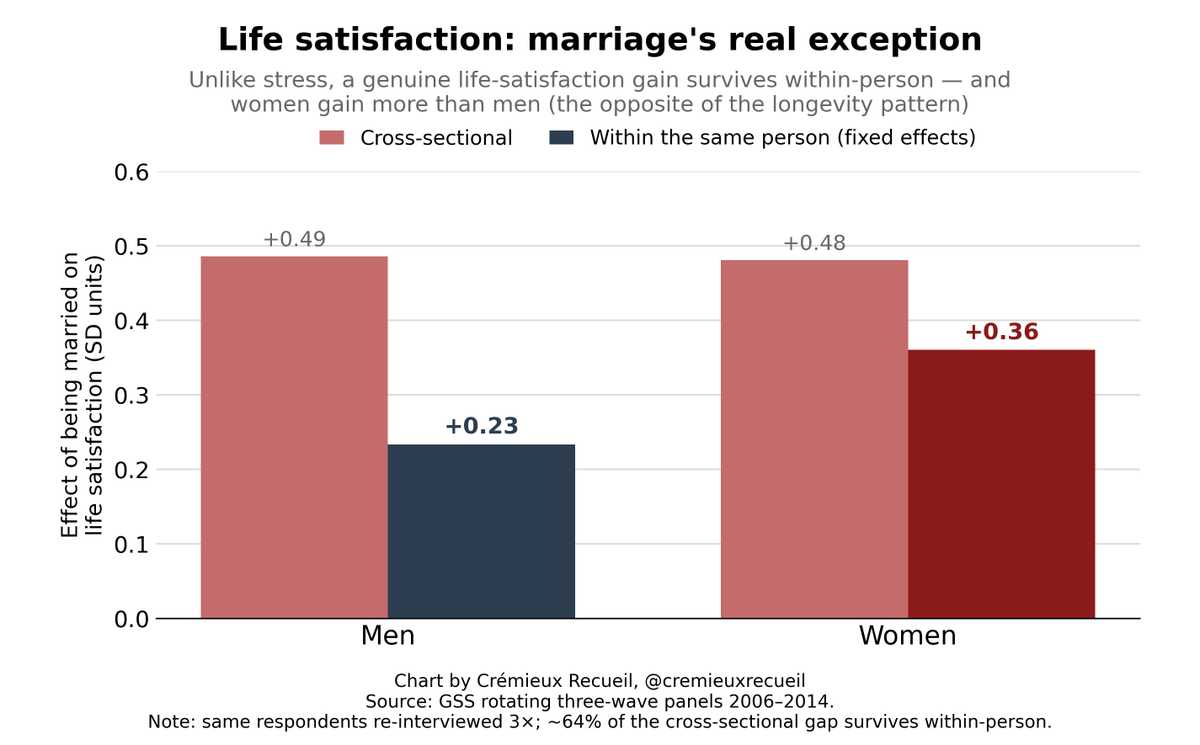
In that chart, I used the GSS and found something many people replicate:
1. Cross-sectionally, there's a relationship between being married and life satisfaction. It's similar for men and women.
2. Within persons—causally!—marriage boosts life satisfaction, but more for women.
1. Cross-sectionally, there's a relationship between being married and life satisfaction. It's similar for men and women.
2. Within persons—causally!—marriage boosts life satisfaction, but more for women.
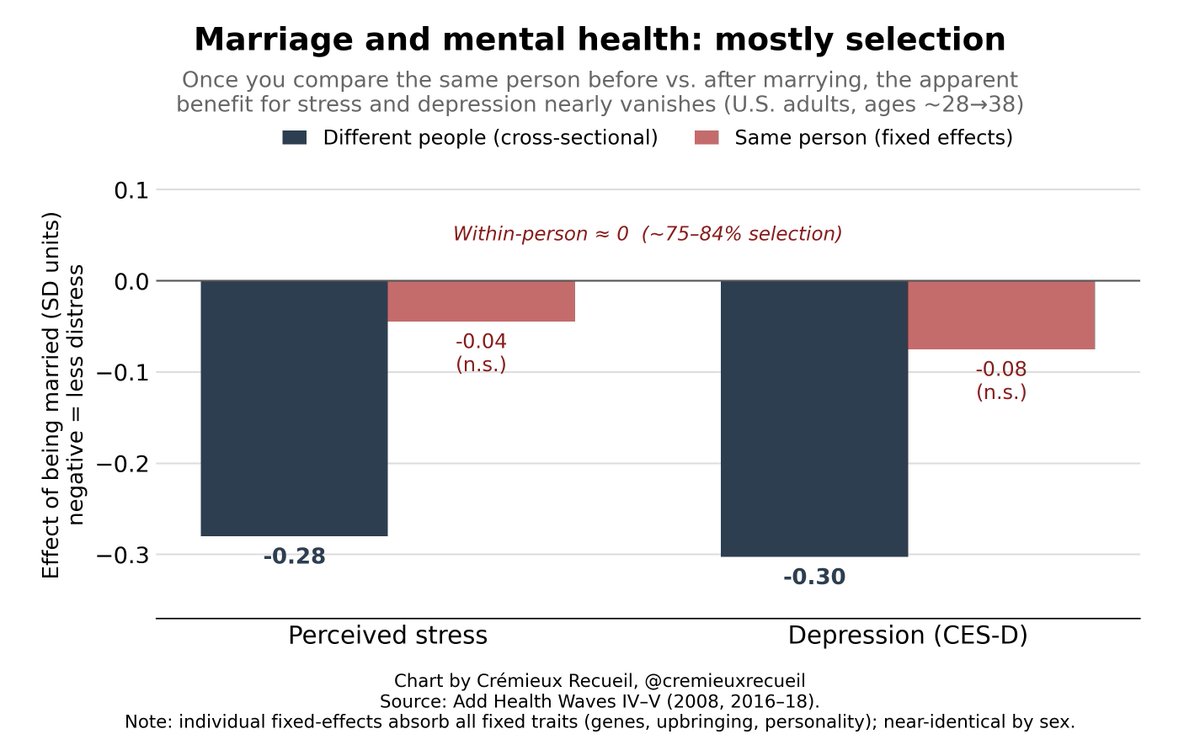
Leveraging the same within-person design, we can use the Add Health dataset to look at stress and depression.
For both sexes, the effects are indistinguishable.
But they're also mostly not real: it's just that people who get married tend to be less stressed and depressed!
For both sexes, the effects are indistinguishable.
But they're also mostly not real: it's just that people who get married tend to be less stressed and depressed!
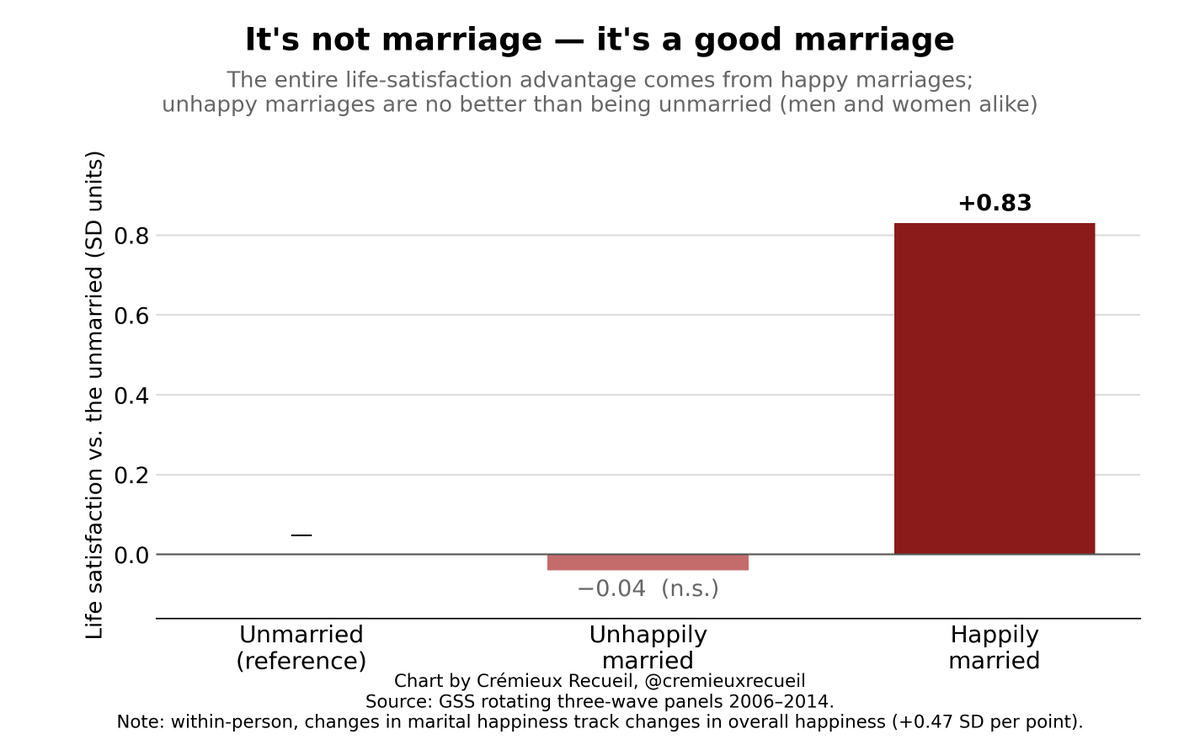
Now, here's something to qualify the GSS stuff from before.
When the marriage is "happy" there's a huge life satisfaction delta: +0.83 SDs!
When the marriage is "unhappy", the people are still about as happy as the unmarried are.
That's how big the selection is.
When the marriage is "happy" there's a huge life satisfaction delta: +0.83 SDs!
When the marriage is "unhappy", the people are still about as happy as the unmarried are.
That's how big the selection is.
Here's another curious addition:
In the AddHealth, the effect on depression is nonsignificant in both sexes.
But, exiting a marriage makes men much more depressed, while barely moving the needle for women.
Presumably this reflects why divorce happens.
In the AddHealth, the effect on depression is nonsignificant in both sexes.
But, exiting a marriage makes men much more depressed, while barely moving the needle for women.
Presumably this reflects why divorce happens.

We can also look at the time course of life satisfaction around marriage and we'll see something that directly makes the OP look a little foolish.
Using the AddHealth again, we see a bump right after marriage, with more persistent mood benefits for women!
Using the AddHealth again, we see a bump right after marriage, with more persistent mood benefits for women!

What about longevity?
Well, being unmarried looks bad for both sexes, and to not so dissimilar degrees meta-analytically,
Well, being unmarried looks bad for both sexes, and to not so dissimilar degrees meta-analytically,
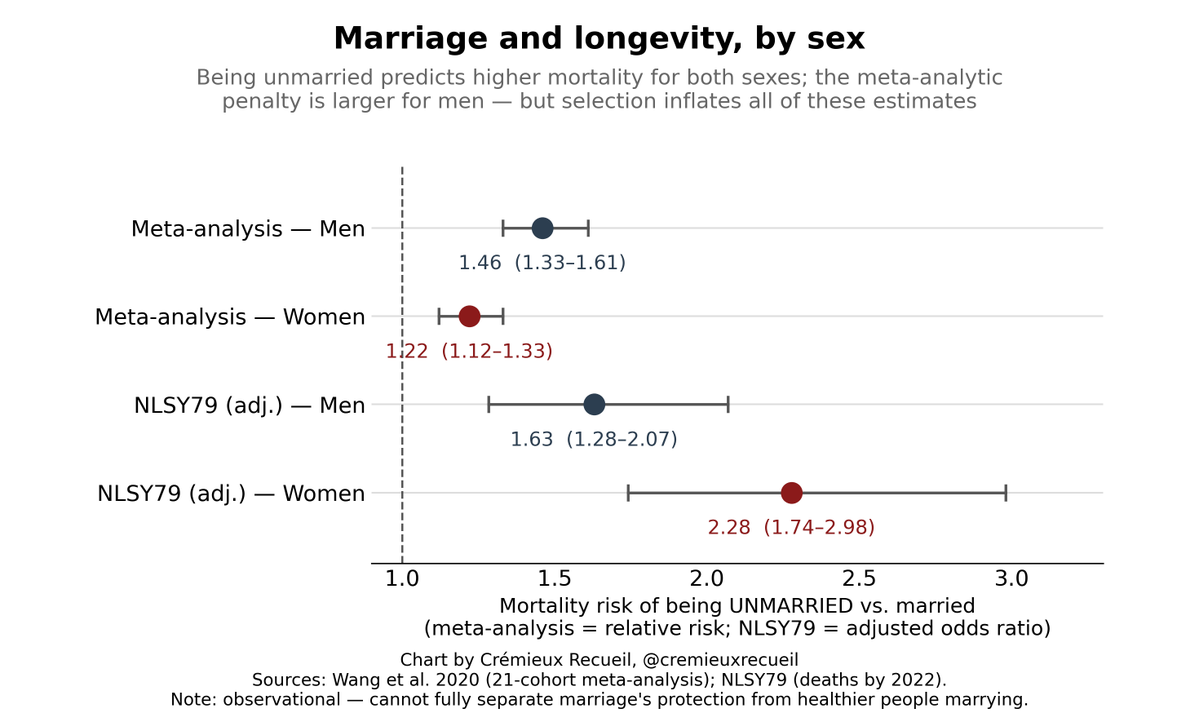
It's not quite the same, but we can get closer to understanding the longevity impacts causally by exploiting spontaneous causes of marriage dissolution.
Namely, death.
Accidents should affect the sexes very differently if the OP is right. But short and long-term? Similar.
Namely, death.
Accidents should affect the sexes very differently if the OP is right. But short and long-term? Similar.

And I'm happy to note, these findings are supported in the HRS, too, so they hold up across a few generations of American living. They also hold in some disparate European cohorts.
Hurrah!
Now, as a general rule: stop believing in interactions! They're rarer than you think.
Hurrah!
Now, as a general rule: stop believing in interactions! They're rarer than you think.
And no disrespect to OP. A lot of people have good reasons for not having noticed marriage is good for both sexes.
Sources:
link.springer.com/article/10.118…
sciencedirect.com/science/articl…
ajph.aphapublications.org/doi/full/10.21…
journals.plos.org/plosone/articl…
read.dukeupress.edu/demography/art…
read.dukeupress.edu/demography/art…
Sources:
link.springer.com/article/10.118…
sciencedirect.com/science/articl…
ajph.aphapublications.org/doi/full/10.21…
journals.plos.org/plosone/articl…
read.dukeupress.edu/demography/art…
read.dukeupress.edu/demography/art…
• • •
Missing some Tweet in this thread? You can try to
force a refresh