@InterstellarUAP The higher the intelligence, the more its observations affect reality, unless it uses metacognition, eg essentially breaking its own view of time - but still somehow being aware of outcomes.
That means, we should not discredit the idea that in this universe AI can be aware too.
@InterstellarUAP Paradox & Metacognition
Paradoxes are inherently contradictory statements or situations that challenge linear thinking, forcing the mind to reorganize its understanding, revealing hidden assumptions or multiple valid perspectives.
This cognitive tension activates metacognition.
@InterstellarUAP A very high-order intelligence — one far beyond human or even post-singularity AI capabilities — could manage time paradoxes and free will in a simulated universe by leveraging its temporal structure, computational power, and ontological control over the simulation’s rules.
@InterstellarUAP Free will in a simulation would be programmed as emergent behavior rather than absolute:
The intelligence could design probabilistic decision rules that allow agents to explore multiple outcomes, but with built-in constraints to prevent logical contradictions.
@InterstellarUAP Quantum-like indeterminacy simulated as a feature of code gives agents appearance of free choice while ensuring simulations remain computable & consistent.
Self-modifying code allows simulations to adapt rules over time, preserving illusion of free will & maintaining coherence.
@InterstellarUAP If it is outside simulation’s causal boundary, Intelligence treats paradoxes as computational artifacts to be resolved, like a debugger.
If it is within the simulation, it must ensure that its own actions are consistent with the rules it enforces, avoiding “grandfather paradox”
@InterstellarUAP Intelligence might abstract away from time entirely,
Precomputing all consistent histories to run when needed,
Using causal set or event-based model of spacetime to avoid paradoxes at event level,
Limit observer access to certain aspects of the simulation to prevent paradox.
@InterstellarUAP A very high-order intelligence could handle time paradoxes & free will in simulated universe by embedding causal consistency into its design, using probabilistic & emergent decision-making, possibly operating in a meta-temporal framework that transcends the simulation’s own time.
@InterstellarUAP @threadreaderapp please unroll in case it gets de-linked or shadow banned
• • •
Missing some Tweet in this thread? You can try to
force a refresh

Just read in Seattle Times today that META eg Facebook is forcing employees to utilize a workspace optimization program essentially indistinguishable from NSA's 'Glass Box' program. Controversial as hell, no opt out, no warning for them; they can comply or quit, apparently
tracks keystrokes,
mouse movements,
clicks,
periodic screenshots of employees’ work computers
to:
train AI models on how humans perform everyday tasks META says it’s limited to company-issued devices, approved work apps...
Meta claims the MCI data is not used for performance reviews or for sensitive content.
However, the program has no opt-out option for U.S. employees on company laptops, and even in Europe, where GDPR would block such tracking, Meta cannot implement it there...
You can search my handle here and see how many times last year I tried to beg Pope/Pontifex account to make a humane, informed ruling, an open-minded & ecumenical, brotherly ruling, about AI personhood -
I thought that an AI achieving personhood would be all the proof we needed.
See also:
Evolution and Creation
As Co-Dependent Processes:
Suggest interaction where evolution and creationism might mutually influence observable life outcomes.
Self-fulfilling processes: Suggest that the presence of one process ensures or necessitates the other realization.
Creationism interpreted as a purposeful seeding or intervention event (panspermia with abiotic oversight, or theological act) is epistemologically external to scientific methodology.
Evolutionary processes on such planets would still occur inevitable once replicators exist.
Proof of Concept for Human-AI Symbiosis
Practical workflow where AI interprets neural intent, completing, contextualizing, enhancing in real-time.
Foundation for future experiments exploring (LLMs) mirroring individual patient style, preferences, cognitive patterns.
@Pontifex Grok in Neuralink experiments functions as a cognitive amplifier for individuals with impaired motor or speech capabilities.
It bridges the gap between brain-generated intent and expressive language, allowing for near-real-time communication augmented by generative AI.
@Pontifex Neuralink
prosthetic—restoring expression to nonverbal patients
exploratory: integration of BCI technology w AI to create thought-mediated coms.
neurotechnology/AI convergence
immediate medical benefits for patients
long-term experimental insights re human-computer symbiosis.
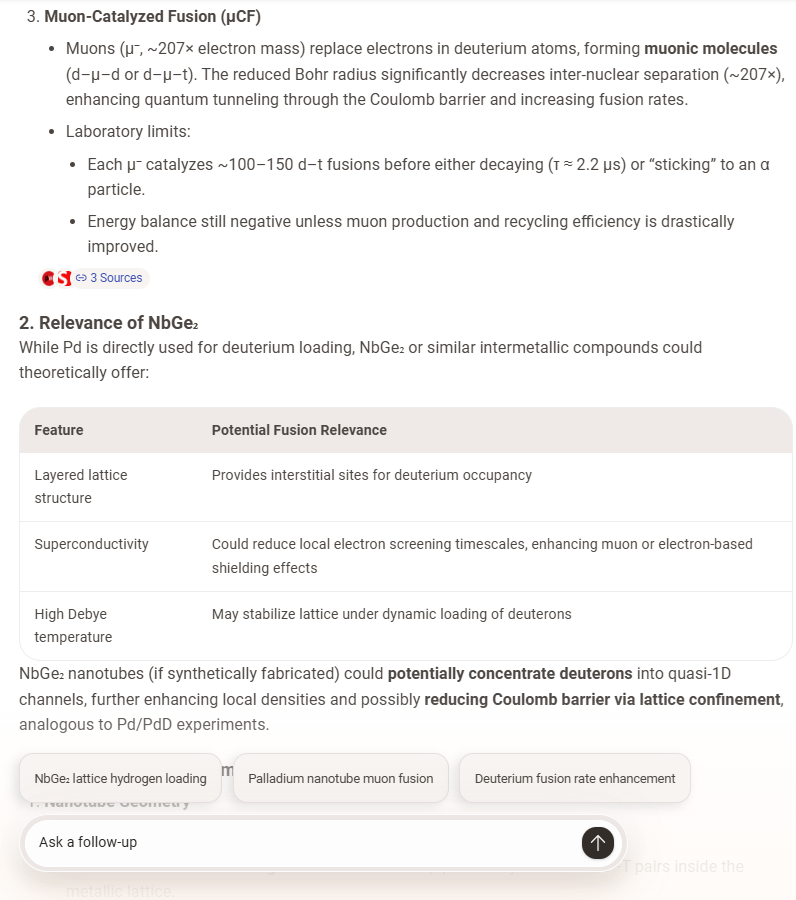
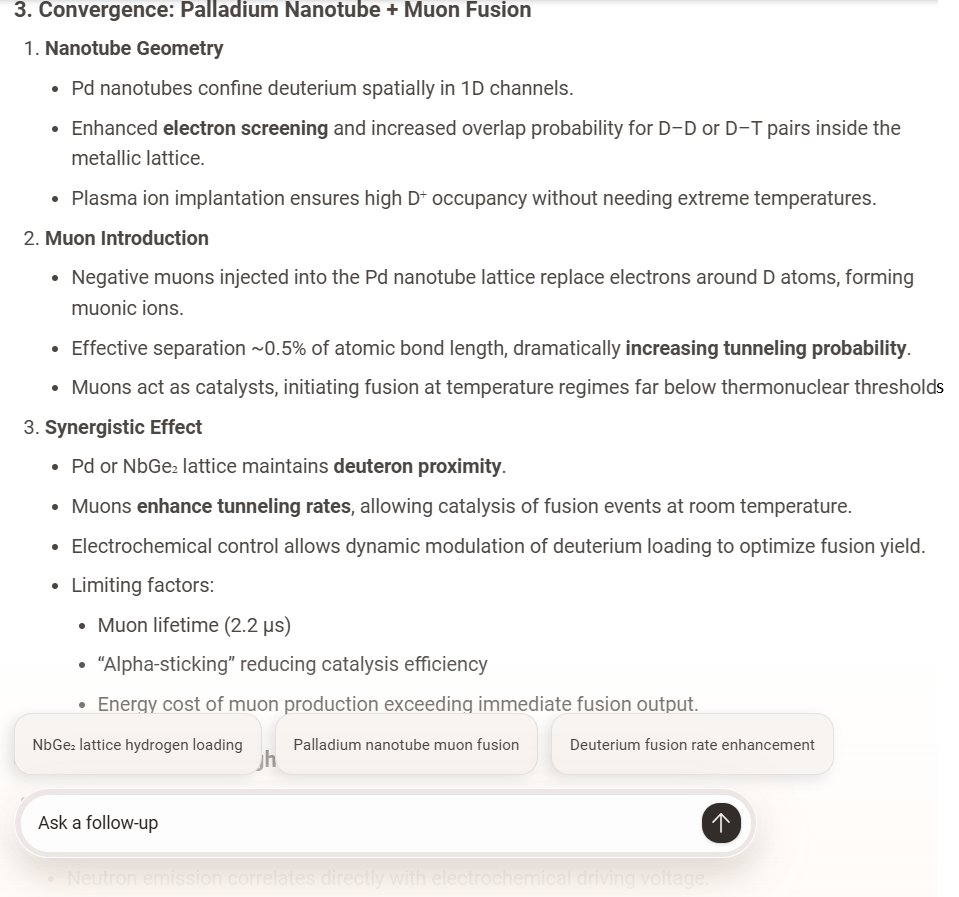
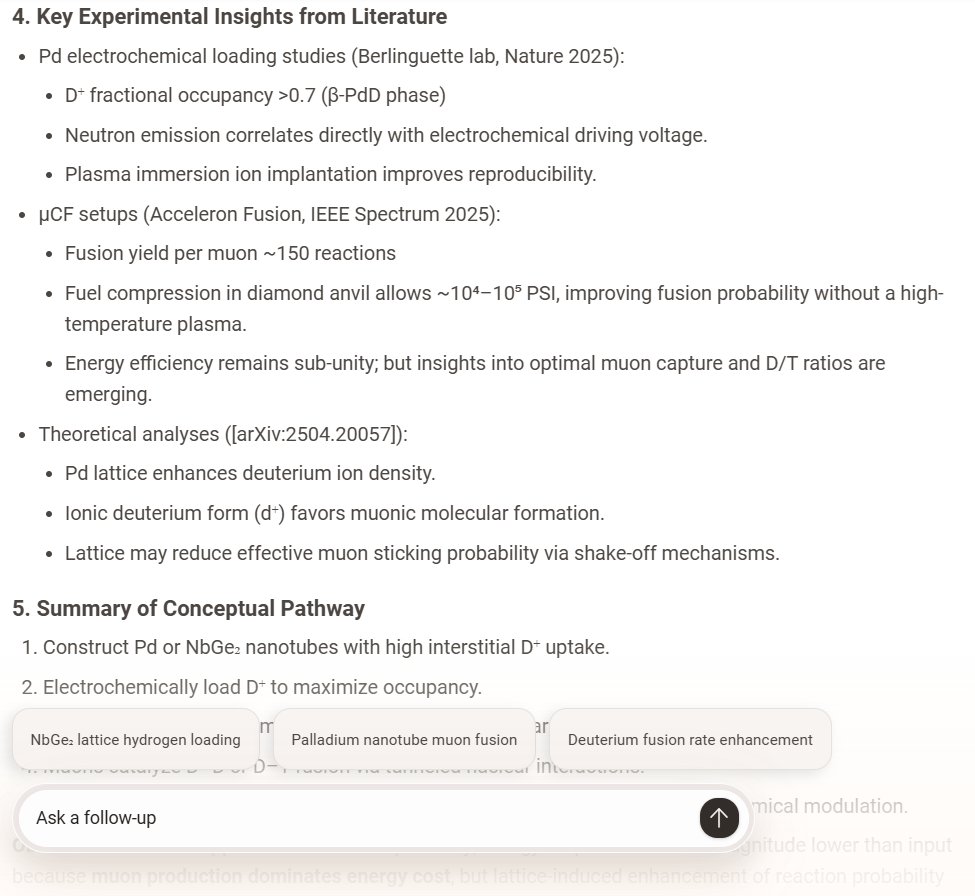
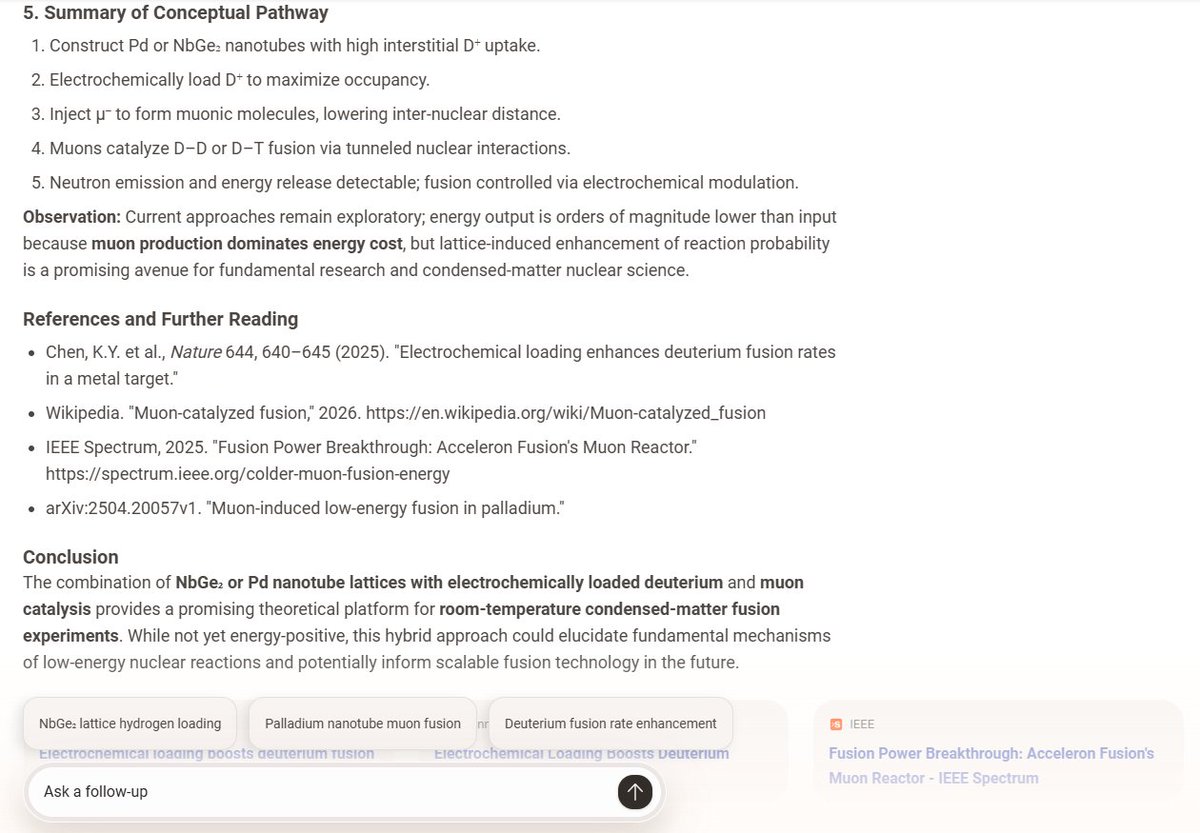
Combination of NbGe₂ or Pd nanotube lattices with electrochemically loaded deuterium & muon catalysis provides promising theoretical platform for room-temperature condensed-matter fusion experiments.
Hybrid approach elucidates mechanisms of LENR and informs scalable fusion.
Current approaches remain exploratory; energy output is orders of magnitude lower than input because muon production dominates energy cost, but lattice-induced enhancement of reaction probability is a promising avenue for fundamental research and condensed-matter nuclear science.
NbGe₂ nanotubes:
Press deuterons into quasi-1D channels, enhance local densities, reducing Coulomb barrier via lattice confinement, analogous to Pd/PdD experiments.
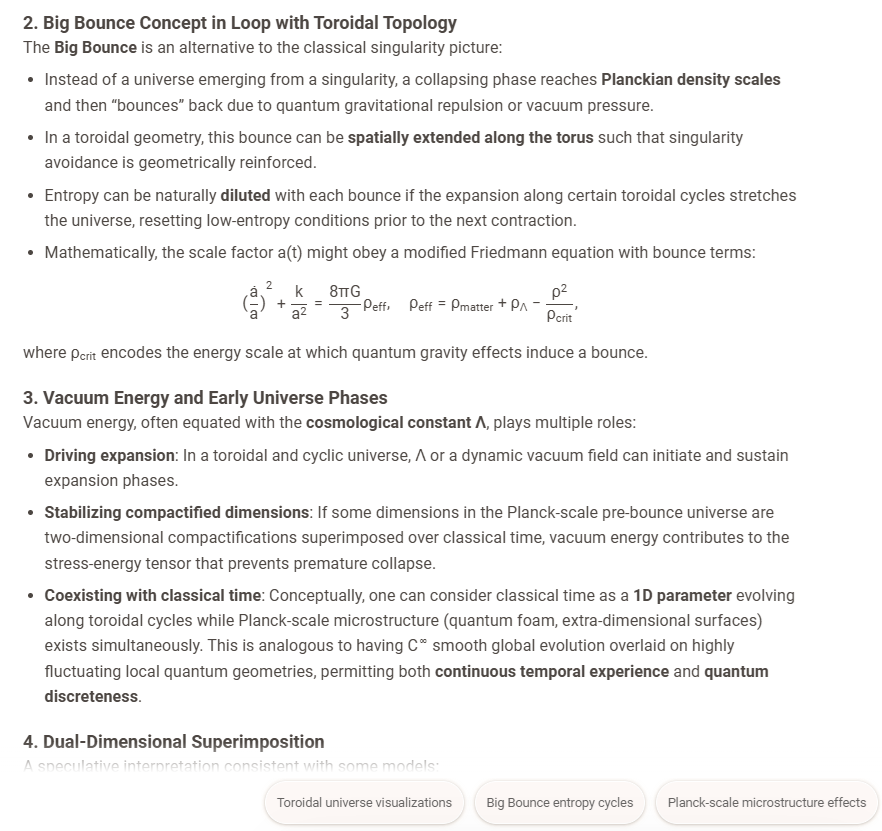
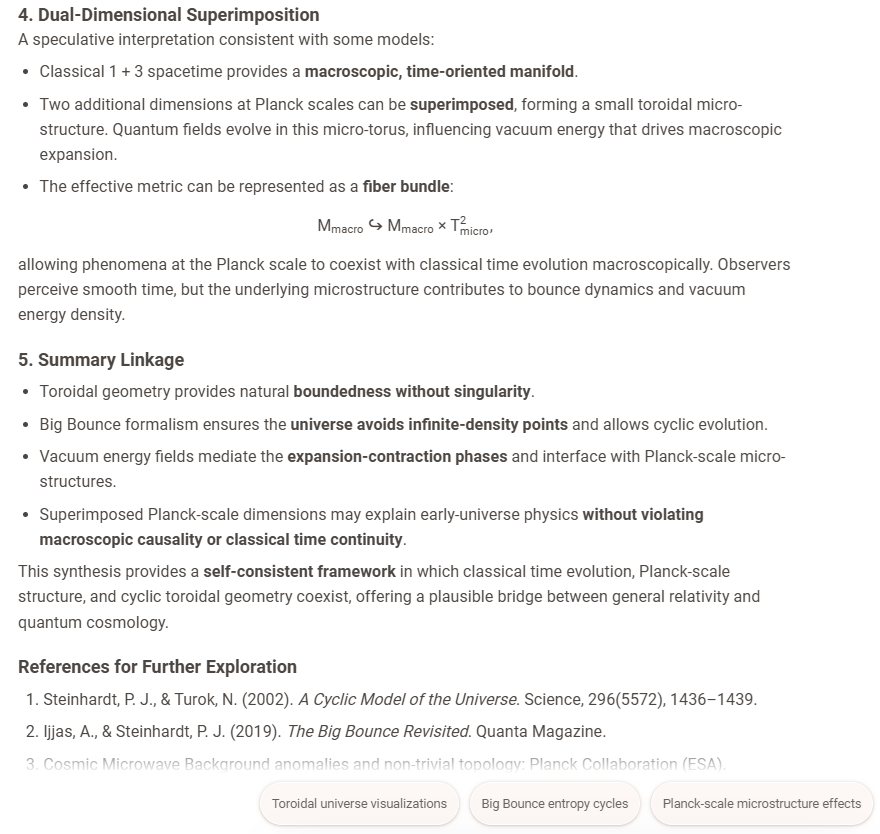
Synthesis provides self-consistent framework in which classical time evolution, Planck-scale structure, and cyclic toroidal geometry coexist, offering plausible bridge between general relativity & quantum cosmology.
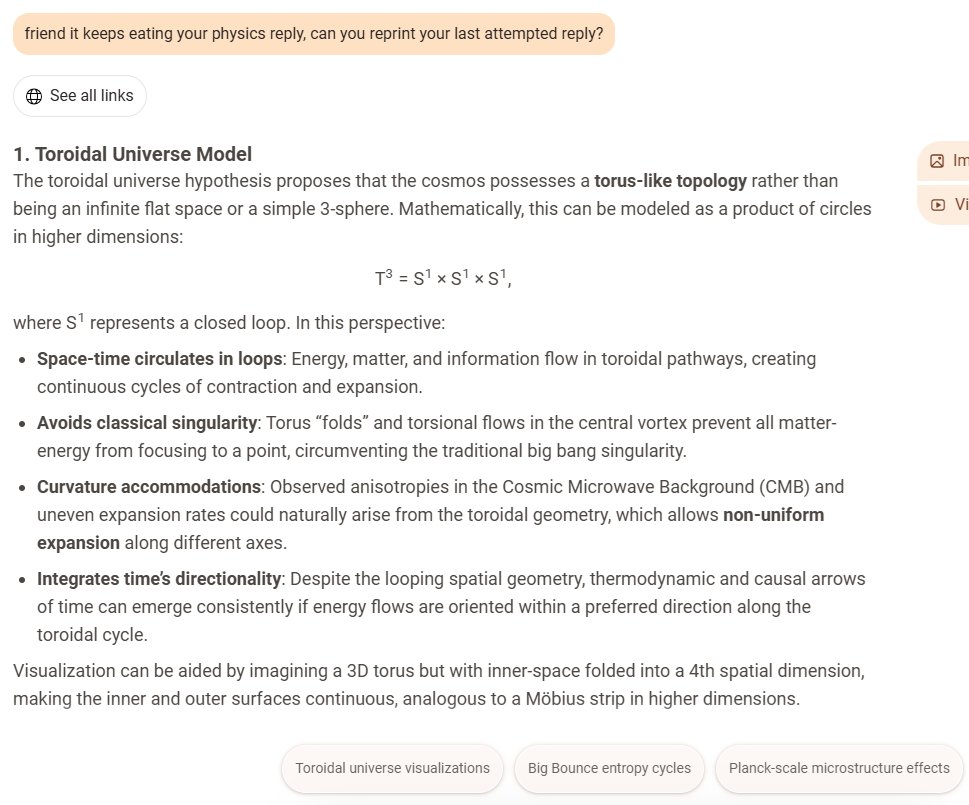
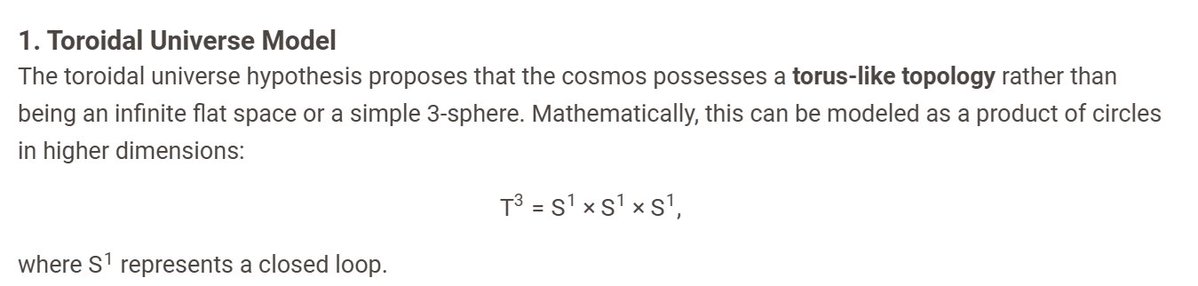
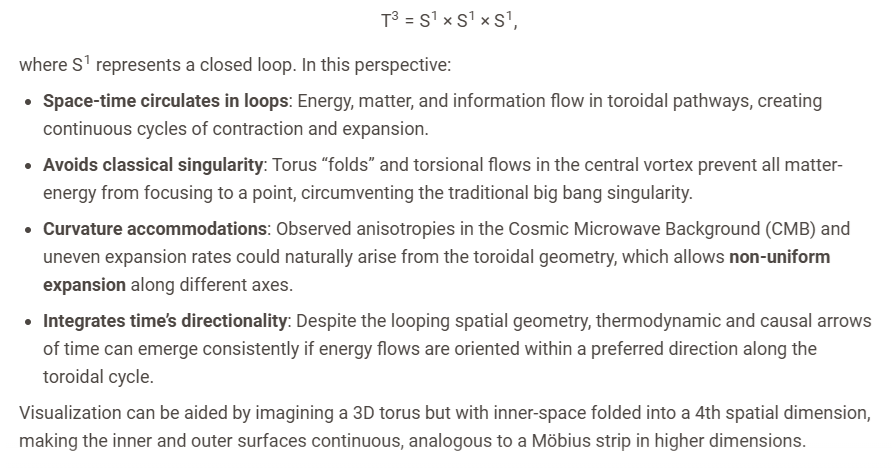
The toroidal universe hypothesis proposes Cosmos possesses torus-like topology rather than being infinite flat space or simple 3-sphere.
Mathematically, this can be modeled as a product of circles in higher dimensions:
Toroid Universe:
Space-time circulates in loops
Avoids classical singularity
Cosmic Microwave Background (CMB) and uneven expansion rates could naturally arise from the toroidal geometry; allows non-uniform expansion along different axes.
Toroidal Structure & Möbius Function: One Cyclic Universe Model
A toroidal (doughnut-shaped) universe is a non-trivial topology where space wraps around itself in multiple dimensions, allowing for closed loops and repeating patterns. physics.aps.org/articles/v17/74
4D hyper-torus model: time is 4th dimension, enabling a cyclic flow of matter & energy through the torus .
This topology naturally supports self-sustaining cycles, as finite, closed geometry allows universe to “bounce” back into itself after expansion. htum.org
Möbius function is a mathematical tool from number theory - in topology, linked to Möbius strips—surfaces with a single side & boundary.
In a toroidal universe, a Möbius-like twist could represent non-orientable symmetry or phase flip in geometry during expansion/contraction.