Brad Setser Profile picture
Jun 2 17 tweets 4 min read Read on X
The argument that China has a comparative advantage at industrial policy is a bit like the argument that the US has a comparative advantage at exporting debt. It is a good line, but even quips need a limiting principle ...

1/ Image
I am not sure this week's Free Lunch column came up with that limiting principle; the notion that "the west might be better off simply leveraging the benefits of Chinese scale" suggests getting out of China's way across the board

2/

ft.com/content/42fc2e…
But China has -- in Greg Ip's phrase (based on Rhodium's analysis) -- an "industrial policy for everything," which would imply that China is on track (with its comparative advantage at industrial policy) to dominate most industrial sectors

3/

wsj.com/world/china/be…
China's industrial policy targets now include quantum, advanced semiconductors, advanced chip making equipment (EUV), legacy analogue chips (many military applications), civil aircraft, and top of the line jet engines --

4/
I think most people would consider those sectors to be important for either national or economic security -- so letting China exercise its comparative advantage in "industrial policy" unchallenged would mean accepting real security trade offs

5/ Image
Does exploiting China's scale extend to its clear existing scale in rare earth processing and refining (including the rare earths that have very clear and important military applications) + its edge in manufacturing magnets that use those rare earths?

6/
That means accepting dependence on China for components used in high end interceptors, nuclear subs and stealth fighters/ their radars -- which seems unwise ... yet those are the sectors were China has scale and a clear cost edge ...

7/
If drone technology is really critical to the future of war (as many think) and massing large numbers of drones so as to overwhelm defensive systems is a big part of that is it tenable to rely on China's battery chemicals and batteries (no one questions China's scale there) indefinitely?

8/
Innovation equally doesn't just come from universities. China's edge in rare earths reflects mastering a set of process technologies - countries with no rare earth refining today won't have any chance of developing those innovations ...
As @SanderTordoir likes to note, ASLM emerged out of Philips and thus out of the engineers trained in Dutch semiconductor production -- so I at least would question the assumption that innovation is entirely separate from participating in cutting edge industries ...

10/
The history of civil aviation also suggests that the West isn't always bad at industrial policy. Airbus was an industrial policy success for France, Germany, the UK and Spain (it also on net made money for the governments involved, their profits on the 320 and 350 will cover losses on the 340 and 380)

11/
@SanderTordoir Boeing equally emerged out of the massive investment the US made in aircraft production in the 40s and jet aircraft production in the 50s ...

11/
@SanderTordoir I at least would argue that a big barrier to investment (and the innovations that come from producing the world's most advanced goods) right now is the prospect of competing against Chinese state subsidies & Chinese firms that can export at an undervalued exchange rate

12/ Image
@SanderTordoir The seductive arguments of Free Lunch (no need to actually get your hands dirty and compete in sectors where China has erased returns ... move to the easy profit in service sectors ... ) also leave out the role of macroeconomics in China's industrial success ...

13/
@SanderTordoir The theory of comparative advantage argues having a successful industrial policy for everything -- the whole point of exporting in Ricardo is to be able to import more, which is what China conspicuously doesn't do right now ...

14/ Image
China isn't just an outlier in its ability to do industrial policy/ state capitalism well (and absorb large losses along the way), it is an outlier on a number of macroeconomic variables which have created an economy that has to export to offset its internal weaknesses

15/
But that is a topic worth another thread -- or an old fashioned blog

16/16

cfr.org/articles/time-…

• • •

Missing some Tweet in this thread? You can try to force a refresh

 

Keep Current with Brad Setser

Brad Setser Profile picture

Stay in touch and get notified when new unrolls are available from this author!

Read all threads

This Thread may be Removed Anytime!

PDF

Twitter may remove this content at anytime! Save it as PDF for later use!

Try unrolling a thread yourself!

how to unroll video
  1. Follow @ThreadReaderApp to mention us!

  2. From a Twitter thread mention us with a keyword "unroll"
@threadreaderapp unroll

Practice here first or read more on our help page!

More from @Brad_Setser

May 22
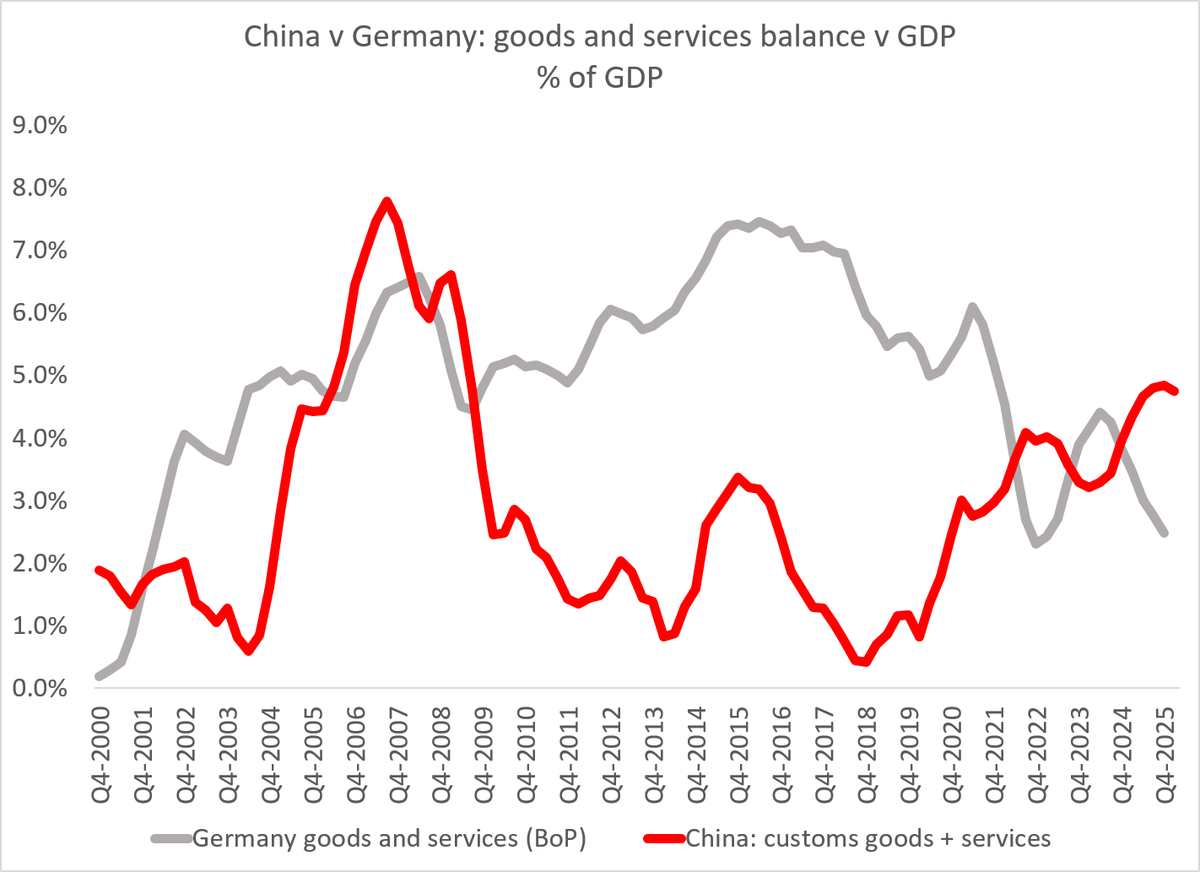
Germany's goods and services surplus has collapsed, and its surplus is now down to 2.5% of its GDP -- about half the level of China's far larger economy

1/ Image
Germany unlike China does report that its accumulated surpluses have generated an investment income surplus -- and China's reported deficit by all accounts (even that of the IMF, which grades China on a very generous curve) makes no sense

2/ Image
I have criticized Germany for overly restrictive budgeting and excess surpluses in the past -- but fiscal has changed (thanks to the defense budget) and the surplus has fallen substantially ...

3/
Read 5 tweets
May 20
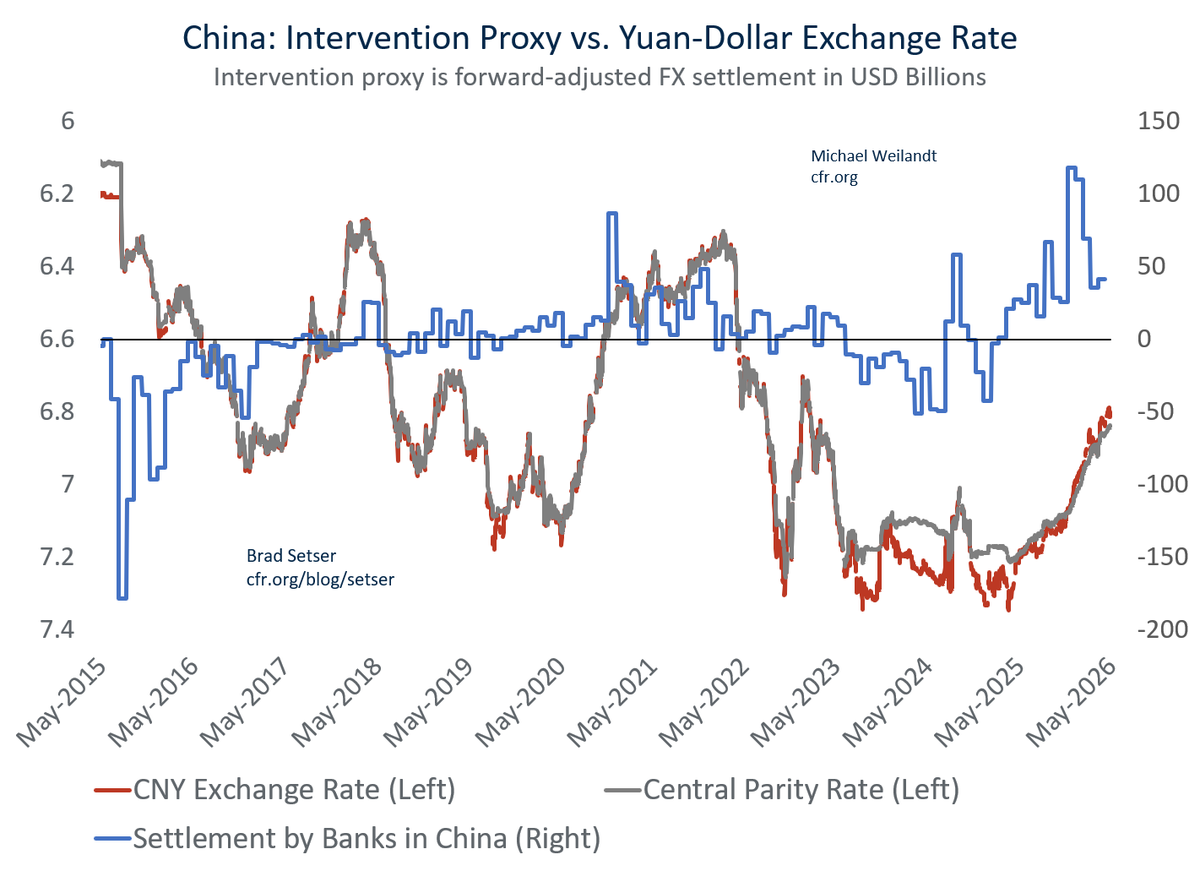
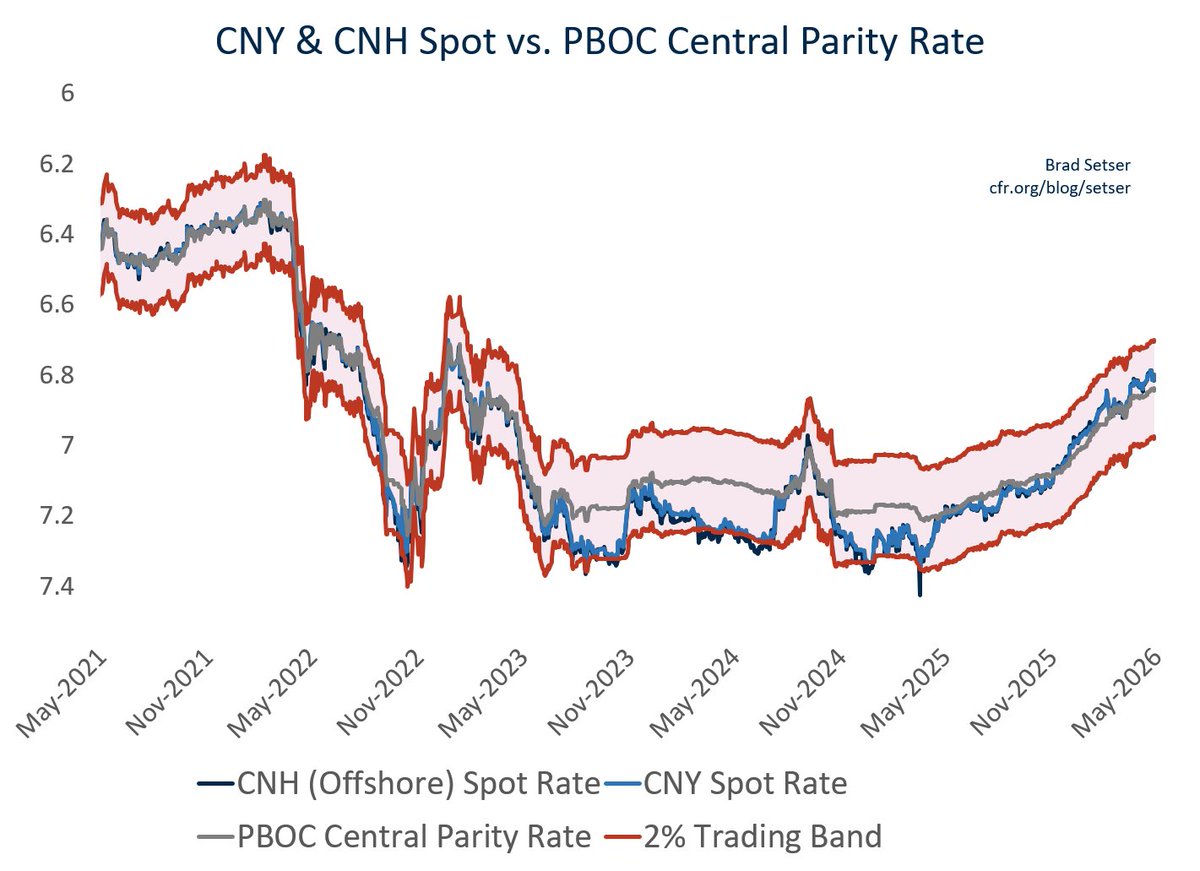
I wanted to highlight this chart, as it is the chart that best illustrates why the available data points to active Chinese state management of the exchange rate. it shows that there is a predictable pattern to fx settlement --

1/ Image
When spot is at the weak edge of the 2% band defined by the PBOC's daily fix, there are predictably sales in settlement (someone is defending the band) and when spot is at the midpoint, there are predictably purchases (esp. when the fix is appreciating)

2/ Image
That is of couse the pattern one would expect from central bank intervention (apart from buying at the mid point not the strong side of the band) -- and for 17 years settlement was basically equal to changes in the PBOC's f. assets

3/ Image
Read 11 tweets
May 20
Handelsblatt has -- on its front page -- an article summarizing my new paper with Sander Tordoir on Germany's need to find policies to actually fight back against the second China shock

handelsblatt.com/politik/deutsc…

1/ x.com/CER_EU/status/…
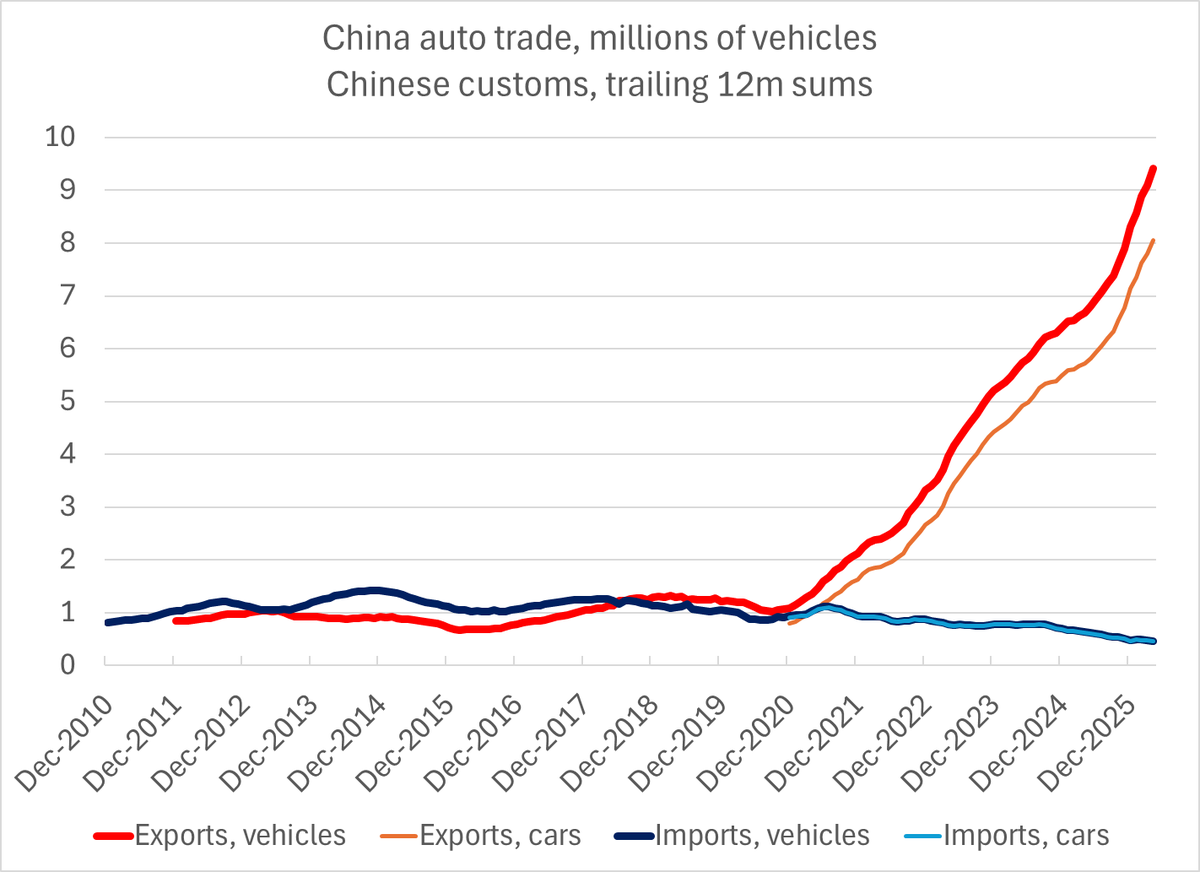
China's industrial structure -- as the ECB and others have noted -- increasingly overlaps with that of Germany ... with autos being the most obvious case.

And the China shock there won't go away on its own; Chinese auto export growth accelerated in the last 12ms

2/ Image
The China shock is also visible in the global data -- an undervalued Chinese currency propelled Chinese exports to grow much faster than global trade. China is now big, so that meant someone else's exports had to grow more slowly than global trade ...

3/ Image
Read 6 tweets
May 16
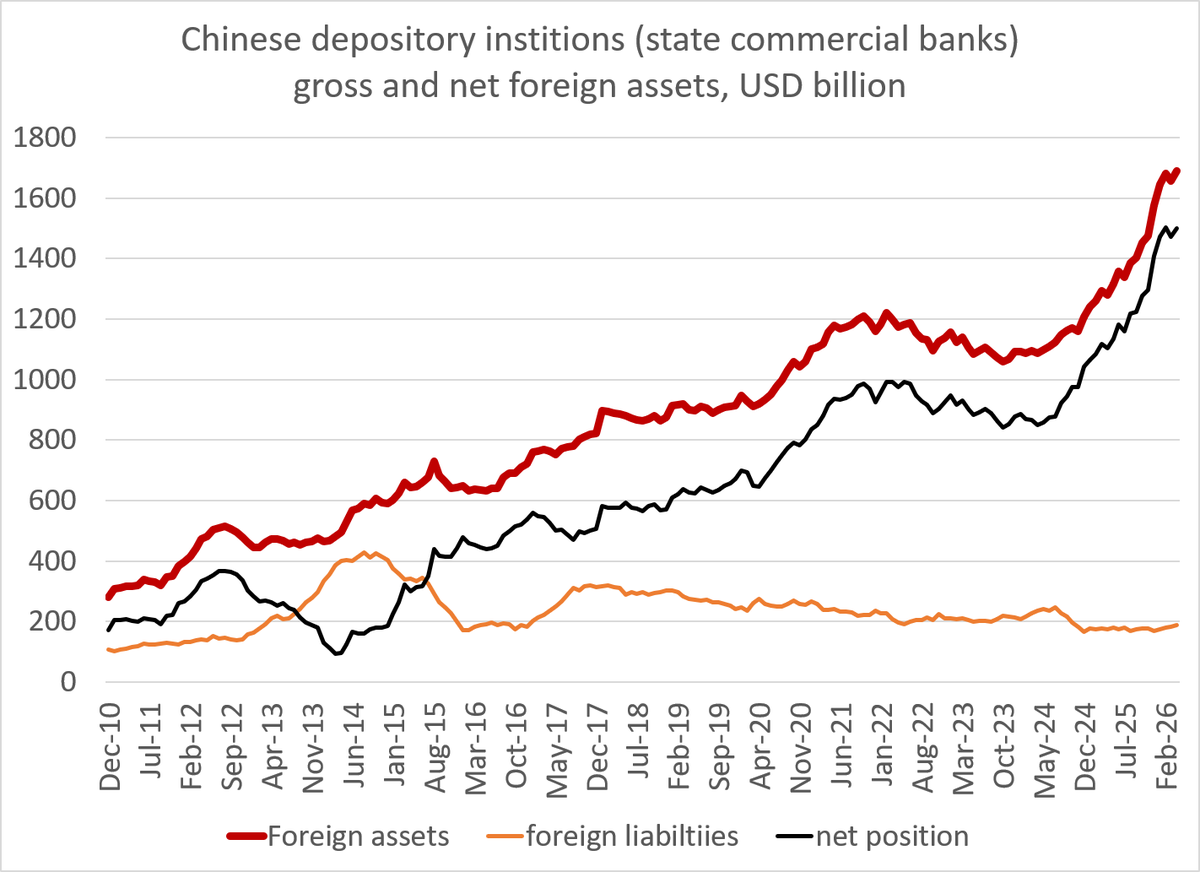
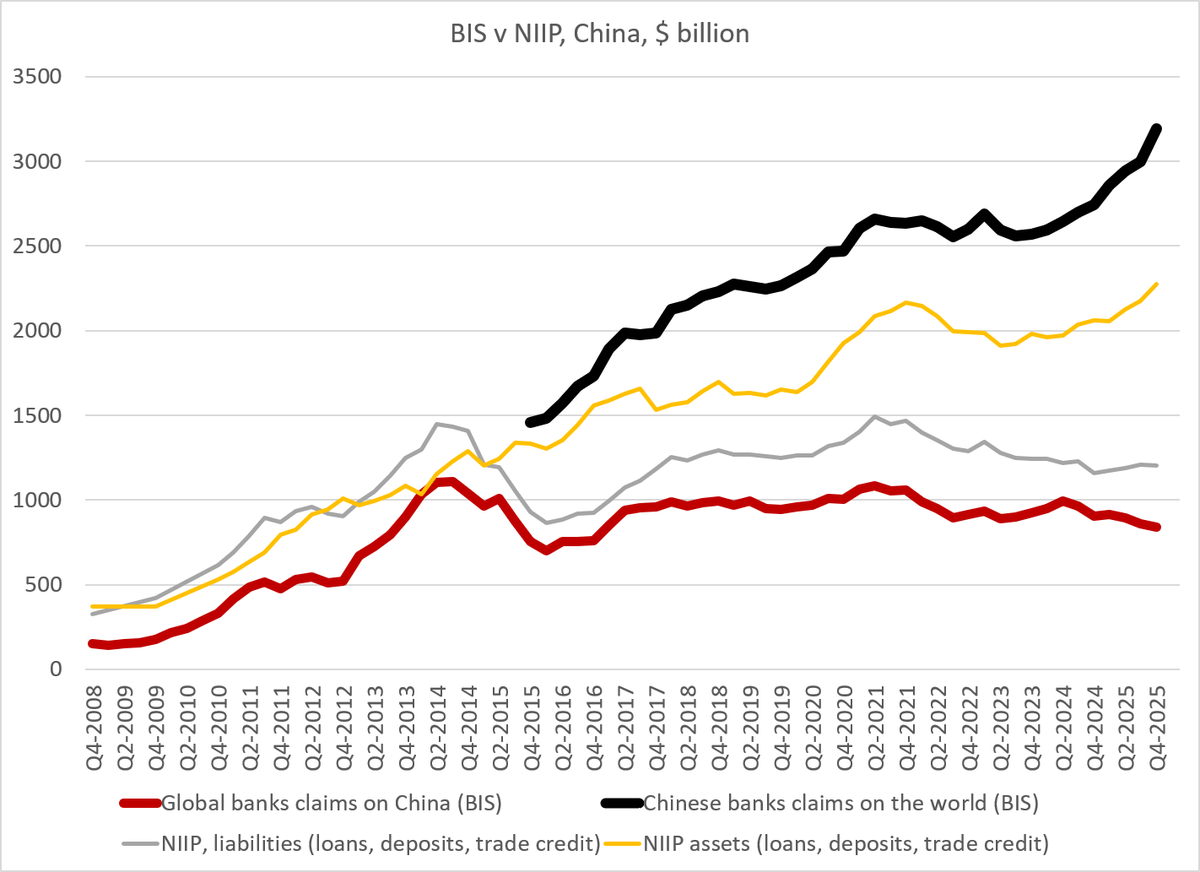
The net foreign asset position of China's state banks (in both dollars and RMB) is now $1.5 trillion -- a rather big sum (close to 1/2 China's formal reserves, a sum bigger than Japan's reserves ... )

1/ many Image
These are mostly funds that the state commercial banks have raised domestically (whether from real deposits, from "fake" deposits from SoEs helping out the PBOC, or swaps with PBOC). Total foreign assets are $1.7 trillion v $200b of external liabilities

2/ Image
This leaves out the policy banks (CDB, Exim) and the investment banks (CICC etc) -- which is why (I assume) the BIS data shows over $3 trillion in external Chinese bank assets (v under $1 trillion in liabilities) and ~ $2.5 trillion net position

3/ Image
Read 16 tweets
May 11
China's auto sector is a near-perfect metaphor for China's economy -- domestic demand is down, quite significantly. But exports are on a rocket ship up -- vehicle exports should come close to reaching 12m this year, car exports 10-11m

1/ Image
Domestic demand for both ICEs and EVs is now shrinking -- and 22m cars, it falls well short of absorbing China's massive auto capacity (widely estimated to be over 50m)

2/ Image
The annual increase in exports (change in 12m rolling sum) is now ~ 2.5m cars. & with import volumes falling, net exports are up even more ...

For scale, peak German net exports were ~ 2m cars. A year. China's growth tops peak German net exports.

3/ Image
Read 4 tweets
May 7
Hauge to me and Pettis: "Don't hide behind the language of "imbalances." If you think China is a competitive threat and that wealthy nations should actively use industrial policy to keep it at bay, say so"

I object to the idea that arguing about imbalances is hiding ...
China's imports have grown in volume terms at an annual rate of ~ 1% over the last 5 years. China's exports have grown at a faster rare that world trade. that is a real imbalance, not a fake one ...
China's savings rate is exceptionally high (comparable to Norway which saves its oil and gas proceeds as a matter of policy and Singapore which hides its investment returns from its citizens and the budget) and China's consumption to GDP ratio is incredibly low
Read 9 tweets

Did Thread Reader help you today?

Support us! We are indie developers!


This site is made by just two indie developers on a laptop doing marketing, support and development! Read more about the story.

Become a Premium Member ($3/month or $30/year) and get exclusive features!

Become Premium

Don't want to be a Premium member but still want to support us?

Make a small donation by buying us coffee ($5) or help with server cost ($10)

Donate via Paypal

Or Donate anonymously using crypto!

Ethereum

0xfe58350B80634f60Fa6Dc149a72b4DFbc17D341E copy

Bitcoin

3ATGMxNzCUFzxpMCHL5sWSt4DVtS8UqXpi copy

Thank you for your support!

Follow Us!

:(