If a historian on the right abused evidence in this way, they'd face career ruination.
When Boston University's Quinn Slobodian does it, he gets a Guggenheim fellowship, book awards, and a Hewlett Foundation grant.
Academia's rot runs far deeper than a simple crisis of rigor.
Slobodian does this sort of thing frequently in his published works - almost always to make the person he is misquoting appear to be sympathetic to racism.
Here's another where he excerpts out the very next sentence in the passage...because it completely contradicts his own claim.
Here's another where he tries to depict Mises as having written "admiringly" about the Roman fasces - better known today as a symbol of fascism.
The full passage reveals the exact opposite.
From another of Slobodian's books. He takes a quote condemning the abuse of black South Africans by the white minority's use of laws to keep itself in the Apartheid government's majority, and manipulates its text through quote-editing into a defense of white South Africans.
Another example I found in Slobodian's latest book "Hayek's Bastards," where he splices unrelated passages to try to portray Mises as having certain sympathies with Nazi race science. The real passage shows Mises disavowing Nazi race science as nonsensical.
These are not one-off errors or cases of sloppiness. It's a pattern of intentional quote editing, with examples like this from Slobodian's books and articles, crossing almost a decade of his scholarship.
Academia rewards him for it because it reinforces left wing politics.
Academia has peer review to catch this sort of thing. In 2018 Slobodian got caught by a referee for the journal Contemporary European History.
The report dinged him for "quoting out of context, partial reading of the relevant material, and ascribing views to other's that they did not hold."
I discovered several of the passages in the thread above after publication, but I then learned that the referee had dinged Slobodian on the same pattern of misquotation.
The referee urged rejection of the piece on these grounds...and was overruled by the journal's editor.
I learned of this in 2020 after I attempted to submit a correction to CEH calling attention to Slobodian's quote-editing. The editors would have none of it and dismissed my efforts.
When I published them online, the referee from 2018 saw it & shared the exact same experience.
We both submitted ethics complaints to the journal documenting how its editor had ignored their own referee, and how they refused to correct unambiguous misquotations.
The journal did a sham "internal investigation" that never contacted either of us, and sided with Slobodian.
But the kicker is what happened in the middle of the discovery of this incident.
Slobodian himself was named as the new co-editor of Contemporary European History, the very same journal where he committed several of these quote-editing exercises.
So there's academic rot for you
Side note: from the above, I also see that Harvard gave Slobodian an award named for the late Thomas McCraw.
I knew McCraw. He was the reader on my dissertation committee. We corresponded until he died in 2012. He would be appalled at Slobodian's abuses of historical evidence.
Side note 2: here's an online copy of the paper I submitted to Contemporary European History to correct Slobodian's misquotations and to challenge his thesis...after Slobodian himself urged me to do so in a now-deleted X thread. I preserved an account of what happened below.
I pick on Slobodian in the thread below as an egregious and recurring offender. But this sort of quote-editing by leftist scholars is *extremely* common in academia.
Here's another by Nancy MacLean & Sandy Darity where they transform an attack on Apartheid into a defense of it.
MacLean et all published the manipulated quote above (along with several other similar manipulations) in an article for the Australian journal "History of Economics Review" in 2023.
In 2023 trio of us wrote a response comment calling attention to MacLean et al's blatant misrepresentations & sent it to the journal as a request for correction.
We encountered the same pattern of a politically partisan editor running interference to protect MacLean.
🧵We all saw Gabriel Zucman's NYT op-ed justifying the California wealth tax proposal, along with ostentatious claims that billionaires pay lower tax rates than average Americans. Let's dig into the methodology...
Zucman & his coauthor Emmanuel Saez have been making this claim in various forms for years and presenting it as "fact," even though they have struggled to gain scholarly acceptance of their approach. Instead, they do "peer review" by sending their stuff to the NYT editorial page
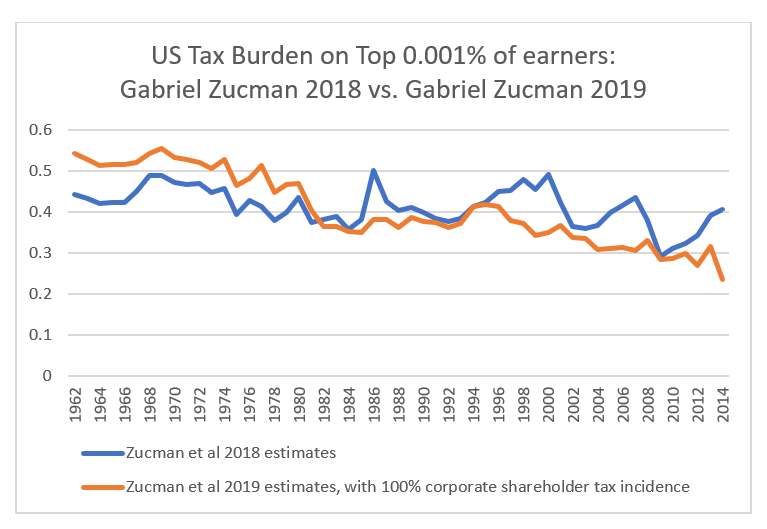
I first caught this pair in 2019 when the rolled out "new" stats claiming that the ultra-wealthy only paid an overall tax rate (federal/state/local) of a little over 20%.
In reality, the wealthiest Americans pay about 41% - a fact admitted in Zucman's own stats from 2018.
And here is a longer academic journal article I wrote about this episode, including digging into what Zucman altered to put his thumb on the statistical scale. independent.org/wp-content/upl…
🧵The Trump admin's defense of Section 122 tariffs has a huge legal obstacle that almost nobody has noticed thus far.
It comes from an obscure provision of the General Agreement on Tariffs and Trade. I'll explain below.
Let's start with Section 122 of the Trade Act of 1974. This is the provision that Trump used to reinstate a 10% across the board tariff after SCOTUS struck down his IEEPA tariffs in February.
The US Court of International Trade ruled against Trump on Thursday. He has appealed.
At issue with Section 122 is the meaning of "Balance of Payments deficits," which must exist before the president can impose tariffs through this law.
Historically, a BoP deficit meant a drawdown on the country's official monetary reserves under the Bretton Woods exchange system
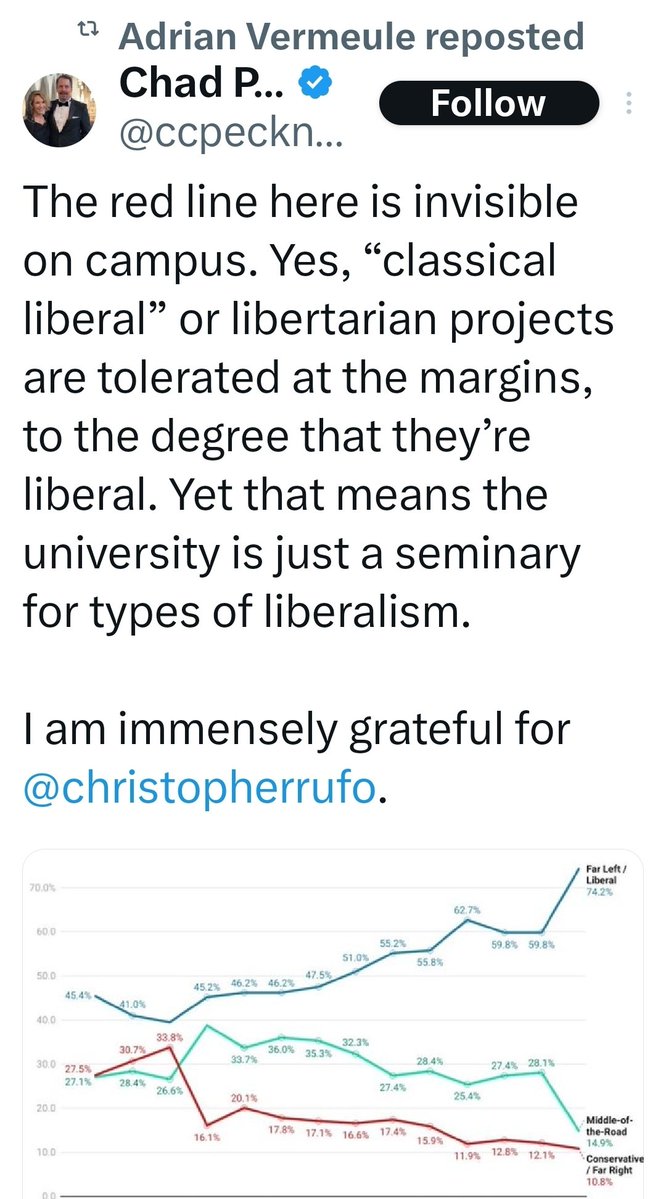
1. There are very few libertarian/classical liberal hubs in academia.
2. Those that exist are under a barrage of Nancy MacLean-style attacks from the far left.
3. Pecknold has never experienced that, nor has he done anything to move the campus needle rightward in his own career
I speak on this from experience, btw. I was in the trenches fighting the AAUP, the Unkoch mvmt, MacLean etc. for a decade.
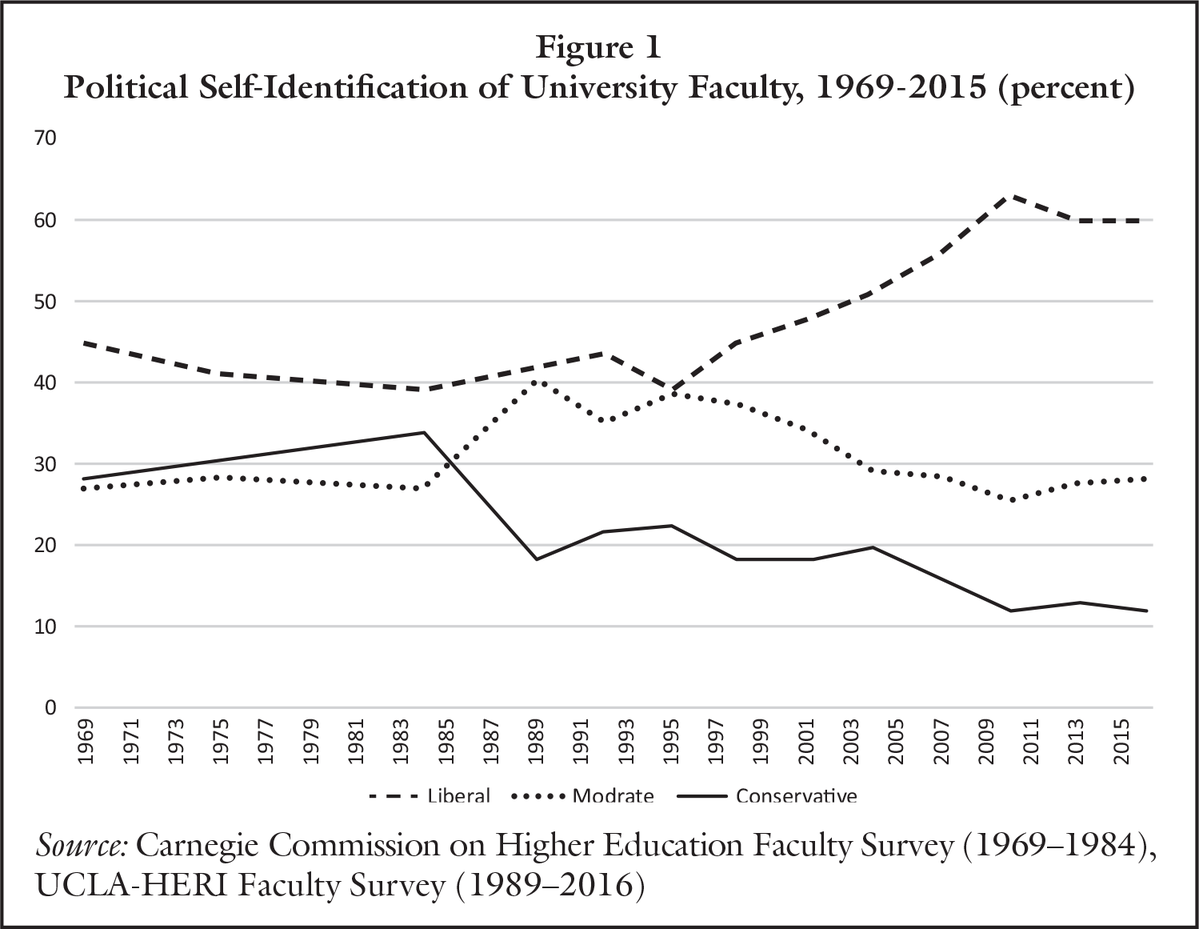
Also, I assembled the original version of the faculty ideology chart Pecknold shared above as part of my research on higher ed bias. I published it in my book w Jason Brennan, and in several subsequent journal articles and popular outlets.
Pecknold was AWOL from that fight and a complete nonentity in the scholarly debate around it.
Among my many battles with the academic left over the years:
- I was one of the first to expose statistical malfeasance in Thomas Piketty's "Capital in the 21st Century," the bible of the Occupy Wall Street movement
- I caught Piketty's co-author Gabriel Zucman red-handed in manipulating tax statistics to advance false claims about the wealthy paying lower tax rates than the poor, and likely cost him a job at Harvard as a result
- I caught Harvard's Naomi Oreskes peddling false data claims political ideology in the national media to downplay the leftwing bias on the faculty
- I demolished Duke professor Nancy MacLean's "Democracy in Chains," the National Book Award-finalist that was the centerpiece of the academic left's crusade to purge free market economics from campus in the late 2010s.
- I was one of the first people to call attention to the failure of Neil Ferguson's Imperial College model during Covid, showing that its predictions about Sweden in the absence of lockdowns were not coming true
- I discovered a basic math error in one of the most heavily cited pro-mask modeling studies during Covid, completely undermining its claims. I published that revelation in the Wall Street Journal
- I discovered and broke the story about the now-infamous FOIA'd "devastating takedown" email order from Francis Collins to Anthony Fauci during Covid
- I dismantled the economic sections of the New York Times's 1619 Project, and broke the story about how the newspaper made ghost-edits to Nikole Hannah Jones's claims on the American Revolution by altering their text on their website
- I caught star left wing Princeton historian Kevin Kruse engaging in plagiarism in his dissertation and several of his other academic works
- I helped to expose Claudine Gay at Harvard for plagiarism, both as one of the only experts who was willing to go on record in the early days of the story after Chris Rufo and Aaron Sibarium simultaneously broke the news, and then by found more examples of it myself in Gay's other academic papers
And those are just a few of the major ones, going back over a decade.
In the founding era, a 10 miles square block was seen as sufficiently large space for a capital that could encompass the whole of the federal government's operations. This was done out of a concern that the federal government's presence in any one state would exert undo influence upon that state's own government, and also become unduly influenced by the host state's political establishment. Both problems were very real and tangible issues in the 1780s-90s when the capital was located in Philadelphia, New York, and briefly in a few other locations. The decision to create a new and completely distinct federal district was a direct response to that problem.
Originally, 100 square miles was more than sufficient to contain the operations of the federal government and keep them relatively buffered from the neighboring states. Unfortunately, the federal government eventually outgrew the District. Part of that happened in 1846 when, at the behest of slaveowners, Congress reverted the Arlington side to Virginia (recall that Arlington Cemetery was formerly the site of a large plantation belonging to Robert E. Lee's wife). The measure was controversial at the time. Former president John Quincy Adams, then serving in Congress, thought that the retrocession was blatantly unconstitutional and hoped that it would be challenged at some point in the Supreme Court (a challenge was attempted in the 1870s, but the Court punted on the issue of retrocession and settled the case on technicalities that avoided weighing in on its constitutionality).
Retrocession had immediate consequences for the capital, because it took away a geographic buffer around the city that had thus far insulated it from the politics of the two surrounding states. Abraham Lincoln called attention to this problem during the Civil War because it also made the capital less-defensible from military attack. In 1861 he explicitly asked Congress to repeal the 1846 retrocession and return Arlington to the District. Congress never acted on his request though, as the battle lines of the war soon shifted away from the capital (in 1861-62 when Lincoln's request was pending, they came within a few miles west of the city, with major battles in Manassas, Virginia). Lincoln also hoped to bring Arlington back into the District because he was working on a bill to abolish slavery inside the capital's boundaries and that would have freed the slaves on the Custis-Lee plantation and other neighboring Virginia estates (he signed it in April 1862).
After the Civil War, the federal government continued to grow until it eventually ran out of space in the now-shrunken District. In 1909 President Taft recognized this problem on the horizon, and tried to unretrocede Arlington as expansion space for federal offices and federal parkland. He made it a major goal for his second term after the 1912 election, but lost the race.
The federal government grew rapidly in the following years, particularly during World War I. The War Department outgrew its office buildings and had to erect temporary structures along the present-day national mall, which were still there at the start of World War 2. They had planned to move into a new permanent structure in the Foggy Bottom neighborhood but it was too small upon completion (the State Department now occupies that building).
DC effectively ran out of room sometime in the WW2 period and outgrew its residual boundaries on the former Maryland side. The construction of the Pentagon in 1941 became the solution, as well as a major milestone that set the precedent for "core" federal departments spilling out beyond the boundaries of the district. Congress was concerned about this effect at the time as it placed essential federal functions in the jurisdiction of neighboring states. During the war, they even gave serious consideration to a bill from Sen. Pat McCarran that would have reverted Arlington to the District in conjunction with the War Department's relocation to the Pentagon. Much like Lincoln's efforts during the Civil War, the McCarran bill withered after the end of World War 2 because it was no longer seen as a pressing issue.
But the Pentagon move set the precedent, and in the decades that followed dozens of other departments started to spill over into Virginia and into neighboring Maryland.
We've now reached the point in both states that the federal government's presence exerts a controlling influence on their respective state governments - or precisely the scenario that the founders aimed to avoid in 1789-91 when they created the 10 miles square federal District of Columbia. The DC suburbs are now the tail that wags the dog in Annapolis and Richmond, such that the politics of both states are largely subservient to federal government interests and people living hundreds of miles away from DC are now governed by the political preferences of those living inside the DC beltway.
One other twist of the story:
Prior to the 1960s, most state legislatures followed the design of the US Congress in how they allocated their districts. The state House seats were divided by population according to the census, but state Senate seats were divided by geography to represent different regions of the state (yes, both were susceptible to being gerrymandered, but the idea was to have different political subdivisions in each chamber so that no faction or region gained a controlling monopoly on the state government). We know that this split design was the intention of the founders, because they implemented it and even based the Constitution's House/Senate distinction on older state-level versions of the same system.
In the 1960s though, the Warren Supreme Court issued a series of rulings that invalidated all state constitutions that allocated their senate seats by geography. The new court order required apportionment by population, so state senate seats simply became larger versions of state house seat. Virginia was one of the most heavily affected states, because the populous DC suburbs gained the most in state senate representation. In the decades that followed, that shifted the entire political locus of the state to the DC Beltway. And now it is the tail that wags the dog for the entire state.
Could the situation be addressed today? Partially. Compromises are uncommon in our garbage DC political climate due to bad behavior of both parties. If sanity ever returns though, I'd suggest this "deal" as a way to bring the federal district's purposes closer to the founders intentions while also offering a fair solution to those in the affected regions.
1. Repeal the 1846 Retrocession, which would place Arlington and the core of Alexandria back within the original boundaries of the District. This would not completely solve the problem of federal offices that have spilled over beyond the original 10 miles sq. boundaries and into VA and MD, but it would address the heaviest concentration of them, which is Arlington County.
2. Begin a gradual long term process of moving other core federal offices back into the district where possible. Utilize empty federal office space downtown when it becomes available, and shutter federal offices in the MD and VA suburbs when they become obsolete or in need of renovation.
3. To make the deal more politically palatable, the reconstituted square District should be given a voting member of the House of Representatives, commensurate with its population. This would probably require a constitutional amendment, which would be part of the deal (i.e. supporters of the retrocession agree to the amendment in exchange). But it would solve the disenfranchisement issue, and it could be implemented by simply adding 1-2 new members to the House (which can be done by legislation).