BREAKING:
Scientists just ran the first-ever clinical trial of creatine in Alzheimer’s patients.
Brain creatine went up.
Memory and thinking improved.
But the same supplement FAILED a 5-year, 1,741-patient Parkinson’s trial in 2015.
What changed?
What does this mean for brain energy?
A thread on the most fascinating story in brain energy research right now. 🧵🧪
#Alzheimers #Parkinsons #Creatine
Scientists just ran the first-ever clinical trial of creatine in Alzheimer’s patients.
Brain creatine went up.
Memory and thinking improved.
But the same supplement FAILED a 5-year, 1,741-patient Parkinson’s trial in 2015.
What changed?
What does this mean for brain energy?
A thread on the most fascinating story in brain energy research right now. 🧵🧪
#Alzheimers #Parkinsons #Creatine
First: why does creatine even make sense for the brain?
Your brain is an energy hog. Your neurons are always energy-hungry.
They run on ATP.
Creatine = your brain’s emergency battery pack.
It rapidly regenerates ATP when demand spikes.
In both Parkinson’s and Alzheimer’s, this energy system breaks down.
Mitochondria fail. Neurons starve.
#BrainHealth #Mitochondria
Your brain is an energy hog. Your neurons are always energy-hungry.
They run on ATP.
Creatine = your brain’s emergency battery pack.
It rapidly regenerates ATP when demand spikes.
In both Parkinson’s and Alzheimer’s, this energy system breaks down.
Mitochondria fail. Neurons starve.
#BrainHealth #Mitochondria
In 2015, the NIH ran one of the largest nutritional supplement trials ever done.
1,741 Parkinson’s patients.
10g creatine/day. 5 years.
Result:
stopped early for futility.
No benefit on movement, thinking, or daily life.
This wasn’t a small study.
It was rigorous.
The failure is real and matters.
So why is creatine back in the headlines?
#Parkinsons
1,741 Parkinson’s patients.
10g creatine/day. 5 years.
Result:
stopped early for futility.
No benefit on movement, thinking, or daily life.
This wasn’t a small study.
It was rigorous.
The failure is real and matters.
So why is creatine back in the headlines?
#Parkinsons

New 2025 imaging from Johns Hopkins helps explain why.
Using a technique called GuanCEST MRI, researchers mapped creatine levels across living Parkinson’s brains for the first time.
What they found:
Creatine depletion is HIGHLY localized — specific brain regions, not everywhere.
Oral creatine goes to muscles first. It may never reach the right places.
My opinion:
The dose in the earlier PD trial might not be sufficient.
#Parkinsons #Neuroimaging
Using a technique called GuanCEST MRI, researchers mapped creatine levels across living Parkinson’s brains for the first time.
What they found:
Creatine depletion is HIGHLY localized — specific brain regions, not everywhere.
Oral creatine goes to muscles first. It may never reach the right places.
My opinion:
The dose in the earlier PD trial might not be sufficient.
#Parkinsons #Neuroimaging
Not all creatine+PD research failed.
One trial combined creatine + CoQ10 in Parkinson’s patients who also had early memory problems.
Over 18 months: cognitive decline was SLOWER than placebo.
Both groups still declined.
Motor symptoms: no difference.
My opinion:
Monotherapy is probably the wrong approach.
The doses need to be optimized.
Combinations targeting mitochondria from multiple angles — that’s where the field is moving.
One trial combined creatine + CoQ10 in Parkinson’s patients who also had early memory problems.
Over 18 months: cognitive decline was SLOWER than placebo.
Both groups still declined.
Motor symptoms: no difference.
My opinion:
Monotherapy is probably the wrong approach.
The doses need to be optimized.
Combinations targeting mitochondria from multiple angles — that’s where the field is moving.

Now here’s where it gets interesting ... Alzheimer’s.
Until May 2025, creatine had NEVER been tested in a clinical trial for Alzheimer’s disease.
Not once.
Parkinson’s had nearly 20 years of trials.
Alzheimer’s had zero.
That just changed.
Until May 2025, creatine had NEVER been tested in a clinical trial for Alzheimer’s disease.
Not once.
Parkinson’s had nearly 20 years of trials.
Alzheimer’s had zero.
That just changed.

The CABA trial:
20 Alzheimer’s patients,
20g creatine/day, 8 weeks. (double the dose in PD trial)
First question: Can creatine even reach the brain at this dose?
Answer: yes. 85% of patients showed increased brain creatine.
Average increase: +11%, confirmed by MRI.
(caveat - No control group. Small sample. But this is the first human evidence. It matters.)
20 Alzheimer’s patients,
20g creatine/day, 8 weeks. (double the dose in PD trial)
First question: Can creatine even reach the brain at this dose?
Answer: yes. 85% of patients showed increased brain creatine.
Average increase: +11%, confirmed by MRI.
(caveat - No control group. Small sample. But this is the first human evidence. It matters.)

So what actually happened to their thinking and memory?
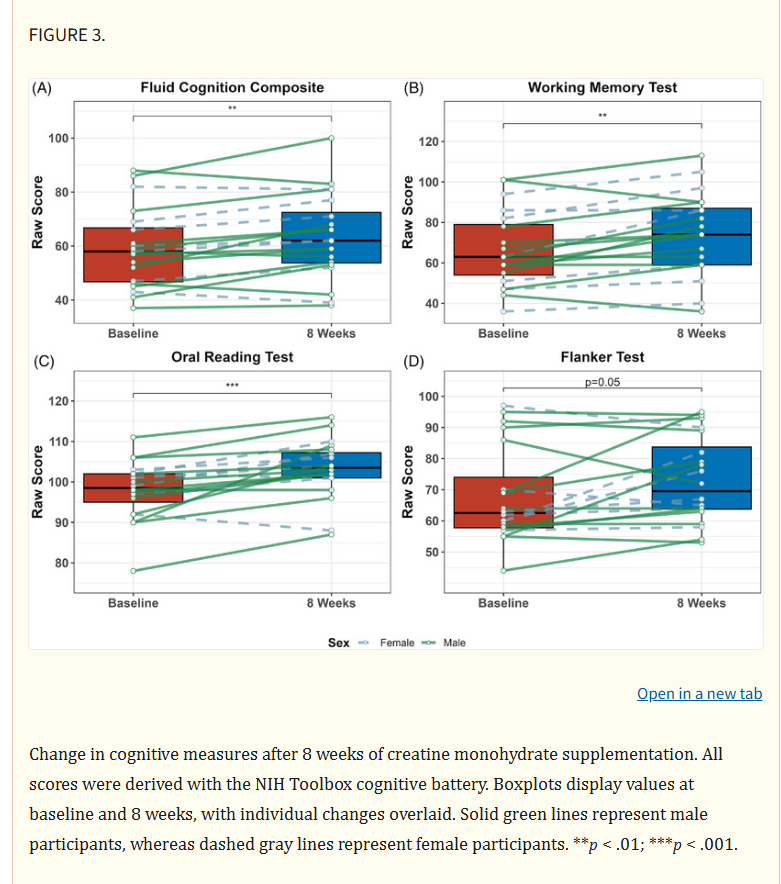
8 weeks of creatine in 20 Alzheimer's patients:
✅ Overall cognition: improved (p=.02)
✅ Fluid cognition: improved (p=.004)
✅ Working memory: improved (p=.001)
✅ Reading recognition: improved (p<.001)
✅ Attention/inhibitory control: trending (p=.05)
No change in crystallized cognition or MMSE.
As I said ... Caveat ...No control group. Can't rule out practice effects.
But in a disease defined by decline, these numbers are worth watching.
8 weeks of creatine in 20 Alzheimer's patients:
✅ Overall cognition: improved (p=.02)
✅ Fluid cognition: improved (p=.004)
✅ Working memory: improved (p=.001)
✅ Reading recognition: improved (p<.001)
✅ Attention/inhibitory control: trending (p=.05)
No change in crystallized cognition or MMSE.
As I said ... Caveat ...No control group. Can't rule out practice effects.
But in a disease defined by decline, these numbers are worth watching.


Here’s what both stories are really pointing to:
Neurodegeneration may be, in large part, a disease of broken brain energy metabolism.
Not just plaques.
Not just alpha-synuclein.
The power supply is failing.
Creatine is one of the simplest tools scientists have to test that idea in real humans.
It’s a molecular probe as much as a potential therapy.
Neurodegeneration may be, in large part, a disease of broken brain energy metabolism.
Not just plaques.
Not just alpha-synuclein.
The power supply is failing.
Creatine is one of the simplest tools scientists have to test that idea in real humans.
It’s a molecular probe as much as a potential therapy.

Important: this is not a green light to start taking creatine for brain disease.
The PD trial failed.
The AD trial had no control group and 20 people.
What we have: a compelling hypothesis, a cautionary tale, and genuinely exciting early data. What we need: larger, controlled trials.
Full article coming soon.
And there’s another piece of this puzzle — involving medications millions already take — coming soon. 🧵
The PD trial failed.
The AD trial had no control group and 20 people.
What we have: a compelling hypothesis, a cautionary tale, and genuinely exciting early data. What we need: larger, controlled trials.
Full article coming soon.
And there’s another piece of this puzzle — involving medications millions already take — coming soon. 🧵

• • •
Missing some Tweet in this thread? You can try to
force a refresh