
1/12 🧵
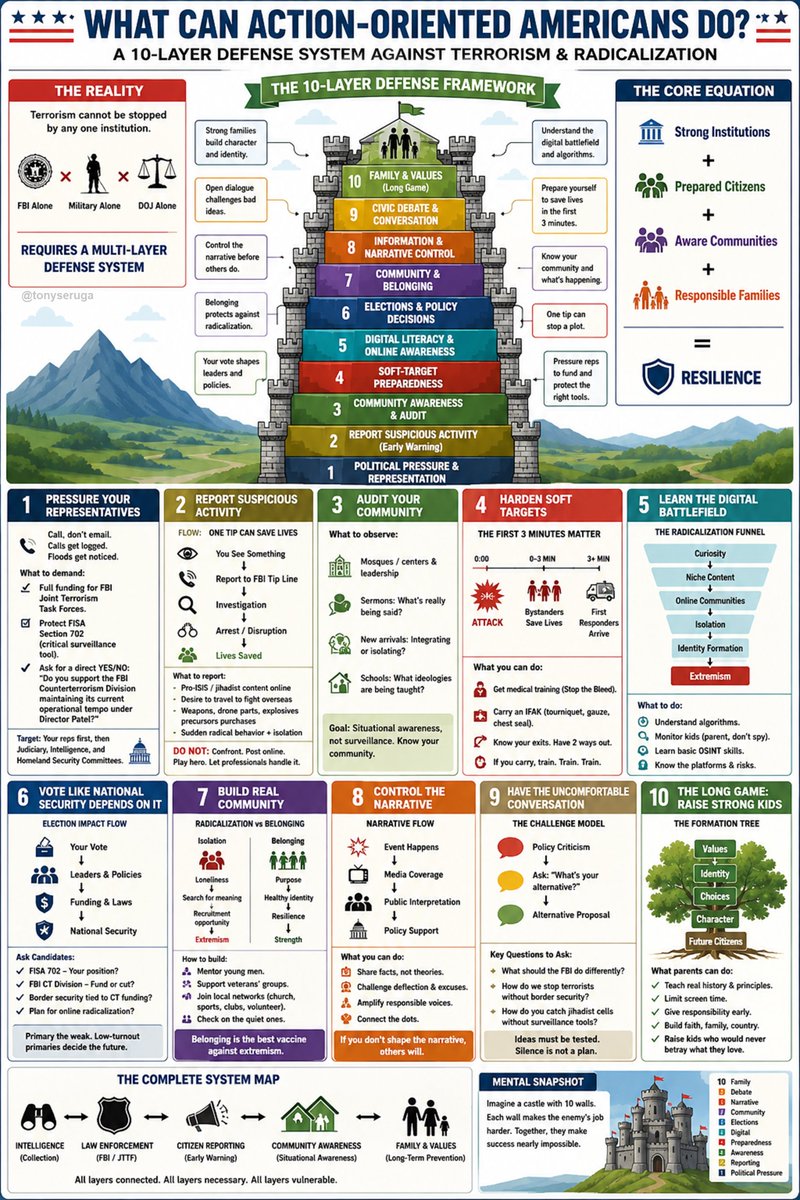
⚡ WHAT ACTION-ORIENTED AMERICANS CAN ACTUALLY DO
Not vague “stay vigilant” pablum. Concrete moves. Some take five minutes, some take a sustained commitment. All of them beat doomscrolling.
👇
⚡ WHAT ACTION-ORIENTED AMERICANS CAN ACTUALLY DO
Not vague “stay vigilant” pablum. Concrete moves. Some take five minutes, some take a sustained commitment. All of them beat doomscrolling.
👇
https://x.com/TonySeruga/status/2063632333195124963
2/12
📞 1. PRESSURE YOUR REPRESENTATIVES — SPECIFICALLY
Generic “support our troops” emails go straight to the trash. Be surgical:
Call, don’t email. Staffers log calls. Emails get auto-replied. A flood of calls on one issue gets flagged to the member within hours.
What to demand:
- Full funding for the FBI’s Joint Terrorism Task Forces. These are the teams that ran the Kansas-California op. They’re not DEI seminars. They’re not “community outreach.” They’re armed agents and analysts hunting actual terrorists. Fund them.
- No weakening of FISA Section 702. This is the authority that lets the FBI monitor foreign terrorist communications with domestic contacts. Without it, the anonymous tip in this case goes nowhere. Every reauthorization fight, the civil liberties absolutists try to gut it. Tell your reps: protect the tool that protects us.
- Ask your member directly: “Do you support the FBI’s Counterterrorism Division maintaining its current operational tempo under Director Patel? Can I get a yes or no?”
Who to target: Your own reps first — they care about their own constituents. Then the House and Senate Judiciary Committees, the Intelligence Committees, and the Homeland Security Committees. Those members control the purse strings and the oversight.
📞 1. PRESSURE YOUR REPRESENTATIVES — SPECIFICALLY
Generic “support our troops” emails go straight to the trash. Be surgical:
Call, don’t email. Staffers log calls. Emails get auto-replied. A flood of calls on one issue gets flagged to the member within hours.
What to demand:
- Full funding for the FBI’s Joint Terrorism Task Forces. These are the teams that ran the Kansas-California op. They’re not DEI seminars. They’re not “community outreach.” They’re armed agents and analysts hunting actual terrorists. Fund them.
- No weakening of FISA Section 702. This is the authority that lets the FBI monitor foreign terrorist communications with domestic contacts. Without it, the anonymous tip in this case goes nowhere. Every reauthorization fight, the civil liberties absolutists try to gut it. Tell your reps: protect the tool that protects us.
- Ask your member directly: “Do you support the FBI’s Counterterrorism Division maintaining its current operational tempo under Director Patel? Can I get a yes or no?”
Who to target: Your own reps first — they care about their own constituents. Then the House and Senate Judiciary Committees, the Intelligence Committees, and the Homeland Security Committees. Those members control the purse strings and the oversight.
3/12
🕵️ 2. KNOW YOUR LOCAL FBI FIELD OFFICE
Every FBI field office has a Joint Terrorism Task Force (JTTF) and a tip line. Save the number for yours. Not to play amateur spy — to actually report if you see something.
What to report:
- Pro-ISIS or pro-jihadist content on public social media, Discord servers, Telegram channels
- Individuals expressing a desire to travel overseas to fight
- Anyone attempting to purchase weapons components, drone parts, or explosives precursors with no legitimate explanation
- Sudden radical shifts in behavior, especially combined with isolation and obsessive online activity
What NOT to do: Don’t confront the person. Don’t play hero. Don’t post about it on social media. Call the tip line, give the facts, let the professionals work.
The Kansas case started with one anonymous tip in March 2025. One person saw something online and reported it. That tip led to three arrests, a dismantled ISIS funding pipeline, and potentially dozens of American lives saved. One call.
🕵️ 2. KNOW YOUR LOCAL FBI FIELD OFFICE
Every FBI field office has a Joint Terrorism Task Force (JTTF) and a tip line. Save the number for yours. Not to play amateur spy — to actually report if you see something.
What to report:
- Pro-ISIS or pro-jihadist content on public social media, Discord servers, Telegram channels
- Individuals expressing a desire to travel overseas to fight
- Anyone attempting to purchase weapons components, drone parts, or explosives precursors with no legitimate explanation
- Sudden radical shifts in behavior, especially combined with isolation and obsessive online activity
What NOT to do: Don’t confront the person. Don’t play hero. Don’t post about it on social media. Call the tip line, give the facts, let the professionals work.
The Kansas case started with one anonymous tip in March 2025. One person saw something online and reported it. That tip led to three arrests, a dismantled ISIS funding pipeline, and potentially dozens of American lives saved. One call.
4/12
👁️ 3. AUDIT YOUR OWN COMMUNITY
You don’t need a badge to pay attention:
- What mosques or Islamic centers are in your area? Who runs them? What’s their leadership’s public record on terrorism, sharia law, or jihadist ideology? Most are perfectly fine. Some aren’t. Know which is which.
- What’s being preached? Sermons in Arabic or Urdu that the congregation doesn’t understand are a known vector for radical messaging. If the imam says one thing in English and something else entirely in Arabic, that’s a problem.
- Are there new arrivals — refugees, asylum claimants, visa holders — from known conflict zones integrating normally, or forming insular clusters with no apparent employment, schooling, or community engagement? Isolation breeds radicalization.
- What’s happening in your local schools? Are students being exposed to “decolonial” or “resistance” curricula that frame America as an irredeemable oppressor? That’s not the same as ISIS recruitment, but it’s the ideological topsoil in which anti-American sentiment grows.
You’re not surveilling your neighbors. You’re being situationally aware of your own community instead of outsourcing that awareness to institutions that may or may not be paying attention.
👁️ 3. AUDIT YOUR OWN COMMUNITY
You don’t need a badge to pay attention:
- What mosques or Islamic centers are in your area? Who runs them? What’s their leadership’s public record on terrorism, sharia law, or jihadist ideology? Most are perfectly fine. Some aren’t. Know which is which.
- What’s being preached? Sermons in Arabic or Urdu that the congregation doesn’t understand are a known vector for radical messaging. If the imam says one thing in English and something else entirely in Arabic, that’s a problem.
- Are there new arrivals — refugees, asylum claimants, visa holders — from known conflict zones integrating normally, or forming insular clusters with no apparent employment, schooling, or community engagement? Isolation breeds radicalization.
- What’s happening in your local schools? Are students being exposed to “decolonial” or “resistance” curricula that frame America as an irredeemable oppressor? That’s not the same as ISIS recruitment, but it’s the ideological topsoil in which anti-American sentiment grows.
You’re not surveilling your neighbors. You’re being situationally aware of your own community instead of outsourcing that awareness to institutions that may or may not be paying attention.
5/12
🛡️ 4. HARDEN YOUR SOFT TARGETS
ISIS and its copycats don’t hit Fort Bragg. They hit concerts, malls, marathons, nightclubs, and churches. Soft targets. Crowded places. Symbolic dates.
Practical steps:
- Get medical training. Stop the Bleed courses are free or cheap and take a few hours. Tourniquets, wound packing, chest seals. If a bomb goes off or a truck plows through a crowd, the people who save lives in the first three minutes aren’t paramedics — they’re bystanders with training.
- Carry an IFAK (Individual First Aid Kit) in your car. Not a boo-boo kit. A real trauma kit with a CAT tourniquet, hemostatic gauze, and a chest seal. Learn how to use it.
- Know your exits. When you walk into a crowded venue, find two exits. It takes five seconds. Most people freeze in an emergency because they never did this basic mental prep.
- If you carry, train. A concealed firearm you shoot twice a year at a static paper target isn’t a self-defense tool — it’s a liability. Dynamic training, stress inoculation, shoot/no-shoot scenarios. If you’re not training, you’re LARPing.
🛡️ 4. HARDEN YOUR SOFT TARGETS
ISIS and its copycats don’t hit Fort Bragg. They hit concerts, malls, marathons, nightclubs, and churches. Soft targets. Crowded places. Symbolic dates.
Practical steps:
- Get medical training. Stop the Bleed courses are free or cheap and take a few hours. Tourniquets, wound packing, chest seals. If a bomb goes off or a truck plows through a crowd, the people who save lives in the first three minutes aren’t paramedics — they’re bystanders with training.
- Carry an IFAK (Individual First Aid Kit) in your car. Not a boo-boo kit. A real trauma kit with a CAT tourniquet, hemostatic gauze, and a chest seal. Learn how to use it.
- Know your exits. When you walk into a crowded venue, find two exits. It takes five seconds. Most people freeze in an emergency because they never did this basic mental prep.
- If you carry, train. A concealed firearm you shoot twice a year at a static paper target isn’t a self-defense tool — it’s a liability. Dynamic training, stress inoculation, shoot/no-shoot scenarios. If you’re not training, you’re LARPing.
6/12
💻 5. LEARN THE DIGITAL BATTLEFIELD
These three were radicalized on Discord, encrypted messaging apps, and social media groups. The digital ecosystem is the recruitment pipeline:
- Understand how algorithms radicalize. YouTube, TikTok, and Instagram recommendation engines push users toward increasingly extreme content because engagement spikes at the fringes. A kid watching military history videos can be algorithmically funneled to jihadist propaganda within weeks. Know the pipeline so you can recognize it.
- Monitor what your kids are on. Not spying. Parenting. Discord servers, Telegram groups, gaming chat channels. If your teenager is suddenly using encrypted apps you’ve never heard of, find out why.
- Learn basic OSINT (Open Source Intelligence). You don’t need a security clearance to find publicly posted extremist content. Reverse image search, username cross-referencing, and platform metadata are all freely available tools. There are free OSINT courses online. Take one.
💻 5. LEARN THE DIGITAL BATTLEFIELD
These three were radicalized on Discord, encrypted messaging apps, and social media groups. The digital ecosystem is the recruitment pipeline:
- Understand how algorithms radicalize. YouTube, TikTok, and Instagram recommendation engines push users toward increasingly extreme content because engagement spikes at the fringes. A kid watching military history videos can be algorithmically funneled to jihadist propaganda within weeks. Know the pipeline so you can recognize it.
- Monitor what your kids are on. Not spying. Parenting. Discord servers, Telegram groups, gaming chat channels. If your teenager is suddenly using encrypted apps you’ve never heard of, find out why.
- Learn basic OSINT (Open Source Intelligence). You don’t need a security clearance to find publicly posted extremist content. Reverse image search, username cross-referencing, and platform metadata are all freely available tools. There are free OSINT courses online. Take one.
7/12
🗳️ 6. VOTE LIKE NATIONAL SECURITY DEPENDS ON IT — BECAUSE IT DOES
Not just presidential elections. Midterms. Primaries. Local races for sheriff and prosecutor.
Questions to ask every candidate:
- “What’s your position on FISA Section 702 reauthorization?”
- “Do you support maintaining or increasing funding for the FBI’s Counterterrorism Division?”
- “Should border security funding be tied to counterterrorism appropriations?”
- “What’s your plan for addressing homegrown radicalization on social media platforms?”
If they can’t answer these coherently, they’re not serious about national security. Vote accordingly.
Primary the weak ones. The soft-on-terror caucus I laid out earlier doesn’t lose general elections in safe districts — they lose primaries. Or they would, if people showed up. Midterm primary turnout is abysmal. A few thousand motivated voters can unseat a decade-long incumbent. Be one of them.
🗳️ 6. VOTE LIKE NATIONAL SECURITY DEPENDS ON IT — BECAUSE IT DOES
Not just presidential elections. Midterms. Primaries. Local races for sheriff and prosecutor.
Questions to ask every candidate:
- “What’s your position on FISA Section 702 reauthorization?”
- “Do you support maintaining or increasing funding for the FBI’s Counterterrorism Division?”
- “Should border security funding be tied to counterterrorism appropriations?”
- “What’s your plan for addressing homegrown radicalization on social media platforms?”
If they can’t answer these coherently, they’re not serious about national security. Vote accordingly.
Primary the weak ones. The soft-on-terror caucus I laid out earlier doesn’t lose general elections in safe districts — they lose primaries. Or they would, if people showed up. Midterm primary turnout is abysmal. A few thousand motivated voters can unseat a decade-long incumbent. Be one of them.
8/12
👥 7. BUILD REAL COMMUNITY
This sounds soft. It’s not. The single best defense against radicalization is belonging.
Young men in their 20s — exactly the demographic of these three — are the most vulnerable to extremist recruitment when they’re isolated, purposeless, and disconnected. The ISIS recruiter offers them identity, mission, and brotherhood. The solution isn’t just FBI surveillance. It’s giving young men something better to belong to.
Concrete moves:
- Mentor a young man. Formal programs like Big Brothers or informal. Doesn’t matter. A 21-year-old with a mentor and a purpose doesn’t pledge allegiance to ISIS.
- Support veterans’ organizations that actually reintegrate service members — not the ones that just throw barbecues and slap bumper stickers on trucks. Groups that provide employment, mental health support, and a continued mission.
- Build local networks. Church groups, sports leagues, hunting clubs, martial arts gyms, and volunteer fire departments. The intermediary institutions that once bound communities together before everyone retreated into screens. These aren’t nostalgic throwbacks — they’re inoculation against the atomization that makes radicalization possible.
- Check on the quiet ones. The guy at work who never talks. The neighbor who’s always alone. The kid in your extended family who’s retreated into his room and his computer. Isolation is the pre-existing condition. Community is the treatment.
👥 7. BUILD REAL COMMUNITY
This sounds soft. It’s not. The single best defense against radicalization is belonging.
Young men in their 20s — exactly the demographic of these three — are the most vulnerable to extremist recruitment when they’re isolated, purposeless, and disconnected. The ISIS recruiter offers them identity, mission, and brotherhood. The solution isn’t just FBI surveillance. It’s giving young men something better to belong to.
Concrete moves:
- Mentor a young man. Formal programs like Big Brothers or informal. Doesn’t matter. A 21-year-old with a mentor and a purpose doesn’t pledge allegiance to ISIS.
- Support veterans’ organizations that actually reintegrate service members — not the ones that just throw barbecues and slap bumper stickers on trucks. Groups that provide employment, mental health support, and a continued mission.
- Build local networks. Church groups, sports leagues, hunting clubs, martial arts gyms, and volunteer fire departments. The intermediary institutions that once bound communities together before everyone retreated into screens. These aren’t nostalgic throwbacks — they’re inoculation against the atomization that makes radicalization possible.
- Check on the quiet ones. The guy at work who never talks. The neighbor who’s always alone. The kid in your extended family who’s retreated into his room and his computer. Isolation is the pre-existing condition. Community is the treatment.
9/12
📢 8. CONTROL THE NARRATIVE
The media will memory-hole this story within a week. They’ll pivot back to whatever culture-war nonsense keeps the outrage machine running. Don’t let them.
- Share the facts. Not conspiracy theories. The actual DOJ complaint. The actual quotes. “I wish I could kill 300,000,000 Americans” is not a dog whistle — it’s a bullhorn. Make people hear it.
- Challenge the “Islamophobia” deflection. Every time a jihadist plot is busted, the same voices rush to say “don’t stigmatize the community.” The community’s problem isn’t stigma — it’s that three of its young men were wiring money to ISIS. Responsible Muslim leaders should be the loudest voices condemning this. Amplify the ones who do. Ignore the ones who don’t.
- Connect the dots. Border security, counterterrorism funding, surveillance authorities, military readiness — these aren’t separate issues. They’re one integrated system. When politicians weaken any piece of it, they weaken the whole thing. Make that connection explicit in every conversation.
📢 8. CONTROL THE NARRATIVE
The media will memory-hole this story within a week. They’ll pivot back to whatever culture-war nonsense keeps the outrage machine running. Don’t let them.
- Share the facts. Not conspiracy theories. The actual DOJ complaint. The actual quotes. “I wish I could kill 300,000,000 Americans” is not a dog whistle — it’s a bullhorn. Make people hear it.
- Challenge the “Islamophobia” deflection. Every time a jihadist plot is busted, the same voices rush to say “don’t stigmatize the community.” The community’s problem isn’t stigma — it’s that three of its young men were wiring money to ISIS. Responsible Muslim leaders should be the loudest voices condemning this. Amplify the ones who do. Ignore the ones who don’t.
- Connect the dots. Border security, counterterrorism funding, surveillance authorities, military readiness — these aren’t separate issues. They’re one integrated system. When politicians weaken any piece of it, they weaken the whole thing. Make that connection explicit in every conversation.
10/12
🔥 9. THE UNCOMFORTABLE CONVERSATION
This one’s for the dinner table, not the ballot box:
If you have family or friends who reflexively oppose every national security measure as “fascist,” who call ICE “Gestapo,” who frame every terrorist attack as blowback for American foreign policy — have the argument. Not the screaming match. The argument.
Ask them:
- “What should the FBI have done differently with these three? Wait until the RPGs were actually fired?”
- “If border security is racist, how do you propose we stop foreign terrorists from entering the country?”
- “You say surveillance authorities are Orwellian. How do you catch a Discord jihadist cell without them?”
Most people who hold these positions have never been forced to articulate an alternative. They just know what they’re against. Make them say what they’re for. The silence is usually instructive.
🔥 9. THE UNCOMFORTABLE CONVERSATION
This one’s for the dinner table, not the ballot box:
If you have family or friends who reflexively oppose every national security measure as “fascist,” who call ICE “Gestapo,” who frame every terrorist attack as blowback for American foreign policy — have the argument. Not the screaming match. The argument.
Ask them:
- “What should the FBI have done differently with these three? Wait until the RPGs were actually fired?”
- “If border security is racist, how do you propose we stop foreign terrorists from entering the country?”
- “You say surveillance authorities are Orwellian. How do you catch a Discord jihadist cell without them?”
Most people who hold these positions have never been forced to articulate an alternative. They just know what they’re against. Make them say what they’re for. The silence is usually instructive.
11/12
🧬 10. THE LONG GAME: RAISE KIDS WHO WOULDN'T DO THIS
These three were someone’s sons. Shamsaldeen’s mother, according to the complaint, encouraged her children to grow up and kill Americans. That’s not a law enforcement failure. That’s a civilization-level parental failure.
- Raise your kids with loyalty to something higher than themselves. Country. Faith. Family. Something that makes “I pledge allegiance to ISIS” unthinkable because they already have an allegiance that fills that space.
- Teach them what America actually is. Not the sanitized textbook version or the “America is irredeemably evil” version — the real, complicated, extraordinary thing. The Constitution. The Bill of Rights. The men who died at Gettysburg, Normandy, and Fallujah. If they don’t know what they’d be betraying, betrayal costs nothing.
- Limit screen time. Radicalization happens through screens. Period. The less time your kid spends in algorithm-driven digital spaces, the less surface area there is for recruitment.
- Give them responsibility early. Work. Service. Competence. A 21-year-old who’s never been given real responsibility is a 21-year-old searching for meaning in all the wrong places.
🧬 10. THE LONG GAME: RAISE KIDS WHO WOULDN'T DO THIS
These three were someone’s sons. Shamsaldeen’s mother, according to the complaint, encouraged her children to grow up and kill Americans. That’s not a law enforcement failure. That’s a civilization-level parental failure.
- Raise your kids with loyalty to something higher than themselves. Country. Faith. Family. Something that makes “I pledge allegiance to ISIS” unthinkable because they already have an allegiance that fills that space.
- Teach them what America actually is. Not the sanitized textbook version or the “America is irredeemably evil” version — the real, complicated, extraordinary thing. The Constitution. The Bill of Rights. The men who died at Gettysburg, Normandy, and Fallujah. If they don’t know what they’d be betraying, betrayal costs nothing.
- Limit screen time. Radicalization happens through screens. Period. The less time your kid spends in algorithm-driven digital spaces, the less surface area there is for recruitment.
- Give them responsibility early. Work. Service. Competence. A 21-year-old who’s never been given real responsibility is a 21-year-old searching for meaning in all the wrong places.
12/12
🎯 THE BOTTOM LINE
The FBI can’t do this alone. The DOJ can’t prosecute its way out of ideological rot. The military can’t kill an idea with drones.
The defense of this country against jihadist terrorism — and against any ideology that wants to destroy it — requires a layered defense: intelligence agencies on the front end, law enforcement on the interdiction, and a population that’s aware, prepared, and unwilling to be gaslit into complacency.
The three guys in Kansas and California got caught because one person saw something and said something, and the institutions actually worked. Next time, the institutions might not. The question is whether regular Americans are ready to be the next line of defense.
Are you? 🇺🇸
🎯 THE BOTTOM LINE
The FBI can’t do this alone. The DOJ can’t prosecute its way out of ideological rot. The military can’t kill an idea with drones.
The defense of this country against jihadist terrorism — and against any ideology that wants to destroy it — requires a layered defense: intelligence agencies on the front end, law enforcement on the interdiction, and a population that’s aware, prepared, and unwilling to be gaslit into complacency.
The three guys in Kansas and California got caught because one person saw something and said something, and the institutions actually worked. Next time, the institutions might not. The question is whether regular Americans are ready to be the next line of defense.
Are you? 🇺🇸
• • •
Missing some Tweet in this thread? You can try to
force a refresh






