🧵Fulton County 2020 Election Probe Update
The usual suspects are gearing up to fight the DOJ probe into Fulton County, this time as regards the grand jury subpoena for records of employees and volunteers who worked the 2020 election.
Norm Eisen, Abbe Lowell, et al
The usual suspects are gearing up to fight the DOJ probe into Fulton County, this time as regards the grand jury subpoena for records of employees and volunteers who worked the 2020 election.
Norm Eisen, Abbe Lowell, et al
https://twitter.com/realjusthuman/status/2051849608150565136

Background
On April 20, 2026, the FBI served a subpoena to the Fulton County Board of Registration and Elections for information concerning individuals who worked the 2020 elections in Fulton. (see red box in pic.)
On April 20, 2026, the FBI served a subpoena to the Fulton County Board of Registration and Elections for information concerning individuals who worked the 2020 elections in Fulton. (see red box in pic.)

Fulton had until May 5, 2026, to comply but on April 29 asked for a 14-day extension.
DOJ agreed to the extension.
DOJ agreed to the extension.

But three days later, Fulton filed a motion to quash the subpoena.
Fulton County now had two court battles ongoing against the DOJ's probe into the 2020 election.
One for the return of the records seized in the raid and another to block the subpoena for staff records.
Fulton County now had two court battles ongoing against the DOJ's probe into the 2020 election.
One for the return of the records seized in the raid and another to block the subpoena for staff records.

Two days later, though, the DOJ emerged a victor as Fulton County lost their civil action to stop investigators from going through the 600+ boxes of records seized in the FBI's January 28 raid on their storage facility. 🥳
So the remaining battlefront is over the grand jury subpoena for staff records.

Fulton's motion to quash the subpoena breaks down to these individual arguments:
- The subpoena requests that the records be sent to an out-of-district US Attorney.
- Trump’s public-facing comments indicate the subpoena is intended to "punish, intimidate, and harass his perceived political opponents."
- The clock has run out on any charges that could conceivably be brought
- That subpoena is overbroad, as it "demands the sensitive, personal information of thousands of individuals who participated in the administration of the 2020 election in any capacity."
- The subpoena "burdens their First Amendment rights and will foreseeably chill their participation in local elections and their association with Fulton County."
- The subpoena intrudes on Georgia's sovereignty
- The DOJ has not acquired a stipulation from Fulton or a court order for the retention of the records sought.
- The subpoena requests that the records be sent to an out-of-district US Attorney.
- Trump’s public-facing comments indicate the subpoena is intended to "punish, intimidate, and harass his perceived political opponents."
- The clock has run out on any charges that could conceivably be brought
- That subpoena is overbroad, as it "demands the sensitive, personal information of thousands of individuals who participated in the administration of the 2020 election in any capacity."
- The subpoena "burdens their First Amendment rights and will foreseeably chill their participation in local elections and their association with Fulton County."
- The subpoena intrudes on Georgia's sovereignty
- The DOJ has not acquired a stipulation from Fulton or a court order for the retention of the records sought.

On May 5, Judge William M. Ray II STAYED enforcement of the grand jury subpoena and asked the DOJ for a response to Fulton's motion to quash.

All of this was initially happening under seal, but on May 14, Fulton motioned for the docket to be unsealed.

On May 15, the DOJ responded AND cross-motioned for enforcement of the grand jury subpoena.
Nice!
Nice!

Dan Bishop be like
On May 19 a hearing occurred.
Judge Ray GRANTED the motion to unseal the docket and gave parties 14 days to submit briefs and 14 more to reply to those briefs.
Judge Ray GRANTED the motion to unseal the docket and gave parties 14 days to submit briefs and 14 more to reply to those briefs.

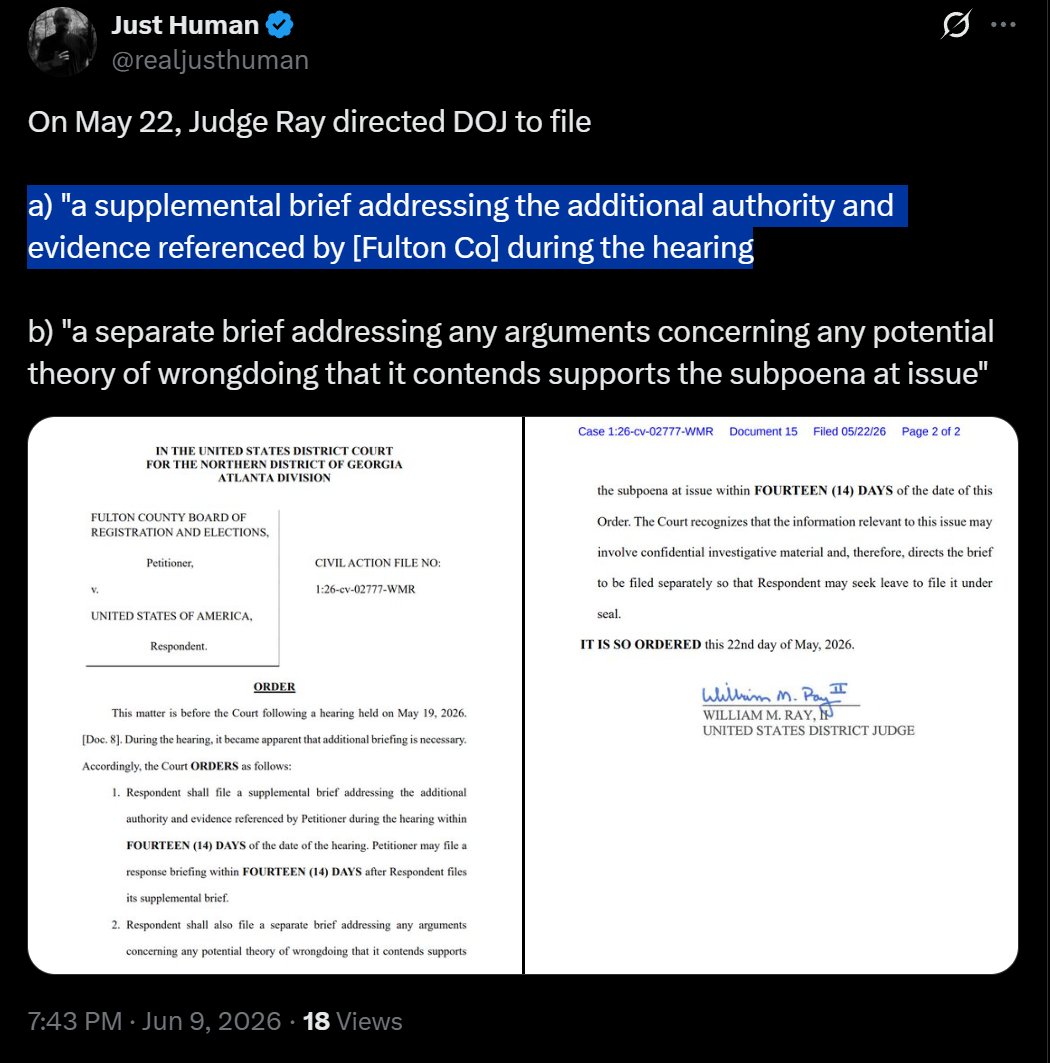
On May 22, Judge Ray directed DOJ to file
a) "a supplemental brief addressing the additional authority and evidence referenced by [Fulton Co] during the hearing
b) "a separate brief addressing any arguments concerning any potential theory of wrongdoing that it contends supports the subpoena at issue"
a) "a supplemental brief addressing the additional authority and evidence referenced by [Fulton Co] during the hearing
b) "a separate brief addressing any arguments concerning any potential theory of wrongdoing that it contends supports the subpoena at issue"


DOJ filed the first supplemental brief on May 28.
It is the b) brief referenced in the previous post.
At the hearing the court had put two key questions to the parties that they were to answer in this particular brief:
- As regards the subpoena: Does the SCOTUS's opinion in the 1964 case of Grunewald v. United States mean that the statute of limitations would bar any criminal charges here?
- As regards DOJ's cross-motion for enforcement of the subpoena: Considering the SCOTUS's opinion in the 1991 case of R. Enterprises, is the subpoena "reasonable" if criminal charges are deemed time-barred?
R. Enterprises was referenced many times in DOJ's response and cross-motion, but Grunewald only came up at the hearing, and it looks like Fulton tossed it out in oral arguments.
It is the b) brief referenced in the previous post.
At the hearing the court had put two key questions to the parties that they were to answer in this particular brief:
- As regards the subpoena: Does the SCOTUS's opinion in the 1964 case of Grunewald v. United States mean that the statute of limitations would bar any criminal charges here?
- As regards DOJ's cross-motion for enforcement of the subpoena: Considering the SCOTUS's opinion in the 1991 case of R. Enterprises, is the subpoena "reasonable" if criminal charges are deemed time-barred?
R. Enterprises was referenced many times in DOJ's response and cross-motion, but Grunewald only came up at the hearing, and it looks like Fulton tossed it out in oral arguments.

The judge informed parties that he "may deem the subpoena unreasonable if possible criminal charges would be time-barred."
Grunewald was a post-conviction appeal where "the contours of the conspiracy remained an open question even after trial"
"In contrast, this investigation is currently collecting evidence from which a charging instrument may be drawn. One would have to anticipate the allegations in an eventual indictment to decide now that Grunewald barred prosecutions. Given that the investigation is ongoing, that simply is not feasible or procedurally proper. It would circumvent the grand jury’s chief function as an investigative body."
"In contrast, this investigation is currently collecting evidence from which a charging instrument may be drawn. One would have to anticipate the allegations in an eventual indictment to decide now that Grunewald barred prosecutions. Given that the investigation is ongoing, that simply is not feasible or procedurally proper. It would circumvent the grand jury’s chief function as an investigative body."

It takes only a few pages for the DOJ to counter Fulton's argument that Grunewald precludes the bringing of charges for violations related to the 2020 election.
"The holding in Grunewald is merely that 'after the central criminal purposes of the conspiracy have been attained,' 'mere overt acts of concealment' and '[a]cts of covering up, even though done in the context of a mutually understood need for secrecy,' are not part of the conspiracy or overt acts in furtherance of a conspiracy that extend the statute of limitations for the completed conspiracy."
"The holding in Grunewald is merely that 'after the central criminal purposes of the conspiracy have been attained,' 'mere overt acts of concealment' and '[a]cts of covering up, even though done in the context of a mutually understood need for secrecy,' are not part of the conspiracy or overt acts in furtherance of a conspiracy that extend the statute of limitations for the completed conspiracy."

SCOTUS said that,
"...a vital distinction must be made between acts of concealment done in furtherance of the main criminal objectives of the conspiracy, and acts of concealment done after these central objectives have been attained, for the purpose only of covering up after the crime."
"...a vital distinction must be made between acts of concealment done in furtherance of the main criminal objectives of the conspiracy, and acts of concealment done after these central objectives have been attained, for the purpose only of covering up after the crime."

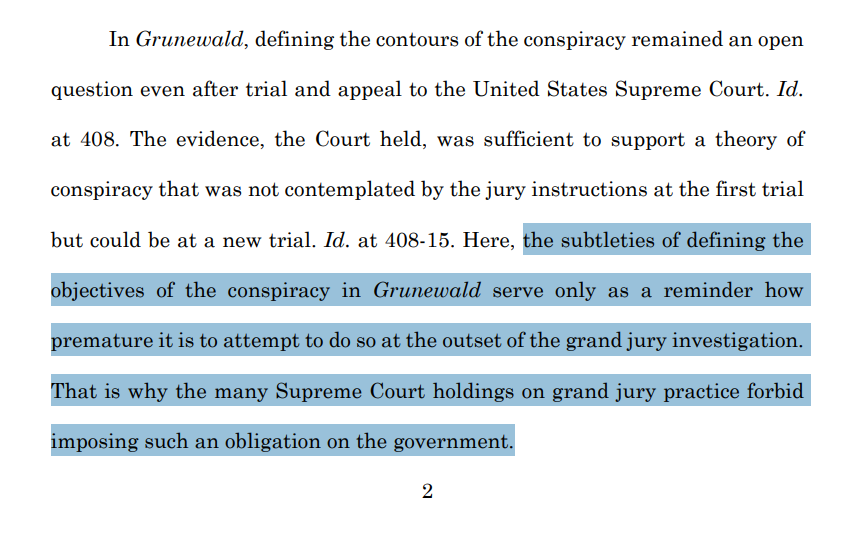
"the subtleties of defining the objectives of the conspiracy in Grunewald serve only as a reminder how premature it is to attempt to do so at the outset of the grand jury investigation."

"Any subsequent criminal acts, or acts in furtherance of the criminal conspiracy, would restart the limitations period.”
"Until a specific conspiracy or other criminal charge is identified and defined, it is impossible to determine when its 'main criminal objectives' are complete, and whether specific acts of concealment are part of those objectives or merely cover-up afterward. As stated, that 'remains to be seen.'"
As regards the subpoena and the probe into Fulton County, an investigation is ongoing. So how can it be said that the clock has started, stopped, or been run out on any conceivable charges?
"Until a specific conspiracy or other criminal charge is identified and defined, it is impossible to determine when its 'main criminal objectives' are complete, and whether specific acts of concealment are part of those objectives or merely cover-up afterward. As stated, that 'remains to be seen.'"
As regards the subpoena and the probe into Fulton County, an investigation is ongoing. So how can it be said that the clock has started, stopped, or been run out on any conceivable charges?

"the subtleties of defining the objectives of the conspiracy in Grunewald serve only as a reminder how premature it is to attempt to do so at the outset of the grand jury investigation. That is why the many Supreme Court holdings on grand jury practice forbid imposing such an obligation on the government."
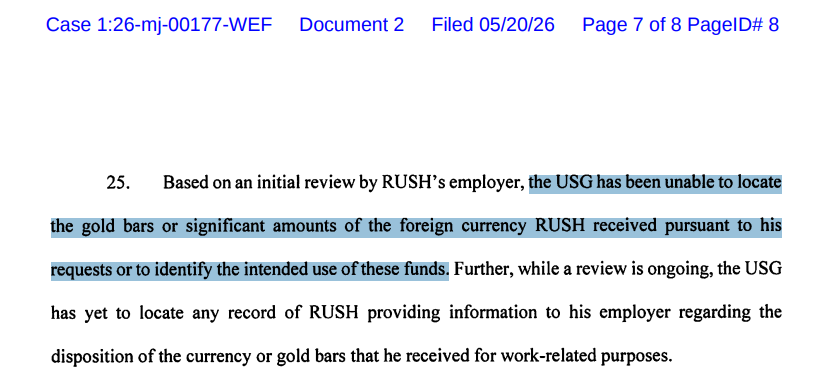
The probable cause affidavit for the search warrants that authorized the seizure of Fulton's 2020 election records noted specific activity as recently as 2022 and 2024 which could conceivably be tied to a criminal conspiracy.
So the SOL has not by any means run out on possible charges here.
So the SOL has not by any means run out on possible charges here.

"Moreover, the only conspiracy-type conduct anticipated by the government’s brief is 'conduct that may have occurred during various inquiries and investigations following the November 2020 election (as detailed in the affidavit).' The probable cause affidavit describes inquiries and investigations ongoing as late as December 2025."

"Whether a conspiracy to obstruct justice occurred in the present matter will be a subject of the grand jury investigation.
Given the many possibilities for timely criminal indictments, a subpoena for information back to the time of the election is well within norms for a grand jury."
Given the many possibilities for timely criminal indictments, a subpoena for information back to the time of the election is well within norms for a grand jury."

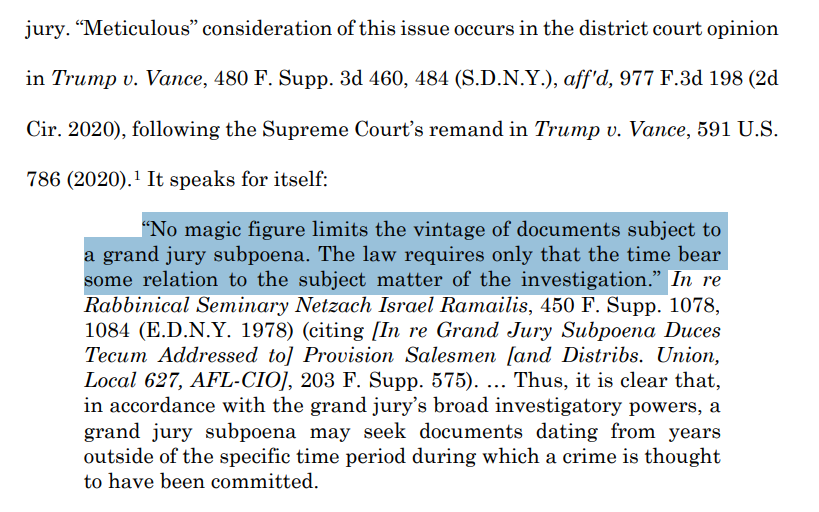
From SCOTUS's remand in Trump v. Vance
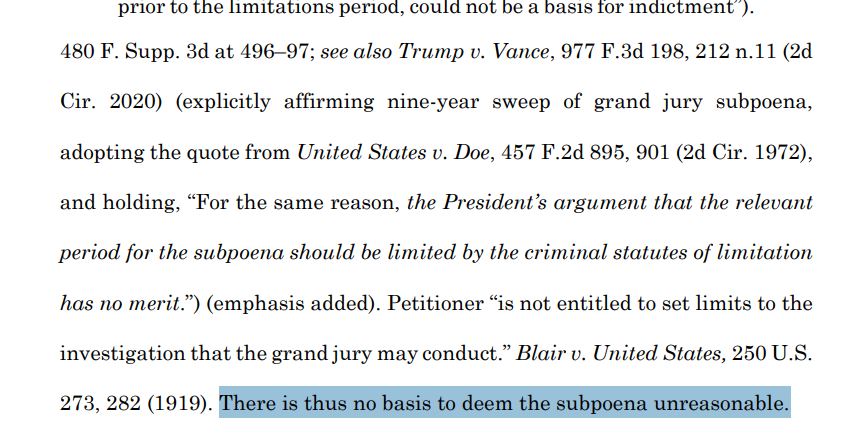
“No magic figure limits the vintage of documents subject to a grand jury subpoena. The law requires only that the time bear some relation to the subject matter of the investigation.”
“No magic figure limits the vintage of documents subject to a grand jury subpoena. The law requires only that the time bear some relation to the subject matter of the investigation.”
"Furthermore, even if “some of the requested records are so old as to be beyond the potentially applicable statute of limitations,” that “does not render the subpoena unreasonable.”"

"There is thus no basis to deem the subpoena unreasonable."
Now onto the argument for cross-motion to enforce the subpoena.
Arguments for cross motion rely heavily on the SCOTUS's opinion in R. Enterprises.
At the May 19 hearing, Judge Ray had "indicated that the majority opinion contains “preamble-type” language, and that the Court is inclined to take guidance from Justice Stevens’ concurrence and may deem the subpoena unreasonable if possible criminal charges would be time-barred.
Arguments for cross motion rely heavily on the SCOTUS's opinion in R. Enterprises.
At the May 19 hearing, Judge Ray had "indicated that the majority opinion contains “preamble-type” language, and that the Court is inclined to take guidance from Justice Stevens’ concurrence and may deem the subpoena unreasonable if possible criminal charges would be time-barred.
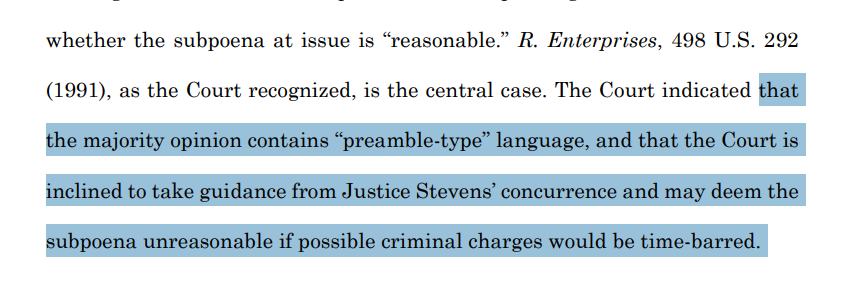
DOJ first addresses what guidance the court should draw from SCOTUS's opinion.
"It would conflict with R. Enterprises’ majority opinion to use a general skepticism about timeliness of a possible future indictment to truncate the investigation under a “balancing” approach suggested by Justice Stevens’ concurrence."
"It would conflict with R. Enterprises’ majority opinion to use a general skepticism about timeliness of a possible future indictment to truncate the investigation under a “balancing” approach suggested by Justice Stevens’ concurrence."
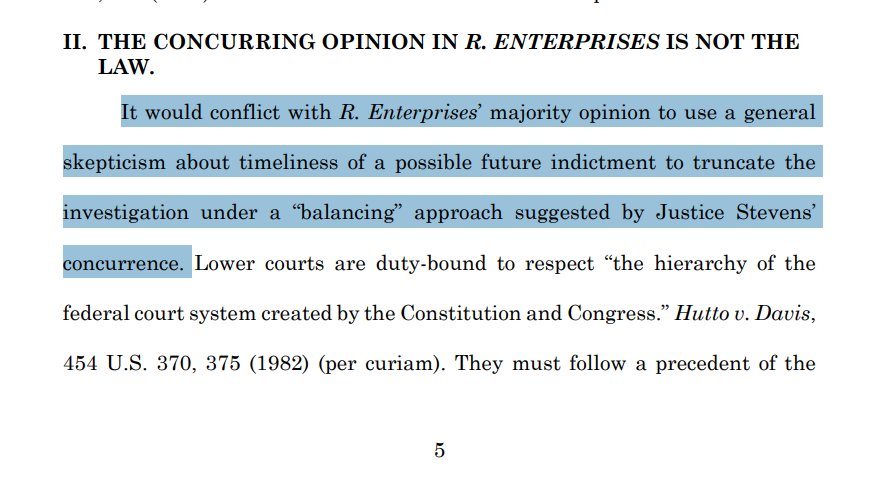
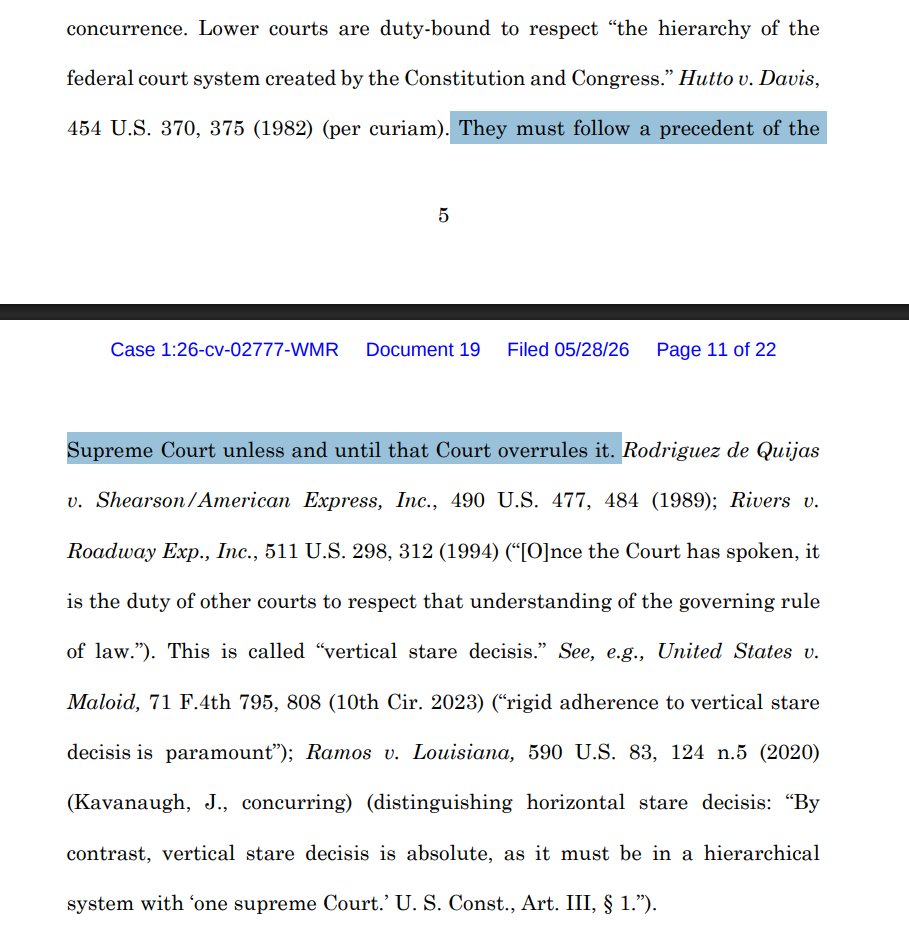
"They must follow a precedent of the Supreme Court unless and until that Court overrules it."
"The holding of an opinion of the Court joined by five justices is a precedent that binds a lower court."
"Except in rare circumstances, concurrences are not the law. That is so even for a concurrence by a justice who joins and elaborates on or nuances the majority opinion."
"The holding of an opinion of the Court joined by five justices is a precedent that binds a lower court."
"Except in rare circumstances, concurrences are not the law. That is so even for a concurrence by a justice who joins and elaborates on or nuances the majority opinion."

"In R. Enterprises, Justice Stevens and two other Justices concurred only in the judgment and the parts of the majority opinion (Parts I and II)"
They dissented in effect from parts IIIA, IIIB, and IV.
They dissented in effect from parts IIIA, IIIB, and IV.

"Because at least six justices joined all parts of the majority opinion, it binds this Court. The approach of the concurrence—'balanc[ing] the burden of compliance, on the one hand, against the governmental interest in obtaining the documents on the other,' in order to 'constrain[ ] the overzealous prosecutor'—is not the law. This Court’s assessment of reasonableness must conform to the majority’s constraints in R. Enterprises and take no guidance from the concurring opinion.

"[Fulton County] asserted in the final minute of the hearing that R. Enterprises 'is not controlling' because the challenge to the grand jury subpoena is on grounds other than relevance. But to adopt [Fulton’s] position would necessitate rejecting the Supreme Court’s reasoning not only in R. Enterprises but a slew of other cases also."

"The R. Enterprises majority’s reasoning thoroughly explained the nature of the grand jury in statements this Court termed “preamble” language."
"the Grand Jury, which does not depend on a case or controversy for power to get evidence but can investigate merely on suspicion that the law is being violated, or even just because it wants assurance that it is not.”
"the Grand Jury, which does not depend on a case or controversy for power to get evidence but can investigate merely on suspicion that the law is being violated, or even just because it wants assurance that it is not.”

"The R. Enterprises majority quoted Branzburg v. Hayes, 408 U.S. 665 (1972), which declined to hold that the First Amendment exempts reporters from grand jury subpoenas:"
"A grand jury investigation is not fully carried out until every available clue has been run down and all witnesses examined in every proper way to find if a crime has been committed."
"A grand jury investigation is not fully carried out until every available clue has been run down and all witnesses examined in every proper way to find if a crime has been committed."

"Other Supreme Court holdings cited by the R. Enterprises majority illuminate other aspects of the grand jury’s independence and function."

SCOTUS's "reasoning" in R. Enterprises, Branzburg, Calandra, and Costello "is sharply at odds with the notion that this Court could refuse to enforce a grand jury subpoena against a party that lost a Rule 41(g) motion on grounds that a resulting indictment would be time-barred."

"United States v. Williams, 504 U.S. 36 (1992), once again 'sharply cabined' the supervisory authority of district courts over grand juries."
"It held that a district court may not dismiss an indictment because of the government’s failure to disclose exculpatory evidence to the indicting grand jury."
"It held that a district court may not dismiss an indictment because of the government’s failure to disclose exculpatory evidence to the indicting grand jury."

"Having thus emphasized anew the grand jury’s robust independence, Williams addressed limits on the power of the district court to deny aid to its subpoenas:
- "When the compulsion the grand jury seeks would override rights accorded by the Constitution"
- When it contradicts "testimonial privileges recognized by the common law"
"Even in this setting, however, we have insisted that the grand jury remain “free to pursue its investigations unhindered by external influence or supervision so long as it does not trench upon the legitimate rights of any witness called before it.”"
- "When the compulsion the grand jury seeks would override rights accorded by the Constitution"
- When it contradicts "testimonial privileges recognized by the common law"
"Even in this setting, however, we have insisted that the grand jury remain “free to pursue its investigations unhindered by external influence or supervision so long as it does not trench upon the legitimate rights of any witness called before it.”"

"Thus, under Williams, district courts lack general supervisory authority over grand jury proceedings as a mechanism for policing prosecutorial decisions and actions."

"Williams reflects yet another binding precedent and additional, binding reasoning incompatible with denying enforcement to a grand jury subpoena on grounds that the government has not made a prior showing that conceivably indictable offenses are not time-barred.
Correspondingly, [Fulton County] has not identified a single authority suggesting that as a sufficient basis to quash."
Correspondingly, [Fulton County] has not identified a single authority suggesting that as a sufficient basis to quash."

So that's the "b) brief" as I called it earlier in this thread, dealt with and dealt with very well, I reckon.
But what about the "a) brief"—the one addressing the additional authority and evidence referenced by [Fulton Co.] during the hearing?
But what about the "a) brief"—the one addressing the additional authority and evidence referenced by [Fulton Co.] during the hearing?
On June 5, the DOJ asked to file that brief for in camera review.
Meaning for the judge only.
If the judge declines, they ask that it be filed under seal.
Meaning for the judge only.
If the judge declines, they ask that it be filed under seal.


I'm tracking the Fulton County 2020 Election Probe in threads and video formats. You can find the playlists on my Rumble and YouTube channels.
I'll have a new video up going over the material in this thread and offering commentary soon.
I'll have a new video up going over the material in this thread and offering commentary soon.
• • •
Missing some Tweet in this thread? You can try to
force a refresh