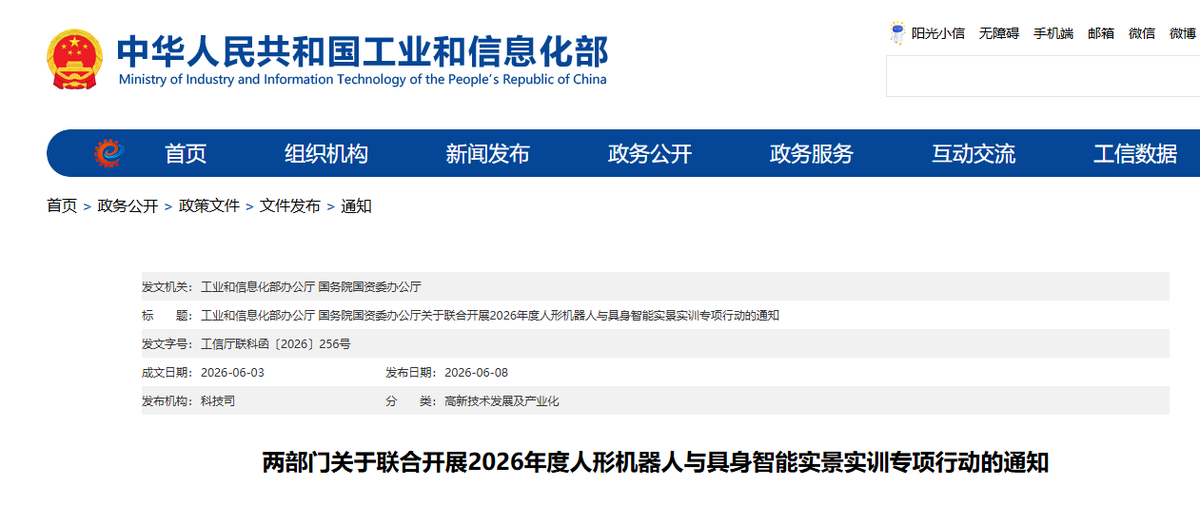
Notice from SASAC and MIIT on jointly launching the 2026 Special Action Plan for Real-Scene Training of Humanoid Robots and Embodied Intelligence
Goal: Create over 100 use cases and deploy 10,000 robots by year-end.
? miit.gov.cn/zwgk/zcwj/wjfb…
The Ministry of Industry and Information Technology and the State-owned Assets Supervision and Administration Commission of the State Council will establish a regular tracking and evaluation mechanism to dynamically monitor work progress and phased achievements, organize industry experts to conduct on-site guidance, and coordinate to overcome difficulties and obstacles in the process.
Support innovative application consortia in participating in the work of the Standardization Technical Committee for Humanoid Robots and Embodied Intelligence under the Ministry of Industry and Information Technology, and strengthen the implementation and application of key standards. for more on this committee see: pstaidecrypted.substack.com/p/chinas-human…
The Ministry of Industry and Information Technology and the State-owned Assets Supervision and Administration Commission of the State Council will coordinate overall efforts to promote the implementation of tasks. They will leverage channels such as the "Deep Dive" initiative to empower supply and demand matching in new industrialization and the "AI+" embodied intelligence industry community to publicize and promote advanced experiences gained during the special campaign, strengthening its leading and driving effect.
Work Plan for Humanoid Robot and Embossed Intelligence Real-Scene Training (Template)
• • •
Missing some Tweet in this thread? You can try to
force a refresh

Critical new policy framework around AI agents released by CAC, NDRC, MIIT. A short thread. 🧵
1/ China’s CAC, NDRC, and MIIT have jointly released a major new policy framework on “智能体” (“intelligent agents” / agentic AI systems), signaling Beijing is moving beyond generic LLM governance toward deployment rules for autonomous AI systems integrated into both digital and physical environments.
2/ The core policy message: China wants agentic AI deployed at scale — but under a governance architecture emphasizing:
• Security and controllability
• Orderly regulation
• Innovation-driven development
• Application-led deployment
This mirrors the broader Chinese AI governance approach: rapid commercialization combined with centralized oversight.
The Ministry of Industry and Information Technology issued a notice to promote the construction of the "1+M+N" national computing power interconnection node system. A short thread. 🧵 miit.gov.cn/xwfb/gxdt/sjdt…
1/15 MIIT just operationalized China’s “national unified computing power network” vision: a Feb 2026 notice launches “1+M+N” national compute interconnection nodes—moving from slogans about “算力网” to real registries, rules & plumbing.
2/15 Big picture: Beijing wants compute to behave like a networked utility—discoverable, schedulable, billable—so workloads can move across regions (east-west) and across clouds/architectures, not stay trapped inside single data centers.
#TheDeepSeekEffect The release of V3.2 and V3.2 Speciale mark a significant moment in the development of frontier models in China by DeepSeek and others. What is the meaning of the release and the timing? A short thread. huggingface.co/deepseek-ai/De…
Let’s be blunt:
DeepSeek’s V3.2 and V3.2-Speciale aren’t just new models.
They are a strategic escalation in the global race for frontier AI dominance.
China didn’t just catch up.
It changed the rules.
#AIWars #ChinaAI
👉 V3.2 = frontier-level performance at bargain-bin pricing
👉 V3.2-Speciale = the first open reasoning model hitting Olympiad-tier math/coding
This combo directly threatens the API-only closed-source advantage of OpenAI + Google.
#OpenAI #GoogleAI #Gemini
Yes, export controls, why is this? Short thread. 🧵
Export controls—a major concern for industries worldwide—are moving to the top of the agenda of Monday trade talks between the U.S. and China via @WSJwsj.com/economy/trade/…
Yes, we are in a completely new ball game, where US export controls are running directly up against Chinese export controls and supply chain weaponization. There is no going back. Beijing will continue to hold the cards here for the foreseeable future, with only marginal adjustments possible around alternative sources of REE materials and magnets.
Who could have seen this coming? Anyone who understood global supply chains and the importance of rare earth products in US automotive, green tech, and defense industrial sectors, and in those of our allies in Asia, particularly Japan and South Korea, and Europe, that is who.
Excellent piece but completely misses the critical technology piece, advanced semiconductors and AI. a short thread. 🧵
The Risk of War in the Taiwan Strait Is High—and Getting Higher via @ForeignAffairsforeignaffairs.com/united-states/…
Much analysis of Taiwan and the potential for crisis between the US and China to lead to conflict ignores or downplays the role of technology in the calculus of Beijing, Washington, and Taipei. For a corrective to this, see: thewirechina.com/2024/07/14/the…
The piece fails to mention increasingly frequent calls by Lai that assert that Taiwan is part of the "blue" or "non-red" (democratic) global supply chain, and not part of the "red" (China/authoritarian) supply chain, comments which do not go down well in Beijing. taiwannews.com.tw/news/6108759
Huawei and Alibaba are outpacing established U.S. providers by aligning with government priorities and addressing data sovereignty concerns.
Think AI data centers, serving Chinese AI agents up all along Belt and Road....A shot thread. 🧵 restofworld.org/2025/china-clo…
Amazon, Microsoft, Google, and Oracle spent years building regional tech ecosystems with data centers across the Gulf. In recent years, however, Huawei and Alibaba have outmaneuvered them by aligning more closely with local government priorities.
@pstAsiatech: The AI Diffusion Framework will force some countries into the rapidly developing Chinese AI stack ecosystem.
Despite this established footprint, Chinese cloud providers such as Huawei formed strong partnerships with regional telecommunications companies including STC, E& Enterprise, du, Zain, OmanTel, and Ooredoo, driving developments in cloud, artificial intelligence, 5G, and smart city technologies.
@pstAsiatech: here Huawei has huge advantages because it does 5G and soon 6G mobile infrastructure end to end, something no US firm can offer.



