Lot's of requests to discuss the Wedbush report on $ABVX today. It's a doozy. Obviously I'm a biased bull so sure, take my thoughts with a grain of salt, but this is truly, awful work from my perspective. Let's dig in on a few of the key issues.
"We are skeptical that efficacy signals will hold at a one-year readout."
Ok, well, the bear thesis for $ABVX *used* to be that the induction was weak, whereas the maintenance data were super strong. *By far* the strong point of the P2 dataset was the maintenance data.
As I have previously discussed, $ABVX's P2 maintenance dataset showed a higher remission rate than literally any phase 3 trial has ever shown...And it actually wasn't even *close*.
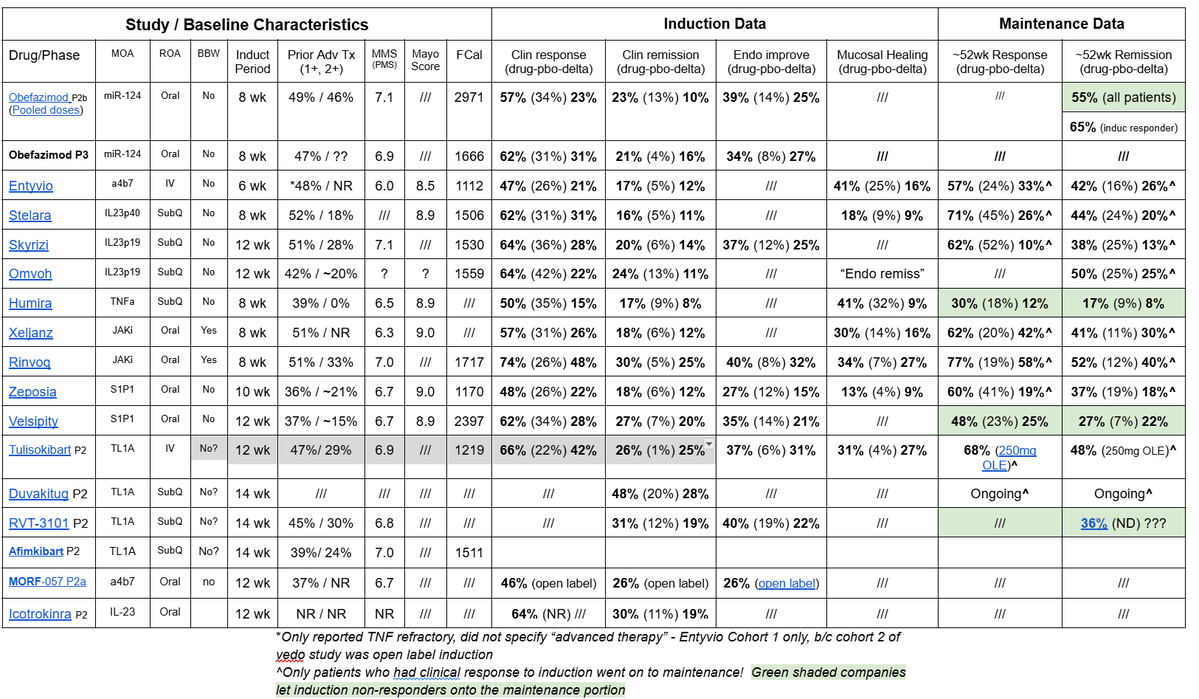
When only looking at induction responders (which is how P3s are run), Obe produced a 65% remission rate...the 2nd highest of any drug was Rinvoq (top of the market efficacy) with 52%. 13% difference.
The caveat here is that ABVX's trial was open label, whereas the Rinvoq study was blinded. That makes a difference, but 13% is a hell of a lot of breathing room...In fact, that's higher than the placebo remission rate in Rinvoq's study!
And Rinvoq is above the rest of the pack. If you compare Obe's 65% to Entyvio (42%), Skyrizi (38%), or even the supposedly "exciting" TL1A inhibitors like Tuli (48%) and RVT-3101 (36%)....ABVX's 65% with Obe is blowing everything on the market out of the water. Yes, even stuff with safety warnings, yes even "novel" stuff like TL1A.
And that was in the P2 where the induction responses weren't even that strong...
So, Wedbush's first bear point is that they aren't sure that maintenance efficacy will hold up...OK...why? No reason? Just pure conjecture that goes directly in the face of the proof of concept data that we have.
"Market cap implies sales greatly exceeding Entyvio."
WWWHHHHAAAATTTT?!?!?!?!?!? (please emphasize that in your mind when you read it as hard as you possibly can).
Entyvio is already doing $6B in sales, and $TAK projects $7.5B-$9B peak sales. Let's take the midpoint of $8.25B
Even if $ABVX was *only* trading at 2x of Entyvio's projected peak sales, and you made that $8.25B...That's $16.5B...~50% upside from $ABVX's current levels
WTF is Wedbush even talking about? Legitimately - I do not understand.
If $ABVX were a standalone company with a projected peak sales of $8.25B, it would more likely traded at a 2.5-3x peak sales, with M&A potential taking it to 4-5x on a buyout...That's almost small cap pharma territory. We would be talking about a ~$25B valuation at ~3x peak sales...
But it's not even $8.25B...it's supposedly more! Wedbush says the market is already pricing in $ABVX sales "greatly exceeding" entyvio's? So if it is say $10B in peak sales that the market is projecting for $ABVX, that means it is trading at a ~1x peak sales multiple? Legitimately, I'm completely lost on this point by Wedbush, it is so truly bizarre.
Believe me...If $ABVX were even pricing in a multiple on $8B in peak revenues (let alone "greatly exceeding"), the stock price would currently be double or more. Full stop.
I’ve gotten a lot of messages asking about my BioPick selection for this year, $TENX. I’ve responded to a few but don’t have the time to respond to everyone.
I actually considered making $TENX an official “pitch”, but I don’t think I can get there on the risk/reward skew to say that this is “one of the best setups I’ve ever seen” like I try to do for “official” pitches.
Still, it’s been an obscure name, and IMO very clearly has a heavily underappreciated 2026 catalyst that many people don't know about, so I think it's worth talking about. I am long currently and there’s a decent chance that I’ll be exposed to the binary - at least I think that I’ll be exposed to the readout if the stock stays at these prices going into the data.
So, I won’t pitch it with a comprehensive thread like $NKTR & $ABVX, and I won’t share my full large diligence document like I did for those. But, I hope the brief (by my standards) discussion here could lead to some solid sharing of thoughts with the “biotwitter” community. Frankly, I'm not even sure the best way to "play" this one, so some feedback and collective diligence here could be useful.
Everyone’s favorite part of the thread → Disclaimers!
First one is important - Don’t be fooled by your brokerage account telling you this has some tiny microcap valuation. There are lots of warrants outstanding from the company’s history, making the fully diluted share count more like ~65M (by my calculations).
Second, much like $ABVX, the downside on a total fail by $TENX is huge. Like 90%. I’d also say that, for $ABVX, I eventually arrived at such high confidence that they were going to hit that I’d almost have called that a "guarantee" (although nothing in biotech ever actually is). For TENX, the *massive* +500-1000% upside scenarios are certainly on the table like they were for $ABVX, but the odds of that happening versus the ~90% downside crash are certainly nowhere near as positively skewed for $TENX. THE BINARY HERE IS GOING TO BE RISKY.
The Disease:
$TENX aims to treat PH-HFpEF (i.e. patients who have pulmonary hypertension as a result of heart failure with preserved ejection fraction). This is a very sick, and very large patient population for which there are zero FDA approved treatments.
Basically, the issue is that the patient’s heart has become stiff and is unable to fill up with blood appropriately. This is HFpEF (heart failure with preserved ejection fraction).
But, over time, the HFpEF worsens to the extent that excess blood backs up behind the stiff heart and starts filling up the vessels in the lungs. Over time these vessels also become stiff and thickened thanks to this backpressure from the heart. *That* is the PH (pulmonary hypertension) of PH-HFpEF.
The US TAM for this condition is absolutely huge…~1.4M patients. No approved drugs.
Other companies like $TECX and recently $MRK have been going after a smaller segment of the PH-HFpEF population. I won’t go into the (deep) nitty gritty on the differences, but roughly, the 1.4M patient US PH-HFpEF TAM is comprised of
~0.4M CpCPH patients
~1.0M IpcPH patients
Recently, better known trials like those from $TECX and $MRK have focussed on the smaller 0.4M CpcPH sliver of the market.
$TENX, on the other hand, is studying their drug in the entire PH-HFpEF population. Well over 1.4 million patients in the US alone, with extremely high unmet need.
THIS IS 🚨NOT🚨 A PITCH, but the $PALI story is a fascinating one, and I am currently long (and bought more this morning).
This is a wild story of a nanocap biotech that was valued at ~$8M only a few days ago, but has now burst onto the scene with a potentially unique approach to an increasingly validated target in IBD and >40x'd its "value" (a number which I think will likely continue to balloon today ).🎈
People will compare it to $ABVX given that both have QD oral treatments for IBD, but let's break down the specifics of the nascent $PALI story...
First...❓How did a seemingly left-for-dead ~$8M company raise $138M seemingly out of nowhere❓
Well, some keen observers noticed that on 10/6/15 (today) there was going to be a presentation of new data from a Chinese company testing their drug (Mufemilast) in UC. That presentation was a "prestigious" late-breaking presentation, placed immediately after highly anticipated data from...none other than $ABVX!
The tea leaves suggested that this meant the Mufemilast trial data were positive. This was important because $PALI's lead candidate has the same MoA as this Chinese drug (Mufemilast)
➡️PDE4i
Furthermore, one could look back at old data from 2018 where another PDE4i, apremilast (AKA Otzela) had shown signs of efficacy in UC. This further strengthened the idea that Mufemilast could positively validate $PALI's target. (More on the apremilast PoC later).
So, investors piled into this nanocap biotech in order to invest ahead of potentially validating data from a Chinese drug with the same MoA, raising $PALI's market cap from ~$8M to ~$330M in less than a week! 🤯
Today, the Mufemilast UC data came at an early morning presentation in Berlin.
The numbers are...impressive, to say the least. We will of course have to make note of caveats like small n, all overseas (China) patients, a milder/less refractory treatment population, etc.
BUT, just looking at the raw numbers, there is a *lot* of room for the data to get worse and still have a meaningful drug in UC.
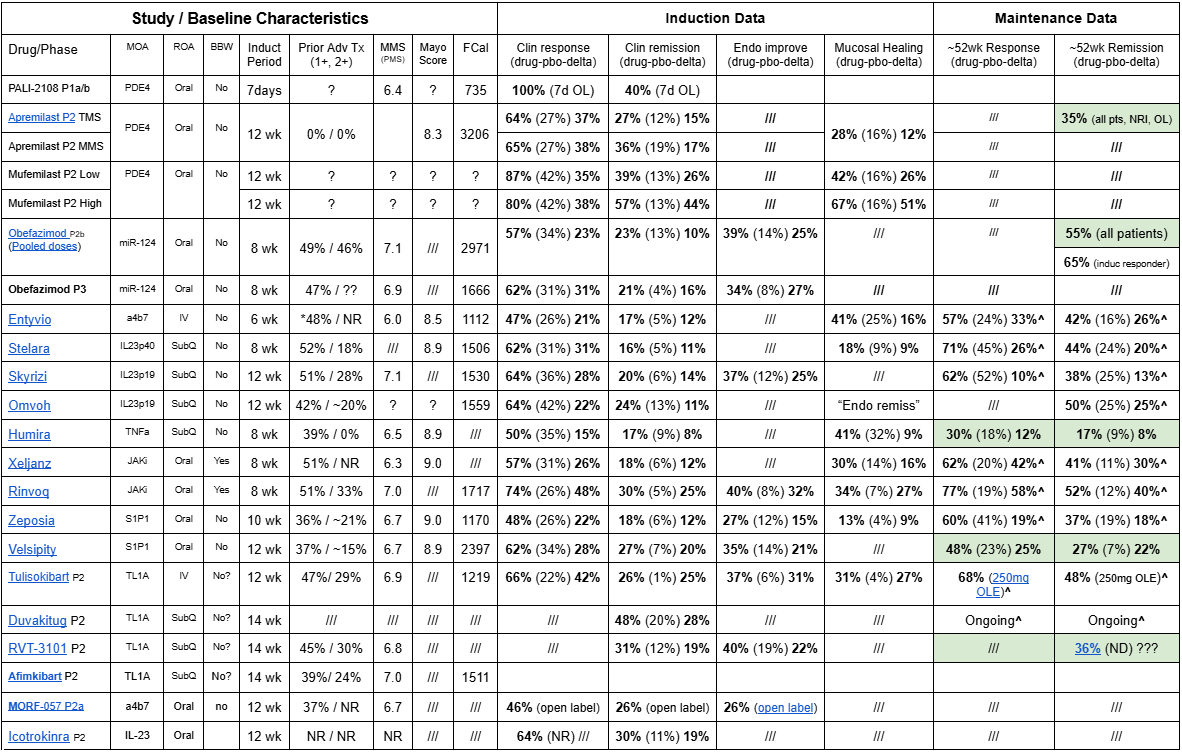
Take a look at the table I built for $ABVX and updated with these data for more detail, but the highlight for Mufemilast/$PALI is...
👉A 44% clinical remission delta at the high dose!
This is an absurdly high number...it's >double the CR delta of the mean/median UC drugs on the market right now. Again, caveat emptor, but the data are impressive for what they are.
Importantly, I suspect that these mufemilast data have exceeded the bullish hopes/expectations of the large funds who just invested in $PALI awaiting their release.
Accordingly, I do expect $PALI to continue its recent move upward today.
$ABVX may be up a lot since last week, but the upside from $66 remains significant. IMO, $ABVX is probably the single most obvious M&A candidate I have ever seen, and the price it's trading at remains quite attractive relative to M&A comps.
You could argue that UC has been the single biggest indication for biotech M&A over the last ~5 years. So far, essentially everything else that has made it past P2 successfully has been bought out (with lofty valuations to boot). $ABVX is in rare territory now, since nothing else like this has even made it this far (past P3) without getting bought out!
Let's go over $ABVX's data and compare it to M&A cases. I'll explain why $ABVX's final destination is, in my biased opinion, well north of $150/share.
1) What $ABVX Just Showed
The results of their P3 studies were incredible. $ABVX has shown:
➡️The 3rd highest clinical remission delta ever seen in a P3 program (16.4%). The only two drugs to have higher deltas are Rinvoq and Veslipity, both with dangerous safety warnings on label.
➡️Squeaky clean safety. Adverse event rates were essentially the same on drug as with placebo...transient headaches were the only tolerability signal (already known from P2 data), and they only lasted an average of 2 days before going away on their own...
➡️Excellent Secondary Endpoint Efficacy. Specifically, a 27% endoscopic improvement delta (the most objective endpoint in UC) is the 2nd highest ever recorded in P3, exceeded only by Rinvoq (which has multiple potentially fatal side effects with black box warning).
$ABVX posted these incredible results despite the facts that:
➡️Their trial enrolled the highest percentage of JAKi refractory patients in any UC trial EVER. Much like their P2b, their P3 showed incredible results despite treating more severe patients than any comparator drug.
➡️Their induction timepoint was only 8 weeks. Most other new studies are using 12-14 week induction timepoints, because the remission delta increases with longer treatment. $ABVX cut no corners, and is still beating the comps that sandbag their data by running longer induction periods.
Top tier efficacy and water-like safety despite treating the most severe patient population ever, all in a convenient once-daily pill that requires no pre-initiation bloodwork/lab testing...this P3 readout for $ABVX was a GRAND SLAM.
2) General M&A Comps for $ABVX
🗒️Important Note: There are no post-phase 3 data M&A comps we can make for $ABVX because...EVERYTHING ELSE HAS BEEN BOUGHT OUT *BEFORE* PHASE 3 DATA ARRIVED!
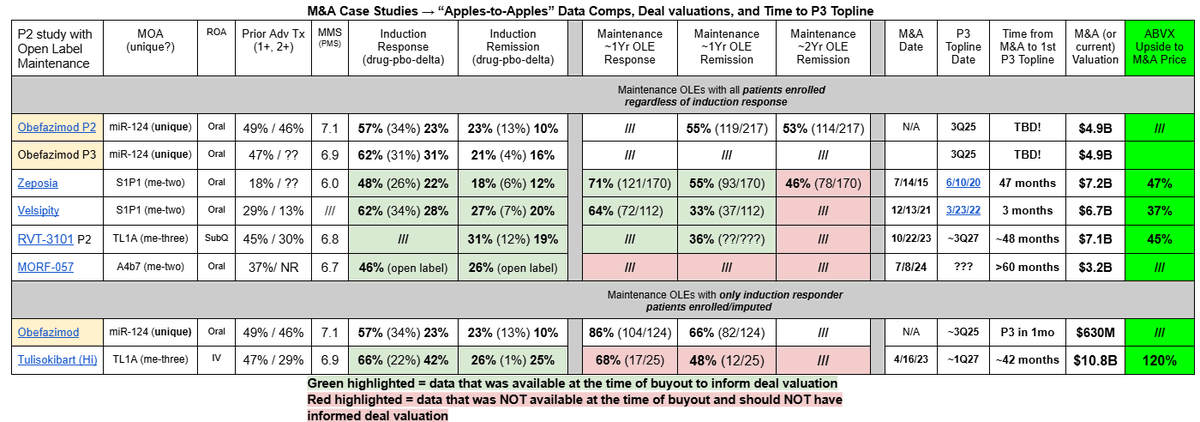
The table attached summarizes the main M&A case studies in this space, with $ABVX's upside to those prices ranging from 37%-120%.
In the slides that follow, I will break down these comps and explain why I think that $ABVX should be valued even higher than the high end of that M&A range (yes, I think remaining upside should be >120%).
I won't share in depth pitches like $NKTR often (2/year?). Only with really compelling setups. I've got another one now. The market says PoS is VERY low and that upside could be 10x+. Like with $NKTR, I think the data say success is far more likely than the market thinks.
The name is $ABVX (Abivax).
Like with $NKTR, I will share my long-form research on $ABVX, for free, via google doc (linked below). This $ABVX research is extensive, and the document is substantially longer than $NKTR’s was at ~25,000 words. It will take a lot to get through it, but I think the case for ABVX here is compelling. IMO the market hasn’t even remotely priced the stock correctly for what I think are relatively high odds of success yielding multibagger potential in August.
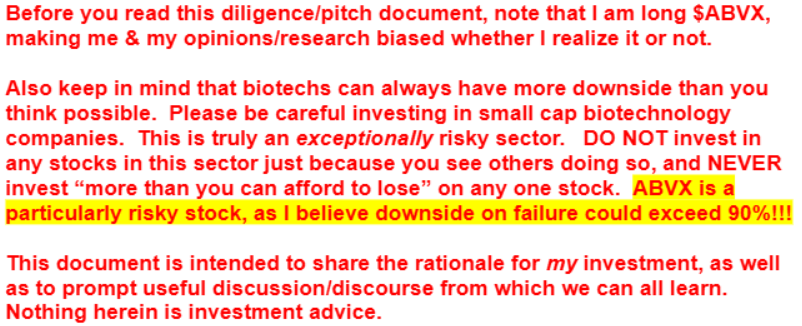
With that said, we need to cover some REALLY important notes on bias and risk:
1⃣ I am long $ABVX, meaning my opinions here are heavily biased. Keep this in mind throughout any of my research that you read.
2⃣THIS IS AN EXCEPTIONALLY RISKY READOUT WITH 90%+ DOWNSIDE POTENTIAL ⚠️📉⚠️
➡️NKTR’s downside potential was “only” ~50%. $ABVX is FAR riskier, and nearly your entire position could be wiped out when the data come if it fails. PLEASE consider the extreme risk involved in this setup!!!
Now, I actually believe that $ABVX’s odds of success are higher than $NKTR’s were going into data, and I spend a ton of time attacking the existing $ABVX data from every possible angle in order to support this opinion. I’ll post the link to my research below. The next slide provides a rough outline of this thread. If you’re not going to follow/understand anything else from this entire pitch, make sure you check out “Slide 6” 😉
Outline of $ABVX thread (don’t miss slide 6!):
Slide 1⃣: Overview of $ABVX and its past
Slide 2⃣: Why is it so cheap?! Overview of main bear theses
Slide 3⃣: P2b Induction data
Slide 4⃣: P2b Maintenance data
Slide 5⃣: P2a+P2b Long term OLE data and attrition analysis
Slide 6⃣: P3 pre-disclosed maintenance arm enrollment (the🔑slide, IMO!)
Slide 7⃣: What is success worth? UC M&A case studies
Slide 8⃣: My projections for the upcoming P3 readout
Slide 9⃣: Summary of thoughts
I’ve been open about being short $HIMS (so understand I am biased). At first this was mostly a counter-momentum short during the short squeeze over $70. However, since then, it has become clear to me that the company is being led into serious legal trouble with apparent reckless abandon.
I’m not a lawyer, but as a biotech investor I do have a better understanding of pharma IP than the “average” person, as well as a better understanding of physician liability as a doctor myself. However, frankly, you really don’t need legal experience to understand why parts of the $HIMS strategy *cannot* not be allowed. If bulls can take of their rose-tinted glasses at least momentarily and actually consider the points I’ll make here, I think basic common sense would suffice to arrive at many of the same conclusions I have.
tl;dr summary of points:
➡️The personalized semaglutide scam being committed at scale would kill pharmaceutical IP, leading to the end of new drug development (yes, I'm serious). HIMS is on a one-way train to getting their assess sued off for this.
➡️Physicians who take part in the personalized dosing scam should be aware that they are opening *themselves* up to huge legal liability in so doing.
➡️HIMS CEO is making bold statements about the efficacy of the oral weight loss “solution” that go against medical evidence. The company is at *high* risk of the FDA taking legal action on this false advertising.
➡️The $HIMS super bowl ad also skirted drug advertising laws, and litigation for this appears likely to me as well. Oh, and the blurred out images of Ozempic that they included in the commercial will bring $NVO lawyers knocking at their door as well.
➡️The company employs unscrupulous and dangerous prescribing behaviors by pushing medications without appropriate medical review (as reviewed in a recent WSJ article)
All of this translates to an untrustworthy company. Do you really want to take their word for how bullish their setup is *while their leadership is constantly dumping shares on the open market*?
The "personalized" semaglutide dosing scam.
$HIMS *cannot* be allowed to sell “personalized” semaglutide at scale. The company has doubled & tripled down on this idea both on the recent earnings call and on the Hims House podcast last week. The thought is that the company can make “personalized” (i.e. non-commercially available) doses of semaglutide through a 503A compounding pharmacy loophole that allows special doses to be made for patients in rare situations where, for some abnormal reason, the standard dosing will not work for them.
People must understand that exploiting this loophole “at scale” like $HIMS is trying to do WOULD MEAN THE END OF PHARMACEUTICAL INTELLECTUAL PROPERTY.
If a generic drug company like $HIMS can simply slightly modify dosing or formulation of an on-patent drug and suddenly be allowed to reap substantial profit from something that a pharma company discovered, developed, and owns, *what would stop generic drug companies from doing this with EVERY patented drug in the world?* There would be nothing to stop generic/compounding companies from stealing the intellectual property of every drug on the market by simply dose-modifying or adding inert compounds to the formula.
$HIMS manipulating the 503A specialized dosing rule may seem innocuous at first - “So what, some people will get some cheap Ozempic and $NVO will lose some money.” But if you actually consider the implications of this precedent even for a moment, it is clear that this scheme could be applied to *any* patented drug. Suddenly pharmaceutical IP is meaningless, and now there is no longer *any* financial protection/incentive for discovering new drugs. New drug development stops.
IMO, it is not at all a stretch to see how the first domino of $HIMS mass-selling “personalized” doses of semaglutide leads to others doing the same thing with other patented drugs, which leads to the end of the pharmaceutical industry and new drug development as we know it.
“Oh come on Adam, that will never happen”. Correct. It will not happen because $HIMS will NOT be allowed to get away with this. The 503A specialized dose “loophole” exists for RARE exceptions in order to help patients who would be at risk of serious harm (example - a small child with a cancer that is treated by a drug that has so far only been approved in adults. They need a much smaller dose than what is available, so 503A allows a compounding pharmacy to legally help this child with a non-commercially available dose).
The 503A specialized dose “loophole” does NOT exist so that $HIMS and other generic drug leeches can steal Novo Nordisk’s intellectual property and make their own c-suite rich by selling stock. If the company actually goes through exploiting this well-intentioned rule in that way, they will be stopped. They will be stopped because they *MUST* be stopped if we are going to preserve the system for developing new drugs.
The idea that $HIMS will actually be able to get away with this is ludicrous, and the CEO repeatedly telling his retail investors that it's not going to be a problem MASSIVELY undermines his credibility and trustworthiness in my book. When he reassures us about something that is so obviously wrong/not going to work, why would we believe him about anything else?
HIMS contracted physicians are at *huge* liability risk in the personalized dosing scam
Another note on this $HIMS “personalized” dosing scam. The physicians who are complicit with prescribing these off-label doses en masse had better watch their backs. You are opening yourself up to incredible legal liability by being a part of this IP scam.
Prescriber data is readily available to regulatory bodies. Outlier prescribers of *any* drug/dose are easy to find. If $HIMS is successful in pumping the personalize dosing scam to thousands of patients, we will be able to see that something like 0.01% of prescribers wrote >90% of the personalized doses of semaglutide.
How is it possible that these few physicians somehow have almost *all* of the patients in the world who needed “personalized” doses of semaglutide? It isn’t. This will be all the evidence we need to confirm that $HIMS has pushed this strategy and funneled patients down the path of seeking personalized doses in order to get cheap drug.
This necessitates that the physicians prescribing such high rates of non-standard semaglutide are COMMITTING MEDICAL FRAUD by repeatedly claiming that there is an indication for off-label dosing whether there actually is or not. There is no way that *only* $HIMS patients are the ones who would “need” personalized dosing.
So, when the prescriber data shows that a bunch of the $HIMS contracted physicians are massive outlier prescribers of personalized doses, those physicians are going to have some explaining to do.
“How can you explain that 99% of physicians prescribed ZERO personalized semaglutide at all in 2025, yet you prescribed it to over half of your patients? How is it possible that only *you* ended up with the few patients for whom this atypical dosing was indicated?”
Caught red handed, because the only plausible answer here is that it actually *wasn't* indicated - these physicians are just going along with the company's goal of pushing patients toward personalized doses whether there is a medical necessity or not. The outlier prescriber data on this matter will not lie, and they will not be subtle.
If these complicit physicians don’t have legal action taken against them directly, I would bet that they'll be dragged into the broader lawsuits against $HIMS when shit finally hits the fan here.
Add in the questionable medical “assessments” that $HIMS performs (see WSJ article that discusses prescriptions being written within 60 seconds of requests having been submitted) and these docs are just setting themselves up for legal slaughter. Good luck arguing that you thoroughly assessed all these patients and found that they needed some nuanced dose through your 1-minute long online assessment where you didn’t even talk to or examine the patient. This won’t hold up.
Oh, and, by the way - these personalized doses are definitionally off-label. This opens up yet another liability can of worms.
IMO the physicians contracted with $HIMS would be absolutely nuts to go along with this scam.