Thread with excerpts from the colonial Mexico portion of "Fire and Blood: A History of Mexico" (1973). 

The Catholic Monarchs who united Spain reined in the aristocracy, abolished serfdom, disempowered the Castilian parliaments, and ended all noble presumptions to royal powers and revenues, creating a new bureaucracy (with a new army) to run the state loyal to themselves.

Spain combined this modern bureaucratic state and army with maintenance of privileges for the old nobility and an almost medieval religious mindset.


Fehrenbach saw imperial Spain as almost a resurrection of late Roman civilization, with the Roman Church subordinate to a theoretically absolute monarchy ruling over a hierarchical and bureaucratized society.
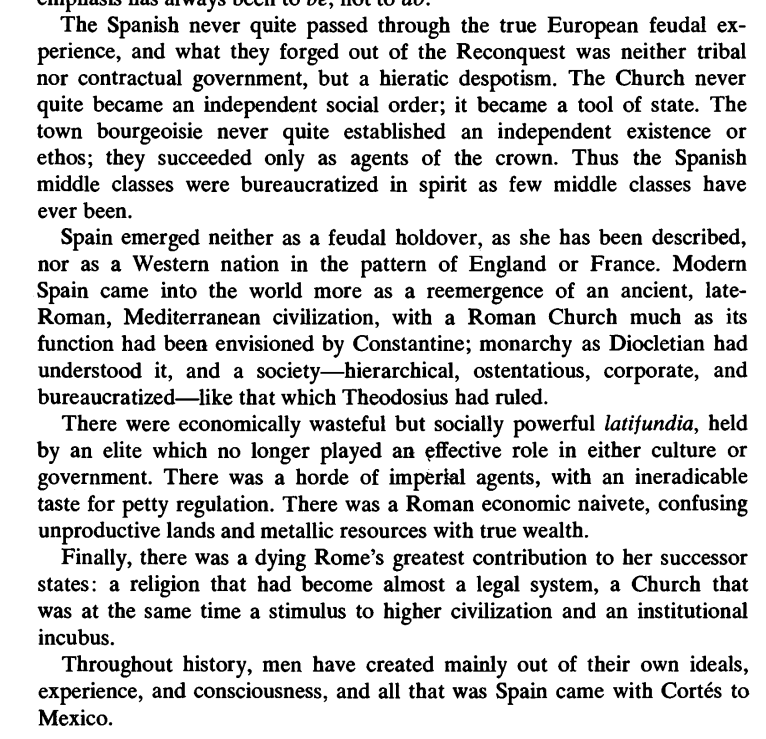
The Spanish ethos was almost post-aristocratic; the aristocracy vanished as an ordering element of society, but Spain was rigidly hierarchical and the Spaniard hostile to menial labor. The major ambitions were holding office and owning land worked by others.

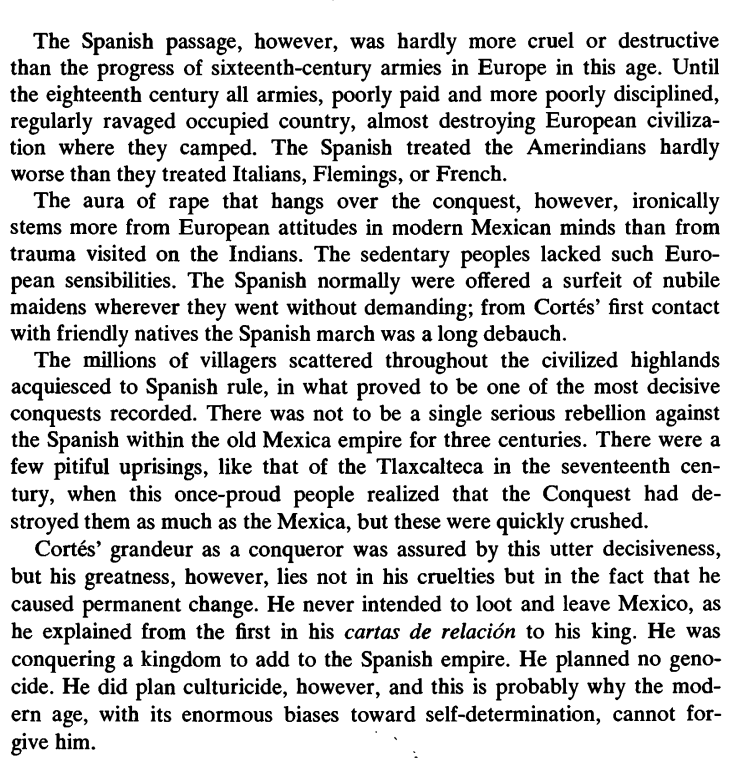
The Spanish passage over Mexico after the Conquest was not especially cruel; most 16th century armies were ill-disciplined looters. Mexico was treated like Italy or Flanders or France. The Conquest was one of the most decisive ever, with no serious rebellions for 300 years.
Cortes' plan: allied tribes would be free vassals of the Spanish Crown, while his soldiers would become colonists transplanting Hispanic civilization, which the Indians would eventually join voluntarily. The Indians would be more free than most Europeans.

The trouble was, the Spanish had no desire to become farmers or artisans or merchants or businessmen; they'd sailed across the Atlantic and conquered a kingdom to become lords and gain titles and offices.

Charles V forbade the inhabitants of New Spain be granted in encomienda, as he was against enserfment of Indians, but Cortes refused to obey because otherwise his (private) army would mutiny, and the Crown could not hold New Spain without it.

Still, encomienda, on paper, was not that bad, superior to many still-extant feudal contracts in Europe, and many native lords received encomienda under Spanish law as well, including two daughters of Montezuma. In practice...

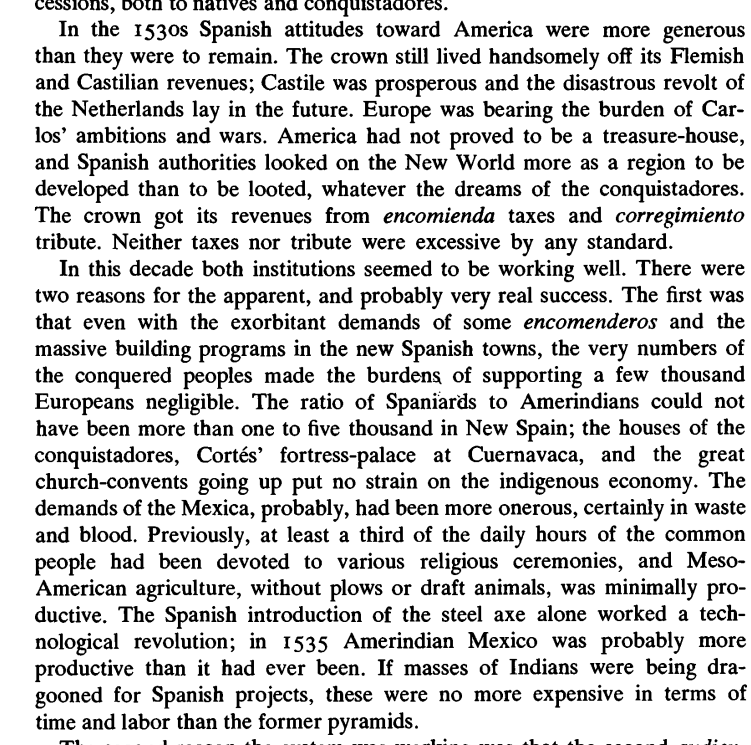
New Spain was, like Castile itself, very urban, composed of basically transplanted Spanish towns ruling over encomiendas in the countryside under Spanish law. The Spaniards also introduced much useful technology, such as work animals, steel axes, and the plow.

Thousands of Spaniards crossed the Atlantic after the Conquest; unfortunately they were adventurers rather than skilled colonists. Authorities heavily restricted emigration to below 1000 Spaniards per year, so New Spain was not thoroughly racially Hispanicized.

In putting down a revolt from one his own men, Cortes was ambushed by southern savages and killed the last speaker of the Mexica, his prisoner, out of fear.

Malinche was finally given a large estate and married off to a Spaniard.

One of his Cortes' legitimate sons succeeded to his titles and estates, but the line died out in the fourth generation. He is hated in Mexico today, as Mexicans side emotionally with the Mexica, but he was the race's premier founding father.

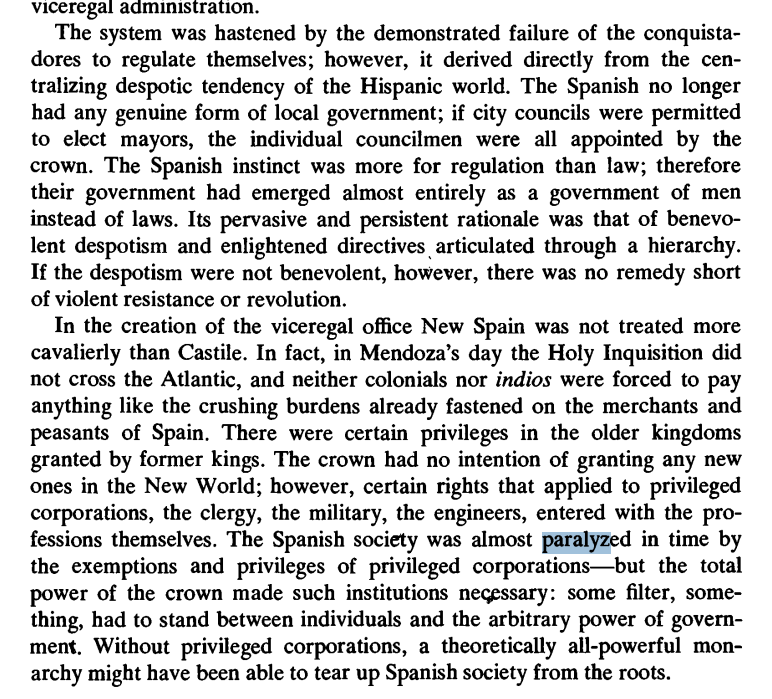
Spanish society was eventually almost paralyzed by the exemptions and privileges of privileged corporations and groups, and crushed by taxes. These burdens were much lighter in New Spain; indios were less taxed than Castilian peasants.
In the 1530s, Spanish attitudes towards America were generous. America was not yet a treasure house, and the encomienda was a trivial burden when the indio:Spaniard ratio was 5000:1. Combined with the technological introductions, Indian life was much easier than pre-Conquest.
The Spanish conquerors quickly became a wealthy landowning leisure class living off of indio labor. But they were not a gentry or bourgeoise or a ruling aristocracy. They performed no social function at all, and proved culturally sterile.
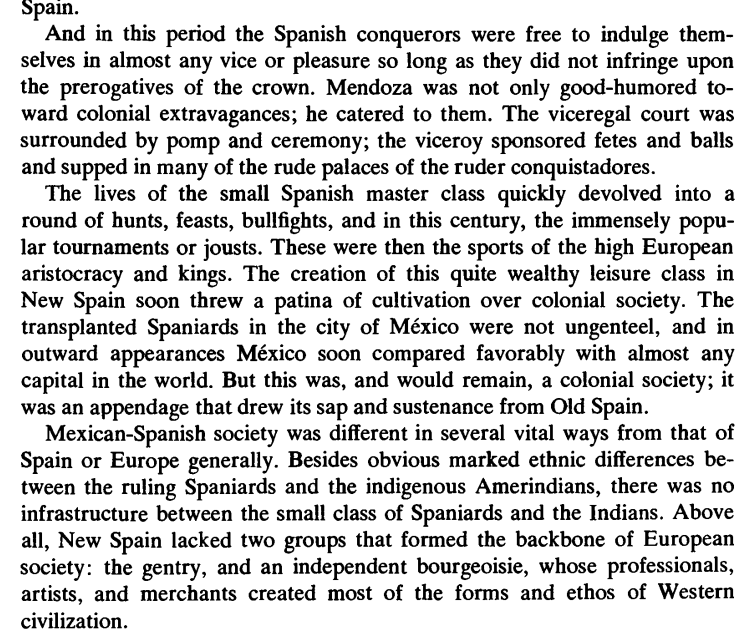

Amerindian blood and precivilized culture survived, but the high culture and knowledge was utterly obliterated.

It was the Church, and specifically the orders such as the Franciscans, who successfully Hispanicized Mesoamerica. But the mission-and-encomiendas model failed beyond the edges of civilization because they relied on a dense settled population for labor.
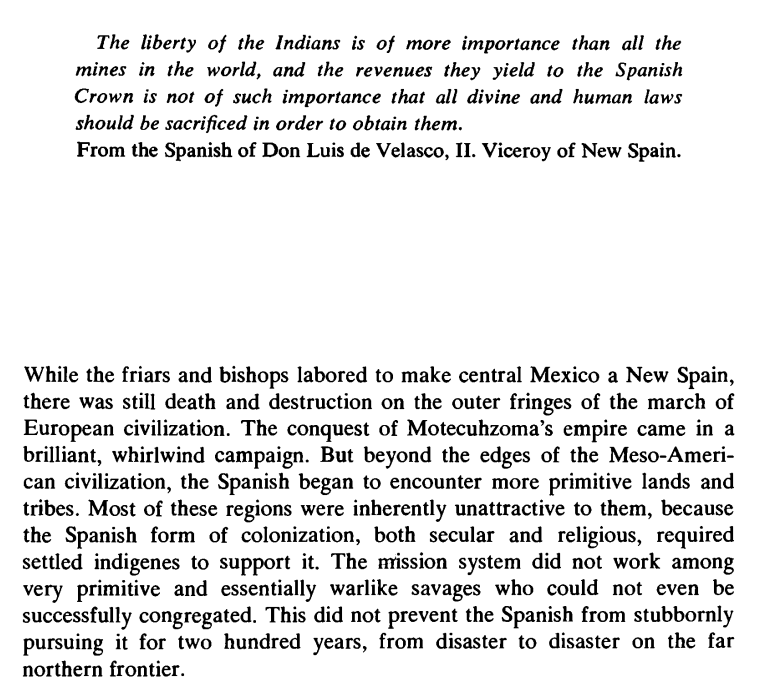
North of civilized Mesoamerica was the tierra despoblada, deserted regions, now northern Mexico, inhabited by wild Indians. The Spanish would spend centuries fighting wars on the frontier here. The coasts were also depopulated by African tropical diseases.

The Yucatan peninsula was almost entirely separate from the rest of Mexico and socially more similar to the Indies.

Expeditions to the north, what is now the US in texas and Colorado, were failures, with savage and thinly-spread American Indians, and far, far too much territory to develop.

By the 1540s New Spain was stable and seemed to be doing well, for both the Spaniards and the Indians. But the great disaster of Old World diseases destroyed this. Burdens that were trivial at a population ratio of 5000:1 were crushing and insupportable at 10:1.

With the collapse in Indian numbers, the Spaniards went from drawing light tribute from a basically undisturbed mass of civilized Indians (freer than before the Conquest or than European peasants) to practically enserfing or enslaving the survivors to meet labor demands.

• • •
Missing some Tweet in this thread? You can try to
force a refresh