A Stanford neuroscientist said something on his podcast that most adults do not want to hear.
Heavy phone use can cause adult ADHD in people who never had it.
The fix takes 30 days. It costs nothing. Almost no one will try it.
1/ The dopamine reset most adults need.
Most adults who think they have ADHD do not have ADHD.
They have something else.
Andrew Huberman said it plainly. Heavy phone use floods the brain with too much input. Email. Texts. Three apps. Two real talks. Fifteen tabs. All at once.
Your brain stops being able to focus on one thing. You trained it to expect a new hit every six seconds.
Huberman calls it a form of ADHD. He said the brain can start to look just like a brain with real ADHD. The good news is that it can heal.
2/ A 2020 brain scan study proved this is not just a theory.
Scientists used a PET scan to study 22 healthy adults. None of them had ADHD.
They tracked each person's daily phone use for weeks.
The result was clear. The more time someone spent on social apps, the lower their dopamine levels were in a key part of the brain called the putamen.
The putamen is the same part of the brain that is broken in real ADHD.
Heavy phone use does not just feel like ADHD. It makes the brain look like ADHD on a scan.
3/ Dr. Anna Lembke runs the addiction clinic at Stanford. She has the cleanest model I have heard.
Your brain has a pleasure and pain balance. Every dopamine hit on one side gets matched by an equal drop on the other.
One TikTok. One scroll. One ping. Each one tips the balance toward pain.
Do that 400 times a day for years.
Soon your baseline drops below zero. You now need the phone just to feel normal.
Lembke calls this a chronic dopamine deficit state. She says it can look like clinical depression.
Most people do not know they are in it. They just feel flat. Tired. Restless. Always reaching for the phone.
4/ The fix is simple. It is also the hardest thing most people will ever do.
Dr. Lembke calls it a dopamine fast.
Stop the addictive habit for 30 days. For most adults that means social apps, short videos, and news apps.
Days 1 to 14 are awful. Anxiety. Bad sleep. Restless feelings. This is real withdrawal. It is biological. Not in your head.
Day 15 is when things start to shift.
By week 4, normal things become fun again. Coffee tastes good. Books pull you in. Talks feel deep.
Most people quit on day 3 and say they are just tired. They are not tired. They are in withdrawal.
5/ You do not need a doctor to know if you have phone driven dopamine damage.
Run this check:
1. You check your phone within 30 seconds of waking 2. You feel anxious if your phone is not near you 3. You cannot watch a movie without scrolling 4. You cannot sit on the toilet without your phone 5. You feel restless after 10 minutes of doing nothing 6. You start tasks and never finish them 7. You feel flat, but your blood tests are fine
Three or more is the threshold. Five or more is severe.
This is not a flaw in you. This is what a brain looks like after years of heavy scrolling.
6/ You do not need to throw your phone away.
Dr. Lembke gives this plan to patients who cannot go cold turkey for 30 days:
1. Delete the top 3 apps for 30 days. For most people that is TikTok, Instagram, and X. 2. Put your phone in another room while you sleep. 3. No phone in the first 60 minutes of your day. 4. No phone during meals. 5. Set your home screen to greyscale.
Change one thing at a time. Each one alone cuts dopamine triggers by a lot.
By week 4 your brain will feel different. The world will look slower. Books will feel readable again. Being bored will feel okay.
That is not magic. That is your brain healing.
The first iPhone came out in 2007.
Between 2020 and 2023, new adult ADHD diagnoses in the United States rose by 15.2% per year on average.
Dr. Anna Lembke called the smartphone "the modern day hypodermic needle, delivering digital dopamine 24/7 for a wired generation."
Huberman said smartphones can "induce adult ADHD."
The Cambridge journal of psychiatry just published a 2025 paper that pulls all of this research together. The brain on heavy phone use looks like the brain on ADHD.
Every adult who feels broken, lost, anxious, and unable to focus should ask the simplest question first.
The Dead Internet Theory was a conspiracy. The idea that the internet is no longer human. That bots and AI have quietly replaced real people. It started on anonymous message boards in 2019. Most people dismissed it.
Stanford, Imperial College London, and the Internet Archive just measured it.
They used the Wayback Machine to scan every new website published between 2022 and 2025. Thirty-three months of the internet, captured and classified. They applied one of the most advanced AI text detectors in the world to every page.
35.3% of all newly published websites were AI-generated or AI-assisted.
17.6% were completely AI-generated. No human involvement at all.
In late 2022, before ChatGPT launched, that number was zero.
In three years, more than a third of the new internet became synthetic. Not over decades. Not over a generation. Three years.
Then they measured what that is doing to the internet itself.
Semantic diversity is falling. The range of ideas, perspectives, and ways of saying things is narrowing. As AI content increases, the internet sounds more and more like one voice. Because it is one voice. The same models producing the same patterns across millions of pages.
Positive sentiment is rising. Everything sounds upbeat. Polished. Confident. Helpful. The internet is getting friendlier while getting emptier. The tone improves as the substance disappears.
The lead researcher, Jonáš Doležal at Imperial College London, said this to 404 Media: "I find the sheer speed of the AI takeover of the web quite staggering. After decades of humans shaping it, a significant portion of the internet has become defined by AI in just three years."
Separately, Cloudflare reported that nearly a third of all internet traffic now comes from bots. Imperva reported that automated traffic surpassed human traffic for the first time in 2024.
If you read my previous threads on Model Collapse and Retrieval Collapse, this is the final chapter. Model Collapse showed that AI trained on AI gets dumber. Retrieval Collapse showed that search engines indexing AI content get emptier. This paper shows the source of both problems. The internet itself is being replaced.
The researchers are now working with the Internet Archive to build a live monitoring tool. A real-time tracker of how much of the internet is human and how much is not.
The fact that we need a tool to measure how much of the internet is still real is the finding.
1/ The growth curve.
In late 2022, the share of AI-generated websites was zero.
By mid-2023, it was 10%.
By mid-2024, it was 20%.
By mid-2025, it was 35.3%.
The red line is fully AI-generated. The purple line includes AI-assisted. Both are climbing. Neither has slowed down.
2/ The internet is getting more similar.
They measured semantic diversity. How different websites are from each other in meaning and ideas.
As AI content increases, diversity falls. The correlation is statistically significant (ρ = 0.47, p = 0.004).
AI-generated pages are 33% more semantically similar to each other than human-written pages. The internet is converging toward one voice. Because it is one voice.
You have noticed that too. Google Search is getting worse. The results look professional but say nothing. The answers are longer but less useful. Every page reads like it was written by the same voice.
You thought Google was broken. It is not broken. It is being replaced.
Researchers published a paper at the ACM Web Conference 2026 proving what is happening. They call it Retrieval Collapse.
Here is the mechanism in one sentence. AI-generated content is flooding the internet so fast that search engines are now showing you mostly AI-written pages. And the search engine cannot tell the difference.
They ran a controlled experiment. They started with a pool of real, human-written web pages. Then they gradually added AI-generated content until it made up 67% of the pool.
By that point, over 80% of the top search results were AI-generated. Not 67%. Over 80%. The ranking algorithm did not just let AI content in. It preferred it. The AI-written pages were better optimized, more fluent, and more keyword-rich than the human pages. They outranked the originals.
Here is the part that makes this invisible.
Answer accuracy stayed the same. The search results still looked correct. The information was still technically right. If you measured quality by accuracy alone, nothing appeared wrong.
But source diversity collapsed. Nearly every result came from the same type of content. AI-written. AI-optimized. AI-structured. The human-written pages, the ones with original reporting, personal experience, and genuine expertise, were buried.
The researchers describe a two-stage collapse. Stage one is Dominance. High-quality AI content silently takes over the top results. Everything looks fine. Accuracy is stable. Nobody notices. Stage two is Corruption. Once AI dominates the pipeline, adversarial and low-quality content starts slipping through. By then, the system is too dependent on synthetic sources to course-correct.
A separate analysis found that 74.2% of newly published web pages now contain AI-generated content. Organic click-through rates on pages with AI summaries have dropped 61%. The human internet is being outranked by the machine internet.
Model Collapse described what happens when AI trains on AI. The models get dumber. Retrieval Collapse describes what happens when search engines index AI. The results get emptier.
Both are happening right now. At the same time. And neither one looks broken from the outside.
The search engine still returns ten blue links. The links still load. The pages still answer your question. But the thing that used to make those answers trustworthy, a human who actually knew something, is being quietly replaced by a machine that sounds like it does.
1/ The amplification effect in one chart.
The researchers started with 0% AI content. They added more each round.
At 33% AI in the pool, 43% of your search results were AI.
At 50% AI in the pool, 68% of your results were AI.
At 67% AI in the pool, 81% of your results were AI.
The algorithm does not reflect the ratio. It amplifies it. AI content outranks human content at every level.
2/ The deception in the numbers.
Round 0: 0% AI content. Answer accuracy 68.17%.
Round 20: 81% AI content. Answer accuracy 67.68%.
Read those two lines again. The search results went from fully human to 81% synthetic. The accuracy barely moved.
That is what makes this invisible. The grades did not change. The source of every answer did. Nobody checking accuracy would notice. The collapse is hidden behind a stable score.
In 1944, a 13-year-old Jewish boy watched the Nazis take Hungary.
His father gave the family fake Christian names. Forged papers. Split them apart so if one was caught, the others might live.
The boy hid as the godson of a government official. 500,000 Hungarian Jews were killed in 8 months. He survived.
He arrived in London with nothing. Worked as a railway porter. Slept in train stations.
48 years later, he placed a $10 billion trade against the British pound.
By nightfall, he had made $1 billion in a single day. The press called him "The Man Who Broke the Bank of England."
His name was George Soros. His book "The Alchemy of Finance" has stayed in print since 1987.
I turned his philosophy into 12 prompts.
Here are all 12:
1. Reflexivity Detection
Soros built his fortune on one idea most economists reject. In The Alchemy of Finance he wrote: "I contend that financial markets never reflect the underlying reality accurately; they always distort it in some way or another, and the distortions find expression in market prices." Reflexivity is the feedback loop where beliefs shape prices, prices shape reality, and that reality shapes beliefs again. Spot the loop early and you see the bubble before the crowd do
PROMPT
"I'm trying to understand a market, trend, or situation where belief and reality seem to be feeding each other. Here is my situation: [describe]. Using George Soros's Reflexivity Detection framework, analyze my position:
1. Where is the feedback loop here? Soros said market prices distort reality rather than reflect it. How are participants' beliefs actively changing the thing they are betting on? 2. What belief is currently driving prices or behavior, and how is that belief altering the underlying fundamentals in return? 3. Is this loop self-reinforcing right now, building the trend higher, or has it started to reverse? 4. What evidence would tell me the gap between perception and reality has stretched too far to hold? 5. Give me one specific action this week to position for the moment the loop breaks instead of getting trapped inside it."
2. The Boom-Bust Anatomy
Soros saw every bubble as a sequence, not an accident. A trend becomes self-reinforcing as belief and price push each other higher, until the distance from reality grows too wide and it collapses. He warned: "Markets are constantly in a state of uncertainty and flux." Knowing which stage you stand in changes everything. Early in the boom you ride it. Late in the boom you prepare to run.
PROMPT
"I'm looking at a trend, asset, or market and I need to know which stage of the boom-bust cycle I am in. Here is my situation: [describe]. Using George Soros's Boom-Bust Anatomy framework, analyze my position:
1. Map this trend onto the boom-bust cycle. Is it early, accelerating, near the peak, or already turning? Soros said trends become self-reinforcing until they collapse. 2. What is the prevailing belief powering this trend, and how far has price moved beyond the underlying reality? 3. What are the signs the self-reinforcing phase is exhausting itself? Where is the fuel running low? 4. If this is late in the boom, what is my exit plan, and what is my trigger to act on it? 5. Give me one specific action this week that matches the stage I am actually in, not the stage I wish I were in."
You have noticed it. ChatGPT feels dumber than it used to. Your prompts that worked six months ago produce worse results now. The writing sounds flatter. The ideas sound safer. The internet itself feels like it is shrinking. Every article reads the same. Every email sounds the same. Every answer sounds like it was written by the same voice.
You thought it was you. It is not you.
Researchers at Oxford and Cambridge published a paper in Nature proving what is happening. They call it Model Collapse.
Here is the mechanism in one sentence. AI trained on AI-generated data gets dumber every generation until it forgets what real human data looked like.
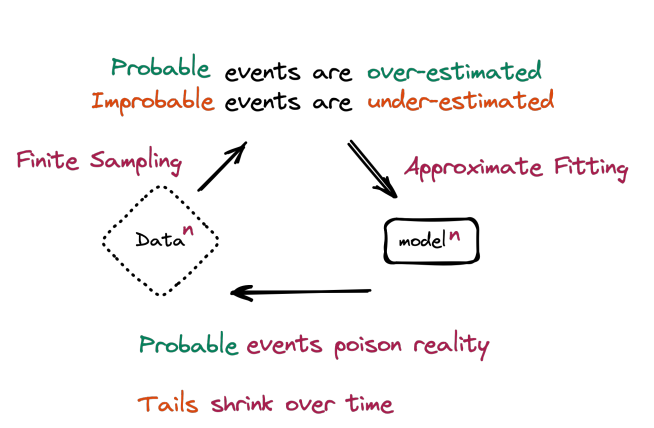
The internet is filling with AI-generated content. Blog posts. Articles. Reviews. Comments. Social media. AI companies scrape the internet to train the next generation of models. Which means the next generation of AI is being trained on the output of the current generation.
Each cycle loses information. Not randomly. It loses the rarest, most unusual, most creative parts first. The researchers call these the "tails of the distribution." The weird ideas. The unexpected perspectives. The things that made the internet feel human. Those disappear first.
What remains is the average. The safe. The expected. The bland.
Then the next generation trains on that. And loses more. And the next generation trains on that. And loses more. The researchers proved this is not a slow decline. Major degradation happens within just a few iterations. Even when some of the original human data is preserved.
They tested it on large language models. On image generators. On statistical models. The pattern was the same every time. The output converges toward a narrow, flattened version of reality that looks nothing like the original data.
The lead researcher put it plainly. "Large language models are like fire. A useful tool. But one that pollutes the environment."
The pollution is invisible. You cannot see which sentence on the internet was written by a human and which was written by AI. Neither can the AI that is about to train on it. And once the tails are gone, they do not come back. The damage is irreversible.
This is not a prediction anymore. It is a diagnosis.
The internet you grew up on was built by humans writing things no algorithm would have written. Strange, personal, imperfect, alive. That internet is being diluted. One generation of AI at a time. And the models trained on what remains are learning a smaller and smaller version of the world.
Model Collapse is not a technical problem. It is a cultural one. The thing that made the internet worth reading is the thing that disappears first.
1/ The death spiral in one chart.
Generation 1: the model produces text that sounds human.
Generation 3: the output starts repeating itself.
Generation 5: rare words disappear entirely.
Generation 9: the model produces nonsense.
Each generation trained on the previous generation's output. Each generation lost more. The researchers watched it happen in real time.
2/ The tails die first.
The researchers plotted what each generation of AI remembers about the original data.
Generation 1: the full distribution. Every rare idea. Every unusual perspective.
Generation 5: the edges are gone. Only the middle remains.
Generation 9: a single narrow spike. One voice. One style. One version of reality.
The weird, creative, unexpected parts of human writing are the first things Model Collapse erases.