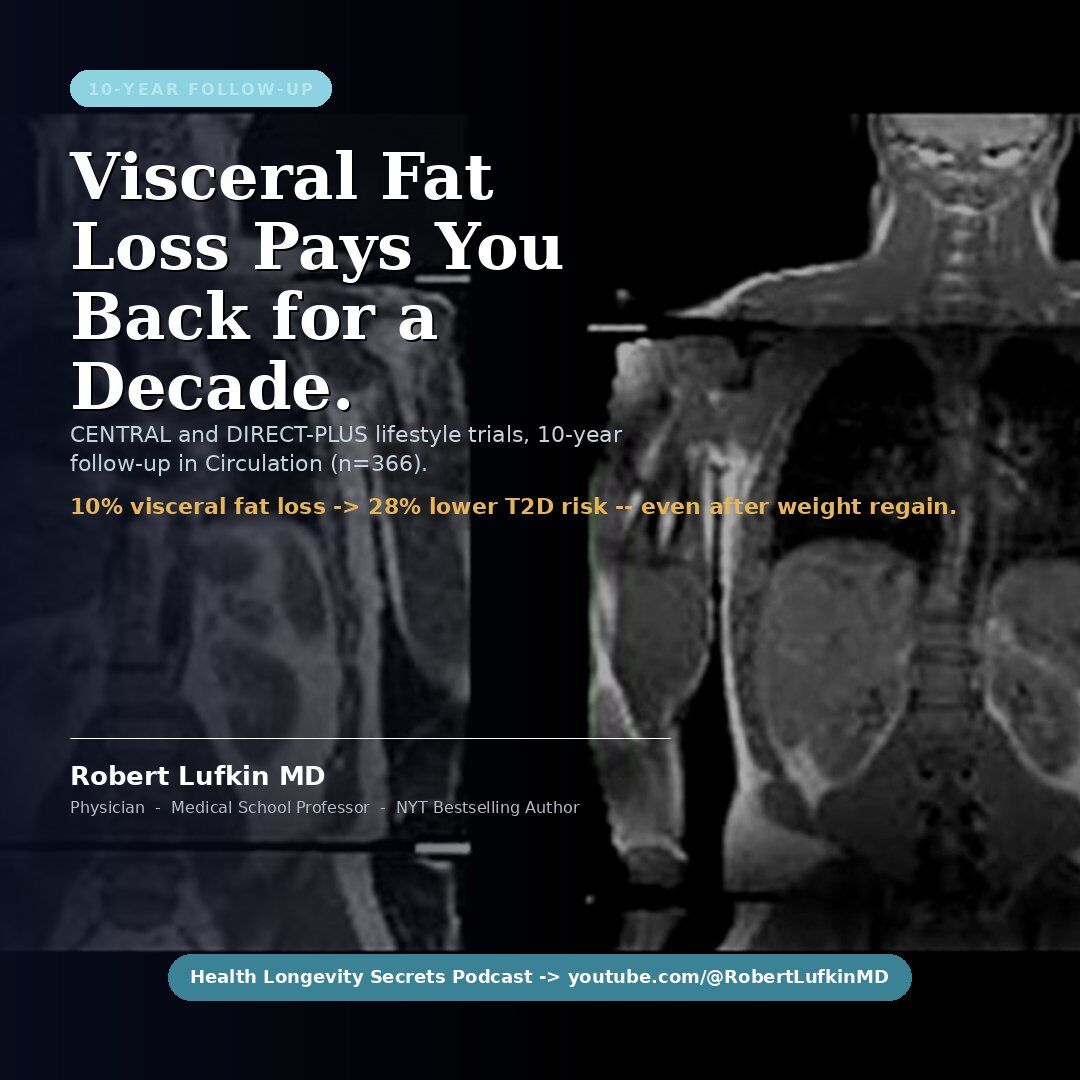
A 10-year follow-up of the CENTRAL and DIRECT-PLUS lifestyle trials (n=366) in Circulation: despite participants regaining the weight, every 10% reduction in visceral fat during the original intervention was independently associated with a 28% lower long-term risk of type (1/7)
2 diabetes. (2/7)
Waist circumference and visceral and subcutaneous fat reductions were partially preserved at 10 years. Liver and pancreatic fat were not -- they snapped back. (3/7)
But the dividends from visceral fat loss persisted: better insulin resistance scores and lower metabolic syndrome severity. (4/7)
Honest caveat: this is observational follow-up of trial participants, not a fresh RCT. It shows association, not proof of cause -- residual confounding from diet, activity, and adherence is real. (5/7)
The lesson: scale weight is a noisy proxy. Visceral fat is the metabolic root cause -- losing it once may keep paying you back even when the scale climbs.
Your blood sugar can look perfectly normal for ten years while your body is quietly breaking. Because the number that actually moves first isn't glucose — it's the hormone your physical almost never measures: fasting insulin. (1/9)
Here's the trap. At your annual physical they check fasting glucose and maybe A1c. Both can sit in the "normal" range while insulin resistance has been building for years. (2/9)
As your cells start ignoring insulin, your pancreas just pumps out more of it — dragging glucose back to normal. The glucose looks fine. What it's hiding is a pancreas working overtime to keep it there — and that can run for a decade before glucose finally cracks. (3/9)
I'm a medical school professor. I taught this stuff for decades. And I still ended up with four chronic diseases at once.
I did everything I was told. I followed the food pyramid. I exercised. I got my annual checkups. (1/8)
Then I was diagnosed with four diseases at the same time — type 2 diabetes, high blood pressure, gout, and abnormal cholesterol. The full picture of metabolic syndrome. These were diseases my own father didn't get until his 80s, and I was decades younger. (2/8)
My doctors had one answer: take these medications for the rest of your life. (3/8)
Ask a longevity doctor: does walking after meals actually work? Yes — and here's the mechanism. (1/5)
When you eat, your blood sugar rises. If you sit on the couch, it stays elevated longer. If you walk — even gently, even for 10 minutes — your muscles pull that glucose out of your blood and use it for fuel. (2/5)
You don't need a gym. You don't need to sweat. You need a short walk after your biggest meals. (3/5)
The most counterintuitive sleep tactic in the literature: a HOT shower 60-90 min before bed drops your CORE temperature faster than melatonin, magnesium, or blue-light glasses. (1/7)
Mechanism: hot water dilates peripheral blood vessels. You step out, radiate heat outward, and core temp drops 2-3F. That core-temp drop is the actual hypothalamic trigger for slow-wave sleep onset. (2/7)
Honest read: this is mechanistic + small-trial evidence, not a large RCT proving longevity benefit. Meta-analyses (Haghayegh et al., Sleep Medicine Reviews 2019) show consistent reductions in sleep latency and improvements in slow-wave depth. (3/7)
The story of longevity science has always been: find the world's oldest people, study what they do, copy it. A new book in Nature this week argues the foundation underneath that story is rotting. (1/6)
In "Morbid: Debunking Modern Longevity Science" (MIT Press 2026), epidemiologist Saul Justin Newman shows up to 72% of supposed Greek centenarians turned out to be pension fraud -- people drawing benefits in the names of dead relatives. (2/6)
Similar errors run through other Blue Zone datasets.
If the source data on "exceptional longevity" is unreliable, then biological age clocks, biomarker panels, and dietary recommendations calibrated against those populations inherit the noise. (3/6)
What if extreme longevity is less about avoiding aging and more about aging cleanly? (1/6)
Maria Branyas Morera lived to 117 -- the oldest verified person on Earth. A new multi-omics study in Cell Reports Medicine (Santos-Pujol, Esteller et al) profiled her genome, epigenome, proteome, metabolome, and microbiome.
What they found: (2/6)
- Biological age 23+ years younger across multiple epigenetic clocks. - Telomeres very short -- yet her cells behaved young. - Very low VLDL and triglycerides, high HDL. - Exceptionally low inflammation. (3/6)