Excerpts from TR Fehrenbach's "Fire and Blood: A History of Mexico" (1973) on the Mexican War of Independence. The Mexican criollos were far less impressive than their South American counterparts, and produced no leaders equal to Bolivar or San Martin.
Where the South American criollos quickly declared independence upon the French conquest of Spain, the Mexican ones dithered. Acting quickly, the local peninsulares coup'd the government and the criollos accepted it.
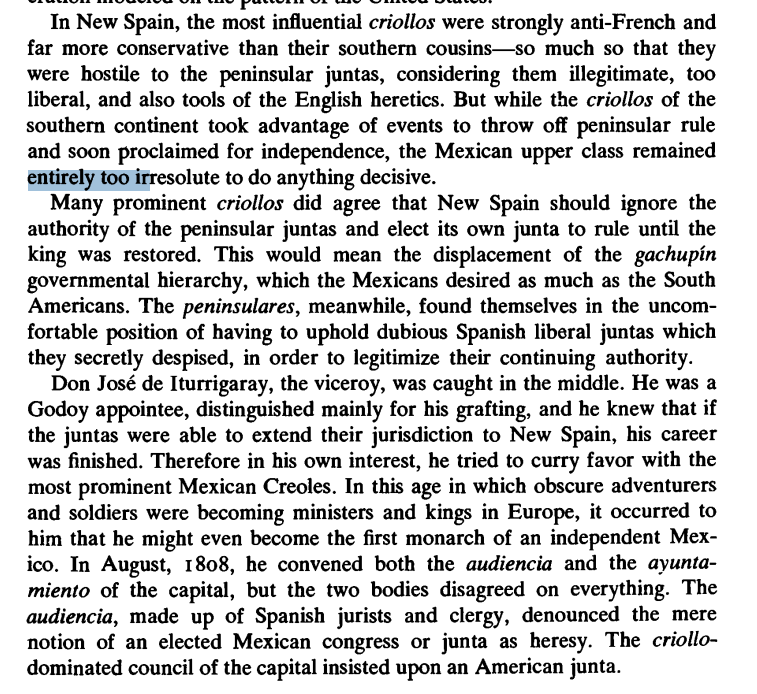
With the criollos basically accepting Spanish domination, leadership of the independence struggle passed to men like Miguel Hidalgo, who turned it from a (hopefully) bloodless coup to a social and race war.
Hidalgo appealed to the lower classes by rebelling in the name of the deposed Spanish king, with the cry "Long Live the King, Long Live America, Death to the Bad Government."
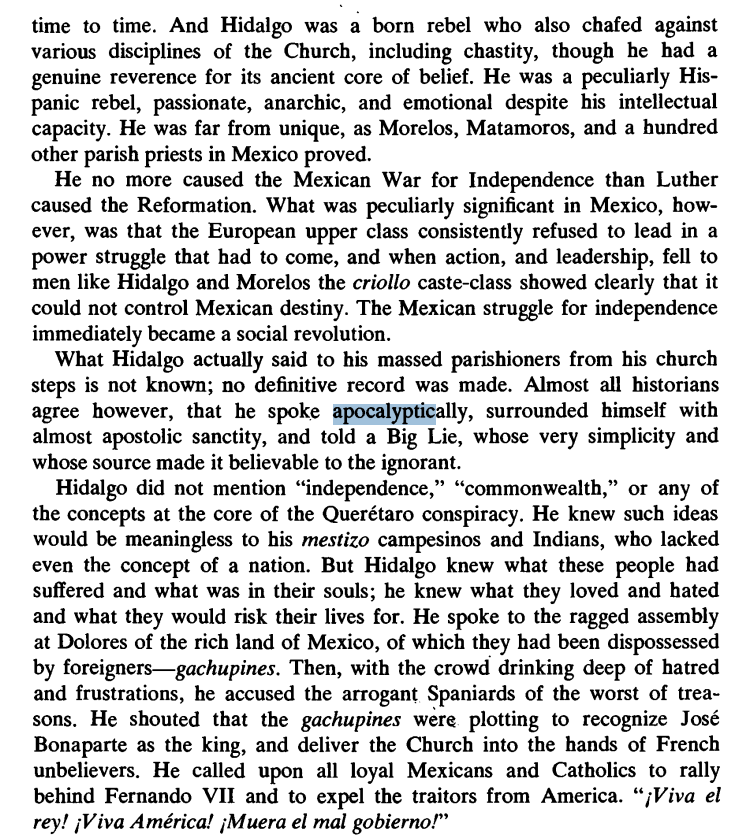
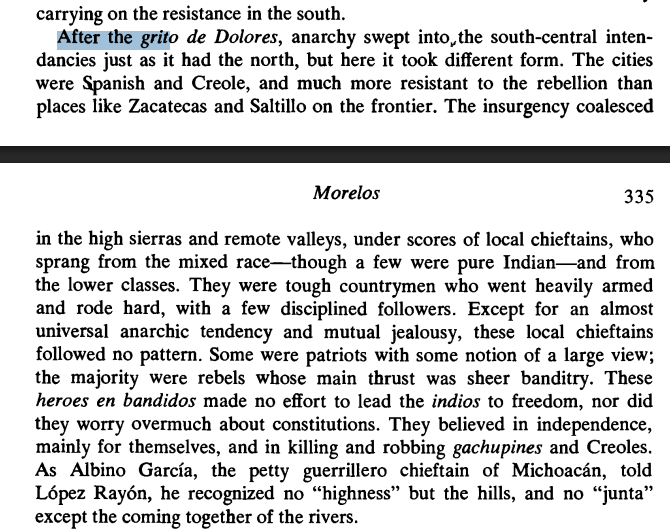
Hidalgo's army was effectively a gigantic mob of indio and casta poor, with a tiny core of the remaining criollo revolutionaries. This mob was quite happy to loot and butcher the European townspeople of Mexico, which led the criollos to side firmly with the viceroy.
The Mexican war of independence was incredibly brutal, with torture, massacres, and decimation of civilians on both sides, perhaps in part because Mexican mortality was so high (higher than anywhere outside the Orient) already.
Hidalgo and his mob were defeated by the smaller but much more disciplined and professional army of the viceroy under General Callejas, but other revolutionaries popped up to replace him.
Anarchy swept Mexico, with hundreds of local bandits rising up in the name of independence and liberty, mostly for themselves, to rob and loot, which alienated civilized Mexicans from the idea of independence.
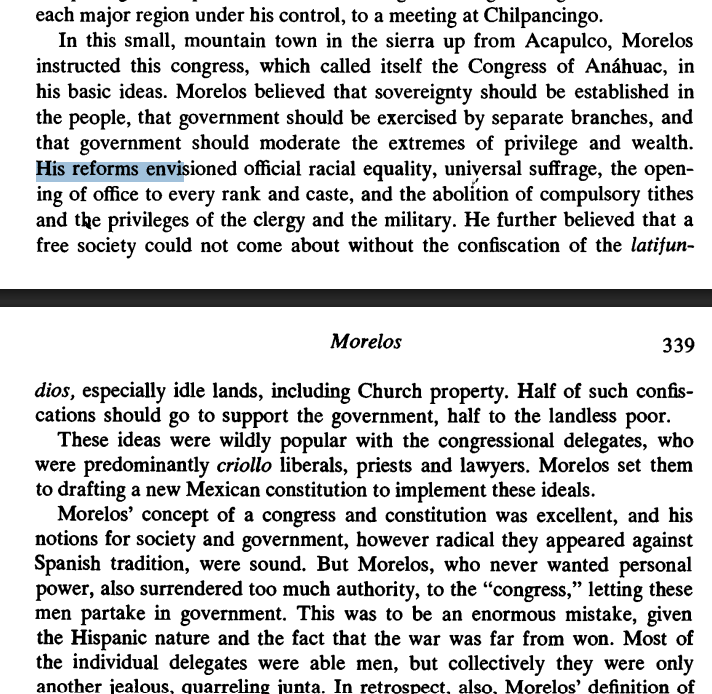
Morelos, in the south, was another casta priest and probably the most disciplined, effective, and idealistic of the independence fighters. The latter proved his undoing; he gave power over to a congress, which turned out to be an ineffective and quarrelling junta.
By 1819, after years of devastating anarchy and civil war, the Mexican insurgents had been thoroughly suppressed and Spanish power appeared stable in New Spain, while the South Americans gained independence.
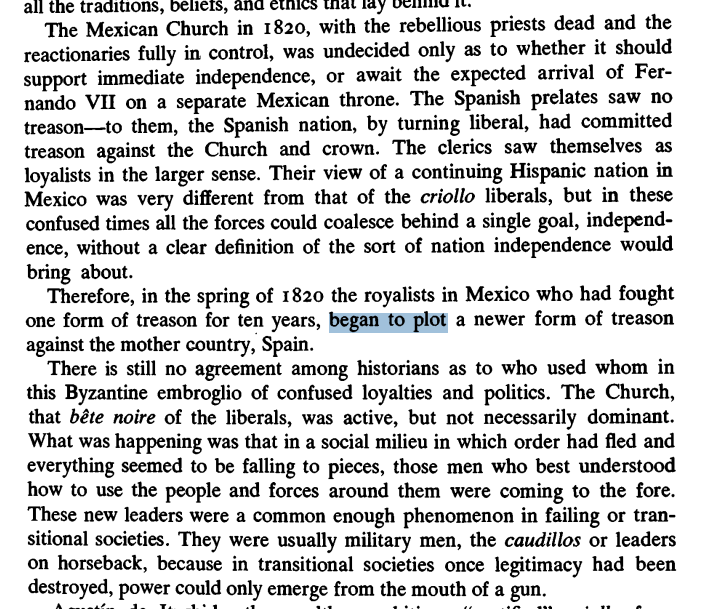
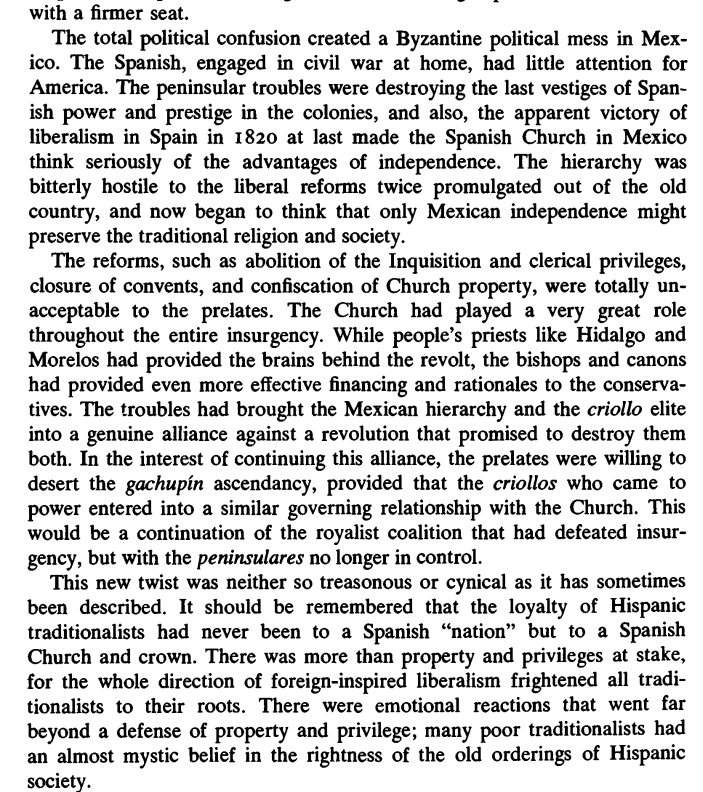
This produced Mexican independence almost by accident; Spanish troops headed to South America revolted, a liberal junta took power in Spain, and this liberal junta alienated the now-conservative Mexican creoles into independence, which they gained almost as an afterthought.
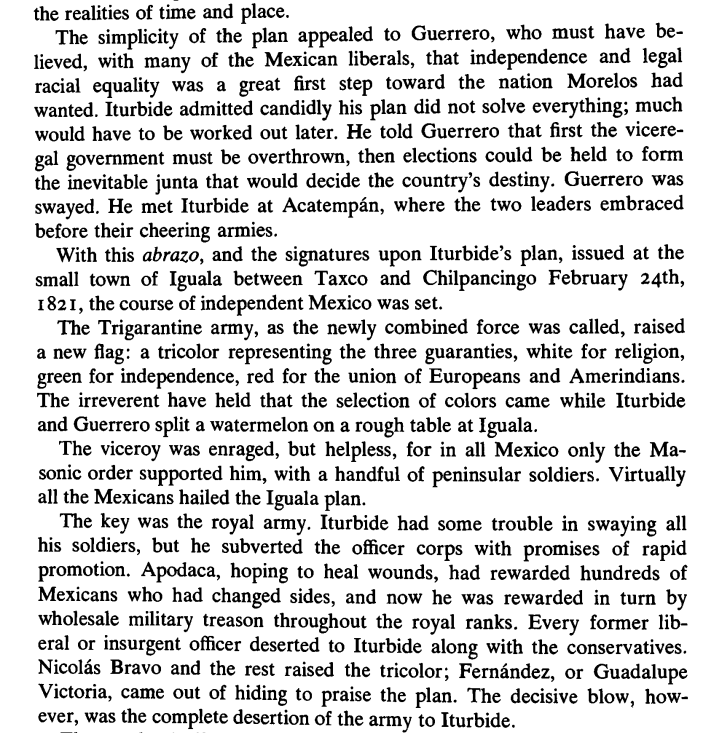
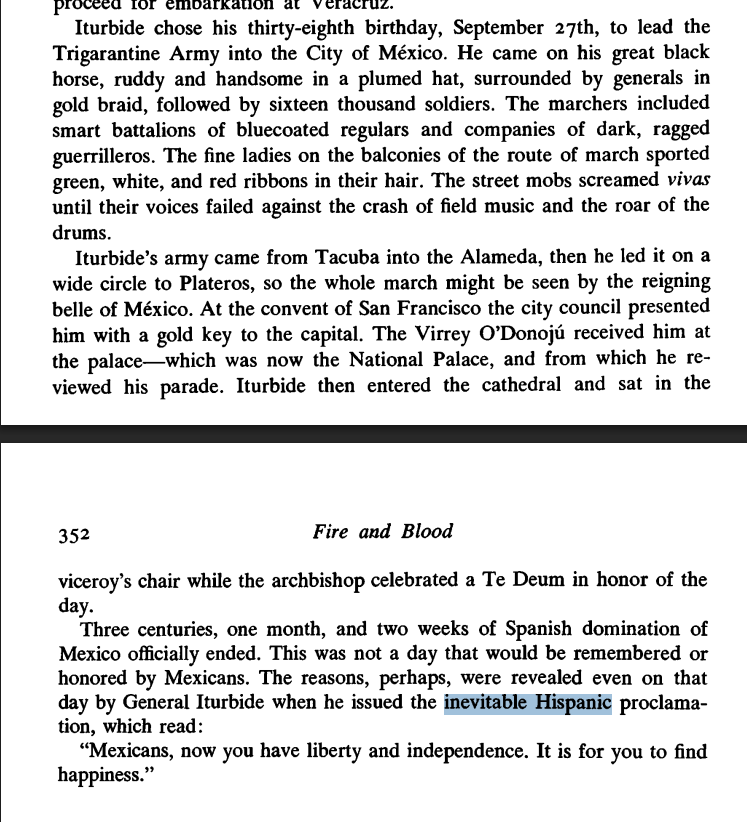
Agustin de Iturbide, in charge of a Spanish army to suppress one of the few remaining insurgents, changed sides, entered the capital, and declared independence, and that was that.
• • •
Missing some Tweet in this thread? You can try to
force a refresh

Thread with excerpts from the 'Pretorians' section of TR Fehrenbach's "Fire and Blood: A History of Mexico" (1973). In 1821, postcolonial nation-building seemed easy; the only example was the USA. But the US was homogenous, well-led, free, and already had an identity.
Mexico was the reverse, with no history of self-rule, the criollo/casta/indio split, and no great leadership. The two major factions were the 'continuistas' (conservatives) and the 'reformistas' (liberals).
Thread with excerpts from the Colonial New Spain portion of TR Fehrenbach's 'Fire and Blood: A History of Mexico' (1973). His view is that New Spain would have remained permanent divided and stagnant if not for the northern frontier.
The true frontier of New Spain was not the thinly-populated and stagnant (almost identical when the Anglos showed up as in the 17th century) New Mexico, but much further to the south, in the arid regions only a little north of the Valley of Mexico.
The frontier lacked civilized Indians who could be reduced to slaves, and was instead populated by energetic mestizos and criollos, working owned ranchos for a market rather than owning huge estates for prestige.
A few excerpts from "Years of Peril and Ambition: US Foreign Relations 1776-1921." Several terms from the Treaty of Paris, especially that Britain would abandon its Great Lakes forts and the US would have the right to navigate the Mississippi, were not upheld.
Americans who moved into Spanish Louisiana retained "allegiance to the United States and displayed open contempt for their nominal rulers." Imagine that.
An 1810, American immigrants to Spanish West Florida seized control of Baton Rouge, proclaimed an independent republic and requested annexation by the US, though this failed.
More excerpts on Colonial Mexico from TR Fehrenbach's "Fire and Blood" (1973). Fehrenbach saw the discovery of silver in Mexico, mostly in the arid north, as a disaster, as it led to Spain administering Mexico as a loot box rather than developing the productive economy.
The thinly-populated, but silver-rich North became a military frontier.
The suspicious Spanish Crown gave those born in Spain, the peninsulares, a monopoly on offices (and commerce) in New Spain. As offices were the main route to upwards mobility, the local creoles resented this.
Thread with excerpts from the colonial Mexico portion of "Fire and Blood: A History of Mexico" (1973).
The Catholic Monarchs who united Spain reined in the aristocracy, abolished serfdom, disempowered the Castilian parliaments, and ended all noble presumptions to royal powers and revenues, creating a new bureaucracy (with a new army) to run the state loyal to themselves.
Spain combined this modern bureaucratic state and army with maintenance of privileges for the old nobility and an almost medieval religious mindset.
Thread with excerpts from the Spanish Conquest section of T. R. Fehrenbach's "Fire and Blood: A History of Mexico" (1973).
According to the Mexic accounts, the years leading up to the arrival of Cortes were full of terrible omens. To avert the prophesized disaster, Montezuma (disastrously) greatly increased tribute from subject cities and even replaced the govt of his (now former) ally Texcoco.
Repartimiento and encomienda, systems by which Indians were 'entrusted' to a Spaniard and owed him labor for protection, were not at all unusual; most Eurasian farmers bore similar burdens and both were long-standing Iberian institutions.