arctotherium Profile picture
Jun 22 18 tweets 7 min read Read on X
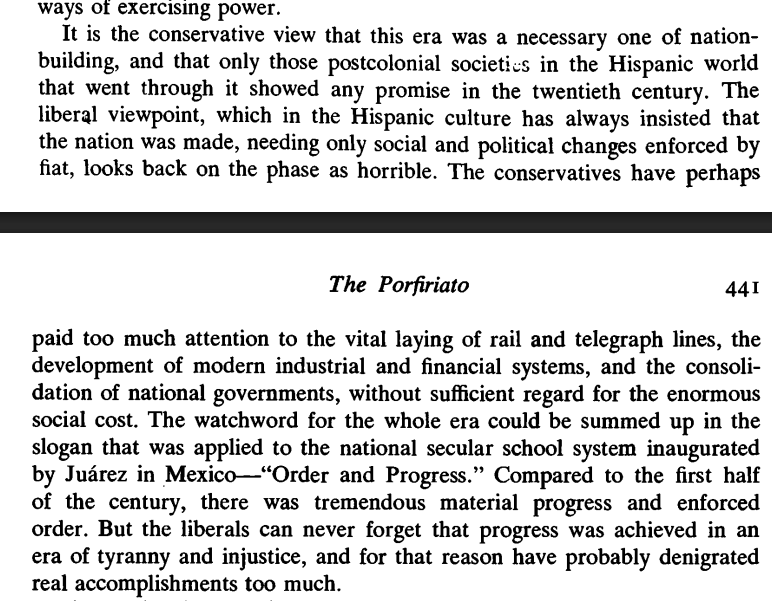
Thread with excerpts from the 'Porfiriato' section of TR Fehrenbach's "Fire and Blood: A History of Mexico" (1973). This was the first era of stability and economic growth in post-independence Mexico, summed up with the slogan "Order and Progress." Image
Independent Mexico's problem was that Mexicans were incapable of setting aside personalisms for truly national institutions; congress, for example, was a joke. Image
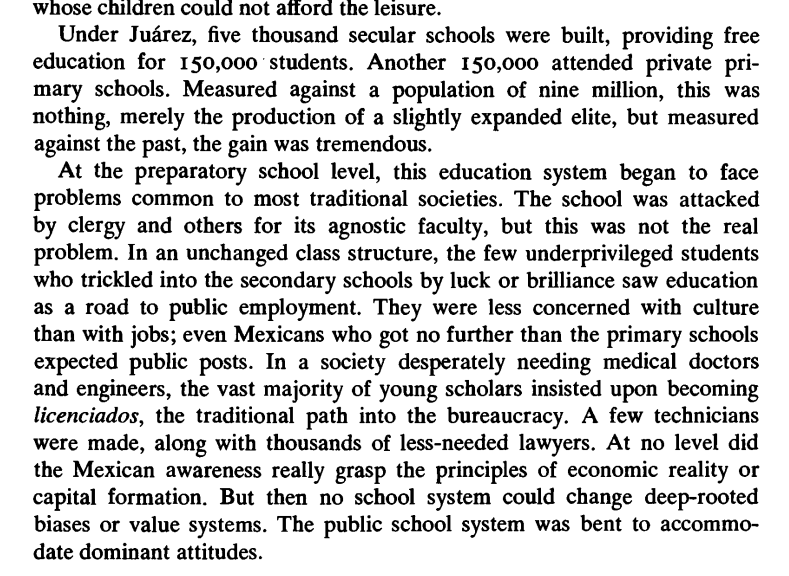
Benito Juarez greatly expanded secular education; but this turned out to be more of a curse than a boon, because the vast majority of people with schooling insisted on government or legal jobs; very few became doctors or engineers or technicians. Image
Porfirio Diaz gained power through the standard procedure (a coup), but turned out to be much more effective than his predecessors. He created a personalist, but flexible and not especially bloody 'national cacique' regime through patronage. Image
Image
He invited in foreign investors and sold mining rights; this required changing Hispanic law to allow for the sale of subsoil resources. Image
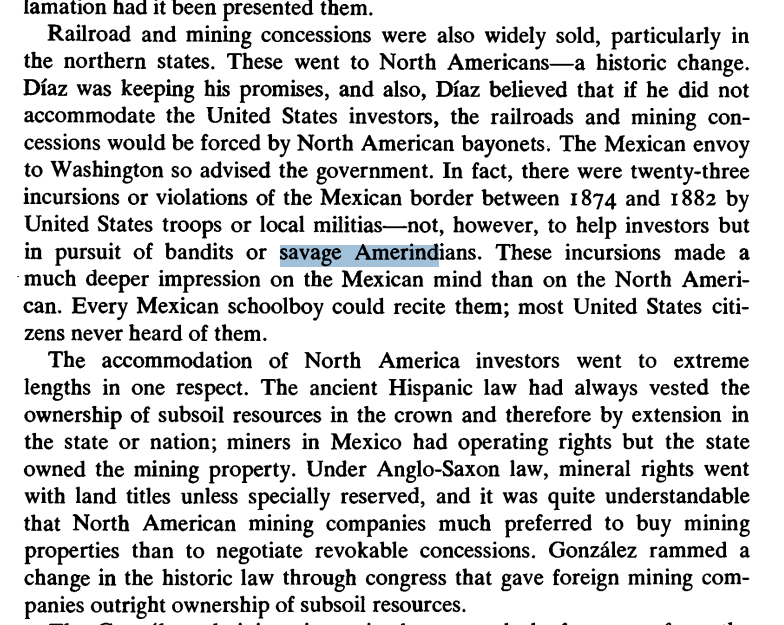
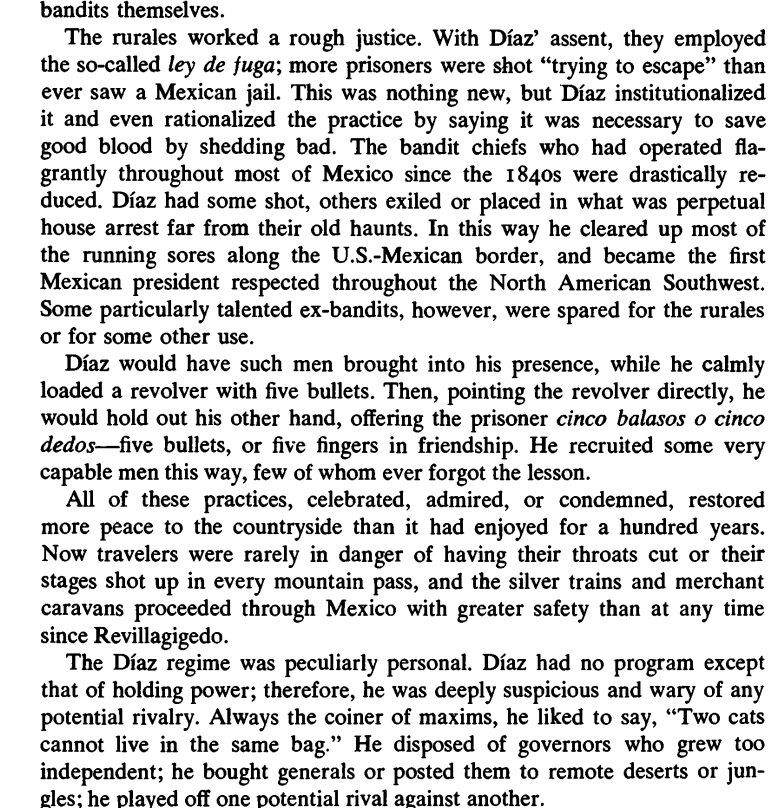
Diaz managed to eliminate Mexico's perennial rural banditry by deputizing some of the bandits to kill the others, recruiting the promising ones. This garnered him American respect. He stayed in power by carefully reducing (usually not killing) potential rivals. Image
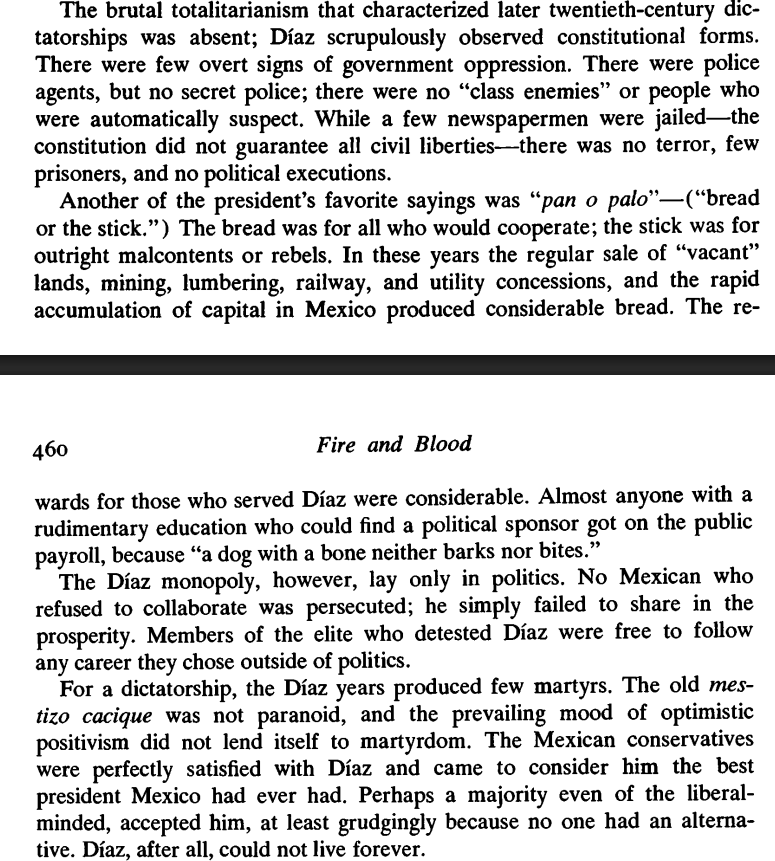
The Porfiriato was not in any way totalitarian and not particularly oppressive; Diaz observed constitutional norms. He monopolized politics, but not other arenas; anti-Diaz elites were free to do other things and he left few martyrs. Image
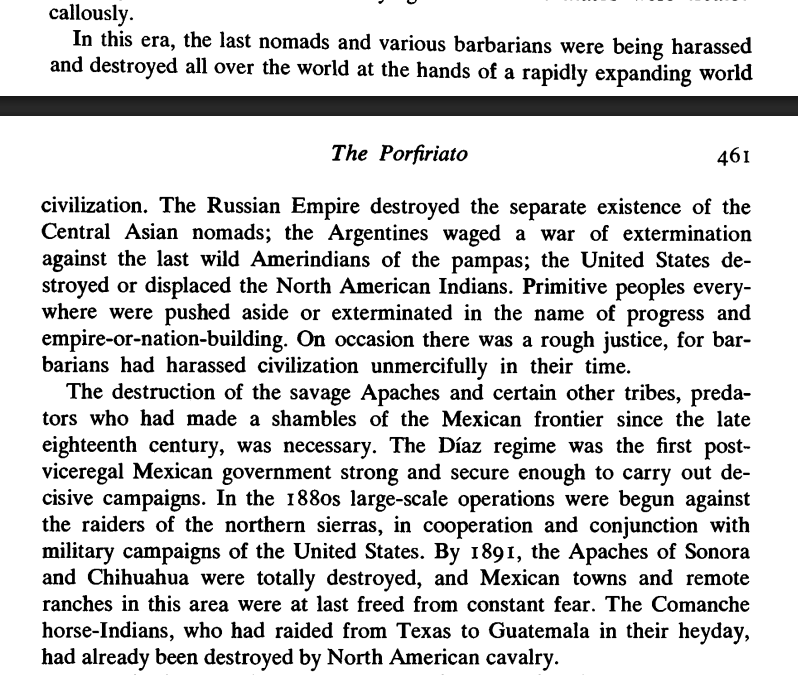
In this era, the last nomads around the world were finally behind defeated by civilization; the Russians in Central Asia, the Argentines in the Pampas, the US in the West, and Mexico with the Apaches in the North, finally securing the Mexican frontier. Image
The peace and economic opportunity of the Porfiriato was able to attract some European immigrants, who brought desperately needed skills and entrepreneurialism; the Catholic ones tended to assimilate into the criollo elite, the Anglos remained separate. Image
Image
The liberal, laissez-faire structure of the Porfiriato, which allowed for the alienation of land, led to land concentration in the countryside; by 1900 only 3% of rural families owned farmland and at least half of the republic belonged to a few thousand families. Image
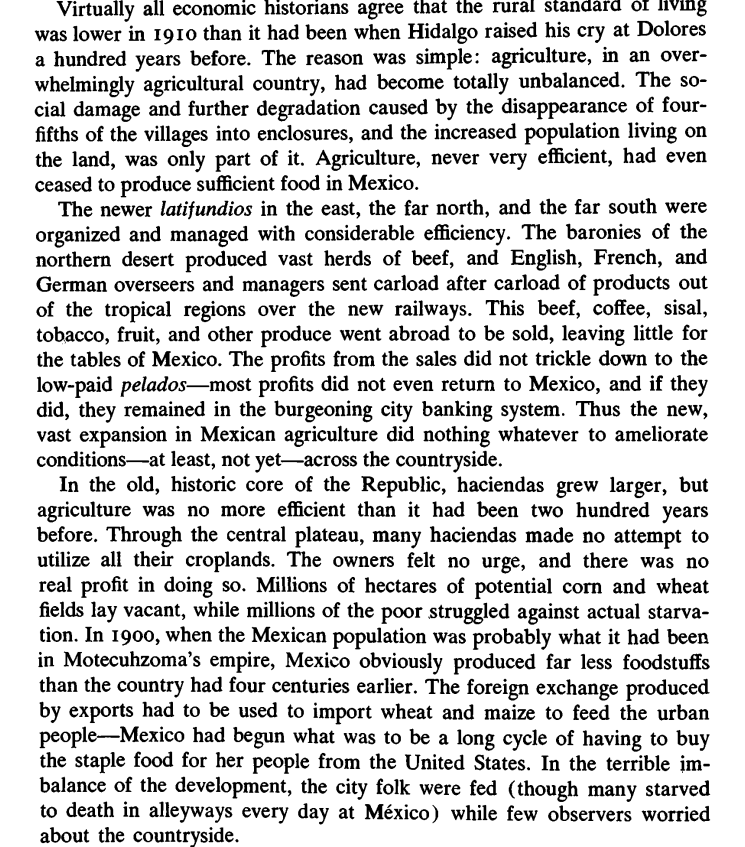
The newer latifundios on the fringes of Mexico (east, north, south), tended to be foreign owned and managed and quite efficient, while the older ones in the Mexican core were no better than 200 years prior. In 1900, Mexico probably produced less food than under Montezuma. Image
The Porfiriato was, for the first time, able to pay Mexico's debts, and enormous capital flowed in from abroad. Image
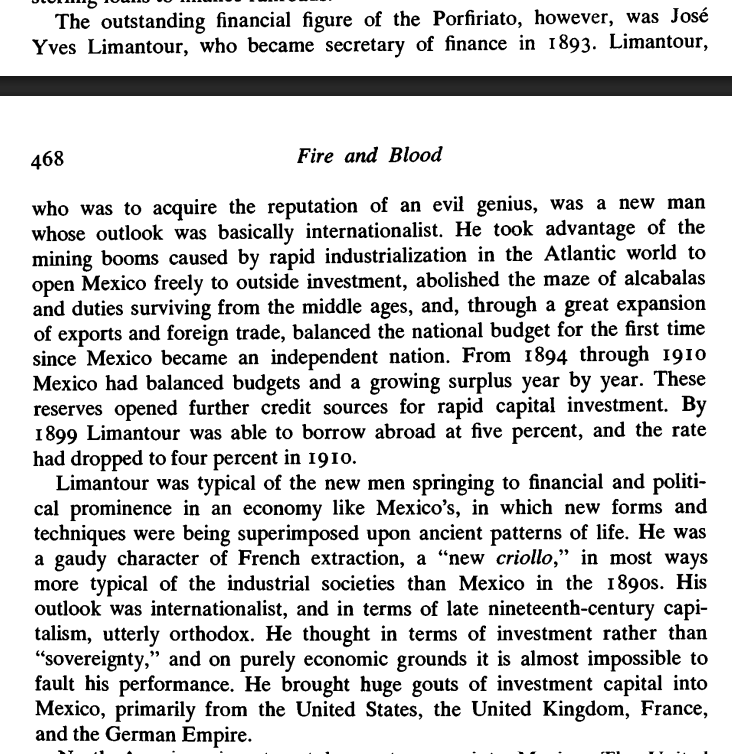
European and North American capitalists transformed the Mexican economy (outside of agriculture), bringing in modern techniques and technology (electricity, mining, waterworks, banking, etc) that could not have been generated locally with massive investments. Image
Exports increased by a factor of 7 between the 1870s and 1910, and for the first time a native group of businessmen came into being, mostly assimilated Europeans or Levantines. No small farmer immigrants arrived, unlike the US, Argentina, or Brazil. Image
The Porfiriato succeeded in stabilizing, modernizing, and developing Mexico for the first time, and managed to preserve Mexican sovereignty. Image
Diaz was popular in the US because he crushed bandits and facilitated trade and investment; Americans only felt the need to intervene in Mexico when Mexico failed to uphold the responsibilities of a civilized nation. Image
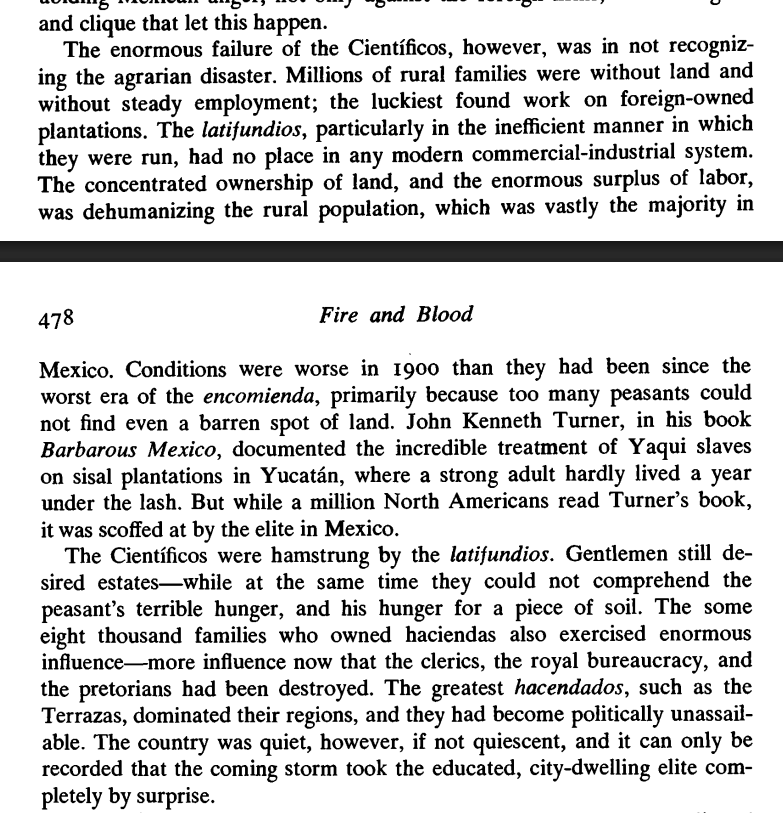
Ultimately, the Porfiriato, despite its massive gains and successfully building a modern economy, failed because it was unable to uplift the rural Mexican masses, who were incredibly poor by world standards, as the population doubled in 30 years. Image
Image
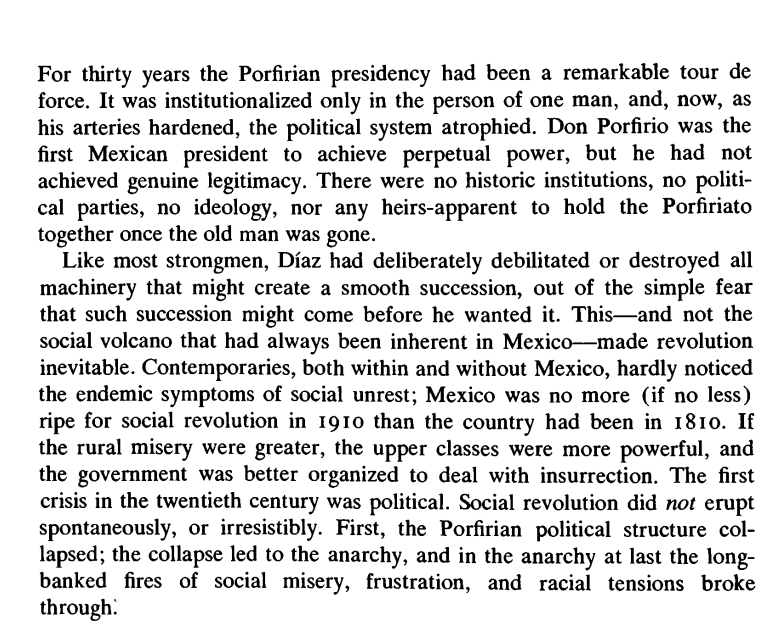
To retain power, Diaz had systematically corrupted other potential power bases (notably the army and state-level governors) as well as any potential mechanisms of succession. This meant that when his time was up, there was no orderly or even swift transfer of power. Image
• • •

Missing some Tweet in this thread? You can try to force a refresh

 

Keep Current with arctotherium

arctotherium Profile picture

Stay in touch and get notified when new unrolls are available from this author!

Read all threads

This Thread may be Removed Anytime!

PDF

Twitter may remove this content at anytime! Save it as PDF for later use!

Try unrolling a thread yourself!

how to unroll video
  1. Follow @ThreadReaderApp to mention us!

  2. From a Twitter thread mention us with a keyword "unroll"
@threadreaderapp unroll

Practice here first or read more on our help page!

More from @arctotherium42

Jun 22
Excerpts from TR Fehrenbach's "Fire and Blood: A History of Mexico" (1973). The Porfiriato gave Mexico a generation of stability and development for the first time since independence. This left Mexico overdue for another civil war: the Mexican Revolution.
One problem was that the Porfirian school system had created a large, literate middle structure (not class). These educated mestizos became dissatisfied due to lack of opportunity; growth was rapid but not rapid enough to absorb them all. Image
The Revolution kicked off in 1910, when Diaz announced he'd won reelection with 99% of the vote. This kicked off an insurgency in Chihuahua, in the mestizo, frontier north. Image
Image
Read 26 tweets
Jun 22
Thread with excerpts from TR Fehrenbach's "Fire and Blood: A History of Mexico" (1973), late 19th century. Like before the war, Mexico after the Mex/Am War was a mess, with many regions sinking into barbarism. Yucatan was the worst, with half the population dying in a race war. Image
Every Mexican president was a Freemason, but Catholicism was still universal and the position of the Church, which retained its royal privileges even in republican Mexico, was a flashpoint. Image
The Mexican Church was immensely wealthy thanks to its tax-advantaged status, and the clergy retained legal privileges. It also collected extremely high fees; one effect of this was to ~abolish marriage among the lower classes. Image
Read 14 tweets
Jun 22
Thread with excerpts from the Mexican-American War section of TR Fehrenbach's "Fire and Blood: A History of Mexico" (1973). Since independence, Mexico had seemingly gone backwards in all respects; in 1840 Mexico was less civilized than it had been. Image
An incident where French warships blockaded Veracruz over nonpayment of debts from unstable and perpetually-bankrupt Mexican governments. The Mexican response: show "Death to the Anglo-Saxons and Jews" and bring back Santa Anna. Image
After the secession of Texas, Mexico appeared to be disintegrating, with the Pacific areas effectively independent, much of the North run by bandits chiefs, and Yucatan seceding. Image
Read 15 tweets
Jun 21
Thread with excerpts from the 'Pretorians' section of TR Fehrenbach's "Fire and Blood: A History of Mexico" (1973). In 1821, postcolonial nation-building seemed easy; the only example was the USA. But the US was homogenous, well-led, free, and already had an identity. Image
Mexico was the reverse, with no history of self-rule, the criollo/casta/indio split, and no great leadership. The two major factions were the 'continuistas' (conservatives) and the 'reformistas' (liberals). Image
Image
Mexico was the reverse, with no history of self-rule, the criollo/casta/indio split, and no great leadership. The two major factions were the 'continuistas' (conservatives) and the 'reformistas' (liberals). Image
Image
Read 20 tweets
Jun 21
Excerpts from TR Fehrenbach's "Fire and Blood: A History of Mexico" (1973) on the Mexican War of Independence. The Mexican criollos were far less impressive than their South American counterparts, and produced no leaders equal to Bolivar or San Martin. Image
Where the South American criollos quickly declared independence upon the French conquest of Spain, the Mexican ones dithered. Acting quickly, the local peninsulares coup'd the government and the criollos accepted it. Image
Image
With the criollos basically accepting Spanish domination, leadership of the independence struggle passed to men like Miguel Hidalgo, who turned it from a (hopefully) bloodless coup to a social and race war. Image
Read 12 tweets
Jun 21
Thread with excerpts from the Colonial New Spain portion of TR Fehrenbach's 'Fire and Blood: A History of Mexico' (1973). His view is that New Spain would have remained permanent divided and stagnant if not for the northern frontier. Image
The true frontier of New Spain was not the thinly-populated and stagnant (almost identical when the Anglos showed up as in the 17th century) New Mexico, but much further to the south, in the arid regions only a little north of the Valley of Mexico. Image
Image
The frontier lacked civilized Indians who could be reduced to slaves, and was instead populated by energetic mestizos and criollos, working owned ranchos for a market rather than owning huge estates for prestige. Image
Read 16 tweets

Did Thread Reader help you today?

Support us! We are indie developers!


This site is made by just two indie developers on a laptop doing marketing, support and development! Read more about the story.

Become a Premium Member ($3/month or $30/year) and get exclusive features!

Become Premium

Don't want to be a Premium member but still want to support us?

Make a small donation by buying us coffee ($5) or help with server cost ($10)

Donate via Paypal

Or Donate anonymously using crypto!

Ethereum

0xfe58350B80634f60Fa6Dc149a72b4DFbc17D341E copy

Bitcoin

3ATGMxNzCUFzxpMCHL5sWSt4DVtS8UqXpi copy

Thank you for your support!

Follow Us!

:(