arctotherium Profile picture
Jun 22 26 tweets 12 min read Read on X
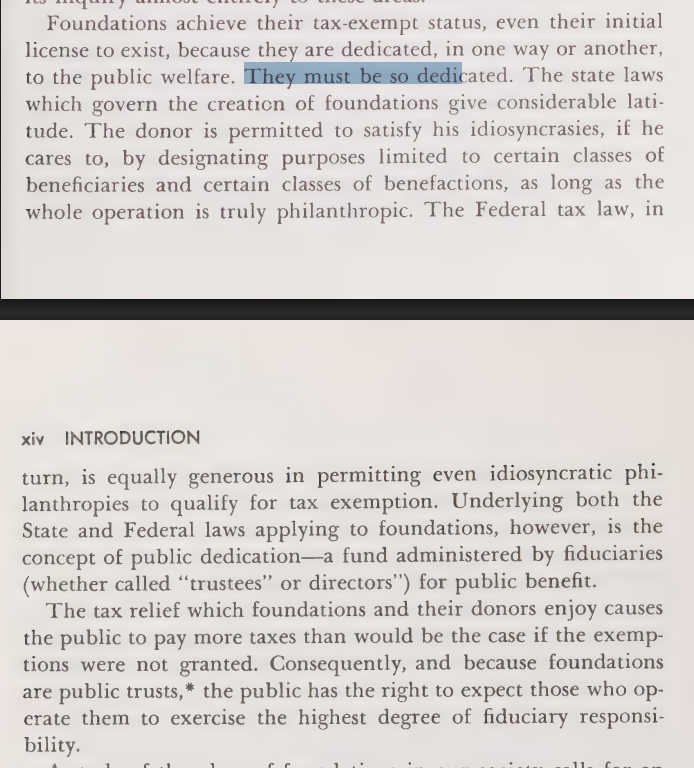
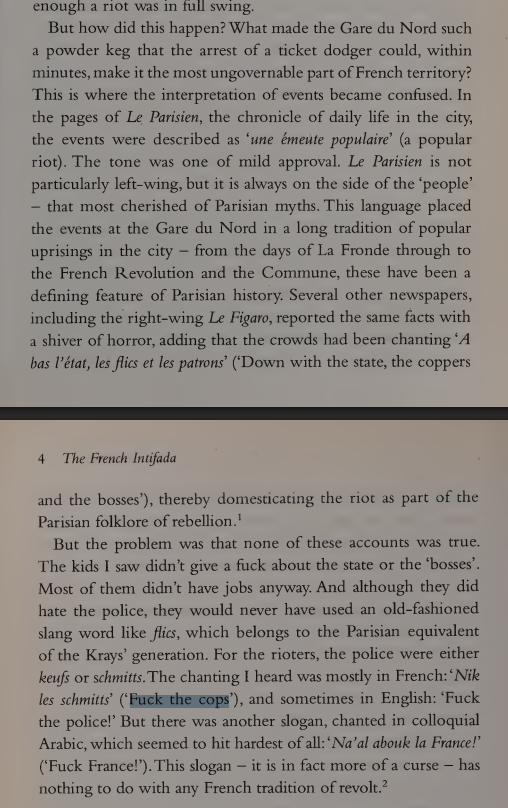
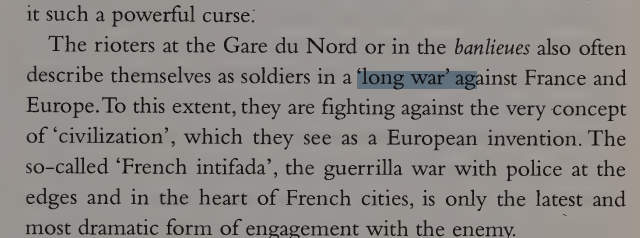
Excerpts from TR Fehrenbach's "Fire and Blood: A History of Mexico" (1973). The Porfiriato gave Mexico a generation of stability and development for the first time since independence. This left Mexico overdue for another civil war: the Mexican Revolution.
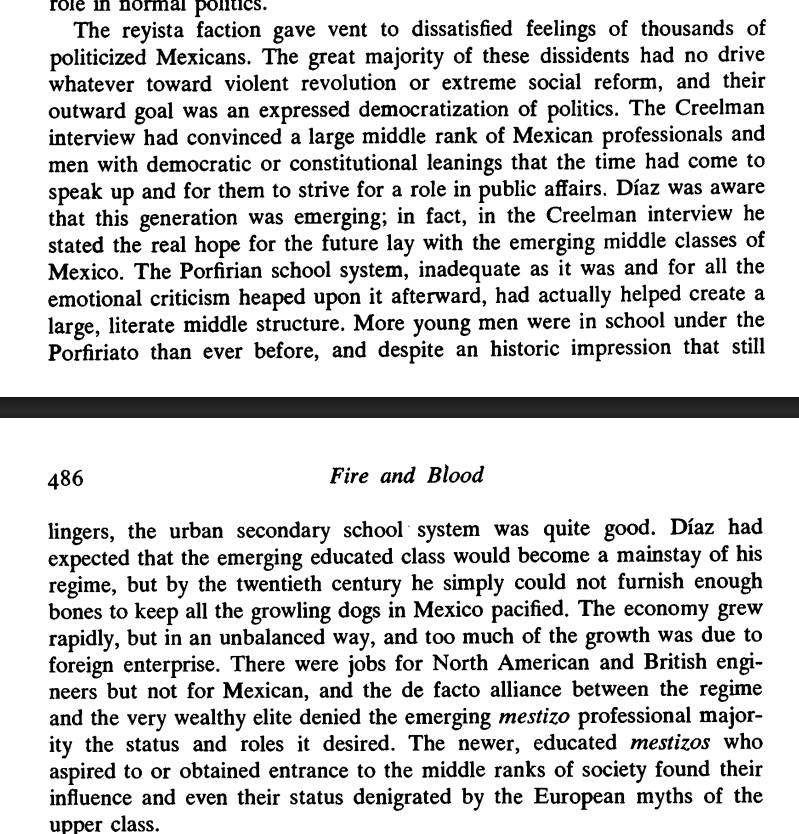
One problem was that the Porfirian school system had created a large, literate middle structure (not class). These educated mestizos became dissatisfied due to lack of opportunity; growth was rapid but not rapid enough to absorb them all. Image
The Revolution kicked off in 1910, when Diaz announced he'd won reelection with 99% of the vote. This kicked off an insurgency in Chihuahua, in the mestizo, frontier north. Image
Image
In the South, in Chiapas, a mestizo named Emiliano Zapato organized indio peasants into an agrarian revolt, killing landlords and seizing the land. Zapata himself was incorruptible and had no desire for power. Image
Image
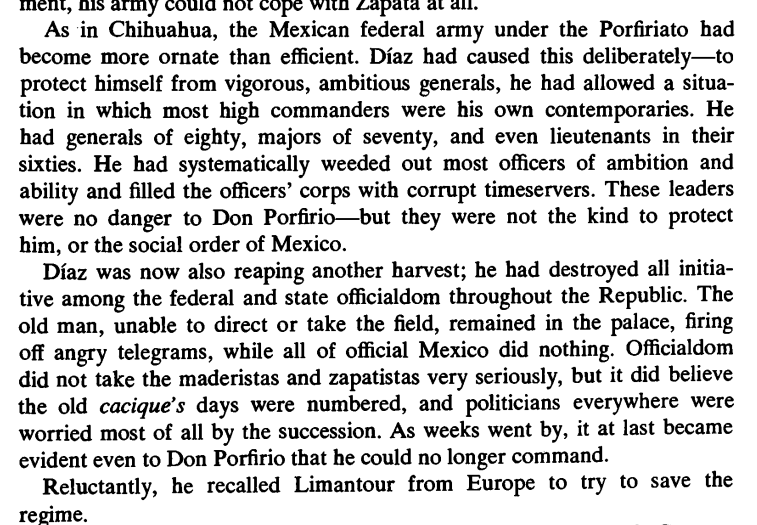
The Mexican army couldn't suppress either revolt because Porfirio had deliberately filled its ranks with old corrupt time-servers so as to prevent ambitious colonels or generals from coup'ing him. Image
Diaz left in 1911, abdicating in favor of his 1910 election opponent Madero, and most Mexicans believed the revolution had succeeded and been mostly bloodless. Image
But Madero was a constitutional liberal, like Diaz (only he believed in democracy and wanted no re-election); the Zapatistas, who wanted mass expropriation and redistribution of land, not democracy, did not lay down their arms. Image
Image
American sympathy might have saved Madero, but Madero was extremely nationalistic and rhetorically hostile to the US, which, tragically, led the US to fail to support his government. Image
Image
Image
As is traditional, General Huerta coup'd Madero, possibly with the assent of the US ambassador Wilson, and had him shot. The Taft admin refused to recognize the Huerta govt as legitimate thanks to this assassination. Image
Image
This coup shattered the legitimacy of the central government, and the northern frontier rose against Huerta, buoyed by a massive young population (infant mortality plummeted during the Porfiriato). Image
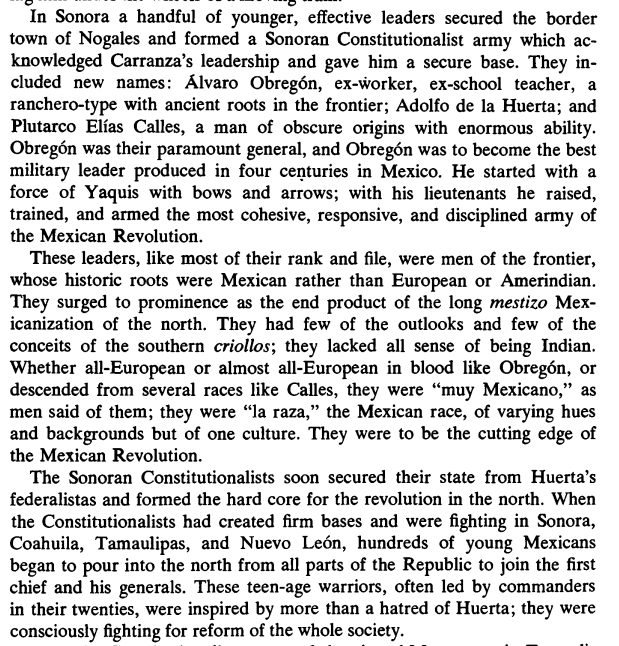
The revolutionaries were officially led by Don Venustiano Carranza, a constitutionalist, but many others sprang up, among them Alvaro Obregon, the most effective military man of the Mexican Revolution. Image
The leaders were men of the northern frontier, Mexican mestizos rather than Europeans or Amerindians. Image
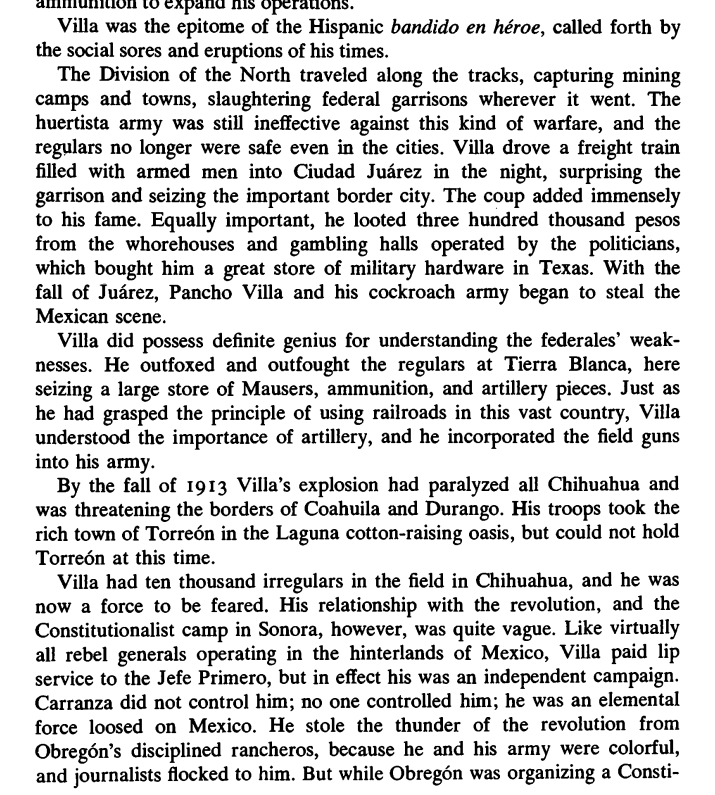
The most famous, due to his charisma, was Pancho Villa, who was basically a bandit operating independently from Carranza. The Villistas robbed, raped, and tortured more or less randomly, except for foreign women (always raped) and Chinese (always killed). Image
Image
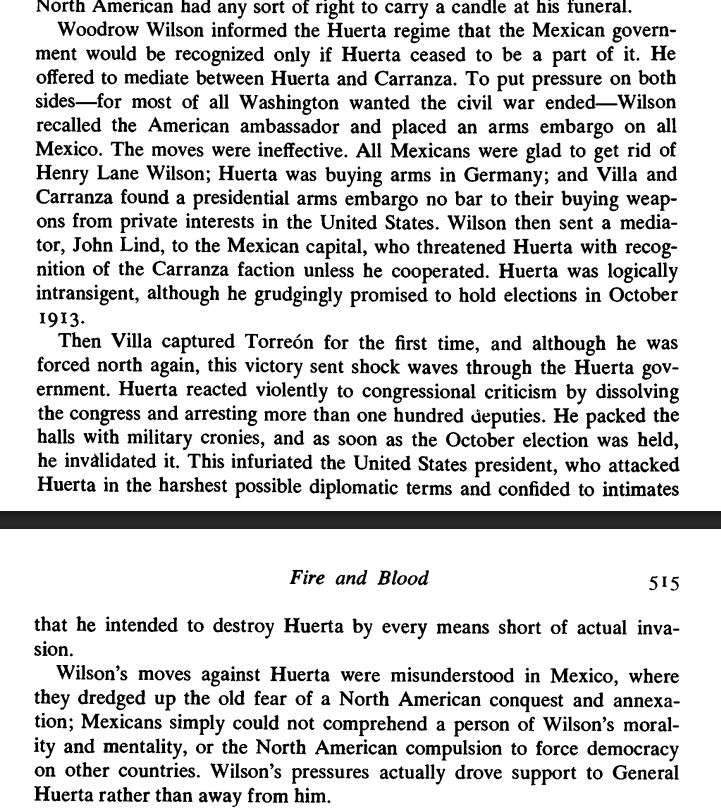
However, Huerta still had the army, the major cities, and the ports through which he could import modern weapons. He might've won, but Woodrow Wilson hated him as an assassin, prioritizing morality over stability or US investments, and embargo'd his govt. Image
Image
Huerta was OK with the US, and the Constitutionalists very anti-American, but Wilson authorized sales to the latter on moral grounds. He also managed to blunder into occupying Veracruz; war was only averted by South American arbitration. Image
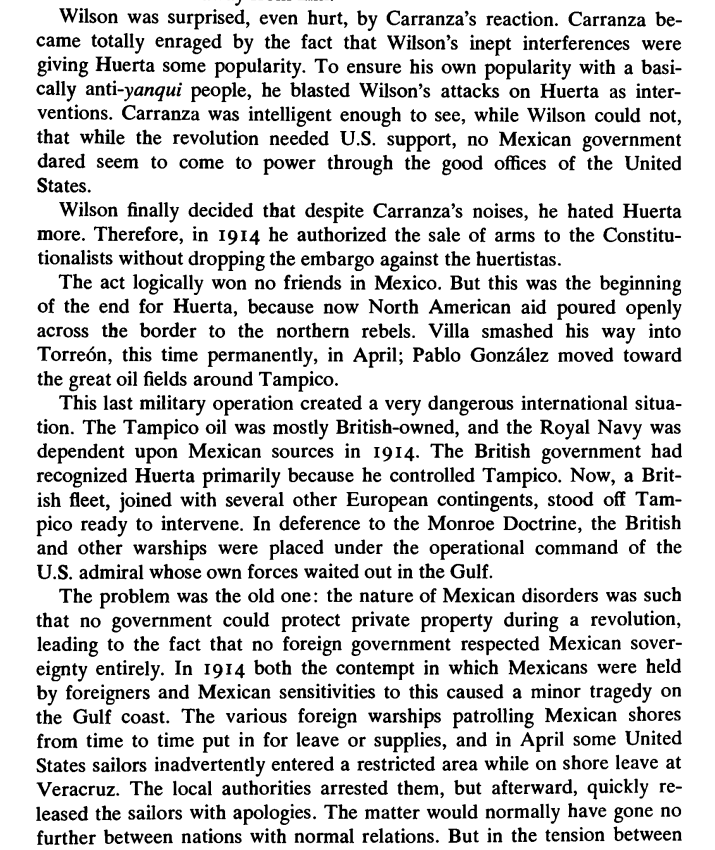
Image
Image
Cut off from arms, the Huerta regimes lost several key battles to the Constituionalists, Zapata, and Villa, and Obregon took Mexico City. Image
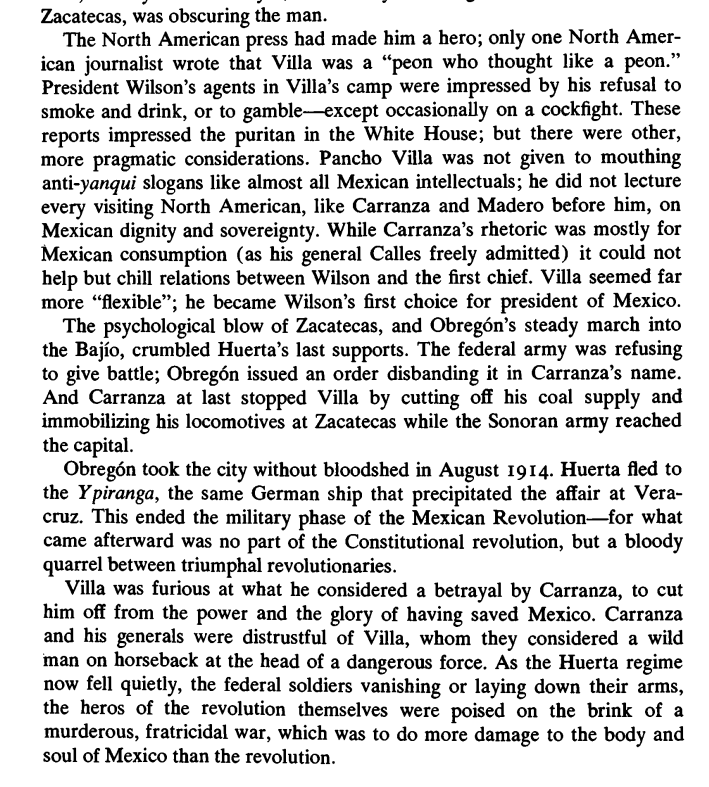
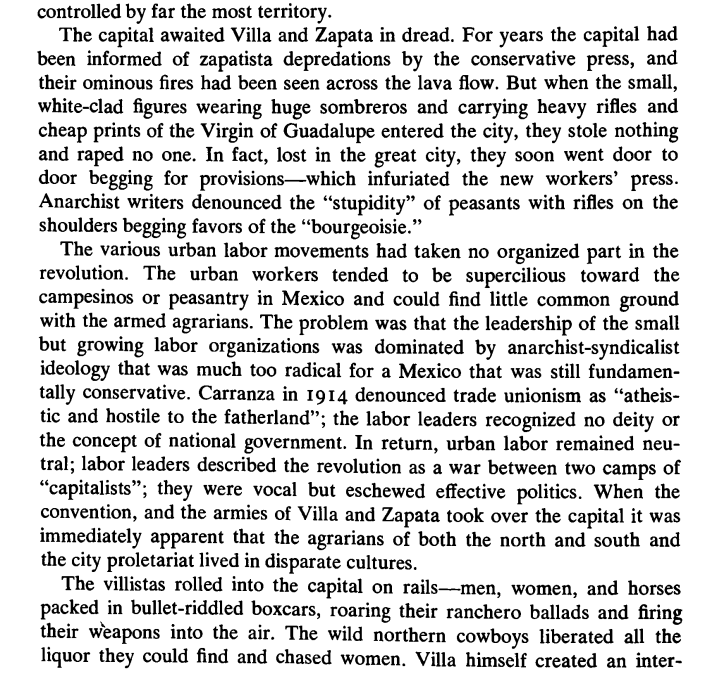
The Northerners held the people of the capital in contempt for their passivity. They'd played no role in the revolution, and all three revolutionary forces were rural and agrarian, with little in common with organized labor. Image
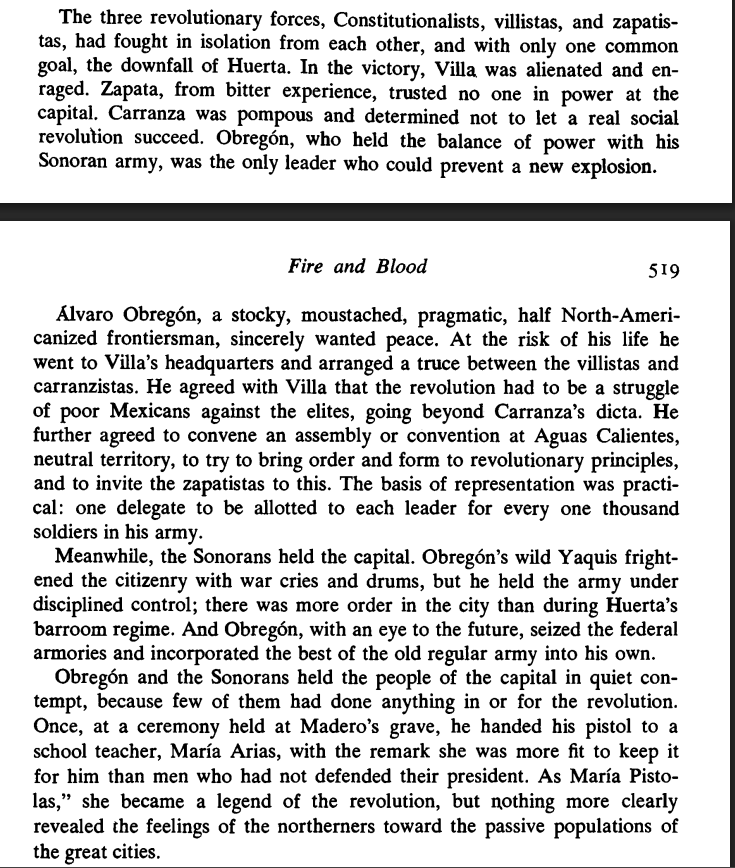
Image
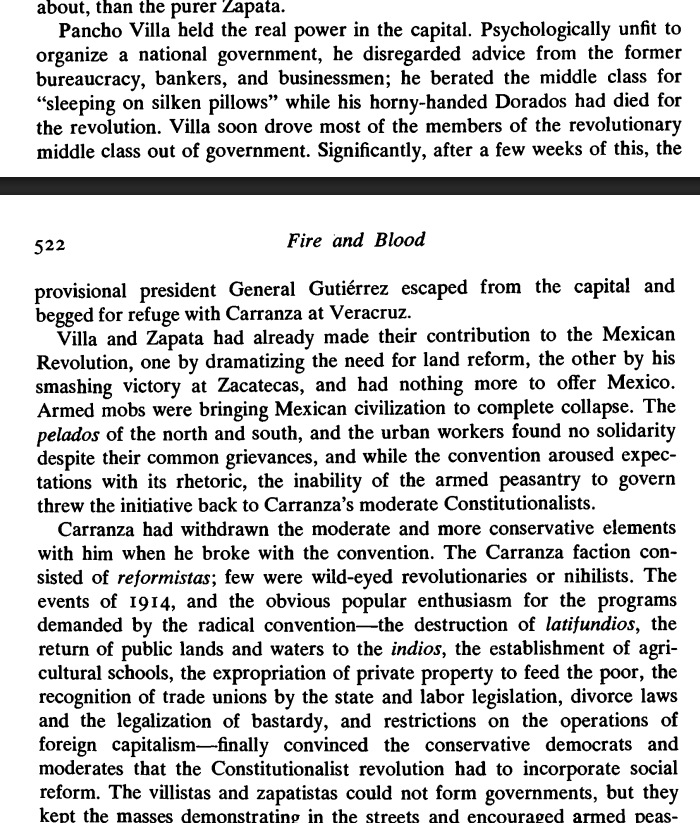
When the Villistas arrived in the capital, they looted it and dominated it, but, as bandits, couldn't really rule. Still, they and the Zapatistas made the masses an ever-present threat, and forced a social revolution on Carranza's constitutionalists. Image
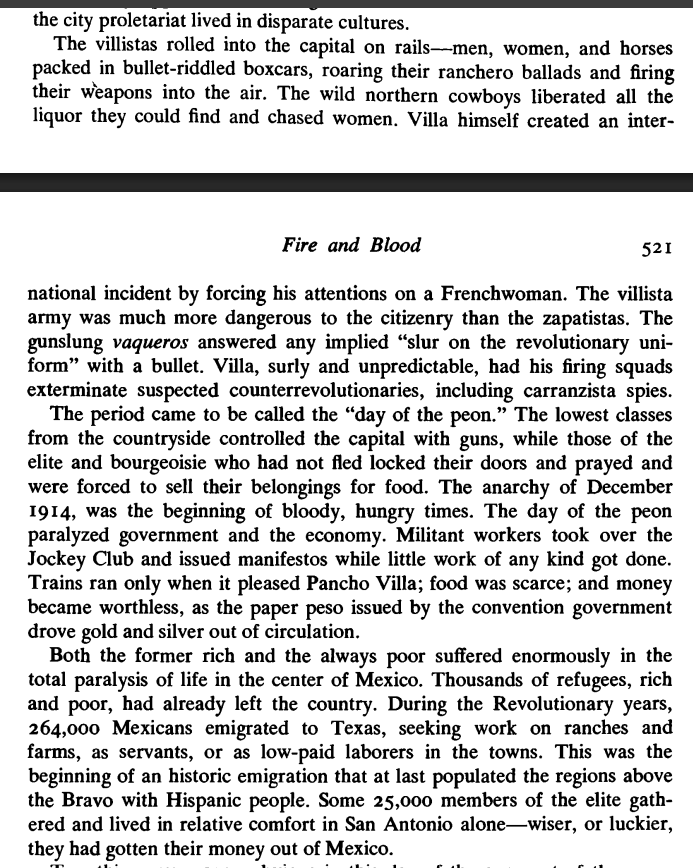
Image
Image
After the Zapatistas and Villistas ate the capital bare and were forced to withdraw, Obregon moved in, organized a new army with 'red battalions' from the urban proletariat, and took the fight to Villa, defeating him in a bloody battle of 50,000. Image
Demographically and economically, the Mexican Revolution/Civil War was a calamity. Perhaps 2M Mexicans, out of a population of 12M, died or fled. Image
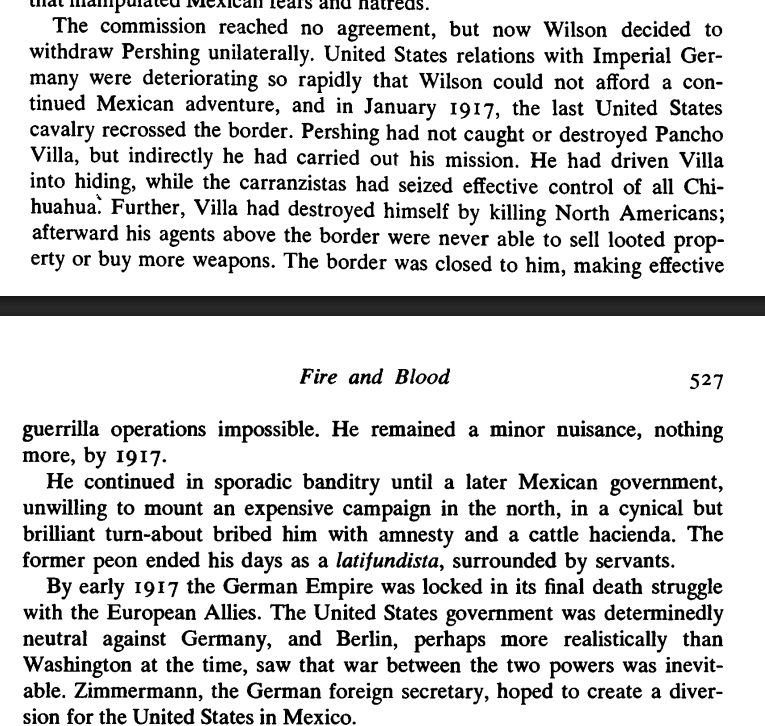
The defeated Villa tried one last role of the dice: raiding the United States to draw an intervention which might smash the Carranza government. But Carranza handled it skillfully, permitting an intervention but so regulated it didn't anger nationalist Mexicans. Image
Image
Attacking Americans destroyed Villa; he could no longer buy arms, sell loot, or seek refuge over the border. He remained a minor bandit until the Carranza bought him off with an hacienda (and he was later murdered by relatives of some of the women he'd raped). Image
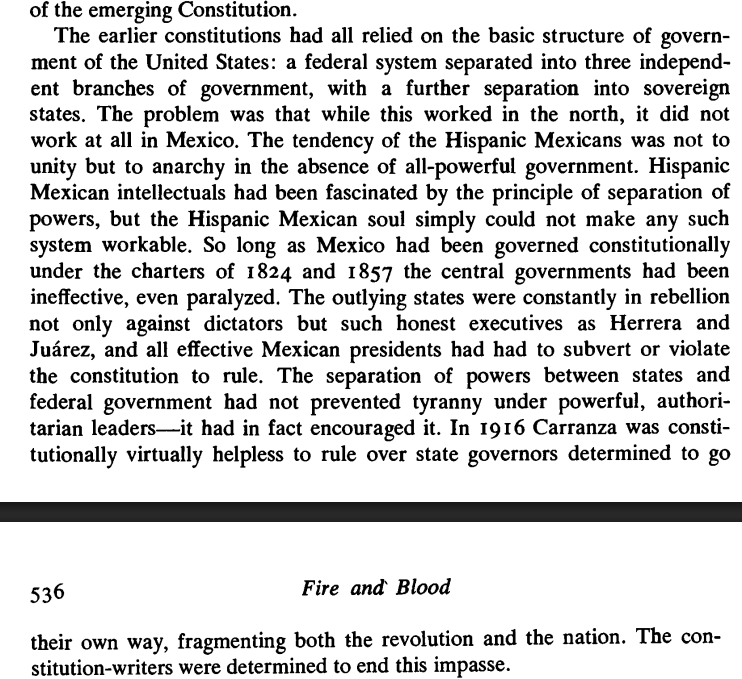
The Constitutionalists/Carranza had won, but they had to write a new Constitution. Previous Mexican constitutions copied the US, but this did not work in Mexico, as Mexicans tended not to unity but anarchy in the absence of an all-powerful government. Image
Image
Fragmenting power between federal and state and between three branches failed in Mexico; it did not prevent tyranny and simply paralyzed national governments unless subverted (eg Diaz). So the new constitution created an all-powerful President as effectively elected monarch. Image
Image
Rather than try to limit the executive and center to prevent tyranny, he was given near-absolute power, with the only condition being "no reelection." Image
The Mexican mind could not cope with true separation of powers, but it did understand hierarchy. Image

• • •

Missing some Tweet in this thread? You can try to force a refresh

 

Keep Current with arctotherium

arctotherium Profile picture

Stay in touch and get notified when new unrolls are available from this author!

Read all threads

This Thread may be Removed Anytime!

PDF

Twitter may remove this content at anytime! Save it as PDF for later use!

Try unrolling a thread yourself!

how to unroll video
  1. Follow @ThreadReaderApp to mention us!

  2. From a Twitter thread mention us with a keyword "unroll"
@threadreaderapp unroll

Practice here first or read more on our help page!

More from @arctotherium42

Jun 22
Thread with excerpts from the 'Porfiriato' section of TR Fehrenbach's "Fire and Blood: A History of Mexico" (1973). This was the first era of stability and economic growth in post-independence Mexico, summed up with the slogan "Order and Progress." Image
Independent Mexico's problem was that Mexicans were incapable of setting aside personalisms for truly national institutions; congress, for example, was a joke. Image
Benito Juarez greatly expanded secular education; but this turned out to be more of a curse than a boon, because the vast majority of people with schooling insisted on government or legal jobs; very few became doctors or engineers or technicians. Image
Read 18 tweets
Jun 22
Thread with excerpts from TR Fehrenbach's "Fire and Blood: A History of Mexico" (1973), late 19th century. Like before the war, Mexico after the Mex/Am War was a mess, with many regions sinking into barbarism. Yucatan was the worst, with half the population dying in a race war. Image
Every Mexican president was a Freemason, but Catholicism was still universal and the position of the Church, which retained its royal privileges even in republican Mexico, was a flashpoint. Image
The Mexican Church was immensely wealthy thanks to its tax-advantaged status, and the clergy retained legal privileges. It also collected extremely high fees; one effect of this was to ~abolish marriage among the lower classes. Image
Read 14 tweets
Jun 22
Thread with excerpts from the Mexican-American War section of TR Fehrenbach's "Fire and Blood: A History of Mexico" (1973). Since independence, Mexico had seemingly gone backwards in all respects; in 1840 Mexico was less civilized than it had been. Image
An incident where French warships blockaded Veracruz over nonpayment of debts from unstable and perpetually-bankrupt Mexican governments. The Mexican response: show "Death to the Anglo-Saxons and Jews" and bring back Santa Anna. Image
After the secession of Texas, Mexico appeared to be disintegrating, with the Pacific areas effectively independent, much of the North run by bandits chiefs, and Yucatan seceding. Image
Read 15 tweets
Jun 21
Thread with excerpts from the 'Pretorians' section of TR Fehrenbach's "Fire and Blood: A History of Mexico" (1973). In 1821, postcolonial nation-building seemed easy; the only example was the USA. But the US was homogenous, well-led, free, and already had an identity. Image
Mexico was the reverse, with no history of self-rule, the criollo/casta/indio split, and no great leadership. The two major factions were the 'continuistas' (conservatives) and the 'reformistas' (liberals). Image
Image
Mexico was the reverse, with no history of self-rule, the criollo/casta/indio split, and no great leadership. The two major factions were the 'continuistas' (conservatives) and the 'reformistas' (liberals). Image
Image
Read 20 tweets
Jun 21
Excerpts from TR Fehrenbach's "Fire and Blood: A History of Mexico" (1973) on the Mexican War of Independence. The Mexican criollos were far less impressive than their South American counterparts, and produced no leaders equal to Bolivar or San Martin. Image
Where the South American criollos quickly declared independence upon the French conquest of Spain, the Mexican ones dithered. Acting quickly, the local peninsulares coup'd the government and the criollos accepted it. Image
Image
With the criollos basically accepting Spanish domination, leadership of the independence struggle passed to men like Miguel Hidalgo, who turned it from a (hopefully) bloodless coup to a social and race war. Image
Read 12 tweets
Jun 21
Thread with excerpts from the Colonial New Spain portion of TR Fehrenbach's 'Fire and Blood: A History of Mexico' (1973). His view is that New Spain would have remained permanent divided and stagnant if not for the northern frontier. Image
The true frontier of New Spain was not the thinly-populated and stagnant (almost identical when the Anglos showed up as in the 17th century) New Mexico, but much further to the south, in the arid regions only a little north of the Valley of Mexico. Image
Image
The frontier lacked civilized Indians who could be reduced to slaves, and was instead populated by energetic mestizos and criollos, working owned ranchos for a market rather than owning huge estates for prestige. Image
Read 16 tweets

Did Thread Reader help you today?

Support us! We are indie developers!


This site is made by just two indie developers on a laptop doing marketing, support and development! Read more about the story.

Become a Premium Member ($3/month or $30/year) and get exclusive features!

Become Premium

Don't want to be a Premium member but still want to support us?

Make a small donation by buying us coffee ($5) or help with server cost ($10)

Donate via Paypal

Or Donate anonymously using crypto!

Ethereum

0xfe58350B80634f60Fa6Dc149a72b4DFbc17D341E copy

Bitcoin

3ATGMxNzCUFzxpMCHL5sWSt4DVtS8UqXpi copy

Thank you for your support!

Follow Us!

:(