I’ve been an orthopedic surgeon for 30 years. The thing I watch happen to people — more than any injury or surgery — is what I call the narrowing.
Most of my patients have no idea it’s happening. They think it’s just aging. It’s not...
The narrowing is the slow shrinking of what your body allows you to do — or what you assume your body can or should be doing at your age. You used to carry four grocery bags. Now you take two. You used to sit on the floor with the grandkids. Now you sit on the couch.
Nobody intentionally decides to narrow their life. Your body quietly loses some capacity, your daily choices adjust to the loss, and within a few years, the smaller version is your new normal.
Patients tell me about the narrowing every single day. They just don’t use that word. They say, “I can’t do what I used to do.” Or they say, “That’s just what happens at my age.” And they say it as if it’s a law of physics.
Yes — some decline is real. VO2 max drops. Max heart rate drops. Strength drops. Power drops faster than strength!! Proprioception drops.
But the unavoidable decline is only a small fraction of what most people are actually losing. The rest — the bigger part, the part that turns a sixty-year-old into a frail seventy-year-old — is not aging. It is disuse.
The cruelest part is that people normalize it. They don’t question it. They talk about capacities they’ve lost as if losing them was scheduled.
Once the narrowing starts, it accelerates on its own. You stop lifting heavy things. Your muscles lose fast-twitch fibers. You get weaker. You lift even less. You lose more. The loss feels like aging. You accept it. The loop tightens.
Again... yes, VO2 max declines about 10% per decade in sedentary adults. Strength declines slowly starting in the forties. Power declines about twice as fast as strength after fifty. Bone density drops. Balance degrades.
Get over it — you still have agency over all of these.
The slope and severity of each of those declines are profoundly modifiable with training. The sedentary decline curves are not the same as the human decline curves.
They are the untrained decline curves.
Trained adults in their seventies routinely outperform untrained adults in their fifties. The body remains responsive to training well into the seventies and eighties. This is one of the best-established findings in the aging literature. Almost nobody’s doctor tells them about it.
The patients who reverse the narrowing are not the ones with the best genetics, the best knees, or the best circumstances. They are the ones who decided to do something. Something made them stop accepting the losses as inevitable, and they started doing things differently.
For many of you... Most of the narrowing in your life right now is reversible to some degree. I have watched it happen in thousands of patients. It is not a miracle. It is just the body doing what the body does when you start asking it to do something again. The door you thought had closed is usually still open.
I am not a one-off. I am a sixty-three-year-old who decided not to let my life narrow, and who did the specific work to back up the decision, for long enough that the work is now visible. You can do this too. At any age, start where you are...
I saw this freight train coming nearly 2 decades ago... I was lucky to do so. I recently wrote a long-form post about how I train as a Midlife Athlete to minimize the chances that I will lose more than age alone will take from me... the link is below.
Six Things I See in My ‘Strongest’ 80-Year-Old Patients
I am 63 now, and after three decades as an orthopedic surgeon, I have examined thousands of people in their eighties. Some arrive frail and afraid, others walk in straighter and more confident than patients half their age.
They’re still skiing, still gardening, still picking up grandchildren without a second thought. The gap between those two groups is not luck, and it is rarely genetics alone. The same patterns keep showing up in those who are thriving.
Here is what they have in common. The most important reasons are lower down in the list…
1. They never stopped moving. The strongest 80-year-olds in my office did not start exercising at 79. They simply never quit. There may have been a busy stretch, an injury, a hard year, but movement always came back, because it was part of who they were rather than a program they were on. Perhaps they were dancers, farmers, or a postal worker who enjoyed walking on his lunch break. The body honors that kind of consistency. Decades of regular, ordinary movement leave a margin of strength and capacity that a frightened sedentary body simply does not have.
2. They kept lifting something heavy. Almost none of them would call themselves weightlifters, but the ones who stayed strong kept asking their muscles to work against real resistance. Carrying, climbing, hauling, digging, or actual strength training, the form mattered less than the fact that they kept loading their muscles and bones well into later life. The people who guarded both are the ones still standing tall.
Seven Things This 63 Year Old Surgeon Would Tell My 40-Year-Old Self
I am 63 now, and I spend my days as an orthopedic surgeon watching how people's earlier choices show up in their bodies decades later. I see it in my college friends, high school buddies, and patients that I have known for 20+ years. If I could sit across from myself at 40, here is what I would want that man to understand. None of what follows is complicated, and all of it compounds over the decades… either against you… or in your favor. You are largely in control.
1. Your health is the foundation, not the reward. Most of us treat fitness, sleep, and strength as things we will get to once the real work is settled. The problem is that health is the one asset you cannot easily buy back later at any price. You can rebuild a career, recover from a bad investment, and repair most mistakes given enough time. The capacity you let slide in your forties and fifties is far harder to reclaim, and some of it does not come back at all. Invest in it now.
2. Strength buys you freedom later. Muscle, balance, and aerobic capacity are not about how you look in a mirror at 40. They are about whether you can carry your own groceries, get up off the floor, and stay independent at 80. I see the people who built that capacity early, and I see the ones who did not, and the difference decades later is enormous. The strength you build now is the freedom you are banking for your future self.
The Most Painful Shoulder Conditions:
Many folks think that severe pain means something must be torn.
But... in patients with one of the three most painful shoulder conditions, there's nothing torn at all.
After 30 years, it's safe to say that the three most painful shoulder conditions I see have nothing to do with a rotator cuff or labral tear.
These patients are often in far more pain than someone with a massive rotator cuff tear, and I can usually identify them before I even begin the examination because of how they hold themselves, how miserable they look, and how they move into the exam room.
Calcific tendinitis occurs when calcium deposits form within the rotator cuff tendon. When those deposits start to resorb, the inflammatory reaction can be dramatic. Patients come in unable to move the arm at all, unable to sleep, unable to find a single position that doesn't make it worse.
The pain comes on fast, sometimes overnight, and it can be relentless. On an X-ray, you can see the calcium deposit sitting in the tendon, and yet the tendon itself is often completely intact.
Luckily, most of these can be washed out with a needle under ultrasound and do not require surgery.
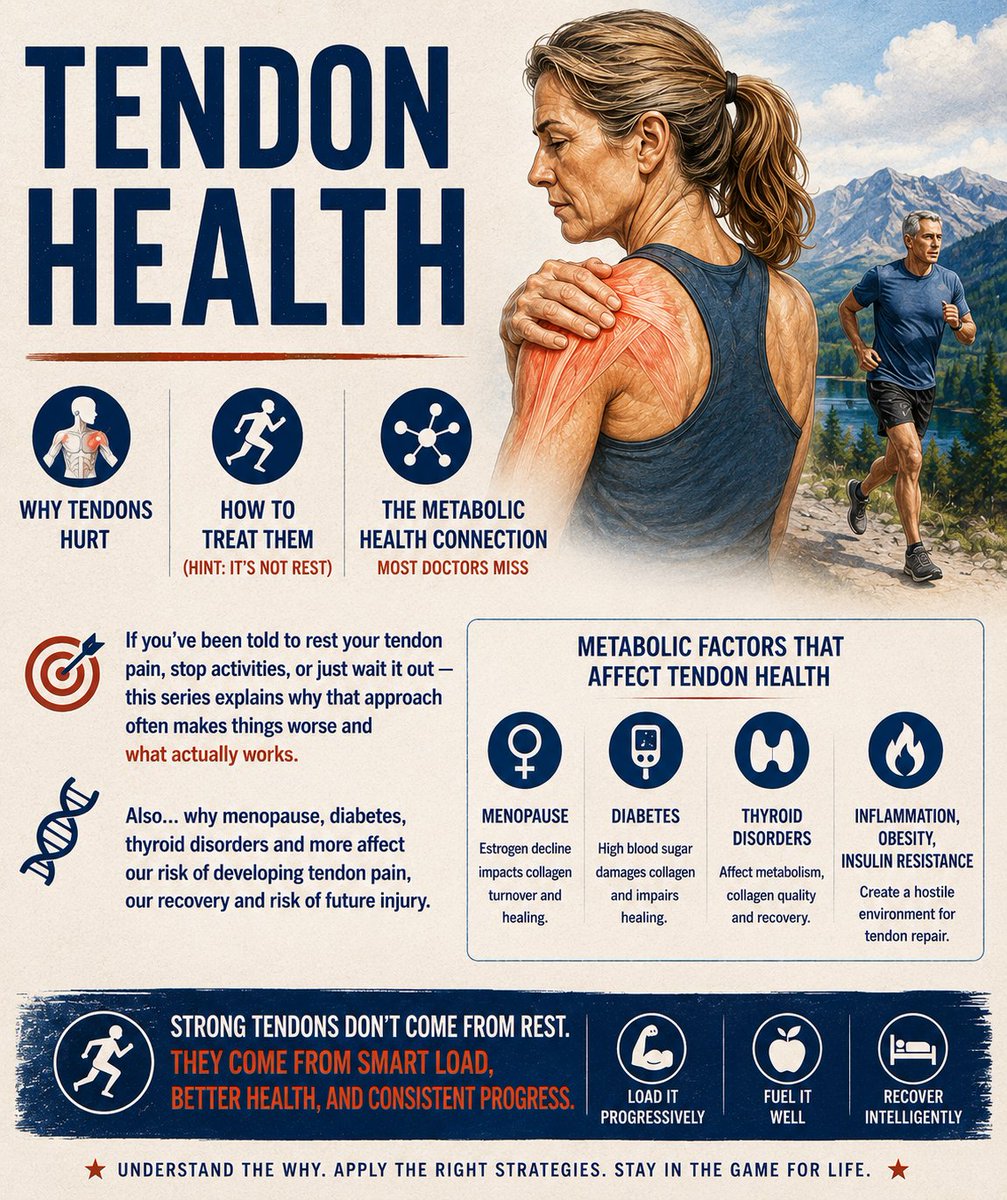
I have probably written more about tendons in the past year than most surgeons have written in their careers. I do this because tendon disorders are among the most common issues I see in the office.
You will need to know this stuff at some point.
Also... Don't think that because of severe pain, something is torn. Let's do this...
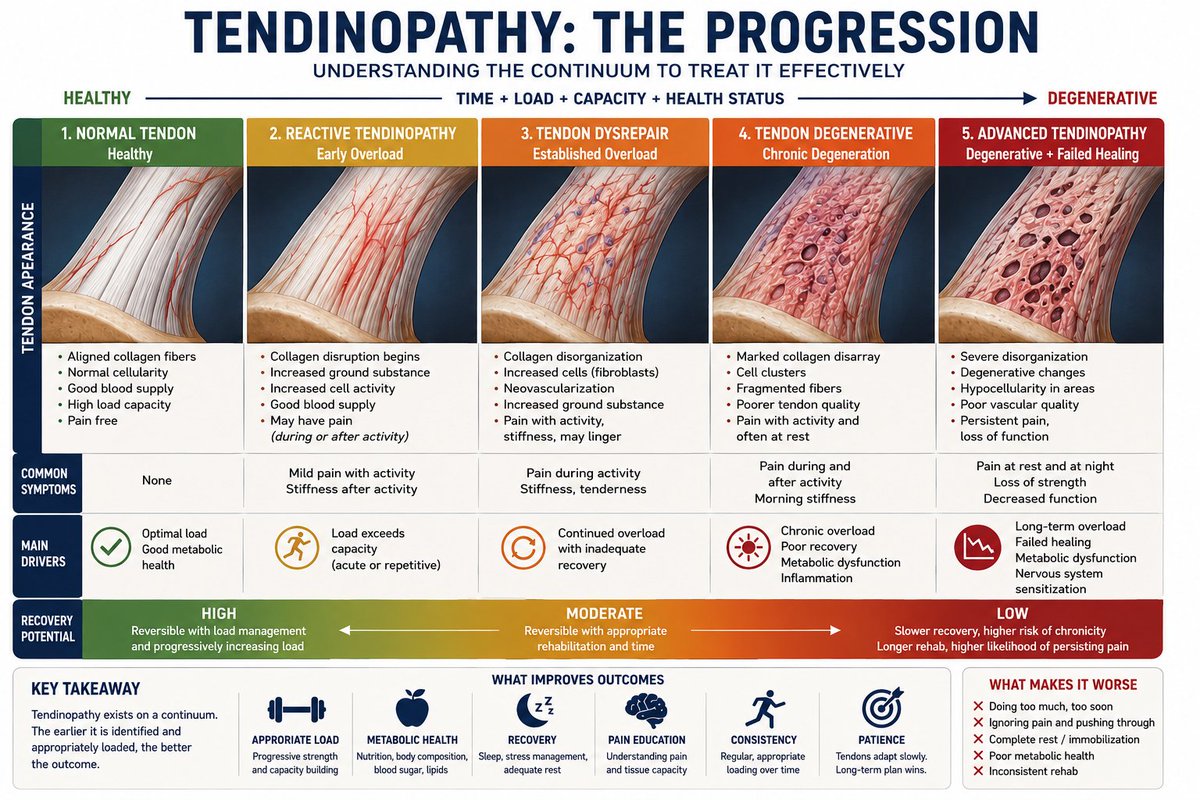
Most tendon pain is not caused by a single traumatic event. Tendinopathy is the most common cause of tendon pain. It is a failed response to loading over time. Simply put... Your tendon was asked to do more than it was adapted to handle, and the rate of breakdown exceeded the rate of repair.
This can happen to someone sedentary who tended to their garden in the spring... or a runner whose achilles was used to 20mpw, and now they decided to run 40mpw.
The tendinopathy process occurs on a spectrum... from a reactive stage that is usually reversible to a degenerative stage where the tissue has changed structurally but can still be managed effectively.
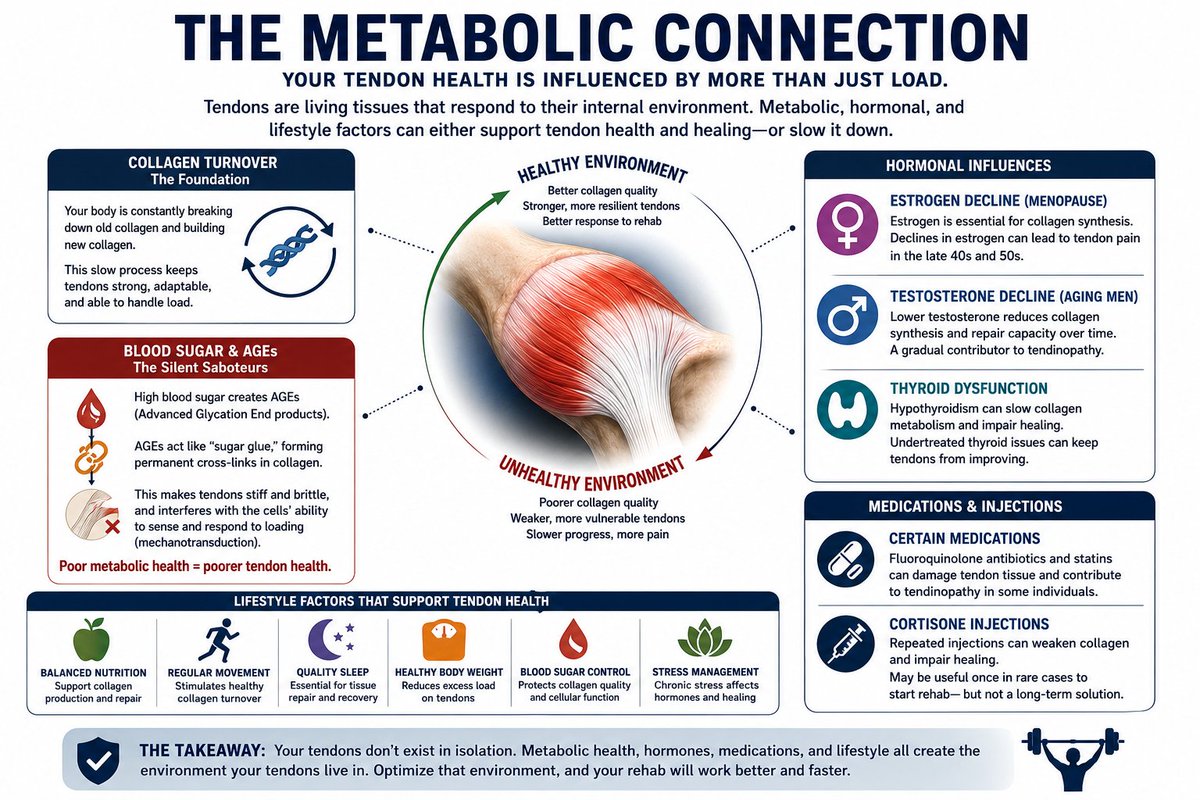
Your overall health has a significant role in your risk for developing tendon-related issues. Your tendons do not exist in isolation from the rest of your systemic physiology. Elevated blood sugar leads to collagen cross-linking (via AGEs) that makes tendons stiffer and more brittle.
Declining estrogen and testosterone reduce collagen turnover.
Elevated uric acid and dyslipidemia are both associated with increased tendon disease.
Certain medications, including fluoroquinolone antibiotics and repeated cortisone injections, can directly weaken tendon tissue.
If your tendon issue is not responding to rehab alone, your metabolic health is the next place to look.
The Frozen Shoulder... a thread.
A frozen shoulder is one of the most misunderstood conditions in orthopedics. It is not purely a mechanical problem. It is a metabolic one. The shoulder capsule becomes a target of systemic inflammation, hormonal disruption, and glycemic dysfunction. Most people, and some surgeons, still treat it as if something is stuck and just needs to be loosened... Properly managing this and the contributors is essential to resolving it.
Perimenopausal women are disproportionately affected, and we need to look at the receptor-level interactions.
Estrogen acts through GPER to suppress the PI3K/AKT signaling pathway, thereby preventing fibroblast activation and blocking progression to fibrosis.
When estrogen drops, that brake is removed. A Duke Health study found that postmenopausal women not on HRT had 99% greater odds of developing frozen shoulder compared to those who were.
Diabetics develop frozen shoulder five times more often than the general population. Their version is different. It is more severe, longer-lasting, and frequently incomplete in resolution.
Advanced glycation end products accumulate in collagen-rich tissue, permanently stiffening it and binding to RAGE, which drives a chronic inflammatory cascade that does not resolve the way it does in metabolically healthy patients.
Once we start falling… serious health issues are just around the corner.
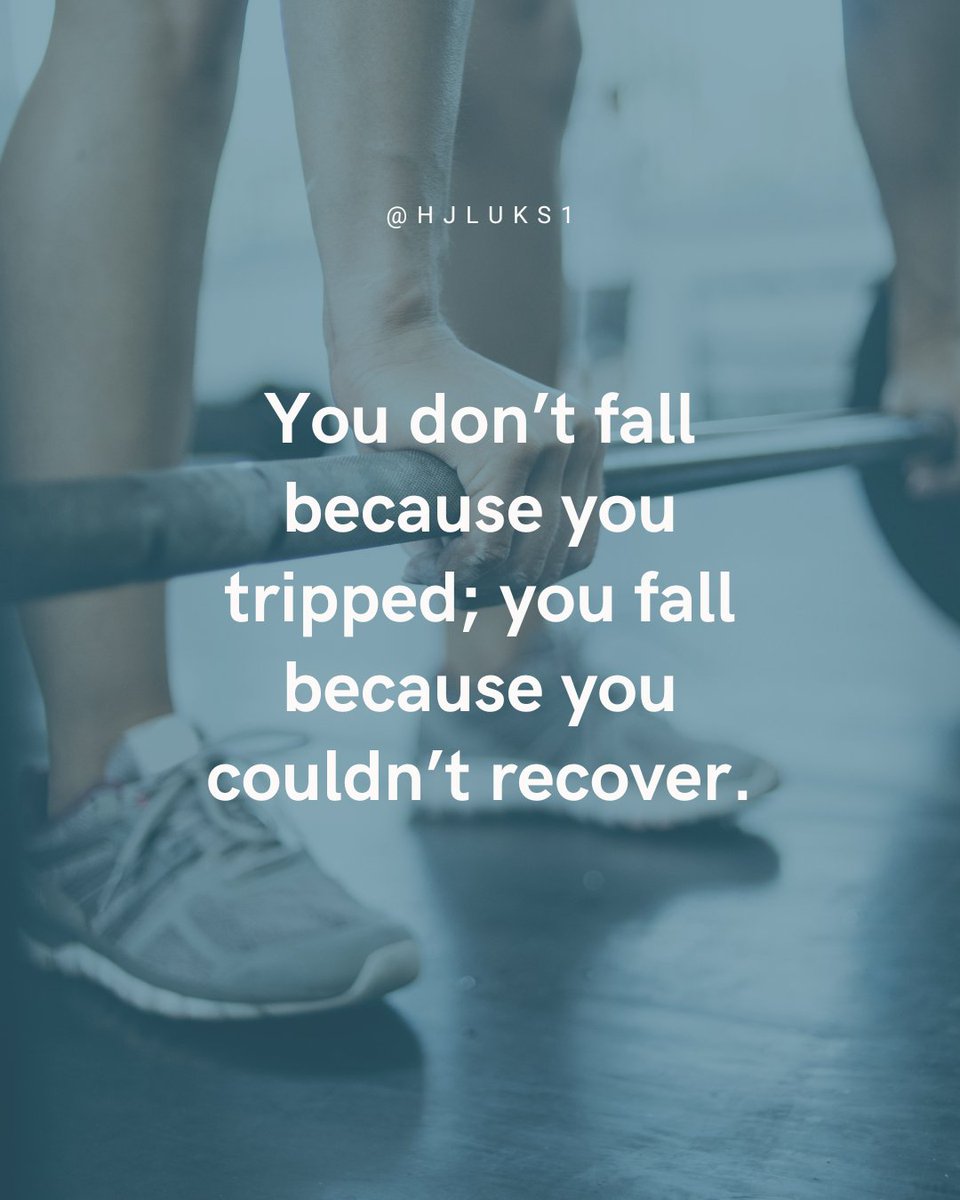
We don’t fall because we stumble… we mostly fall because we can’t recover.
An important thread...
I have spent three decades across an exam room table from people who are trying to figure out why their body stopped being the thing they could count on.
Most people assume they fall because they are getting older, but they fall because they have stopped practicing the things that keep them upright.
Balance, power, and strength all decline with age… But the rate and severity of those losses are driven far more by disuse than by the calendar alone.