Howard Luks MD Profile picture
Orthopedic Surgeon, author, trail runner, very amateur cyclist. Exits x 3. Cofounder: Masterlete https://t.co/5Ed5XQBV3M
Apr 21 12 tweets 4 min read
Knee Osteoarthritis Thread 4: Metabolic Health and the Knee.
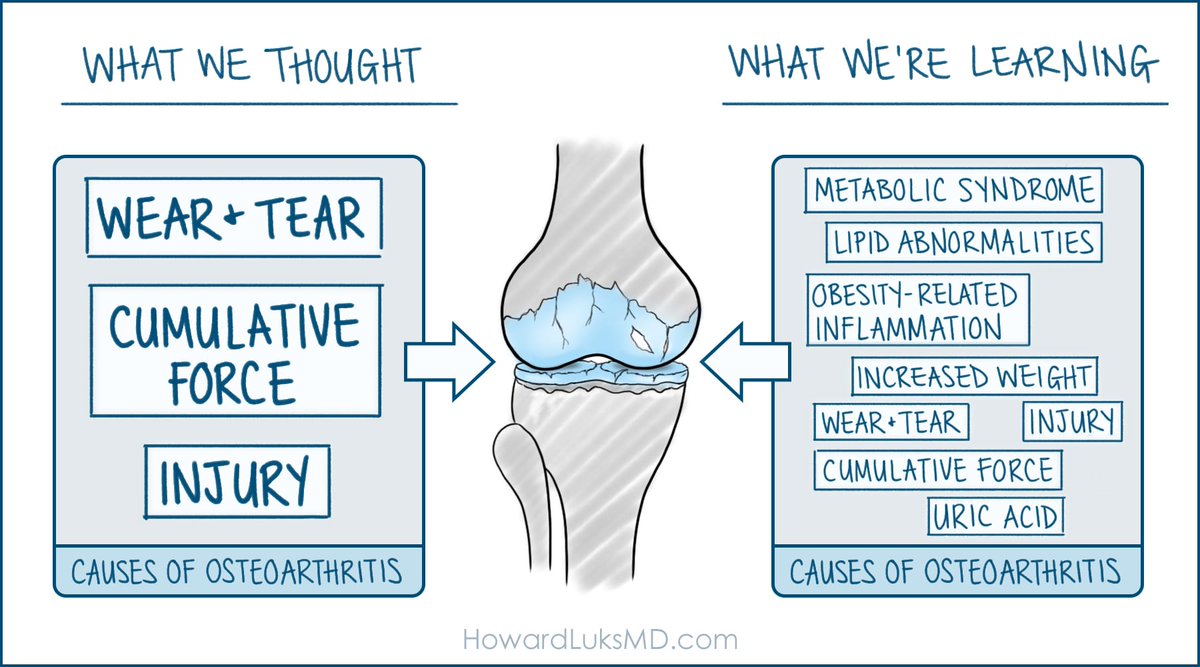
Your metabolic health will directly impact how your knee feels more than you can imagine. Your metabolic health directly influences how quickly your arthritis progresses and how your cartilage responds to the stress it's under.
This is the part of the knee OA conversation that most patients never hear.Image Here's a useful fact to set the stage for this discussion: Hand osteoarthritis is far more common in people with obesity.
Hands don't bear weight. So if OA were purely a mechanical wear-and-tear issue, this wouldn't make sense.
But... It does make sense if OA is driven, in part, by systemic inflammation, which circulates everywhere, including into non-weight-bearing joints.
Apr 20 15 tweets 4 min read
I'm a 62-year-old orthopedic surgeon, trail runner, climber, and cyclist. This is my Midlife Athlete's Playbook. I've combined what I've learned from 30+ years of treating active adults, and from training through my own 50s and 60s. The physiology of aging is real, but most of the decline people accept is optional. Aging brings real physiological changes. But lack of specific age-appropriate training brings far worse ones. A few things I've learned from three decades of treating active adults and from my own body.
Apr 18 12 tweets 4 min read
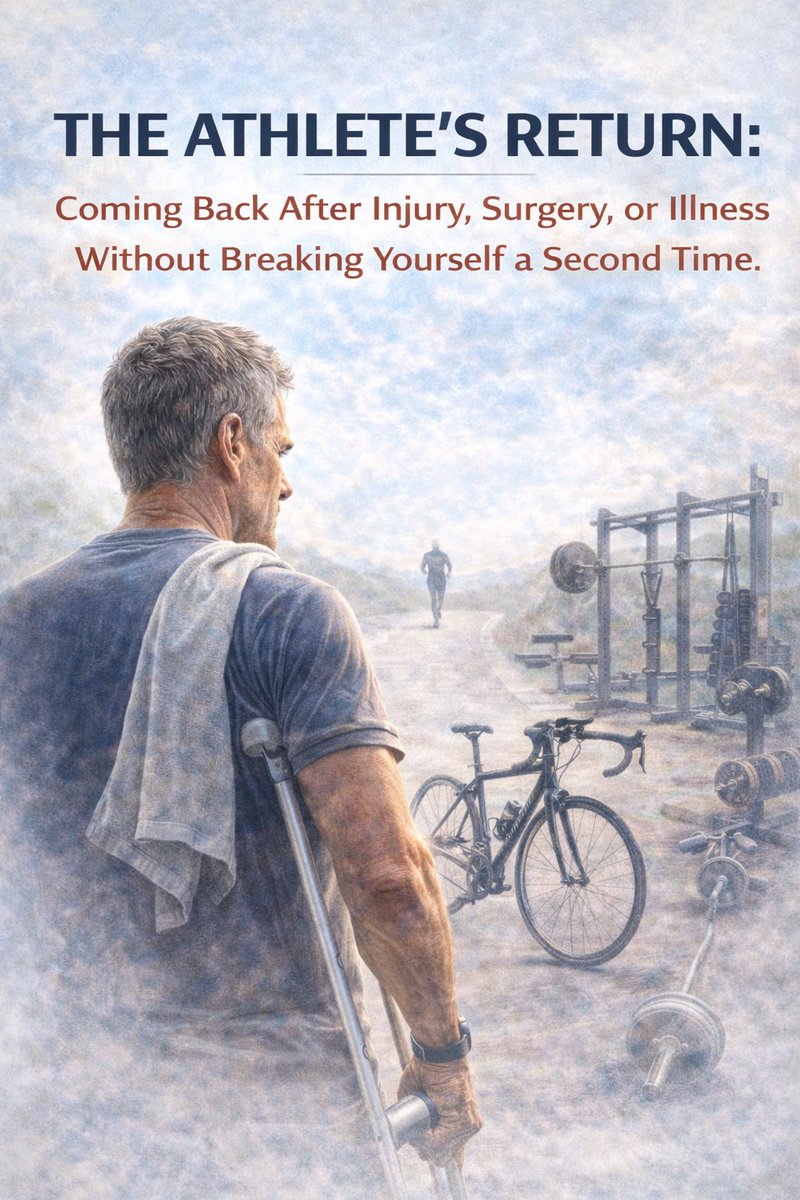
Coming Back After Injury, Surgery, or Illness... Why It's Easy To Set Yourself Up For Breaking Again.

1/ I've helped hundreds of athletes return to activity after injury, surgery, or serious illness.
The return is almost never linear.
The sooner you accept that, the better the return will be.
A thread on the actual data — and how to try to come back without breaking yourself a second time. 🧵Image 2/ Most returning athletes underestimate two things:
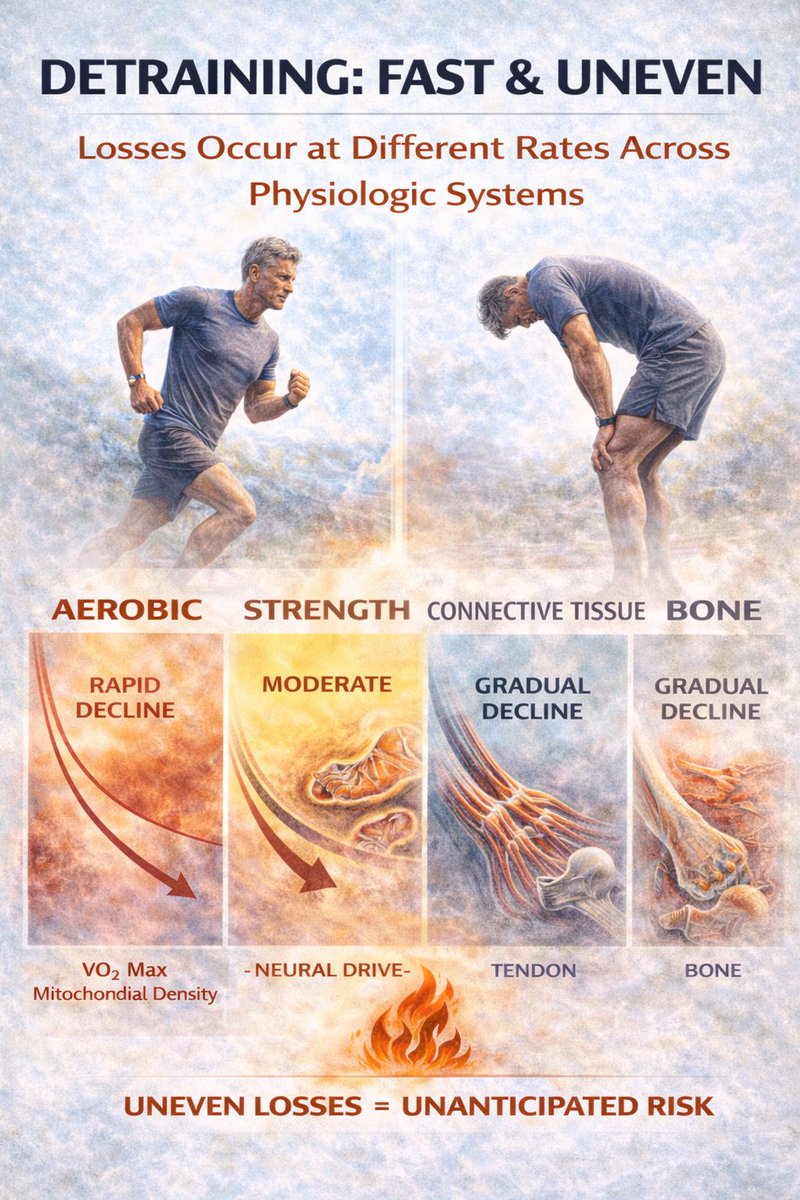
How fast you detrain.
and...
How uneven the losses are across different systems.

Your aerobic base, strength, tendons, bone, and metabolism all lose capacity — but not at the same rate. And they don't come back at the same rate either.Image
Apr 15 12 tweets 3 min read
Knee Osteoarthritis: Thread Number 3
The most powerful intervention for knee osteoarthritis is not a pill, not an injection, and not a surgery. It's not PRP and certainly not stem cells.
It is the muscle above and below the joint.
If you have knee OA and you are not doing targeted strength training, you are leaving the most effective treatment on the table. 🧵 Every time you take a step, force travels through your body. Strong muscles, especially the quadriceps, absorb a substantial portion of that force before it reaches the joint.
When those muscles weaken, the joint takes the full load. More load, more inflammation, more pain, faster progression.
Muscle is the knee's primary shock absorber.
Apr 13 12 tweets 5 min read
Knee Osteoarthritis... Thread #2 !
Your knee hurts. Your instinct is to rest it. Please don't.
That instinct is very often wrong — and following it makes osteoarthritis worse, not better.
Movement is one of the best evidence-based primary treatments for knee OA. Here's why. 🧵 Image Most people mismanage their diagnosis of knee arthritis. It's not their fault... They make wrong assumptions... and they narrow their lives further.
Start here, though.... This was the first thread... ideally, you consume these in order ;-). Then again... it might be a lot to ask people to read that much ;)
Apr 11 21 tweets 5 min read
Don't Let Your Lives "Narrow"!!
I've been an orthopedic surgeon for 30 years.
The thing I watch happen to people, more than any injury or surgery, is refer to as the narrowing.
Most of my patients have no idea it's happening to them. They think it's just aging. It's not. 🧵 The narrowing is the slow shrinking of what your body will let you do... or what you assume your body can or should be doing at your age.
You used to carry four grocery bags. Now you take two. You used to sit on the floor with the grandkids. Now you sit on the couch and watch. You used to take the stairs two at a time. Now you hold the rail.
If you're under 80 and you lie down for an injection... you shouldn't need a two armed lift to sit back up. Granted... in some instances you will... but I'm speaking about the "healthy" 60-70 something that can't because they never recognized this loss of ability and never did something about it.
Apr 10 9 tweets 4 min read
Osteoarthritis Of The Knee... Thread #1... of 4
"Bone on bone."
"Your cartilage is worn away."
"You have the knee of a 90 year old."
I've heard these phrases bantered about thousands of times in 25 years. They are very common explanations patients get for their arthritic knee pain.
They cause harm.
Xray findings do not correlate with symptoms... they just don't.
... and those descriptions lead to decisions that might not be the proper treatment at that point in time. 🧵 Patients fear the phrase bone on bone. They think that's the end.
Heck... I run with people who are bone on bone. I've replaced knees in people who aren't bone on bone. The diagnosis of severe arthritis is a clinical diagnosis... not a radiographic diagnosis!!

But, often, after hearing those bone on bone words, the patient goes home believing their knee is a machine with completely worn-out parts, and that any movement will grind it down faster.
But... we know that's not true.
Apr 9 21 tweets 5 min read
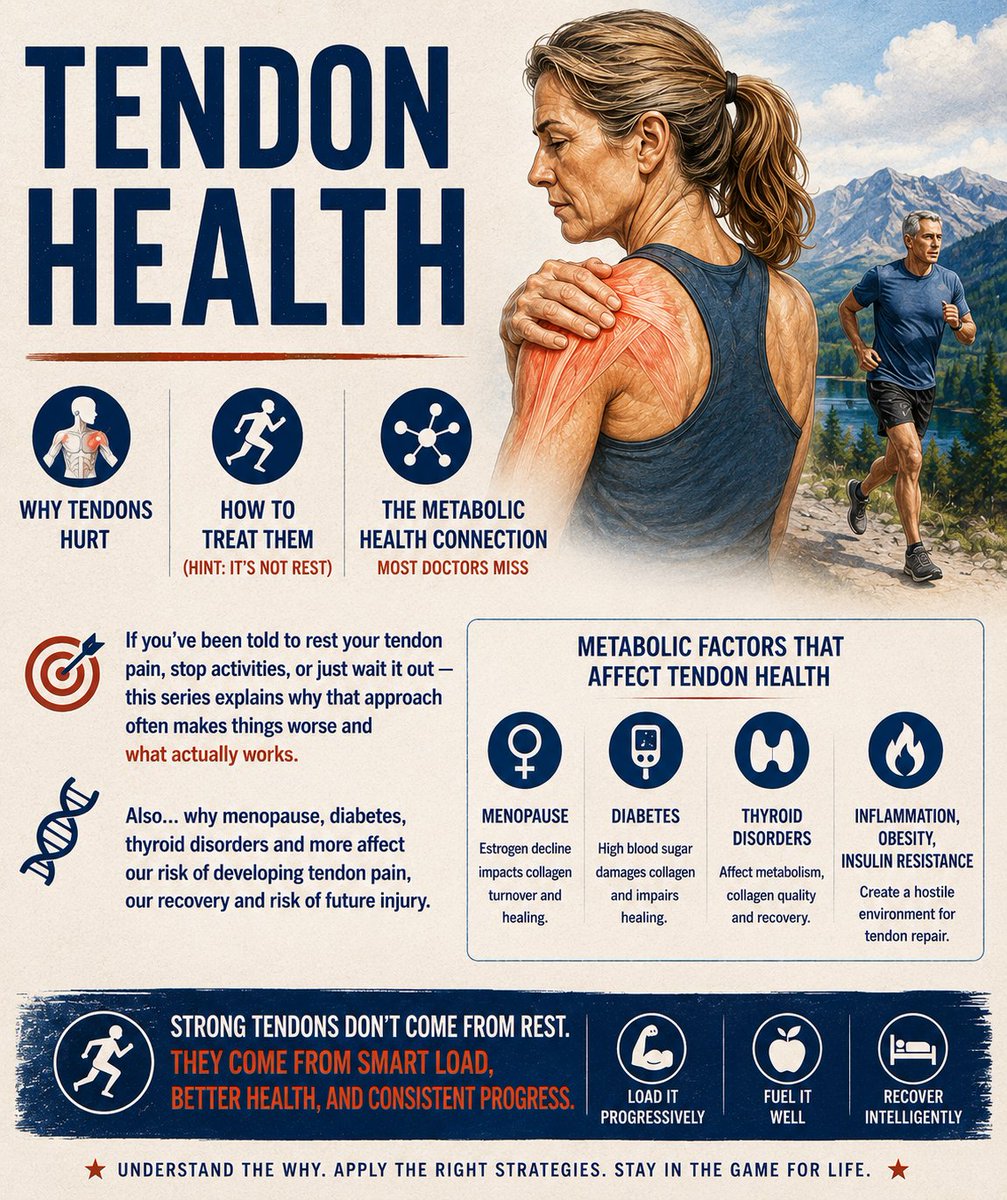
Tendon pain is the most common reason people come to see me.
Most of it is self-inflicted — from doing too much, too soon, or from doing too little for too long.
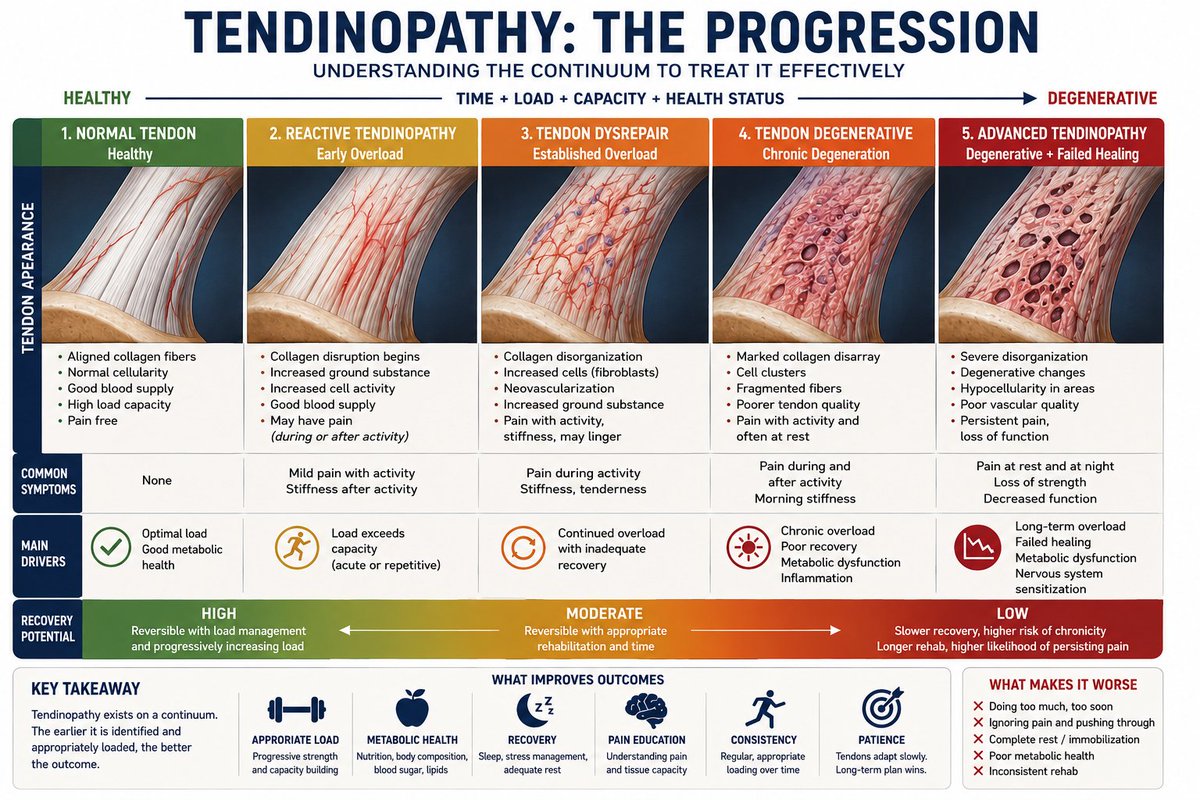
Let's review what most people (including many doctors) don't understand about why tendons hurt and how to fix them. 🧵 Tendinitis is a myth (mostly) When your tendon hurts, most people assume "tendinitis" — inflammation, swelling, immune cells.
That's not accurate for most adults with tendon pain.
Under the microscope, those tendons rarely show the classic signs of inflammation. What they show is something different entirely.
Apr 8 17 tweets 4 min read
Why I Train This Way at 62
1/ I’ve been an orthopedic surgeon for nearly 30 years, and over that time, I’ve watched something happen to many of my patients that isn’t dramatic or sudden, but ends up being far more consequential than any single injury or diagnosis. 2/ Their lives narrow. Not all at once, but gradually. The trips they stop taking, the hobbies they quietly give up, the activities they once enjoyed but no longer feel capable of doing. It’s rarely a conscious decision. It’s a slow loss of capacity. And they normalize all of it.
Apr 6 13 tweets 3 min read
Viruses and Joint and Tendon Pain
You had a cold two weeks ago. Nothing serious. But now your knee hurts more than it has in months. Your achilles is flaring. Your easy run felt like a half-marathon. You didn't do anything wrong. Here's what's actually happening... I've been an orthopedic surgeon for nearly 30 years. One of the most consistent patterns I see: patients come in with a flare of their knee, shoulder, or tendon pain — no new injury, no change in activity — and when I ask if they've had a recent illness, the answer is often yes.
Apr 2 13 tweets 3 min read
I hear this every week in my office:

"Doc, my heart rate hits 150 during squats — that's cardio, right?"

No. And if your cardiologist hasn't explained why, keep reading. 🧵 A high heart rate during lifting is due to cardiovascular stress... No one is disputing that.

But cardiovascular stress and aerobic adaptation are not the same thing. The type of load your heart sees during a heavy lift produces a fundamentally different physiological response than sustained aerobic exercise.
Apr 1 7 tweets 2 min read
Having been an orthopedic surgeon for 30 years...5 things I wish someone had told you before you walked into my office — in atraumatic joint and tendon pain.

Most of you will present with atraumatic joint and tendon pain... traumatic injuries are far less common in adults. And no... you didn't "sleep wrong." Your MRI is not your diagnosis. It's fine to get the MRI. But what comes next is what really matters.

Meniscus tears, rotator cuff changes, disc bulges, and labral tears— we find these in people with zero pain all the time. By midlife, they're nearly universal.
The scan shows what's there. It doesn't explain why you hurt. Those are two different questions.
You need to be listened to and examined. That's the only way to correlate the MRI findings.
Mar 25 6 tweets 2 min read
Pain on the outside of your hip is one of the most common problems I see in my practice.

Walkers get it. Runners get it. People who've never been to a gym get it.

For decades, we called it bursitis and injected it. We were treating the wrong thing. The problem is almost always the gluteal tendons — the gluteus medius and minimus — not the bursa.

Think of it like the rotator cuff in the shoulder. The bursa gets irritated, but it's reacting to what's happening next door.

Both can hurt without a tear. Both can show tears on imaging and cause no pain. Both respond to progressive loading — not rest.
Mar 24 9 tweets 2 min read
I'm a 62-year-old orthopedic surgeon, trail runner, and cyclist. I've also spent 30+ years watching people give up on their bodies too soon. And watching too many lives narrow.

Athletic performance doesn't have to decline sharply in midlife. Most of what drives that decline is addressable. We yield too much to age. Yes, aging brings changes. Lack of training brings far worse changes.

A few things worth knowing — The Midlife Athlete Playbook 🧵 After 30, you lose roughly 1% of muscle mass per year without resistance training. By 70, that loss compounds significantly.

Skeletal muscle doesn't care about your age — it responds to load. Consistent resistance training at any age builds and preserves it.

If you're not lifting, start. If you're already lifting, don't stop.
Nov 17, 2024 10 tweets 2 min read
Our bodies are a series of highly complex interrelated systems... one system will affect the others.

The older I get, the more obvious this becomes.
Even in Orthopedics, it's clear that adult joint pain is often the downstream result of issues elsewhere.
A Thread... I've mentioned some of these before...
Folks with elevated lipids and/or uric acid experience tendinopathy more often. The crystals replace or damage the collagen in our tendons.

Although unproven, the same might hold true for our menisci.
May 12, 2024 10 tweets 3 min read
Knee swelling hours after playing a sport, with no recollection of injury. These are very common scenarios... and almost never require surgery... but the swelling will be with you for months. Image Nope... it's not due to the meniscus tear seen on your MRI Image
Dec 23, 2023 11 tweets 2 min read
Muscle mass and strength...
I fed GPT4 my book. I asked it to tweet about muscle mass. I have not edited/changed anything...
How did GPT do??? Sarcopenia, the age-related loss of muscle mass, is a silent factor affecting our longevity. As we age, our muscles naturally diminish, impacting our overall health.
Dec 22, 2023 10 tweets 2 min read
High-tech, low-touch medicine... it's more prevalent than ever-- and it's not getting any safer. And the downstream consequences are getting worse. I've noticed a shift toward high-tech diagnostics for a long while, but let's not forget the healing power of the human touch. The human touch in medicine isn't just comforting; it's a critical tool for diagnosis and connection.
Dec 8, 2023 26 tweets 4 min read
Let's chat about frozen shoulders... A 🧵

There are a few ortho conditions that can make a mess of things due to its natural history, initial presentation, and progression.
Frozen shoulders are one of those diagnoses. I love it when I read review articles that state that frozen shoulders are a benign self-limiting disease.
Clearly, none of those authors have had a frozen shoulder. During the acute phase, it's one of the more painful shoulder conditions. Loss of sleep isn't benign. Image
Dec 2, 2023 23 tweets 4 min read
You exercise, you do not sustain an "injury" --- and later that day your knee is swollen. There's some discomfort... mostly due to pressure and the swelling. But there's no acute sharp pain.
The all too often sad tale of what happens next. In most of our minds, we are convinced that pain implies harm.
Sure, sometimes that's true. But very often, it's not.
Yes, some types of pain should stop you in your tracks, but that's rare. More often than not, you can carry on. But...
Jun 10, 2023 8 tweets 3 min read
The @WSJ put out an article on how fragile our knees are. These titles attract attention... but we are a terribly sedentary population. Our knees are not fragile. They can handle a lot of force. The risks of inactivity far outweigh the risk to your knee. wsj.com/articles/why-o… I've seen 100s of folks who have shut down their activities due to reading something like this. I have seen 1000s curtail activities bcuz they think it will damage their knees. This is unfortunate. The risks of rest far outweigh the risk of injury. howardluksmd.com/health-consequ…