Sandy Petersen 🪔 Profile picture
Jun 24 4 tweets 3 min read Read on X
How Quake ruined id Software.

There has been a lot of praise of Quake of late, with its 30th anniversary, and it's deserved. Quake is an amazing feat of art, programming, and design. I worked on it, and everything came together almost perfectly from all of us. We ended up with a free-wheeling, frenetic action game with enough of a visible world to grip the imagination.

All the team did a brilliant job, fulfilling tasks just right. But at a grim cost. We worked long and hard, and I think it broke us spiritually.
1/3
Here is the toll it took. Within a couple years of finishing Quake, the following men left id Software:

John Romero(!), Shawn Green, Dave Taylor, Mike Abrash, and American McGee. (Oh yes, and me.) Some of us were forced out, some left eagerly. But here's the thing - look at we who left. EVERY ONE of us went on to an incredible career in game development, so plainly we didn't depart because of some kind of talent issue. The idea is ridiculous. We were all highly competent, just a little burnt out after the labor of Quake. And if my naysayers want to say, "Well Sandy, YOU should have clearly been ousted because you suck." Okay, but even John Romero was gone. Michael Abrash!! Id's workhorse, Dave Taylor. American! It wasn't just me. You don't think id Software suffered by losing John frigging Romero?!

Id Software was never the same aftger. In my opinion (only an opinion), the only other truly great game that id produced was Quake 3, and it was not at the level of the pre-Quake games.
2/3
So if my theorem is correct, and Quake gutted id Software, was it worth it? Well I'd say yes absolutely. Games are more important than game companies, and Quake is an iconic titan of the gaming world.

Plus it's not like the people who left vanished off the face of the Earth. John Romero's still making games. I'm still making games, Mike Abrash as well, and so forth. We're all contributing to the hobby. Heck, I'm GLAD I was gone, because I got to work on the Age of Empire series which was amazeballs.

But man alive it seems like the company could have had its act together better and kept that dream team.
3/3
Despite Quake's greatness, I think that Doom, though technically inferior, had a bigger impact on gaming. Image

• • •

Missing some Tweet in this thread? You can try to force a refresh

 

Keep Current with Sandy Petersen 🪔

Sandy Petersen 🪔 Profile picture

Stay in touch and get notified when new unrolls are available from this author!

Read all threads

This Thread may be Removed Anytime!

PDF

Twitter may remove this content at anytime! Save it as PDF for later use!

Try unrolling a thread yourself!

how to unroll video
  1. Follow @ThreadReaderApp to mention us!

  2. From a Twitter thread mention us with a keyword "unroll"
@threadreaderapp unroll

Practice here first or read more on our help page!

More from @SandyofCthulhu

Jun 19
This is a really good rule.

Try it out on Loki, Draco Malfoy, Hannibal Lecter, and Killmonger. You'll see how totally correct the DeVito rule is. Image
For women, we can call it the Roseann Barr rule. Would guys still crush on Harley Quinn or Queen Akasha or Maleficent if they were played by Barr? (The answer is no.) Image
Dang it now I want to see Wallace Shawn as Voldemort and Joe Pesci as Thoth Amon taking on Conan.
Read 4 tweets
Jun 17
What do giant game companies do for us?

They have four main functions.

First: they buy smaller companies and then destroy them. Where is Westwood? Pandemic? Lionhead? Visceral Games? Tango Gameworks? Bullfrog? Origin Systems? Maxis? These were not minor developers. They made some of our best loved games ever.

Think back about these amazing companies and how they were killed. And I'm not even mentioning Ensemble Studios.
1/4Image
Second: the big company, who owns the IP, takes it away from the original team and gives it to another, cheaper or better-connected politically team and let them ruin it.

Remember Spyro the Dragon? Crash Bandicoot? Halo? Metal Gear Solid? Mass Effect? Dead Space? Fallout? Banjo-Kazooie? Prince of Persia? Star Wars: Battlefront? Sonic the Hedgehog had it happen multiple times.

ALL THESE were successful great games. ALL had the IP ripped away and given to timer-serving incompetents. Search your feelings. You know it to be true.

I spoke to the woman who was one of the chief level-creators for Spyro at GDC. She was so enthusiastic about the clever things she'd done to make it work. I guarantee her replacement did it by the numbers, which is why Enter The Dragonfly was a soulless waste of time. Plus it was full of bugs.

Below is a shot from Mass Effect: Andromeda, the retarded stepchild of a game stolen from the original Bioware team.
2/4Image
Third: if the big company doesn't own the company OR the IP, they sometimes just straight up murder it.

Example: a game company I know really well did a game that I know you've heard of. The game was so popular enough it actually had action figures made for it. The company devs and owners were good friends of mine. We played RPGs at my house weekly.

Electronic Arts had funded the game's development with advances. When the game came out and sold millions of copies, my friends were super-excited. At last they hit the big time. But EA told them they needed to pay back the advances yet - clearly a baldface lie because the initial sales royalties plainly far surpassed their pittance advances. My friends tried to get their act together but this took them completely by surprise. Starved of their royalties, my friends couldn't hire a legal team (at least not one willing to take on EA), lost all their income, and had to disband their studio.

EA got to keep a few hundred thousand royalty money in exchange for never getting another multi-million selling game from the studio. I think it was a terrible deal, because another such game would have given them 10 times as much money. It was such a bad decision business-wise, my guess is that the deal was torpedoed by EA internal politics. I.e., some producer was angry at the game's success. Either that, or EA is literally controlled by Satan, which might be more likely.
3/4Image
Read 5 tweets
May 27
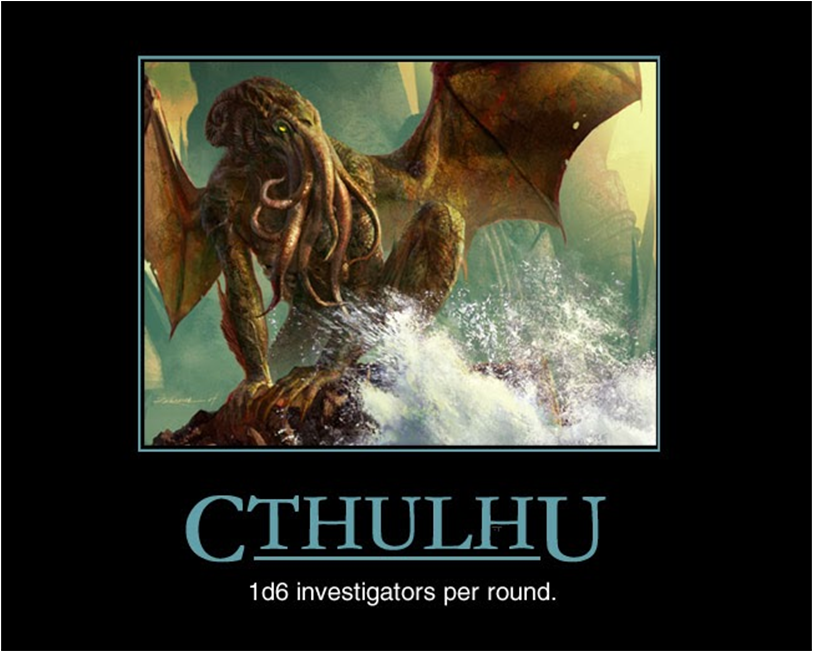
Where did Call of Cthulhu's Sanity System come from?

In 1980 I got the job of writing The Call of Cthulhu roleplaying game. Even back then, my goal was always for my games to reflect the game's theme as much as possible. I wanted players to feel like they were in a ghost story or a horror movie. I guess I didn't, and still don't, look on my games as just games - but as fun experiences, that you control instead of an author.

Anyway, one feature of Lovecraft's tales is that the hero often freaks out, goes insane, or faints dead away. So I wanted this in the game. The monsters would be so shocking that the hero would swoon or go into hysterics.

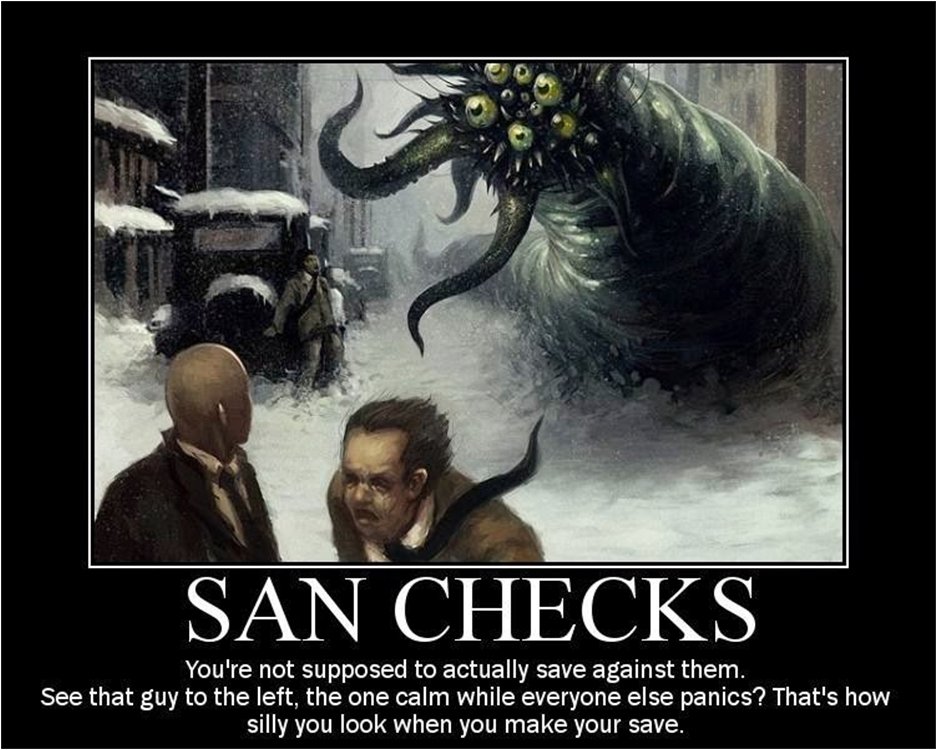
To reflect this, I created the Sanity system. I gave each player an amount of Sanity, and as they learned more about the Cthulhu Mythos, or saw monsters, or read terrible arcane books, their Sanity would seep away.
1/4Image
Now, my idea for the monsters was that this would just be one more tool that the monsters would have at their disposal. They could claw or tentacle you, they could cast spells, AND they could blast your Sanity with their horror.

The first time I tested Sanity was in Davis California. The players were alerted to how Sanity worked. They were playing the scenario The Haunted House (still available). They'd found a creepy old book and found a spell in it which they were going to cast. I told them it was "Summon Malignity From Beyond" but they weren't discouraged. They collected the components and cast it. I tried to make it all theatrical - "You hear a weird rasping noise in the air. A blue-lit portal opens! A talon claws forth!"

And here I was astounded. One player said, "I'm covering my eyes." Another said, "I run upstairs." A third said, "I'm turning my face to the corner." Wow! This would NEVER happen in D&D, or any other RPG. Knowledge is power! Why would you not want to look?

Well of course it was because the monster was scary. I hadn't realized this would actually make the players act as if their characters were frightened! I'm not saying the PLAYERS were scared, but they acted that way.
2/4Image
While I didn't realize that this is what would happen, I was smart enough to realize that this was an extremely powerful mechanic. I had a tool that would change roleplaying. In D&D a scary monster is dangerous because it can kill you. In Call of Cthulhu an investigator is scared to see what's around the corner in the catacombs. Just like a horror movie! Or, I suppose, a monster story.

I then began adapting it to other things and it became so handy. Does a player want to murder innocent people? Obviously he's going mad. Dock his Sanity. He can still DO it. He just gets ... twitchy. Eventually he actually becomes a Keeper tool, and then the other players get to enjoy his presence a long long time.

Let me tell you, nothing is better in a session than having your current crop of players being stalked and threatened by one of their former characters. The recriminations are non-stop. "Why did you give your guy Dapper Dan 75% in Demolition?! Now he's sneaking bombs into the sewers under our building." It really works.
3/4Image
Read 5 tweets
May 25
It's Memorial Day, and so I want to remember some of my family that fought for their country.

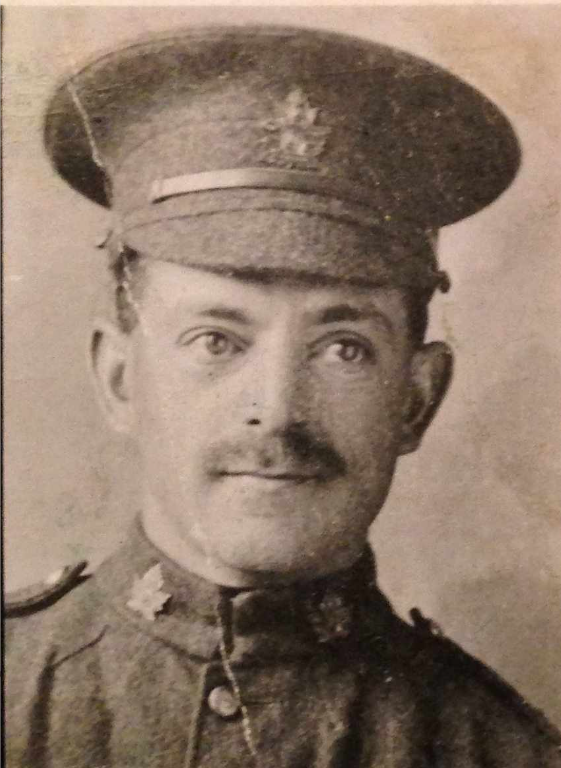
My grandfather, Jack Ousey, emigrated to Canada from Wales, and joined the Canadian Army around 1915. His one and only battle in WW1 was the Somme! He got shot in his arm and leg and lay in a mud puddle for three days. The German Red Cross found him and saved his life. He spent the rest of the war in a prison camp, working on a farm during the summer, and at a lumber camp in the winter.

When he got home, his wife was living with another man. Yes, she knew he was alive - the Red Cross sent letters. So remember, military members. Josey is always waiting, in every time, every age. Eventually they split and he went to Chicago where he found my grandmother. He was an incredible man with many more parts to his story, but today I wanted to focus on just his military career. Also may Douglas Haig rot in the lowest circle of Hell for his arrogance, incompetence, and condemning so many good men to death and crippling. My grandpa did manage to survive his ineptitude, but so many did not.
1/4Image
My wife's father served in Germany in the 103rd Infantry during World War 2. He was actually part of a so-called tank destroyer battery. I say "so-called" because his unit only ever had towed guns. When they first landed in France they had 37mm and they knew these were worthless. They got upgraded to 57mm pretty quick. Not a lot better. Granddad wasn't on a gun crew though. He carried a rifle and stayed in foxholes.

His unit fought through the Vosges, stormed both the Maginot and the Siegfried Lines, and eventually liberated one of the Dachau camps. As far as I know his unit never encountered a German tank, though they saw StuGs and trucks.

One of his stories was about going through the famous Dragon's Teeth of the Siegfried Line. He said as he was walking, he heard a voice cry out, "Duck!" and he jumped behind a "tooth" just as machine-gun fire spattered the place he stood. No one else was around so he attributed it to heaven warning him.

In another story, they were taking mortar fire so he and a friend jumped under a truck for cover. When the bombardment ended, they crawled out from under the truck, and looked at it. It was an ammunition truck! Worst cover ever.

He said as they advanced, sometimes instead of digging their own, they got to occupy a German foxhole. He said German holes were the best - neatly dug, with shelves for storage cut into the walls. Much better than American foxholes.
2/4Image
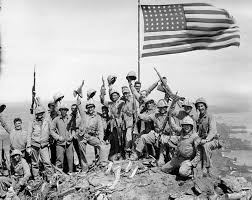
My wife's uncle was a Marine in WW2 and his one and only battle was Iwo Jima! He said that every Marine on the island was able to see the famous flag raising - the island was only 5 miles across and the flag was on the highest point. He said it was exceedingly heartening. He was not on Mount Suribachi - he was down in the ash plains in a hole getting shot at and mortared by the Japanese.

During a banzai charge at night, he shot a sword-waving Japanese officer only a few yards from his hole. When things were still again, he crawled out to the dead officer, and retrieved some of his papers. The officer's paybook had a picture of his wife in a kimono and his child. He couldn't read Japanese of course, but always felt kind of bad about shooting the guy. On the other hand, what could he do? He didn't want to get killed by the sword! He determined he wanted to give the paybook back to the officer's family post-war.

Sadly later he was carrying some coffee up to the front line for his buddies, and a machinegun shot him in both legs, so that was the end of the war for him. In the hospital ship, he lost the Japanese officer's paybook or it was taken away, so he was never able to return it or find the family. So not a Hollywood ending. Just a tragedy, like tens of thousands on Iwo Jima. At least he survived. Thousands didn't.

Curse the Japanese High Command for throwing away their men to preserve their diseased honor.
3/4Image
Read 5 tweets
May 22
What was “Titan”? Ensemble Studios last planned project?

Many of us loved World of Warcraft. (In our defense, this was back in 2007-8, when it was still fun.) We decided to do our own MMO based on our years of experience in MMOs, and our chops in game creation.

We decided to use MicroSoft’s favorite license - Halo.
1/4Image
But not in the current Halo universe. If you know Halo lore, you know the galaxy’s sentients were wiped out by the Halos tens of thousands of years ago. We set our game BEFORE the Halos fired.

You could play the Forerunners - a mostly-human faction, or the Covenant; a confederation of aliens who opposed the Forerunners because the latter had built a wall to keep out the Flood. And the Covenant was on the wrong side of the line.

We had extra races, such as the Mimics. Our idea was that many Covenant races were wiped by the Halos and only a few were preserved somehow.
2/4Image
We had gone quite a long way into the game. We had art, models, and we designers had created missions, and even campaigns. We had classes, races, etc. the Forerunners had 4 “races”: cyborgs, humans, sigmas (humans modified to live & work in outer space), and hardlights (humans who’d transferred their intelligence into a device and made bodies out of hard light.)

We were good to go. MicroSoft estimated conservatively it would earn 1.1 billion dollars. A triple-A game made by a triple-A company at the peak of our creative abilities? What a match.
3/4Image
Read 5 tweets
May 19
How I kill players' characters in my roleplaying games (yes, even Call of Cthulhu).

The rule is that I always give them three chances. First, I warn that there IS a threat. I adjust the warning by threat level.

For instance, in the case of a danger the party can readily handle, a local might say, "You know, not everyone who enters the woods during the Teddy Bear's Picnic comes out again."

But if it's something really serious that I want to alert them to, the locals might say, "No one has EVER returned from the Devil's Playground. Not EVER."

Both these examples are from my Runequest campaign. The Teddy Bear Picnic warning discouraged them enough to make better preparations. But they headed right into the Devil's Playground anyway. But that's okay because the goal isn't to warn them away, but to make them aware that there IS peril.
1/4Image
The players get their second chance once they are at or in the area of the danger. At this point, instead of just a warning, they see actual physical evidence.

Example: "The gnawed corpse of a Pit Fiend is in the clearing. It can't be more than a few hours old."

Or: "Yes, the last person to spend the night in the Falvey house is in this cell." (They see a twisted, scarred ruin of a woman rocking back and forth, obviously insane.)

The idea here is the players know a little more about what they're getting into. They can prep more, find out more information, or bull ahead. It's up to them.
(art Philippe D'Amours)
2/4Image
The team's third "chance" to survive is after they come into actual contact with the threat, which often means combat. If the enemy is likely to kill them I still provide an escape route.

For instance, the monster might take a breather. I'd say, "The creature seems to be gathering its strength for a final strike." They can run away or heal.

Or a hint, "The dying elf points to a crack in the wall. Is it a secret door? A way out?" One of them can quick check it out.

But if the players stick it through, more power to them. If characters die, my conscience is clear - they had three warnings. Of course, they may win, and if so they deserve to be rightly proud.

The purpose behind all this is so when a character dies, they don't blame ME, the gamemaster. They blame their own choices or bad dice rolls. I rise above recriminations.
3/4Image
Read 5 tweets

Did Thread Reader help you today?

Support us! We are indie developers!


This site is made by just two indie developers on a laptop doing marketing, support and development! Read more about the story.

Become a Premium Member ($3/month or $30/year) and get exclusive features!

Become Premium

Don't want to be a Premium member but still want to support us?

Make a small donation by buying us coffee ($5) or help with server cost ($10)

Donate via Paypal

Or Donate anonymously using crypto!

Ethereum

0xfe58350B80634f60Fa6Dc149a72b4DFbc17D341E copy

Bitcoin

3ATGMxNzCUFzxpMCHL5sWSt4DVtS8UqXpi copy

Thank you for your support!

Follow Us!

:(