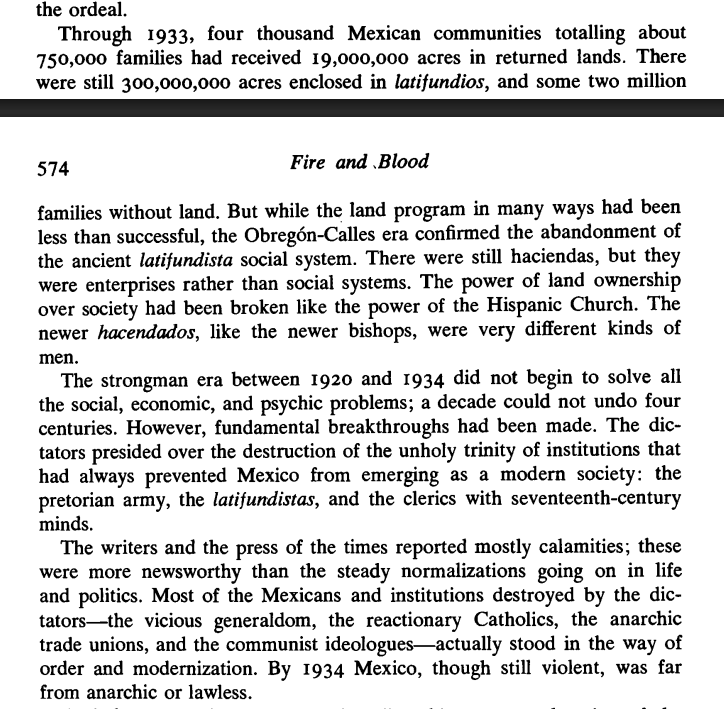
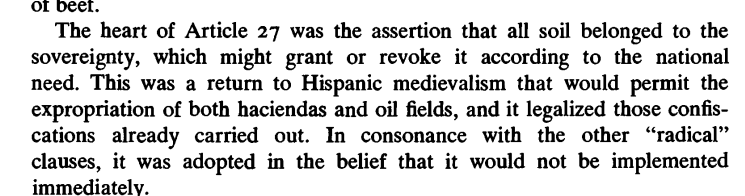
Thread with excerpts from TR Fehrenbach's "Fire and Blood: A History of Mexico" (1995), on post-Revolutionary Mexico. To justify land reform, the revolutionaries revived the principle that expropriation was justifiable if the national interests demanded it. 

The Constitutionalists defeated the Villistas in battle and assassinated the leader of the last revolutionary faction, Zapata, by treachery.

Carranza, the erstwhile leader of the victorious Constitutionalists, dug his own grave by trying to promote someone other than Obregon to the presidency after him; he was forced to flee the capital, run down, and murdered.

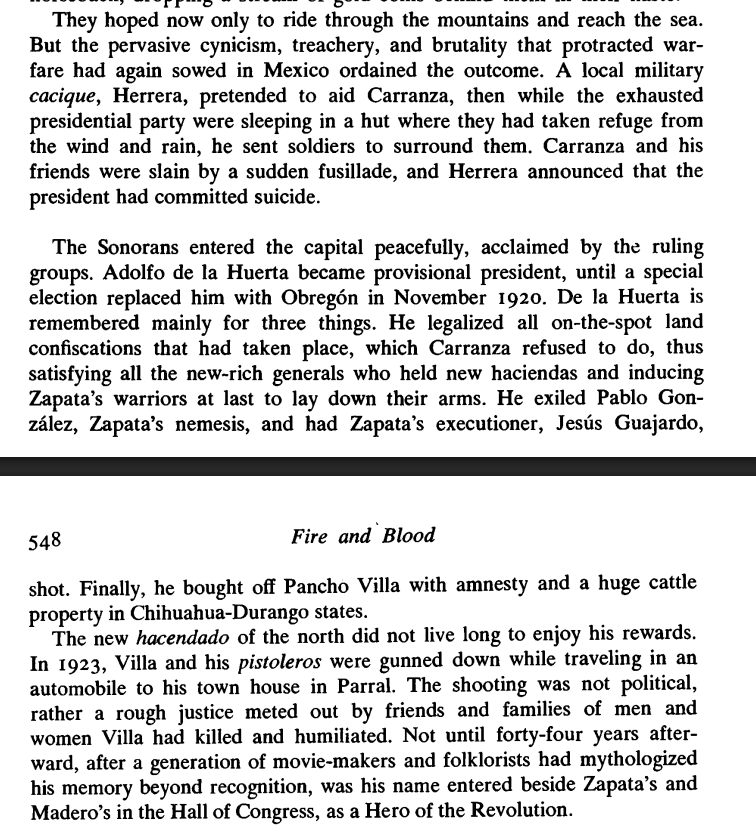
Alvaro Obregon faced the critical problem of a dirt-poor, destroyed, nationalistic (in a country that desperately needed foreign capital) Mexico, full of Mexicans who demanded land expropriation ASAP. He successfully balanced social demands with economic needs.

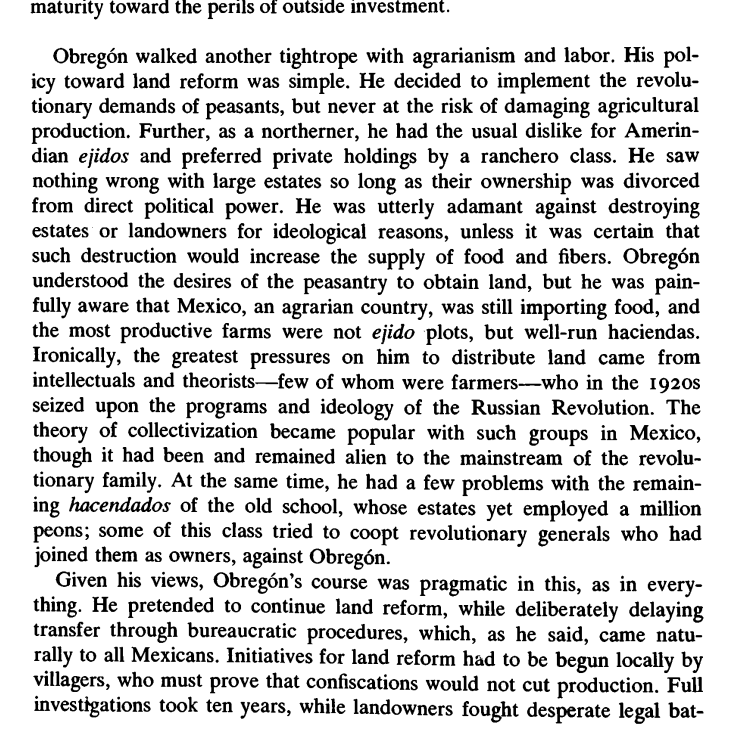
There was a major rebellion against Obregon in 1923; his regime was saved by much-hated Yankee support. He took advantage of his victory to kill most of his major opponents and permanently destroy the military as an independent power-base, eliminating Mexico's Pretorian class.
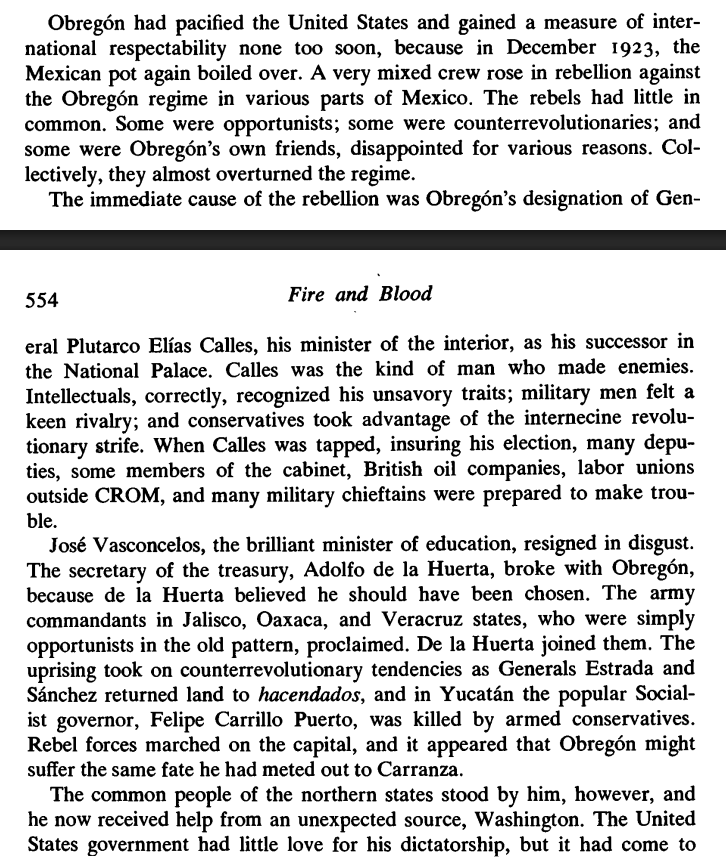

The succeeding Calles presidency was more severe than Obregon (lots of "shot while attempting to escape"), and ramped up spending on education and land reform (while not bowing to the temptation to fully abolish private property).


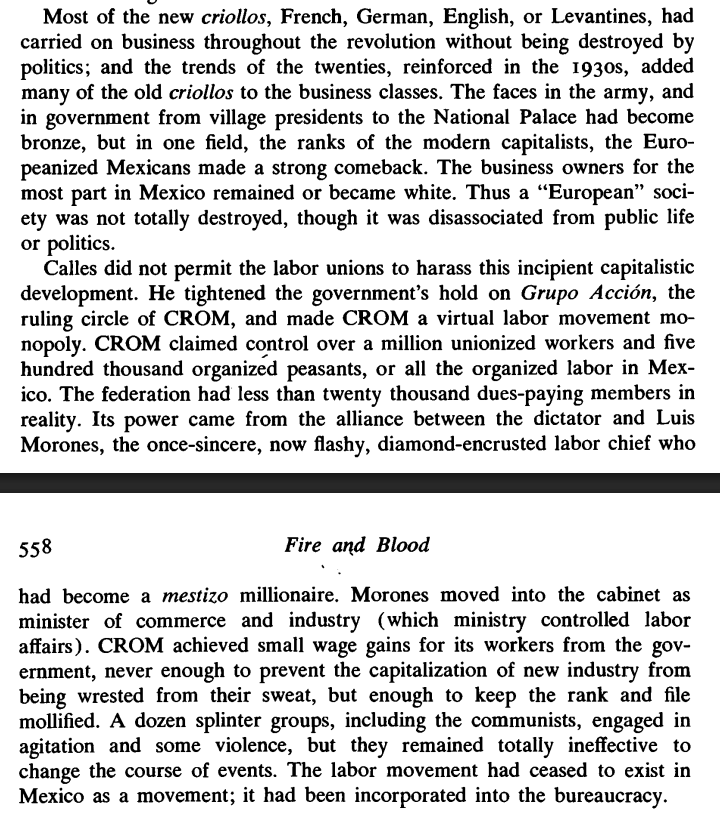
The business and social elite remained white(-ish) while the military and political elite were turned brown by the Revolution. Calles did not allow an independent labor to destroy incipient capitalist development.

During the Calles presidency, the Mexican Church effectively revolted over the constitutional requirement to "six years of socialist education for every child."

The Mexican Church went on strike for three years, refusing to administer sacraments, in the expectation that this would inspire resistance among the pious masses. But the Mexican masses, lacking theological sophistication, didn't even notice and just kept going to Church.

However, some devout middle- and upper-class men launched a guerilla war against the government on behalf of the Church, the cristero revolt. Calles cracked down hard, torturing, massacring, and plundering the faithful (*especially* those uninvolved in the revolt).

Calles and Obregon attempted to subvert the "no re-election" clause of the Constitution by giving Obregon another (non-consecutive) term as president, fortunately (?) for Mexico, Obregon was assassinated; Mexican Catholics were scapegoated.
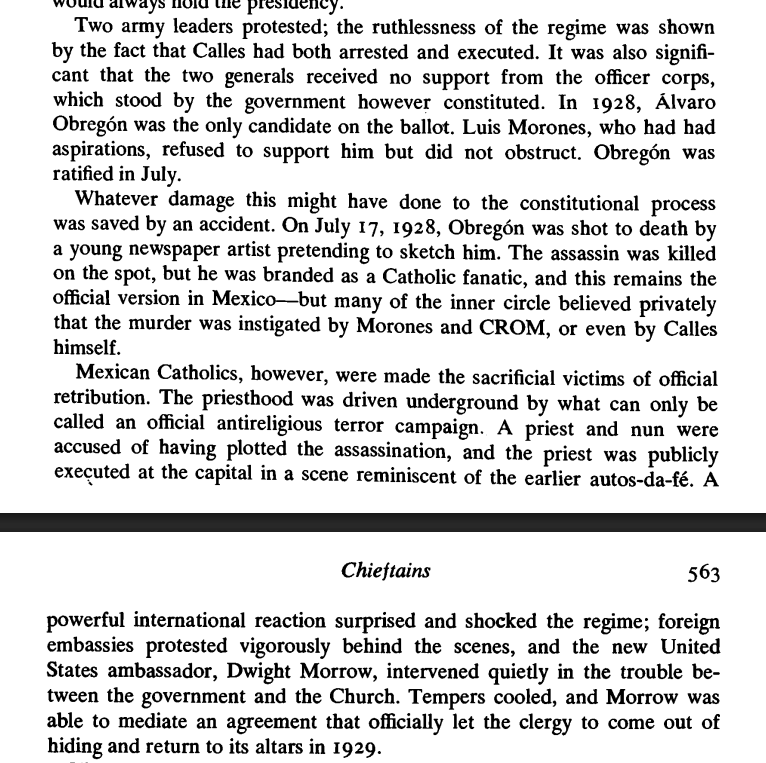
This touched off another round of anti-clericalism, up to and including machine-gunning Catholics en route to Mass and demolishing Churches. This 'Red Terror' lasted through 1934; the Mexican Church was down to under 100 priests.
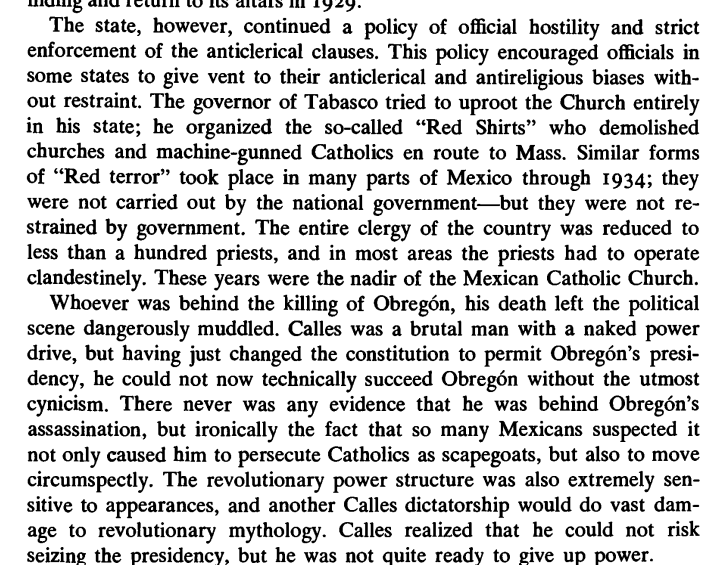
Calles continued to rule for the six years of Obregon's unexpired term under a series of puppet presidents. His administration was brutal, cynical, and corrupt, but nevertheless gave Mexico reasonably good government.
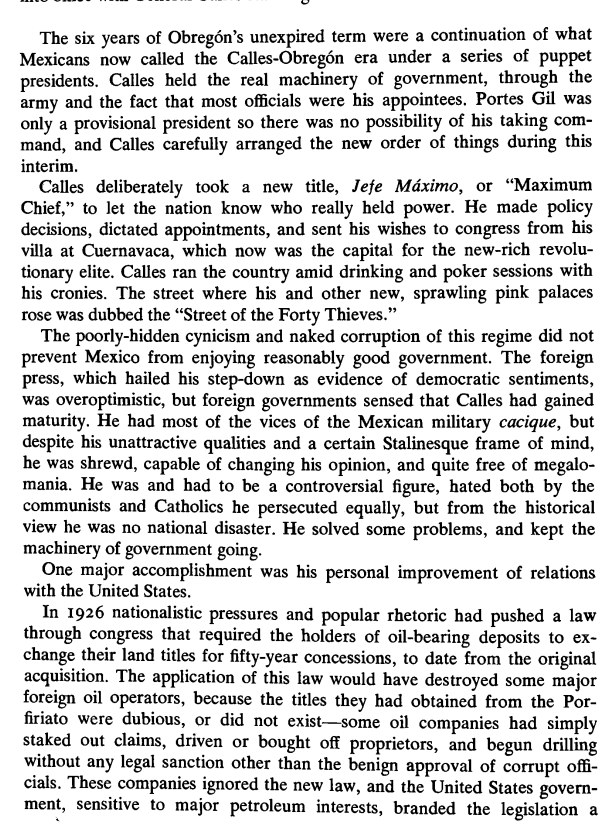
Calles had to balance two issues:
1) The indios and peasants might rise again; they still had their guns
2) The indios and peasants were completely useless, deadweight, to a modern society
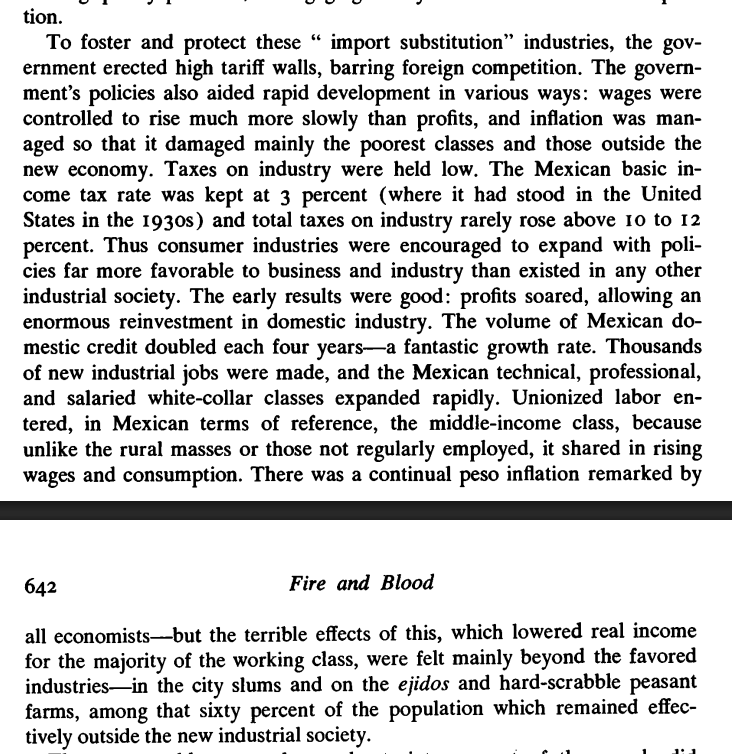
He balanced moderate land redistribution with Diaz-style industrial development.
1) The indios and peasants might rise again; they still had their guns
2) The indios and peasants were completely useless, deadweight, to a modern society
He balanced moderate land redistribution with Diaz-style industrial development.

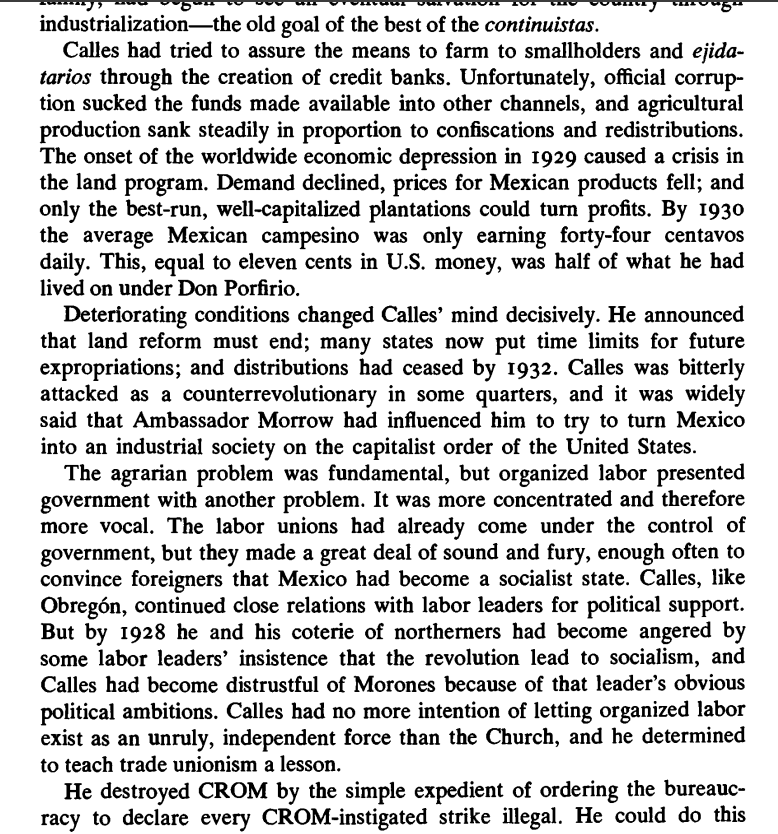
The Great Depression convinced Calles that land reform had to end, as Mexico needed every bit of productivity it could get and the redistribution hurt output.
• • •
Missing some Tweet in this thread? You can try to
force a refresh