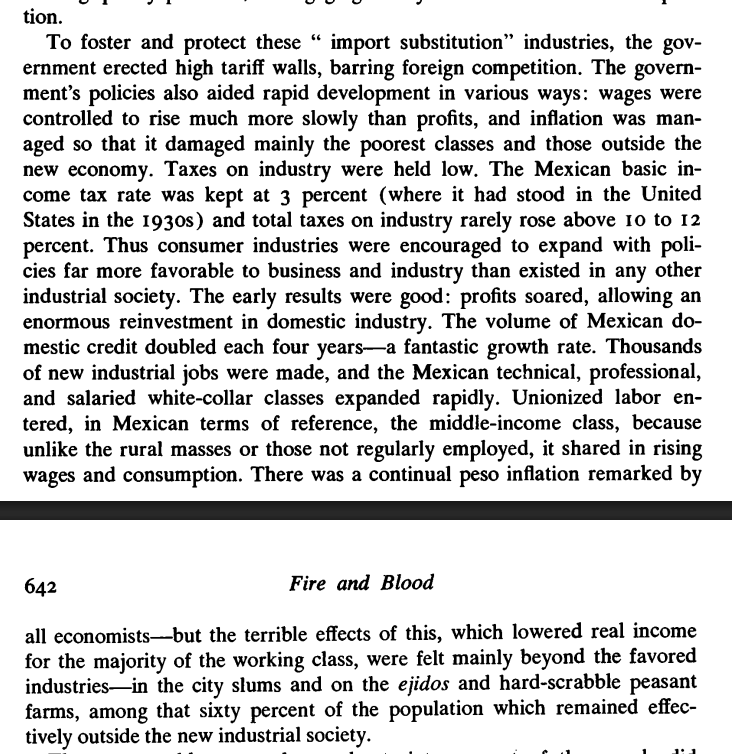
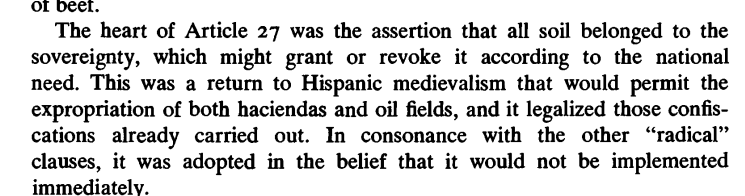
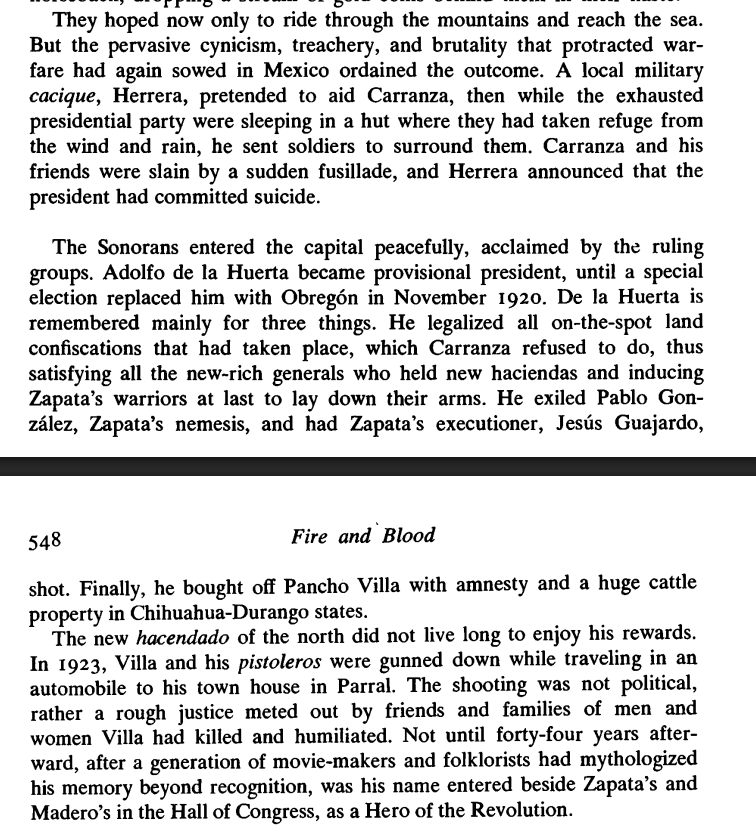
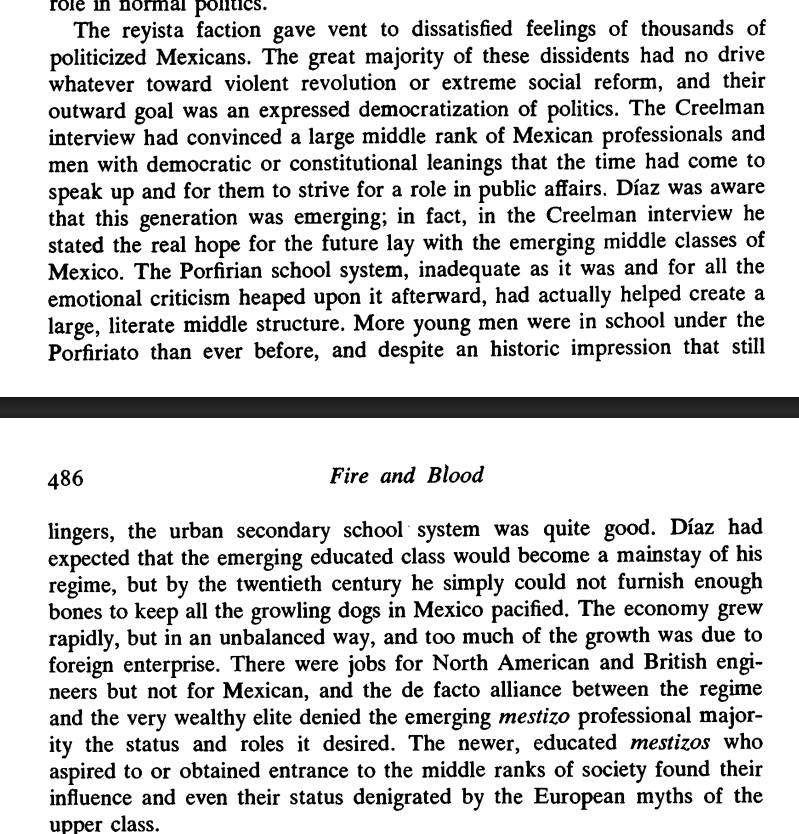
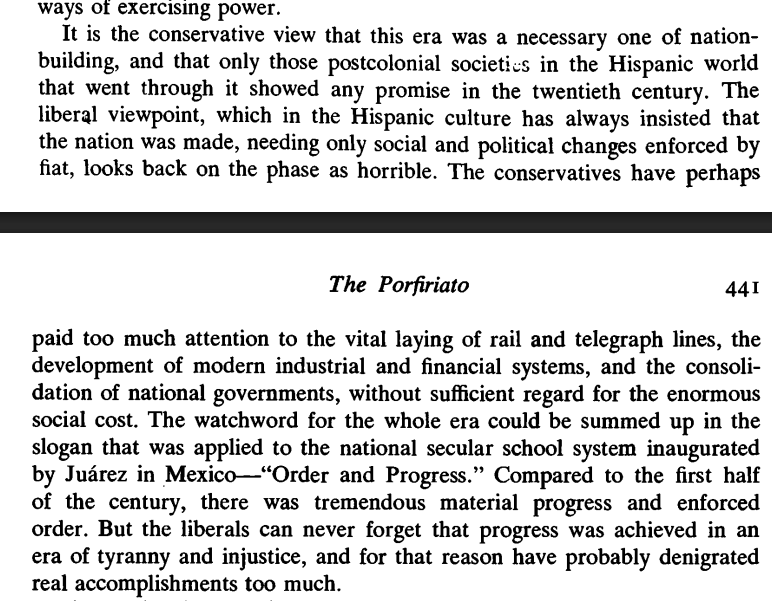
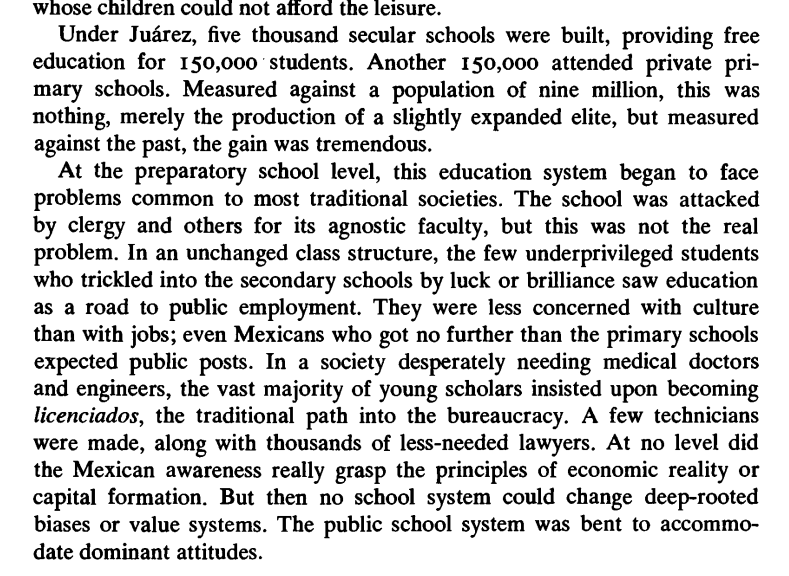
Thread with excerpts from the Partido Nacional Revolucionario (PNR) section of TR Fehrenbach's "Fire and Blood: A History of Mexico" (1995). Calles created the PNR in 1929 to institutionalize the govt and Revolution, creating a Mexican party-state. 

The Calles/Obregon governments were corrupt, but never succumbed to paranoia; there was no equivalent to the Soviet or Chinese liquidations of class enemies, the press was free, and the average Mexican had nothing to fear from the govt (Red Terror against the Church aside).

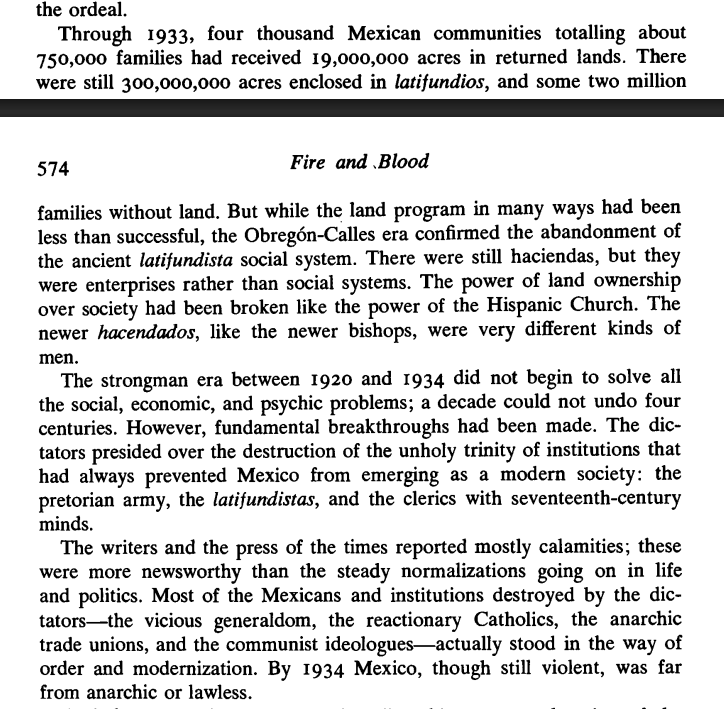
Roughly 19M acres were redistributed through 1933; most land remained with latifundios. But the new latifundios were not like the old ones, they were commercial enterprises rather than social systems. The clerics, army, and latifundistas were all tamed by Calles/Obregon.
The intellectuals of the Revolution praised the indios, but it was the Revolution that finally destroyed them as a distinct group, turning them into mestizo Mexicans. This was necessary; modern Mexico derives from Spain, Europe, and the West.

The Revolutionary period produced the first great outburst of Mexican artistic creativity since the early colonial era.

In 1933, the PNR met to draw up a Six-Year Plan for Mexico, on the model of Stalin's USSR. More importantly, Calles chose Lazaro Cardenas to be his next figurehead president.
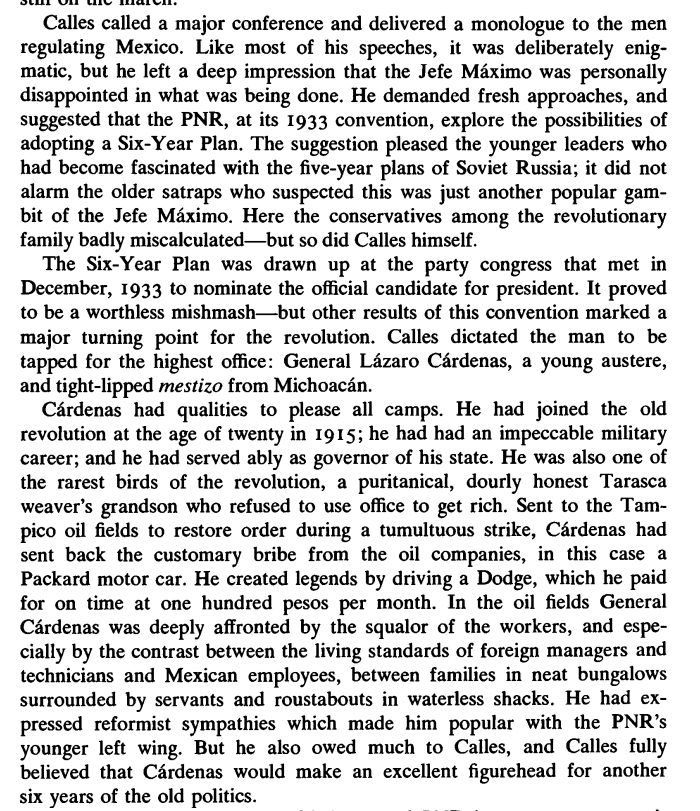
Cardenas turned out to be a sort of Mexican FDR, a genius politician who used the new institutional machinery of the PNR to outmaneuver and marginalize Calles before taking Mexico (fully legal, institutionally conservative, peaceful) in a socialist, agrarian direction.


Cardenas massively scaled up land reform/expropriations, preferentially seizing the best and most improved fields. This tanked and paralyzed production.

Turning over modern agrarian enterprises (large-scale plantations in the south, built up by recent European or Levantine immigrants and doing capital-intensive production for the world market) to indio peasant communes (ejidos) turned out to be a disaster.

Cardenas then set up Soviet-style govt collective farms with the seized land. As in the USSR, this did not work, and extreme population growth made the situation worse.
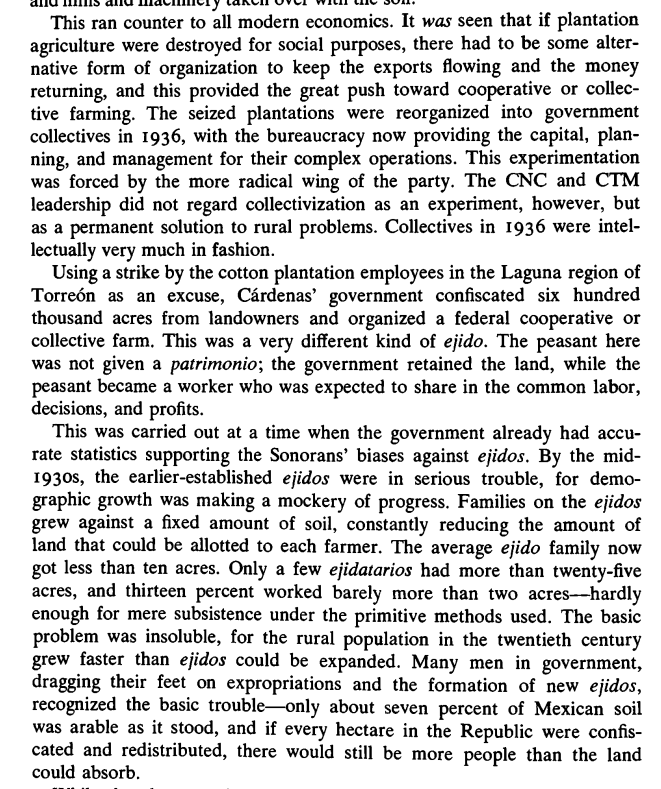
Cardenas expropriated ~1/5 of arable Mexican land between 1934 and 1940. This proved a disaster, as agriculture bureaucrats had no idea how to farm, but proved an indestructible constituency. Mexico was fed by the remaining smallholders and plantations.


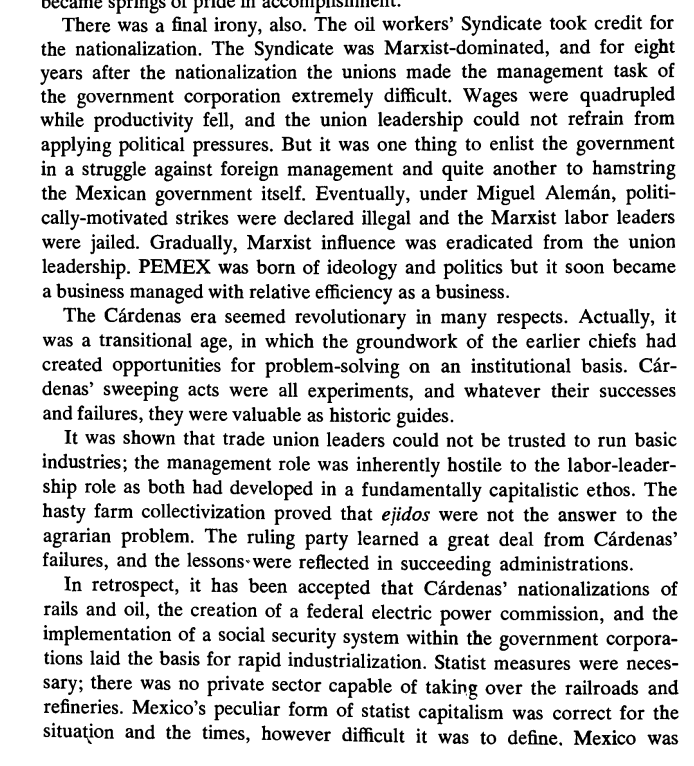
Cardenas also experimented with worker control over enterprises, nationalizing several industries and turning them over to the unions. This was also a disaster, but unlike with the ejidos he was able to reverse course and run them as commercial enterprises.

Cardenas wound up nationalizing the foreign-owned oil industry almost by accident over a labor dispute in 1938. If the US had protested over seizure of property, it probably wouldn't have worked, but the FDR administration was pretty much OK with it.


The first few years of PEMEX were a disaster like the rest of Cardenas' nationalizations, but American technical assistance and demand during WWII turned into a modernized and more-or-less efficient behemoth.
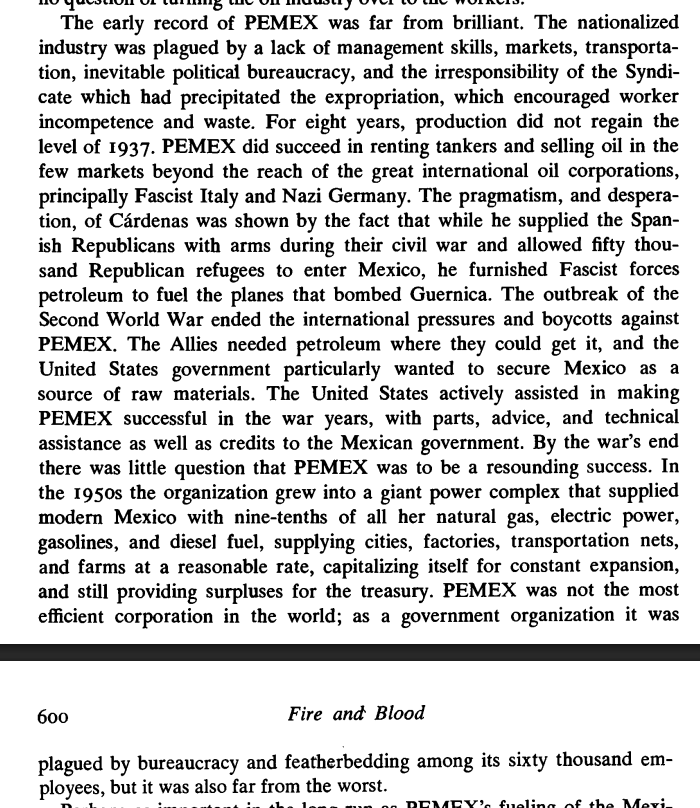
Ironically, one advantage PEMEX had over private foreign operators was the ability to outlaw and crush labor agitation at will; striking against foreign management was acceptable, but not striking against the (socialist-ish) Mexican government.
One of the distinguishing features of the Mexican Revolution and PNR was lack of dogmatism; each president defined his age, but could not outlast his six years in office. The PNR provided an arena where crucial decisions could be made without blood on the streets.

After the radical Cardenas era, the PNR moderated; Cardenas and his faction accepted defeat peacefully.

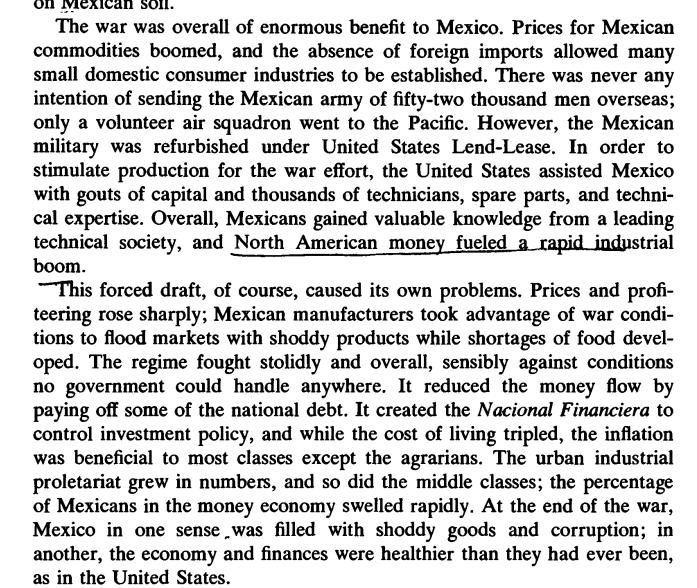
WWII enormously benefited Mexico; US technical assistance revolutionized the economy, Lend-Lease modernized the military, and skyrocketing demand boosted the formal and industrial economy, leaving Mexico economically healthier than ever before.
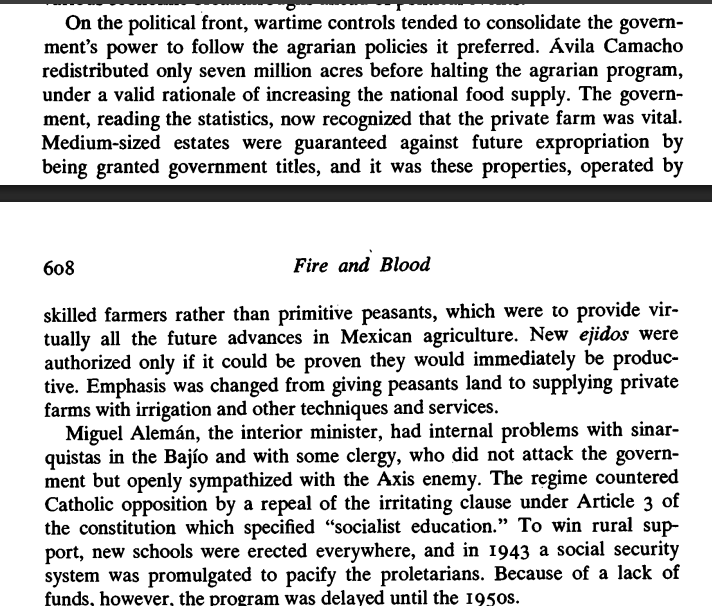
The Camacho presidency finally halted the land expropriations to increase national food supply, and began granting formal titles to medium-sized estates.
The PNR institutionalized succession, choosing the next president by compromise and consensus. This worked better than most democratic systems between 1940 and 1970.

The post-Cardenas PNR were basically non-ideological problem-solvers, statists but not socialists, who prioritized industrial/capitalistic/technical/economic development and political stability over all else.
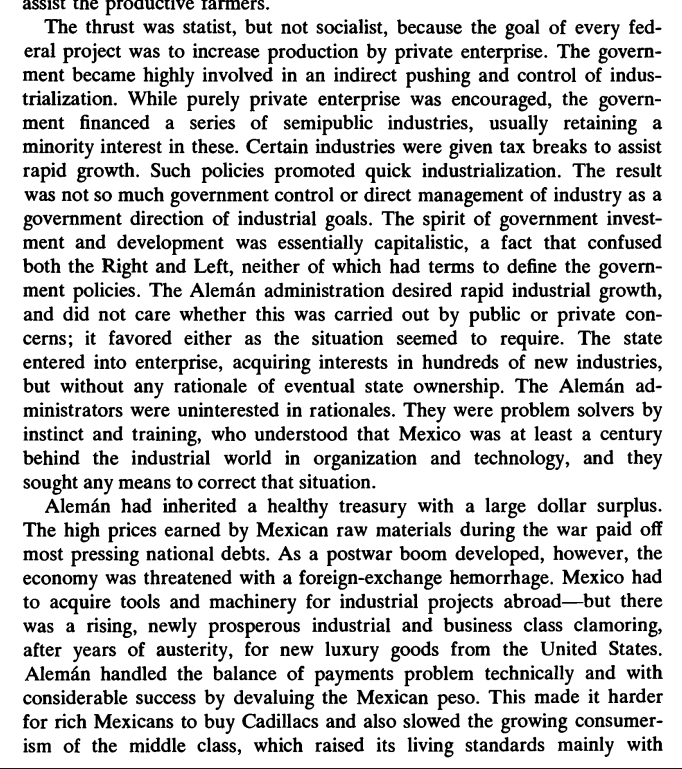
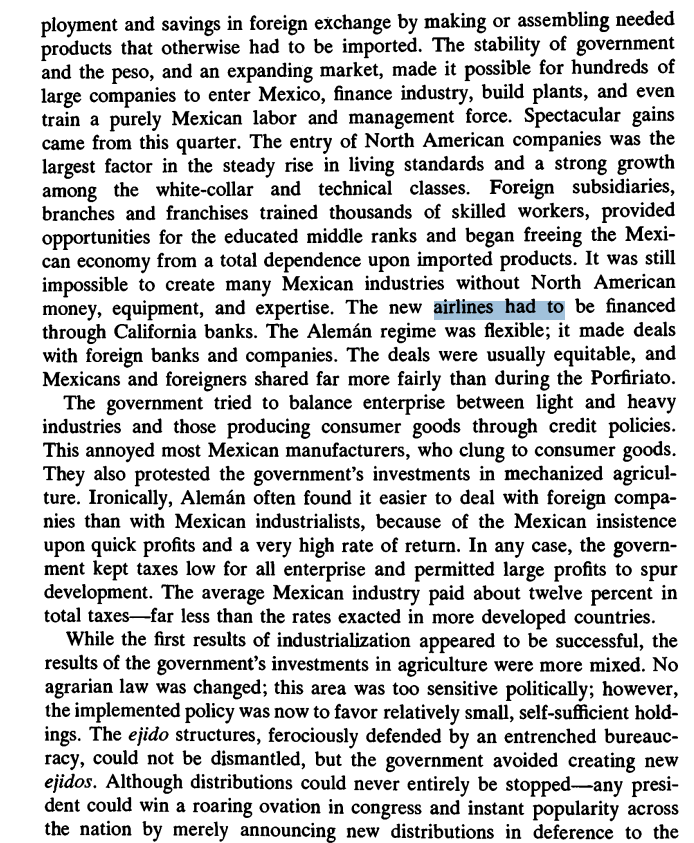
The postwar PNR often preferred working with foreign businessmen, as they were more pacient and demanded less-rapid returns than their Mexican counterparts, and brought desperately-needed tech.
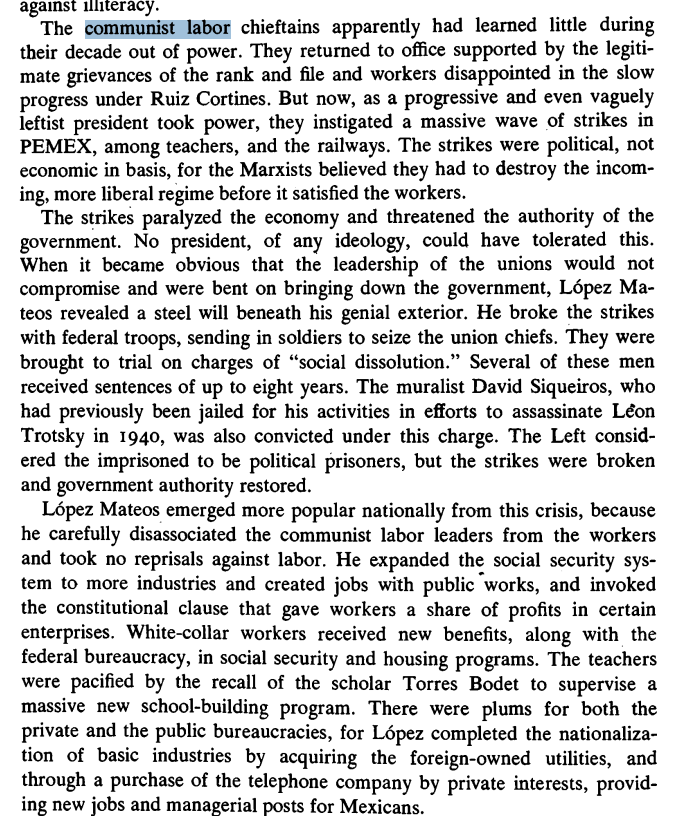
In 1958, Communist labor leaders attempted a nationwide series of strikes; President Matteos broke them with federal troops and imprisoned the union chiefs.
On the outbreak of the Cuban Revolution, the retired-but-still-influential Cardenas took the side of Castro, winning the "Stalin Peace Prize." The Mexican govt as a whole was friendly to Cuba but aggressively arrested Cuban agents.

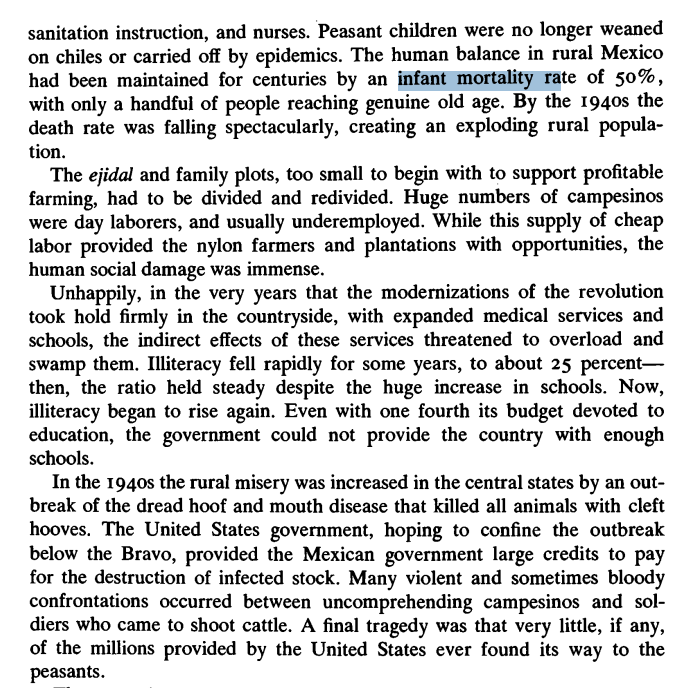
Falling infant mortality led to a colossal population boom and rural misery; this touched off mass immigration to the United States, adding to the accumulated social and cultural problems of the US Southwest.

• • •
Missing some Tweet in this thread? You can try to
force a refresh