H100 ornn index spot prices are falling, now at $2.42 per hour, roughly 40% below the May peak. The ecosystem is concerned that this is a sign that compute demand and by extension the appetite for AI is waning. (1/5)🧵
The important signal is that this is likely a spot price index not term pricing. Our neocloud survey for 1-year H100 contract prices have isntead climbed from a trough of roughly $1.70 per hour late last year to about $2.65 per hour today. (2/5)
Spot and on-demand markets are where buyers run POCs, one-off evaluations, burst workloads, and capacity overflow. They can be useful when taken as part of a dataset but are not reflective of where production economics are set. Contract pricing is where sustained workloads show up with the intention of planned, recurring, revenue-bearing inference or training demand. (3/5)
Falling spot prices alongside rising contract prices are therefore not evidence of weaker demand. It is more likely a shift of opportunistic capacity usage toward committed production deployment. Serious buyers are locking in term capacity, and that is pushing contract pricing higher. (4/5)
The contract market is the one that better reflects where durable AI workloads are actually going and we track this in our GPU pricing index. (5/5) semianalysis.com/gpu-pricing-in…
• • •
Missing some Tweet in this thread? You can try to
force a refresh

AI demand is outstripping Moore's law in the short run
Moore's law drove import prices of computers and semiconductors down by 52% between 2001 and 2020. (1/4)🧵
AI demand has surged so high that import prices for computers and semiconductors rose 3.6% in May, now up 14.4% year-to-year. This is so far from anything in the historical record that 'fastest ever' doesn't do justice to it. (2/4)
Import prices are hedonically adjusted (accounting for chip speed and capacity) so Moore's law means they normally fall over time. (3/4)
China is Mogging Western Auto, and that’s Bad for Semis, National Security & War
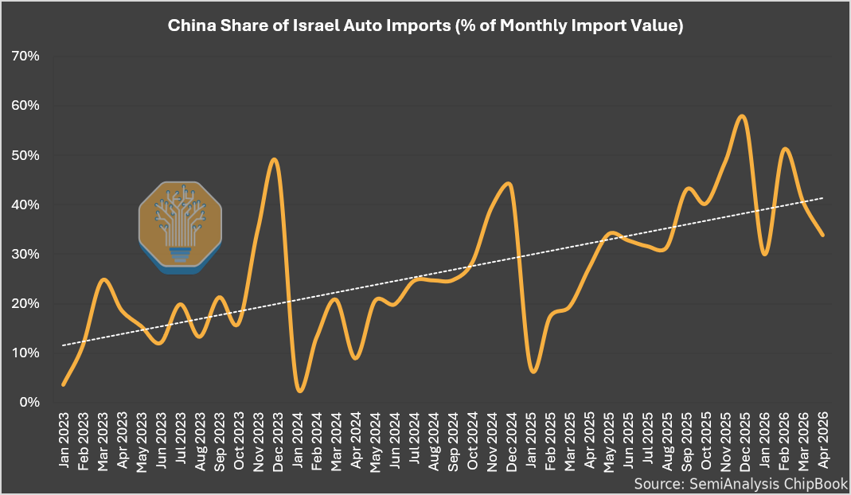
If you live anywhere outside the US, you've noticed it: the streets are filling up with cars you've never seen before. Chery? Jaecoo? Zeekr? Leapmotor? BYD? No, you didn't miss a decade of car launches. They're Chinese. And they're everywhere. (1/10)🧵
Israel is the perfect case study to understand what’s really going on: high car ownership, zero domestic production & no restrictions on auto imports from China. Here’s what the data shows:
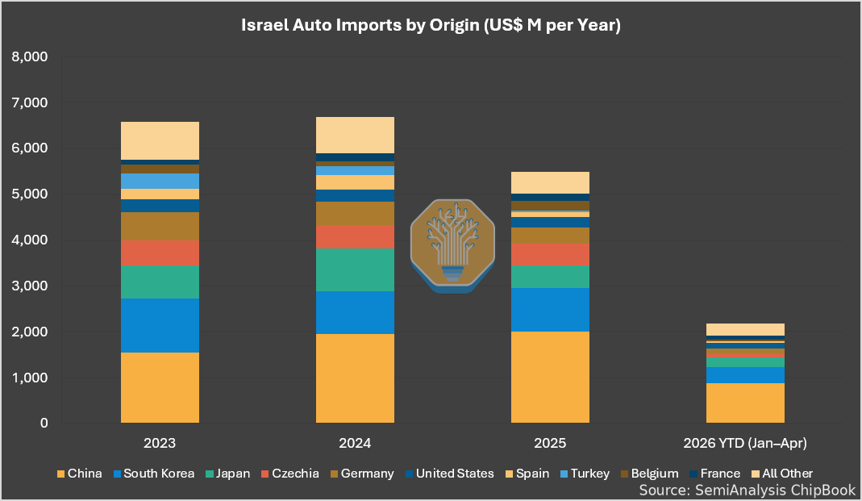
China's share of Israel's auto import value: 2023: 23.7% 2024: 29.1% 2025: 36.6% 2026 YTD: 40.2. (2/10)
China is now Israel's #1 auto supplier: $6.4B of imports since Jan 2023 — nearly 2x South Korea, almost 3x Japan.
The kicker: Israel's total auto imports SHRANK ~18% in 2025. China's still grew. That's pure share capture, not market growth. (3/10)
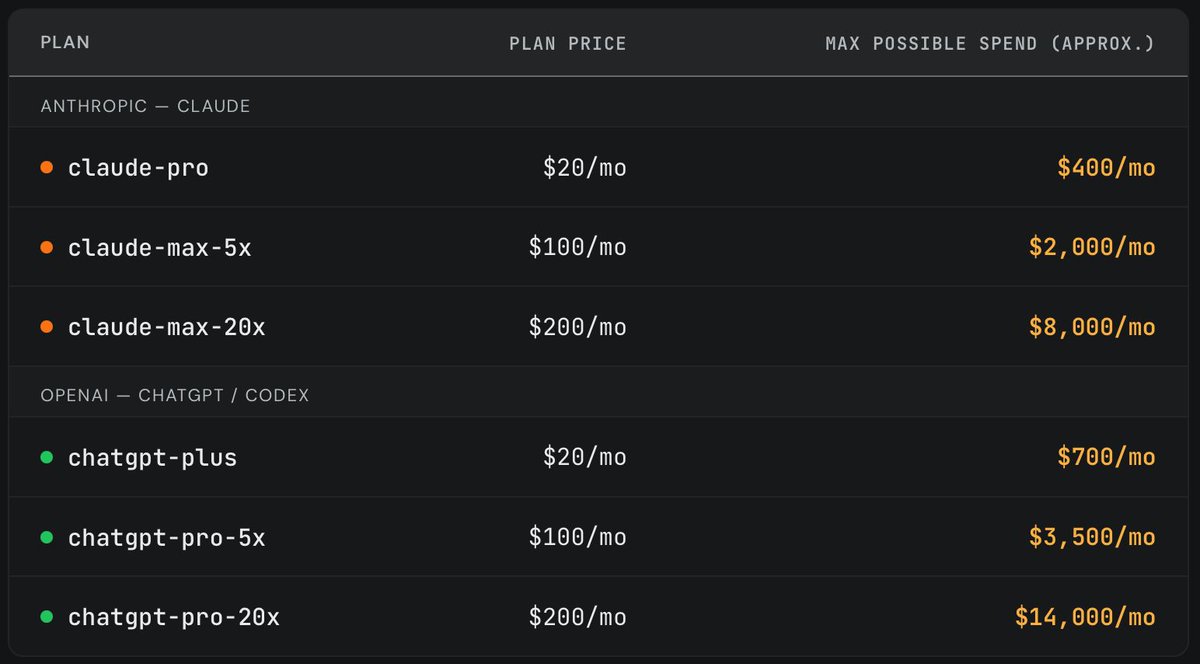
What's the better business model for an AI lab, subscription or API? (1/4)🧵
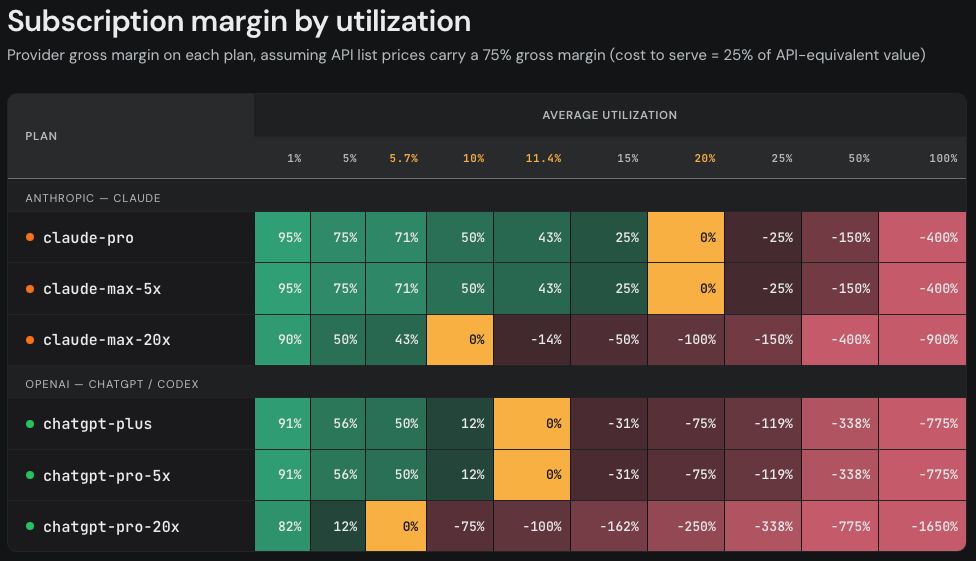
Recently, we purchased one of each Anthropic/OpenAI subscription plan and randomly ran long horizon coding tasks until we exhausted the weekly limit. It's widely believed that a $200/month plan maxes out at ~$2000/month worth of tokens (assuming API pricing). However, we found that the subscriptions are actually far more generous. (2/4)
The margin on a subscription plan is a function of the average utilization. If we assume both companies have 75% API gross margins, this results in the following subscription margins. (3/4)
OSATs are usually seen as “boring” semiconductor companies. But we’ve been, and remain, bullish on Amkor ($AMKR) and ASE ($3711.TW). Why?
Because both sides of the OSAT model, Assembly & Test, are starting to shift in a meaningful way. (1/10) 🧵
Let’s focus on the first for now; Assembly.
Historically, packaging = low-margin wire bonding. Not exciting.
ASE once made up ~40% of $KLIC’s wire bonder business. After the COVID boom, capacity flooded the market and growth stalled. (2/10)
But something is changing.
KLIC is now seeing :
• 90%+ utilization in China
And guiding to:
• H2’26 China growth +15–20% vs H1
At the Chipbook we have been tracking wire bonder imports into China which are up +108% YoY in March. (3/10)
Something to watch closely as the war in Iran drags on:
A very obscure part of the semiconductor supply chain, Naphtha, is potentially
becoming a quiet constraint on AI chips. (1/11) 🧵
Here is what the supply chain looks like:
An oil called Naphtha is shipped on giant tankers from Middle Eastern countries like Kuwait, UAE and Saudi Arabia by companies like Aramco (Saudi Arabia) or
ADNOC (UAE).
Then Integrated Japanese Chemical companies like Daicel and Toagosei and Korean petrochemical giants like LG Chem or Lotte Chemical "crack" it (break it down) in massive factories to create Propylene gas. (2/11)
Next chemical companies in either Japan or Korea convert the propylene gas into an ultra-high-purity liquid called PGMEA. PGMEA is the "workhorse" solvent for the photolithography process. (3/11)
Earlier this year, Micron announced it would acquire PSMC’s P5 Tongluo fab in Miaoli, Taiwan—the process has officially begun.
At first glance, this looked like a straightforward legacy logic/memory fab acquisition. But the details worth a close look. (1/10) 🧵
The site has two key sections: Section A and Section B.
Section A already exists and is now being converted for likely Micron’s 1b DRAM process. Because it is not EUV-compatible, 1b is a practical fit for the existing cleanroom setup with proper equipment from Micron in coming quarters (the existing legacy equipment are from PSMC and those were not including in the acquisition agreement). (2/10)
Section B is different.
The cleanroom has not broken ground yet, so it is unlikely to come online before the end of 2027. But because Micron can design it from scratch, it should be built to support EUV and advanced HBM manufacturing. (3/10)