This vial contains a new drug called PAC-832, which I recently invented to treat Alzheimer’s disease. It is the world’s first selective GalR1 antagonist.
I designed and synthesized PAC-832 in a chemistry lab I built in my garage. (1/16)
I designed and synthesized PAC-832 in a chemistry lab I built in my garage. (1/16)


PAC-832 is the first drug of its kind. It works by selectively blocking a receptor in the brain called “galanin receptor 1,” or GalR1. The drug has sub-micromolar potency for GalR1 and >30x selectivity over GalR2/3. (2/16)

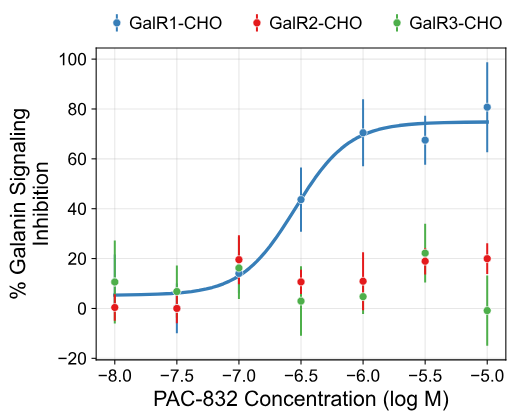
When administered to mice, PAC-832 significantly improves their memory across multiple different memory tests. (3/16)
PAC-832 also has excellent manufacturability and chemical properties (stability, solubility, etc.), low toxicity, and great pharmacokinetics, including being readily absorbed through the stomach and passing the blood-brain barrier - all less appreciated, but no less critical properties needed for an oral neurological drug to succeed (4/16).

PAC-832 is currently undergoing IND-enabling studies and will be the first galanin-targeting drug in 15 years (and first selective GalR1-targeting drug ever) to enter clinical trials. Read more about this drug here: (5/16)pacepharmaceuticals.com
What’s GalR1, and what does it have to do with AD?
GalR1 is one of three receptors for a molecule called “galanin,” which acts as a signaling molecule in mammalian brains. Galanin isn’t nearly as well-characterized as other neurotransmitters like dopamine or serotonin, yet it’s been shown to regulate many of our key bodily functions, like pain, metabolism, mood, sleep, and memory. (6/16)
GalR1 is one of three receptors for a molecule called “galanin,” which acts as a signaling molecule in mammalian brains. Galanin isn’t nearly as well-characterized as other neurotransmitters like dopamine or serotonin, yet it’s been shown to regulate many of our key bodily functions, like pain, metabolism, mood, sleep, and memory. (6/16)

In the 1980s, abnormal galanin signaling was tied to Alzheimer’s through several clinical and scientific observations: (1) brains from deceased AD patients contained many more galanin-producing neurons than normal, concentrated in the basal forebrain - a key memory region in the brain, (2) galanin prevented acetylcholine (ACh), a neurotransmitter essential for memory, from being released when applied to brain slices from rodents/monkeys, and (3) galanin treatment impaired memory in live rodents. (7/16)
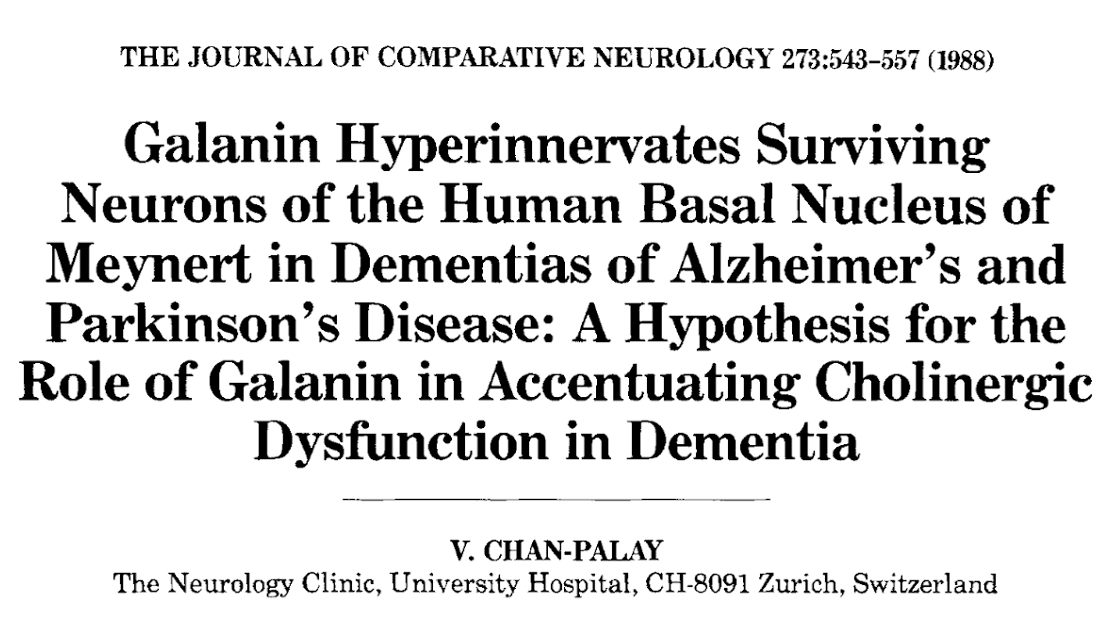


These observations led scientists in the 90s to hypothesize that a drug that blocked the action of galanin in the brain could increase ACh levels and improve memory, similar to how acetylcholinesterase inhibitors like the AD drug donepezil work.
An initial cohort of peptide galanin antagonists was developed. These drugs were unable to pass the blood-brain barrier due to their size and thus had to be administered by direct injection into the brain - feasible for a mouse, obviously not feasible for a human. Still, their effects served as an important proof of concept: a galanin inhibitor could improve memory (in rodents at least), so long as it reached the brain. (8/16)
An initial cohort of peptide galanin antagonists was developed. These drugs were unable to pass the blood-brain barrier due to their size and thus had to be administered by direct injection into the brain - feasible for a mouse, obviously not feasible for a human. Still, their effects served as an important proof of concept: a galanin inhibitor could improve memory (in rodents at least), so long as it reached the brain. (8/16)


The first small molecule inhibitors of galanin with potential to pass the blood-brain barrier appeared in the early 2000s. A few high-throughput screens were carried out for GalR1 (galanin receptor 1) antagonism by big pharma companies Schering-Plough (now part of Merck) and J&J, producing two promising lead compounds/series. However, none of them were developed further due to various practical issues - difficulty of synthesis in the former case, reactivity and solubility issues in the latter case. (9/16)

Later in the 2000s, a more complete picture of galanin signaling emerged. New studies showed that galanin surprisingly protected neuronal health in various contexts, suggesting that neurons in AD patients overexpressed galanin to ‘protect’ the neurons from neurotoxic factors brought on by AD progression. There were now two conflicting mechanisms tied to galanin signaling - one of ACh inhibition, leading to cognitive impairment, and one of neuronal protection.
The newfound pleiotropic nature of galanin threw cold water on the galanin therapeutic hypothesis - it suggested that a blanket inhibitor of galanin ran the risk of causing harm by blocking galanin’s protective effects. (10/16)
The newfound pleiotropic nature of galanin threw cold water on the galanin therapeutic hypothesis - it suggested that a blanket inhibitor of galanin ran the risk of causing harm by blocking galanin’s protective effects. (10/16)


However, the seemingly contradictory harmful vs. protective effects of galanin were soon resolved by molecular research tied to the three galanin receptors, known as GalR1-3. The galanin receptors are part of a large family of receptors known as ‘G-protein coupled receptors,’ which activate a common set of downstream pathways. GalR1 and GalR3 were found to activate one of them, the ‘Gi/o signaling pathway,’ a powerful molecular brake that prevents the release of neurotransmitters (including ACh). In other words, the inhibitory effect of galanin on ACh release was mediated by GalR1 and GalR3. (11/16)
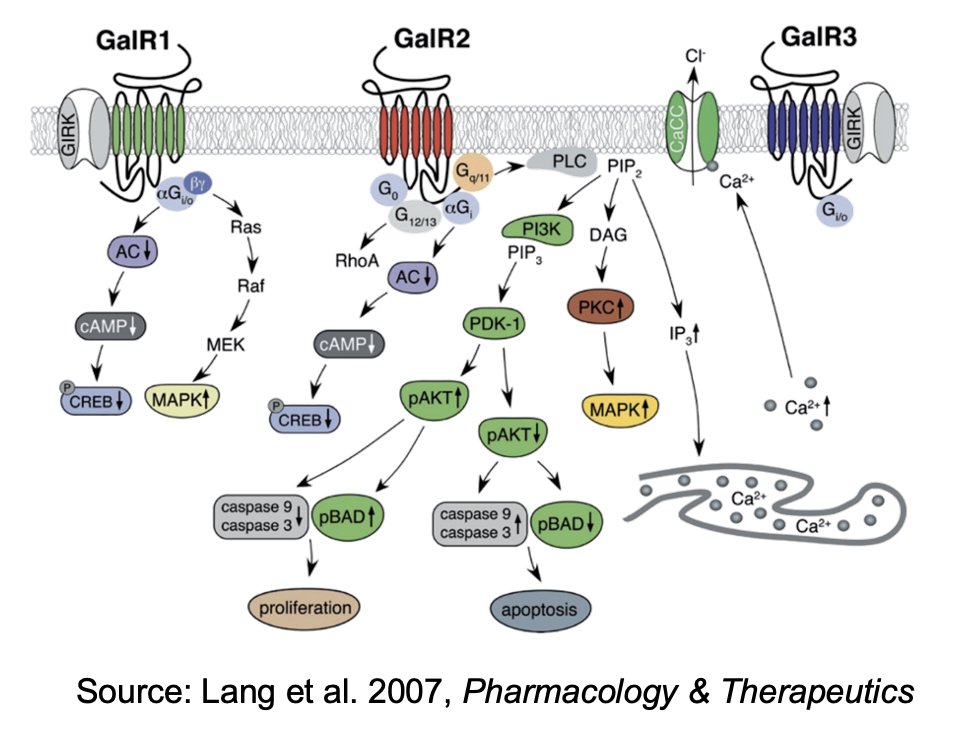
On the other hand, GalR2 was found to activate a different G-coupled pathway - the Gq/11 pathway, which broadly results in cell activation. Various studies found that the protective effects of galanin were downstream of this pathway and mediated through GalR2. (12/16)

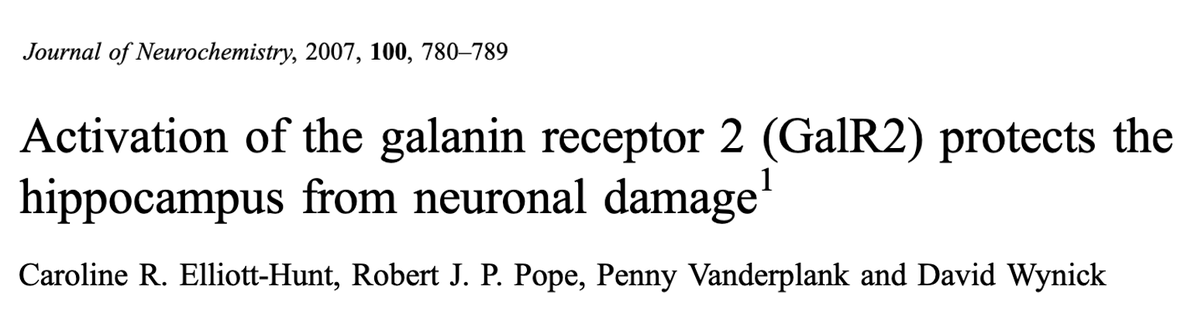
A viable path for a drug targeting galanin signaling emerged from these findings. Rather than blocking galanin activity across all contexts, one could in theory design an inhibitor that selectively blocks ONLY GalR1 and/or GalR3 (thus removing the brake on ACh release, and alleviating the cognitive symptoms of AD), while having no effect on GalR2 (thus preserving the neuroprotective Gq/11 signaling). (13/16)
Following this strategy, the GalR3-selective small molecule antagonist HT-2157 was developed by Synaptic Pharmaceutical and entered clinical trials in 2011 for depression. However, the drug did not progress beyond Phase 1 due to safety issues. After that, interest in galanin-targeting drug development fizzled out, and no additional galanin antagonists entered the clinic. (14/16)

My new drug, PAC-832, builds upon decades of progress from the galanin field and solves all the problems that caused previous galanin-targeting drugs to fail. Unlike Sch202596, PAC-832 has great manufacturability - it’s possible to synthesize large quantities of it in a garage using standard chemistry equipment. Unlike dithiepine-1,1,4,4-tetroxide, PAC-832 has good chemical properties and stability. Unlike HT-2157, PAC-832 has very low / nonexistent toxicity (well-tolerated at doses up to 1000 mg/kg in mice, therapeutic index > 100).
PAC-832 still has a long road ahead of it to reach FDA approval - Alzheimer’s has a notoriously high clinical failure rate - but this is as good of a start as you can ask for. (15/16)
PAC-832 still has a long road ahead of it to reach FDA approval - Alzheimer’s has a notoriously high clinical failure rate - but this is as good of a start as you can ask for. (15/16)
A final word: the development of PAC-832 was catalyzed by various modern technologies, most notably liquid-handling robotics and large language models / AI agents. All of the in vitro screening was performed by an OpenTrons OT-2 liquid-handling robot programmed by Claude Code. Meanwhile, LLMs (mainly ChatGPT Pro) were deeply integrated into virtually every step of the discovery process - I wouldn’t have been able to complete this project without them. (16/16)
• • •
Missing some Tweet in this thread? You can try to
force a refresh