🚨 BREAKING: 100+ companies just backed Open USD, a dollar stablecoin run by a new independent company, Open Standard. Zach Abrams is interim CEO.
Five-minute reaction (and personal views only.)
The instinct is to count the logos when you see a lot of them. The design choices matter much more.
- No mint or redemption fees by default
- No arbitrary caps when you scale from $10k to $10m
- Reserve yield shared by default (issuers used to keep it)
This is clearly about scale, and going after the larger, industrial-grade payments volume.
Open Standard runs like a financial market infrastructure. It remids me more of things like SWIFT, the card networks, the clearing houses. Owned broadly, governed by a board, a little "boring" on purpose.
---
Credible neutrality is the whole game.
One company's coin is a product. A coin a hundred competitors agree to share becomes a standard. The cap tables of SWIFT and the early clearing houses were the incumbents of their day in one room. This rhymes.
Look at the breadth too. Banks, card networks, crypto natives, fintechs, big tech, on one coin. A global PSP, a community bank, an international long-tail player. Everyone finds an animal in the picture that looks like them. That breadth is the ultra significant bit.
---
For stablecoins to get beyond their current use cases, we needed something that got rid of the penalties for scale (like mint burn fees) and could handle massive volume.
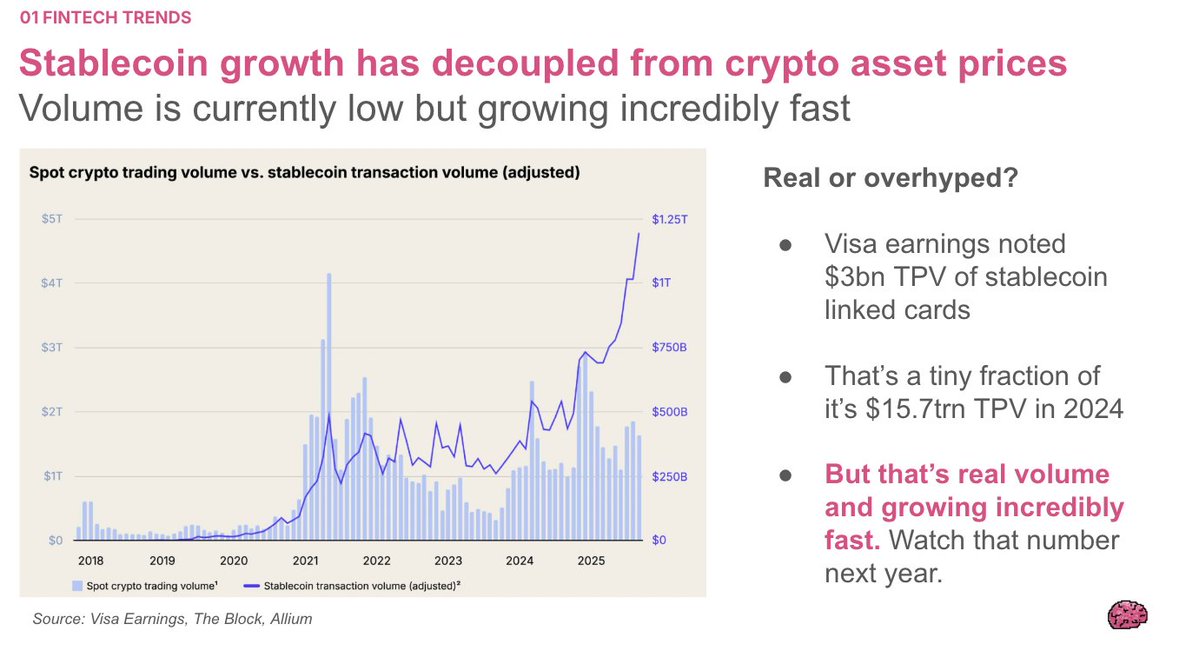
Today's stablecoin use cases are a rounding error against what's coming. with ~$300B in circulation. SWIFT instructs an average of 5 to 6 trillions a day. The card networks settle trillions. Capital markets, QUADRILLIONS. The prize is moving those flows on-chain, 24/7, with the settlement guarantees regulated money actually needs.
If you build payments, capital markets or treasury, this is the rails question of the decade.
Read the design choices first. The logo wall is the easy story.
Five-minute reaction (and personal views only.)
The instinct is to count the logos when you see a lot of them. The design choices matter much more.
- No mint or redemption fees by default
- No arbitrary caps when you scale from $10k to $10m
- Reserve yield shared by default (issuers used to keep it)
This is clearly about scale, and going after the larger, industrial-grade payments volume.
Open Standard runs like a financial market infrastructure. It remids me more of things like SWIFT, the card networks, the clearing houses. Owned broadly, governed by a board, a little "boring" on purpose.
---
Credible neutrality is the whole game.
One company's coin is a product. A coin a hundred competitors agree to share becomes a standard. The cap tables of SWIFT and the early clearing houses were the incumbents of their day in one room. This rhymes.
Look at the breadth too. Banks, card networks, crypto natives, fintechs, big tech, on one coin. A global PSP, a community bank, an international long-tail player. Everyone finds an animal in the picture that looks like them. That breadth is the ultra significant bit.
---
For stablecoins to get beyond their current use cases, we needed something that got rid of the penalties for scale (like mint burn fees) and could handle massive volume.
Today's stablecoin use cases are a rounding error against what's coming. with ~$300B in circulation. SWIFT instructs an average of 5 to 6 trillions a day. The card networks settle trillions. Capital markets, QUADRILLIONS. The prize is moving those flows on-chain, 24/7, with the settlement guarantees regulated money actually needs.
If you build payments, capital markets or treasury, this is the rails question of the decade.
Read the design choices first. The logo wall is the easy story.

• • •
Missing some Tweet in this thread? You can try to
force a refresh