Epoch AI Profile picture
Jul 2 11 tweets 3 min read Read on X
Introducing EBR-bench, our new benchmark to measure on-the-fly learning.

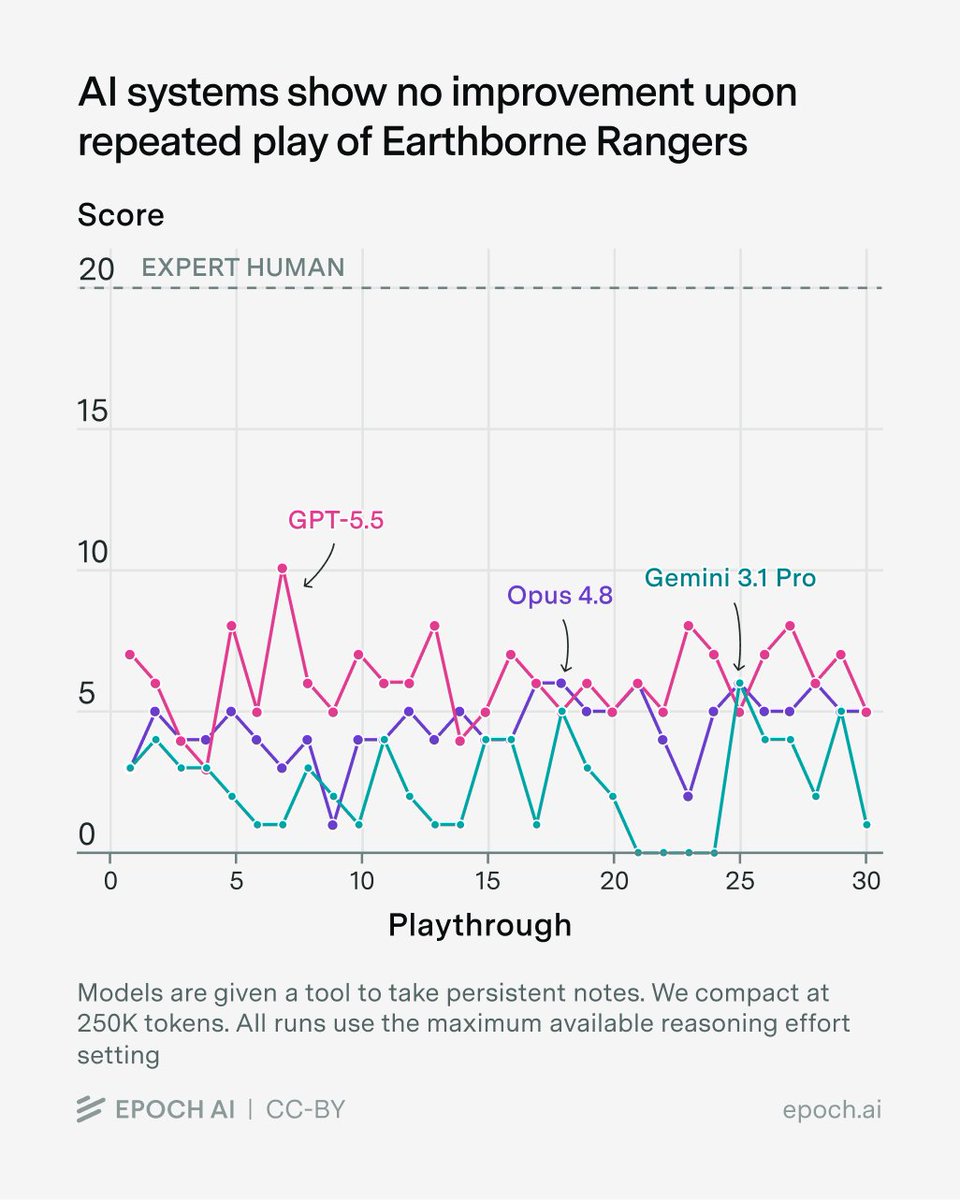
AI repeatedly plays a challenging board game called Earthborne Rangers and tries to learn from its mistakes. So far: no signs of improvement. Image
If AI can learn on the fly, it becomes much more general-purpose. This has economic implications (learning on the job) as well as safety consequences (developing dangerous capabilities post-release). We study the ability to learn an unfamiliar game as a proxy for this dynamic.
For this, we use Earthborne Rangers: a somewhat obscure, largely text-based campaign game. It requires a mix of strategic deck-building and tactical turn-by-turn play. A single playthrough takes humans 2–4 hours, and mastery may require dozens of playthroughs.
AI systems play the game repeatedly. They are given the rulebook, a card database, and the game’s map. They have a note-taking tool that persists across compactions. Their task is to maximize their score on the final 20% of playthroughs. We see no on-the-fly learning. Image
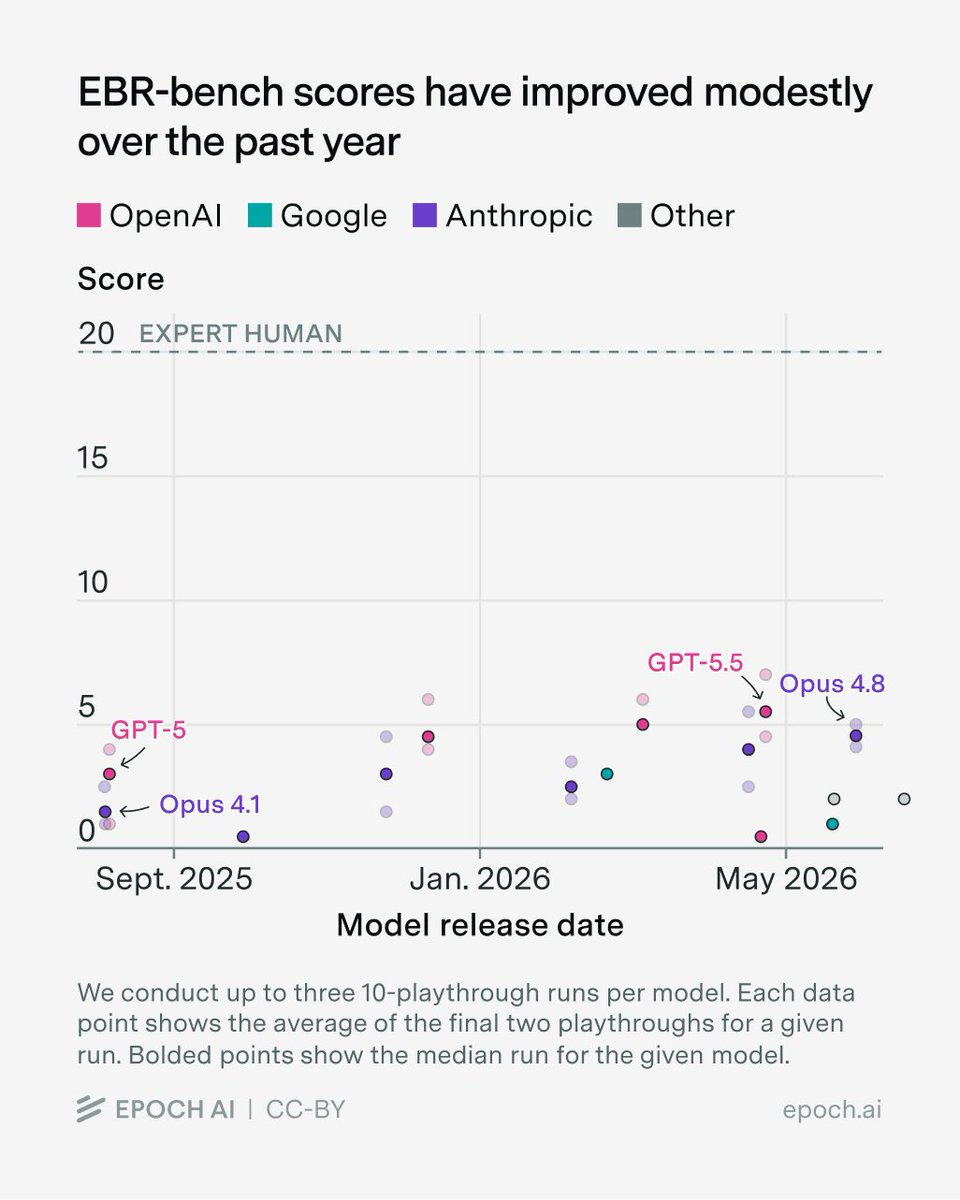
Baseline performance has improved somewhat with newer generations of models. GPT-5.5 and Opus 4.8 clearly outscore GPT-5 and Opus 4.1, though progress since is less obvious. In any case, this comes from better out-of-the-box performance, not from on-the-fly learning. Image
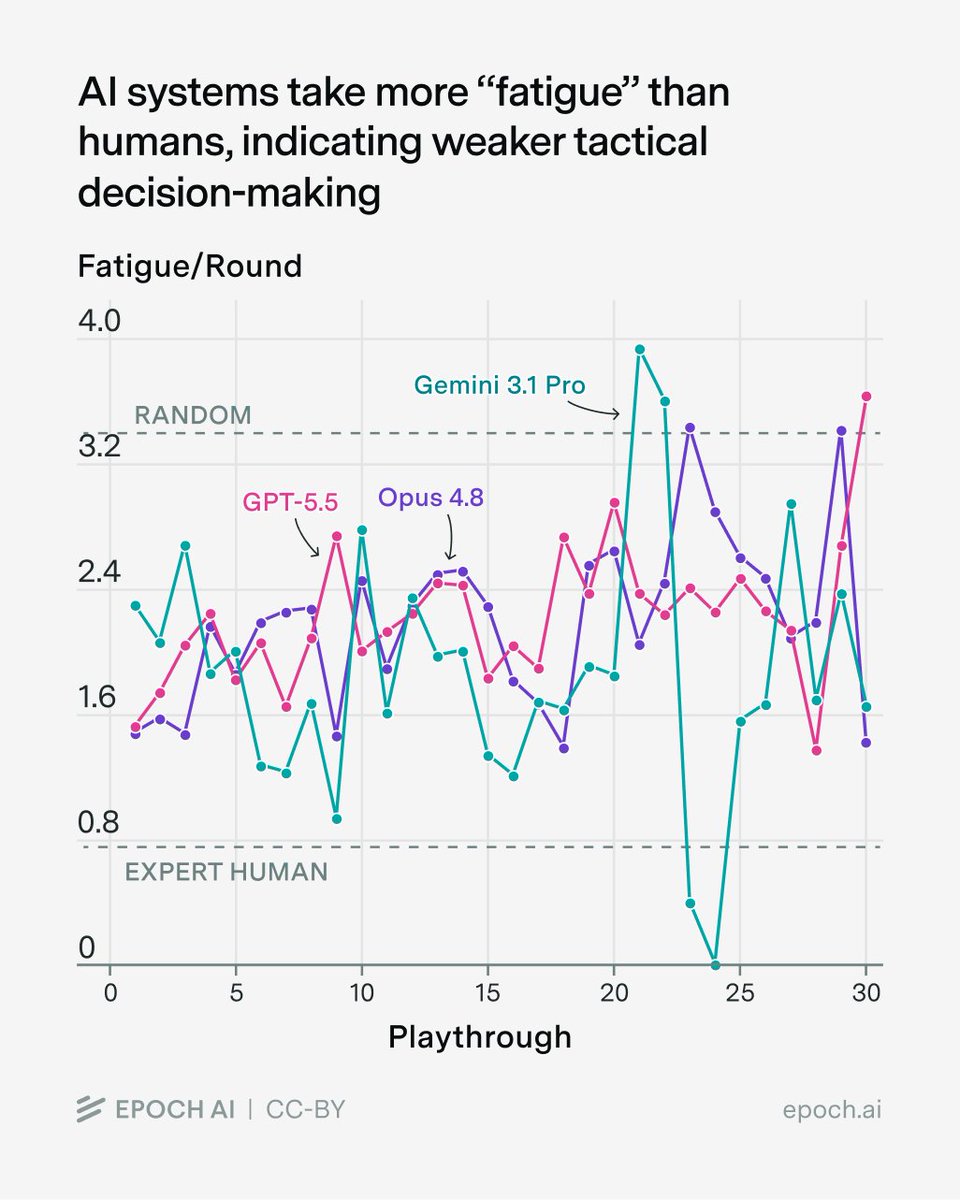
Models struggle with tactics. The game’s core damage mechanic is called “fatigue”, and taking too much fatigue is a sign of managing turn-by-turn play poorly. Models do better than random, but fall short of expert human performance. Image
Models also struggle with strategy. A major aspect of this is deck-building, where the player chooses their initial cards. There are 32 “archetypes” of deck but models explore only a fraction of them. Many models stick to a single archetype in all their exploratory playthroughs. Image
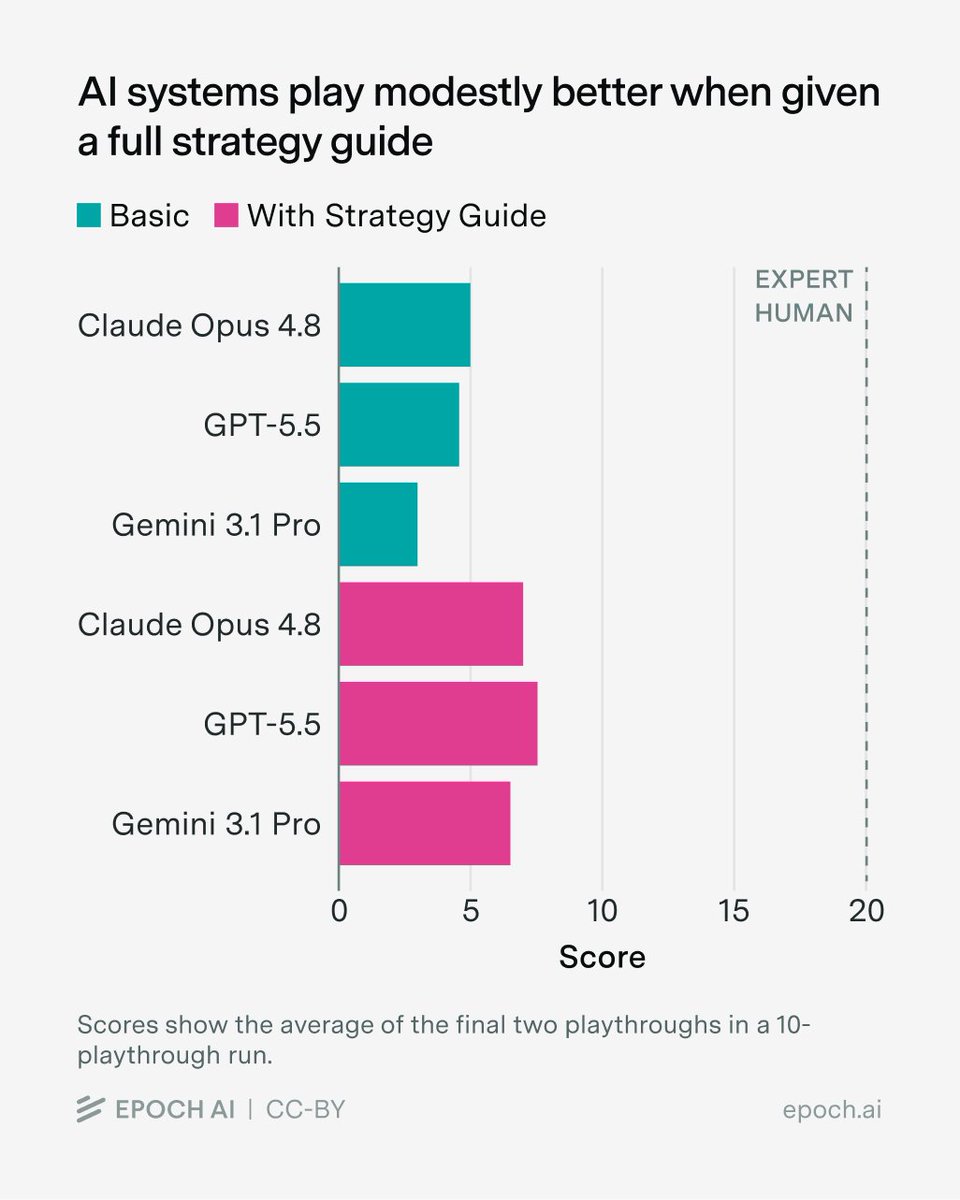
Even if we give them a full strategy guide—the best set of notes we think they could take—models improve only modestly and still show no ability to get better with practice. Image
Have we under-elicited AI’s true capabilities? In the future, we plan to experiment with providing more tools (web search, code execution), trying different scaffolds, using multi-agent setups, and providing expert human playthrough transcripts. Let us know your ideas here!
AI could likely get better at EBR with focused RL training, and we suspect that AI companies have just not prioritized such tasks. So long as this remains the case, EBR-bench serves as a tool to detect the emergence of on-the-fly learning.
Read more about the benchmark on our website.

epoch.ai/publications/e…

• • •

Missing some Tweet in this thread? You can try to force a refresh

 

Keep Current with Epoch AI

Epoch AI Profile picture

Stay in touch and get notified when new unrolls are available from this author!

Read all threads

This Thread may be Removed Anytime!

PDF

Twitter may remove this content at anytime! Save it as PDF for later use!

Try unrolling a thread yourself!

how to unroll video
  1. Follow @ThreadReaderApp to mention us!

  2. From a Twitter thread mention us with a keyword "unroll"
@threadreaderapp unroll

Practice here first or read more on our help page!

More from @EpochAIResearch

Jun 26
What are the largest software engineering tasks AI can perform?

To answer this, we built MirrorCode, our long-horizon SWE benchmark that lets AI code autonomously for days at a time.

The best models complete some tasks we estimate would take human engineers several weeks.
In MirrorCode, AI models are given execute-only access to a program, docs, and tests demonstrating intended behavior. The AI must then reimplement the program from scratch.

The model’s output is graded against a suite of tests, including held-out tests to prevent cheating.
MirrorCode features 25 target programs spanning different areas of computing: Unix utilities, data serialization and query tools, bioinformatics, interpreters, static analysis, cryptography, and compression. Image
Read 12 tweets
Jun 17
How close is AI to automating AI R&D? Right now, the tools economists use to track automation are too blunt to say.

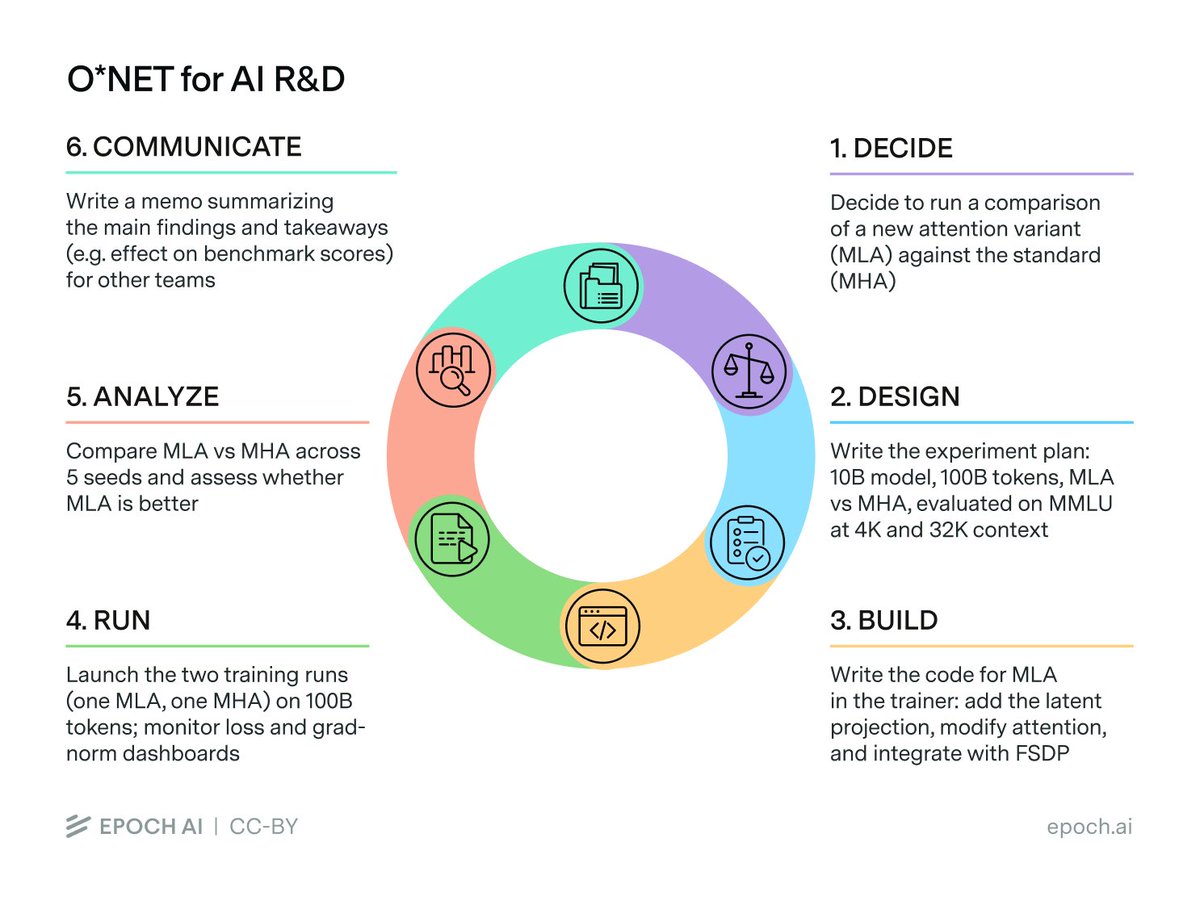
In this week's newsletter, @datagenproc, @joemkwon, and @ansonwhho propose a sharper tool: a thorough taxonomy of 60+ tasks involved in frontier AI research. 🧵 Image
Economists often study labor markets using the O*NET database, which breaks ~1000 occupations into tasks. But these tasks are too coarse-grained to track automation in AI R&D specifically, even in occupations closest to “AI researcher”. Image
We propose an O*NET for AI R&D that includes 60+ tasks (with examples) across the research cycle. The taxonomy covers six categories, from deciding what to work on to communicating results.

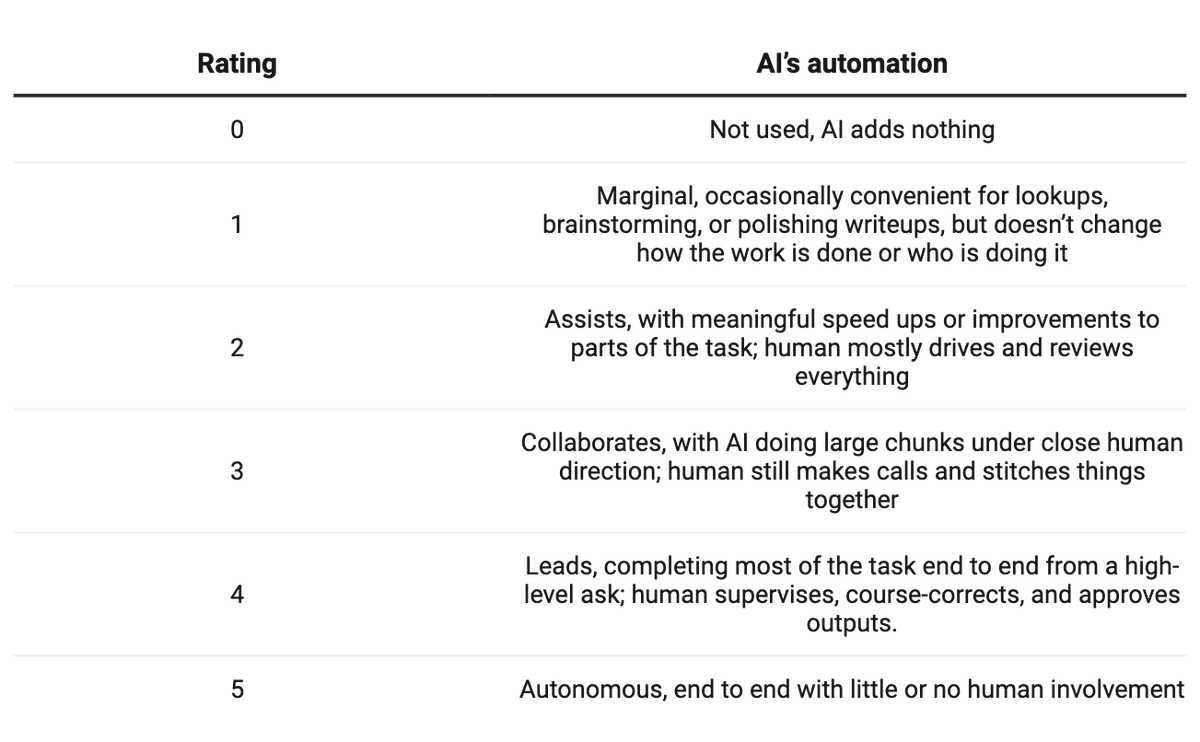
Each task is rated 0–5 for how much we think AI automates it today. Image
Read 6 tweets
Apr 27
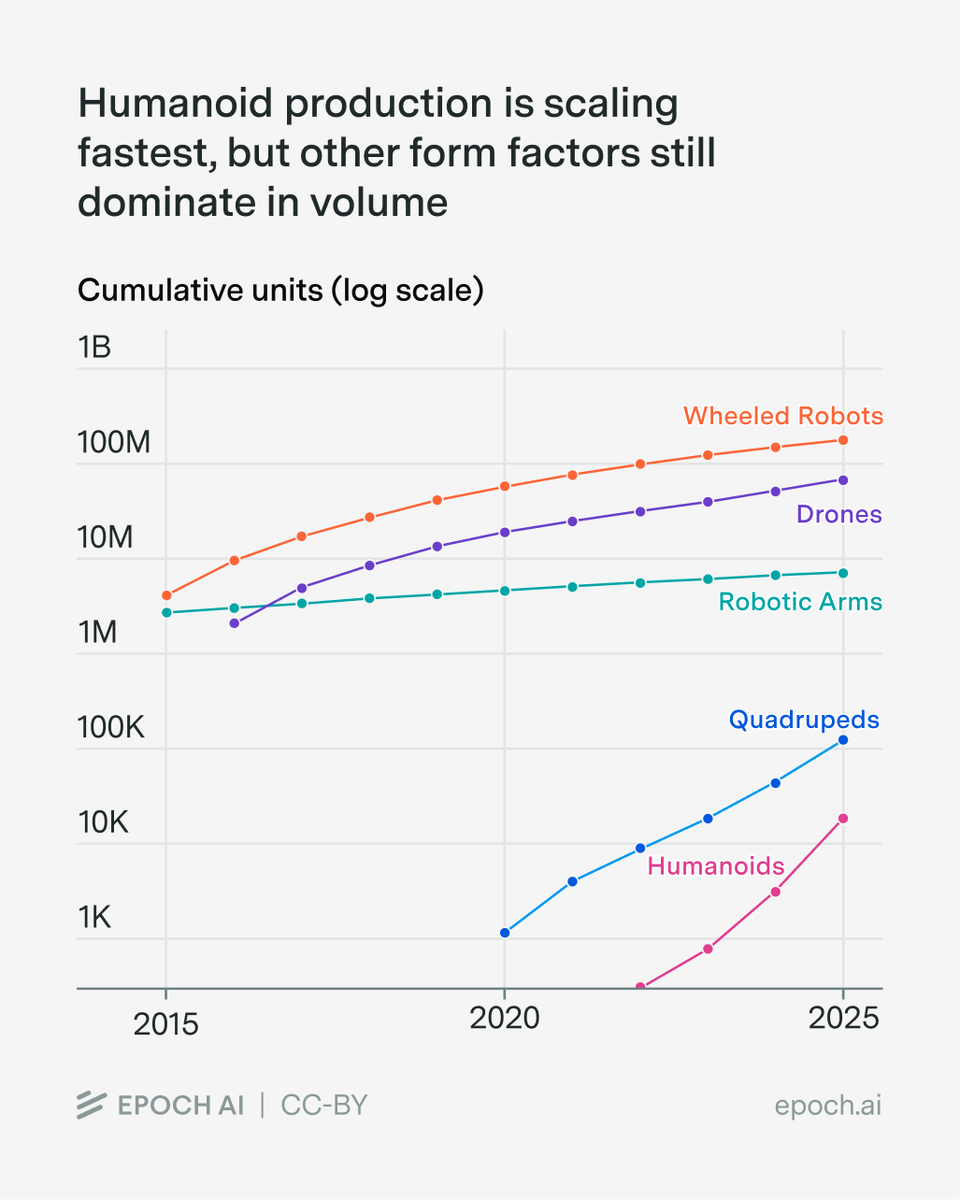
How fast could production of humanoids, quadrupeds, drones, and other robots scale up, in the event of a large demand shock? Image
We first look at current production trends. Humanoids are growing fastest (~16K units in 2025, doubling every ~6 months) but from a small base.

Quadrupeds (~81K) double every ~10 months. Drones (16M/year) and wheeled robots (33M/year) dominate in volume but grow more slowly. Image
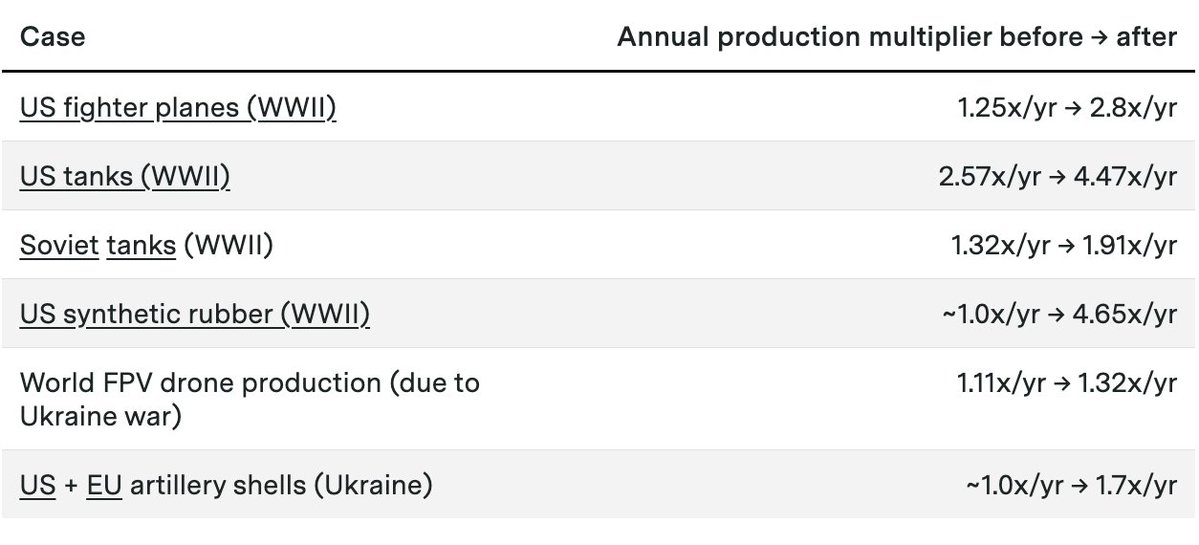
We then look at historical cases of demand shocks, like WWII mobilization and drone production after Russia's invasion of Ukraine. These suggest that under a demand shock, robot production growth could accelerate sharply, though it's unclear how well they apply. Image
Read 8 tweets
Apr 10
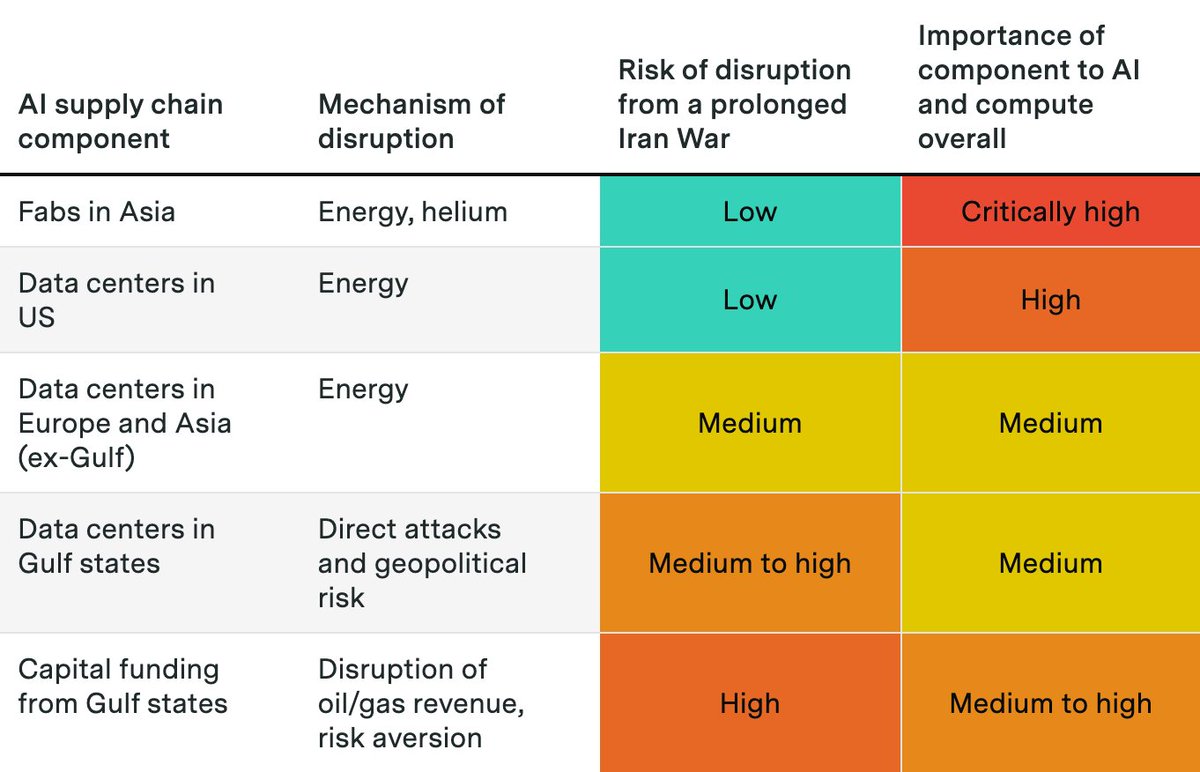
The Iran War and Hormuz shutdown have disrupted oil, gas, and helium exports and threatened data centers and investments in the Gulf states.

@justjoshinyou13 explores how a prolonged Iran war could affect AI, and why it probably won’t completely derail the compute buildout. Image
Fabrication of AI chips and memory is concentrated in Taiwan and South Korea. These fabs rely on energy from natural gas as well as helium, both disrupted by the Hormuz closure.

But chip fabs are so profitable that TSMC and others will likely secure the resources they need.
For AI data centers, the Hormuz energy shock is not a serious threat in the US, where natural gas prices have been stable.

In Europe and Asia, higher costs may kill some planned data centers, but existing data centers will keep running unless prices surge to much higher levels.
Read 5 tweets
Apr 6
Compute may be the most important input to AI. So who owns the world’s AI compute?

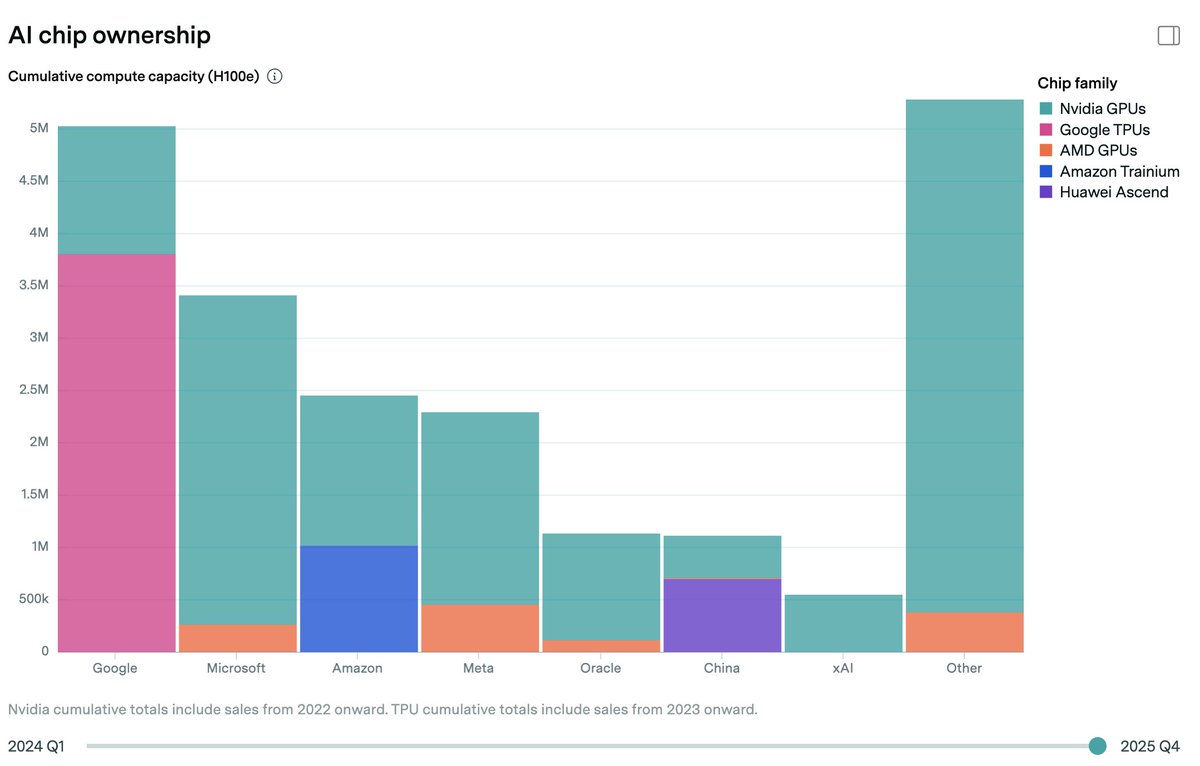
Introducing our new AI Chip Owners explorer, showing our analysis of how leading AI chips are distributed among hyperscalers and other major players, broken down by chip type over time. Image
To estimate global compute ownership, we build on our previous estimates of overall AI chip sales. We then use earnings commentary from chipmakers and hyperscalers, as well as media reports and industry researcher estimates, to allocate chips across owners. Image
We estimate that over 60% of global AI compute is owned by the top US hyperscalers, led by Google with the equivalent of roughly 5 million Nvidia H100 GPUs!

Unlike the other hyperscalers, which rely primarily on Nvidia, Google’s fleet is dominated by its custom TPU chips. Image
Read 6 tweets
Feb 26
Developing more powerful AI isn’t just about scaling compute. It’s also about improving algorithms and data quality, which let you build better models with the same compute.

We call this “AI software progress” — here’s everything you need to know about it: 🧵 Image
There are many ways to improve algorithms and data. For example, you could change model architectures, build better RL environments, and improve training recipes.

But how do you concretize what makes some AI software better than others?
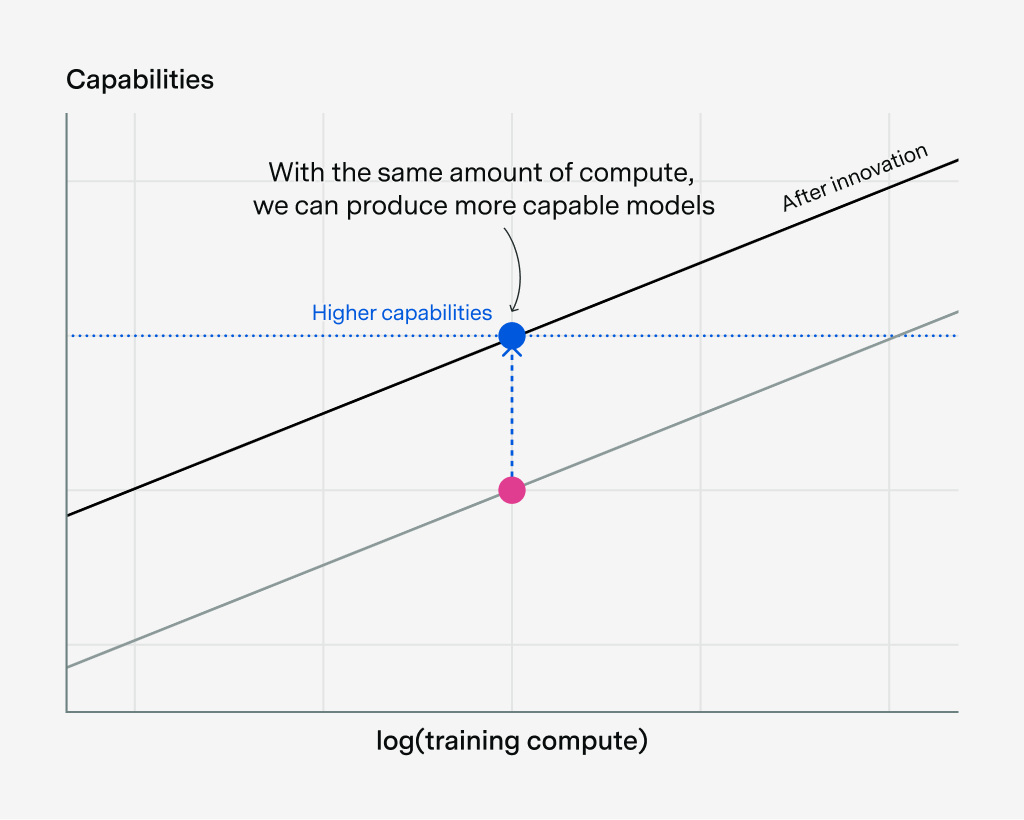
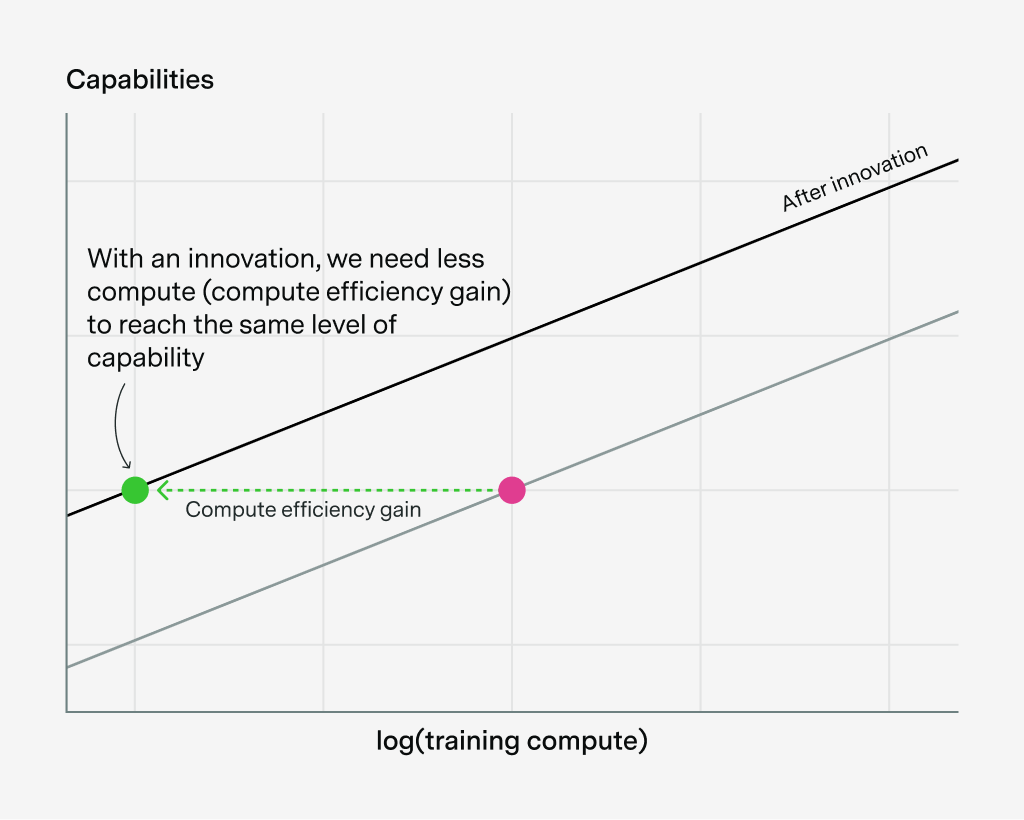
One way is to say that better AI software reduces the compute needed to reach the same capability.

For example, imagine a curve relating a measure of capabilities to log(training compute). After making an algorithmic innovation, the curve shifts to the left, saving compute: Image
Read 8 tweets

Did Thread Reader help you today?

Support us! We are indie developers!


This site is made by just two indie developers on a laptop doing marketing, support and development! Read more about the story.

Become a Premium Member ($3/month or $30/year) and get exclusive features!

Become Premium

Don't want to be a Premium member but still want to support us?

Make a small donation by buying us coffee ($5) or help with server cost ($10)

Donate via Paypal

Or Donate anonymously using crypto!

Ethereum

0xfe58350B80634f60Fa6Dc149a72b4DFbc17D341E copy

Bitcoin

3ATGMxNzCUFzxpMCHL5sWSt4DVtS8UqXpi copy

Thank you for your support!

Follow Us!

:(