Adam | Faithful Messenger Profile picture
Jul 7 7 tweets 3 min read Read on X
Judas felt terrible about what he did.

He went back to the chief priests, threw the silver down, and said: "I have sinned. I have betrayed innocent blood." — Matthew 27:4

That sounds like repentance.
It wasn't.

🧵 A devotional on the most devastating difference in the Christian life — remorse vs repentance.Image
Judas wasn't a random villain inserted into the story.

He walked with Jesus for three years.
He heard every sermon. Witnessed every miracle.
He was trusted enough to carry the disciples' money.

But John tells us something quietly devastating:

"He was a thief; as keeper of the money bag, he used to help himself to what was put into it." — John 12:6

The betrayal for thirty pieces of silver didn't begin in the upper room.

It began in a thousand small surrenders to the same sin nobody was watching.

What we feed in private eventually acts in public.
Here's what makes Judas's story so haunting:

Peter also betrayed Jesus that same night.
Three denials.
Out loud.
In front of witnesses.

Both men felt crushing guilt afterward.

But Peter ran back to Jesus.

Judas ran away from Him to the wrong people, with his confession, looking for relief that religion could not give.

"I have sinned," he told the chief priests.
They said: "That's your problem." (Matthew 27:4-5)

Remorse looks for somewhere to put the guilt.

Repentance brings it to the only One who can remove it.
Remorse and repentance can feel identical from the inside.

Both involve guilt.
Both involve acknowledgment.
Both can involve tears.

The difference is direction.

Remorse is sorrow focused on yourself: what you've lost, what you've done, how bad you feel.

Repentance is a turn away from the sin and toward God.

"Godly sorrow brings repentance that leads to salvation and leaves no regret, but worldly sorrow brings death." — 2 Corinthians 7:10

Judas had worldly sorrow.
It destroyed him.

The question is never just "do you feel bad?"
It's "where are you taking it?"
Judas's tragedy is not that he sinned too greatly for grace.

It's that he never brought his sin to the only place grace lives.

Peter's sin was just as real.
His restoration was just as available to Judas.

The thief on the cross had one breath left and used it to turn toward Jesus.

It is never too late to turn in the right direction.

But the direction matters more than the feeling.

Have you ever confused remorse with repentance, feeling bad without actually turning?

Share below.
🙏 A prayer for anyone carrying guilt today

Lord, I don't just want to feel bad about what I've done.
I want actually to turn.

Teach me the difference between remorse that circles endlessly
and repentance that walks toward you.

I am bringing this to you
not to a priest, not to my own conscience, not to the mirror.

To you.

Receive me.

Amen.

— Save this if you need it today.
More than 600 believers are already going deeper every week.

Join them → Faithful Messages 🔗
faithfulmessages.beehiiv.com

• • •

Missing some Tweet in this thread? You can try to force a refresh

 

Keep Current with Adam | Faithful Messenger

Adam | Faithful Messenger Profile picture

Stay in touch and get notified when new unrolls are available from this author!

Read all threads

This Thread may be Removed Anytime!

PDF

Twitter may remove this content at anytime! Save it as PDF for later use!

Try unrolling a thread yourself!

how to unroll video
  1. Follow @ThreadReaderApp to mention us!

  2. From a Twitter thread mention us with a keyword "unroll"
@threadreaderapp unroll

Practice here first or read more on our help page!

More from @Adam_FaithfulM

Jul 6
Most Christians know Jesus is coming back.

Far fewer can say why.

The return of Christ isn't just a dramatic ending tacked onto history. It's the completion of everything the story has been building toward.

The Bible gives clear reasons, and understanding them changes how you live right now.

Here's why Jesus is coming back.

A thread. 🧵Image
First — He promised He would.

"I will come again and will take you to myself, that where I am you may be also." (John 14:3)

At His ascension, two angels told the watching disciples:

"This Jesus… will come in the same way as you saw him go into heaven." (Acts 1:11)

The return of Christ isn't a fringe idea.

It's mentioned over 300 times in the New Testament, roughly one in every 25 verses.

The first coming was promised for centuries and happened exactly as foretold.

The second is promised just as clearly.
Reason 1 — to finally defeat evil completely.

The first time, Jesus came in weakness as a baby, to suffer and die.

The second time, He comes in power, to end evil once and for all.

"Then the lawless one will be revealed, whom the Lord Jesus will… bring to nothing by the appearance of his coming." (2 Thessalonians 2:8)

Every injustice that was never made right.

Every evil that seemed to win.

Every wrong that went unanswered.

At His return, the account is finally settled.

Evil doesn't get the last word; He does.Image
Read 11 tweets
Jul 3
In His final hours on the cross, Jesus spoke seven times.

Seven short sentences, gathered from all four Gospels.

They are the last words of a dying man, but they are unlike any last words ever spoken.

In them you find forgiveness, agony, tenderness, triumph, and surrender.

Here's each of the seven, and what each one actually means. 🧵Image
"Father, forgive them, for they know not what they do." (Luke 23:34)

His first words from the cross are not about His own pain.

They are a prayer of forgiveness for the very people driving the nails.

While being executed, Jesus intercedes for His executioners.

This is the gospel in a single sentence: forgiveness offered to people in the very act of their sin, before they ever ask for it.

He didn't wait for an apology. He forgave first.
"Truly, I say to you, today you will be with me in paradise." (Luke 23:43)

Spoken to the criminal crucified beside Him — a guilty man, dying for his own crimes, who simply asked to be remembered.

No baptism.
No good works.
No time left to prove anything.

Just a dying plea and a trusting heart.

And Jesus promises him paradise that very day.

This is grace at its purest: a man saved at the last possible moment, with nothing to offer but faith.

If the thief could be welcomed, no one is beyond reach.Image
Read 12 tweets
Jul 2
Solomon's Temple took 7 years to build and cost a fortune almost impossible to calculate.

Tons of gold. Cedar from Lebanon. Stone cut so precisely that no hammer was heard on site.

It was one of the wonders of the ancient world.

And roughly 400 years later, it lay in ruins.

The story of the Temple is the story of everything it was meant to teach and everything Israel forgot.

A thread. 🧵Image
First — why Solomon, and not David?

David wanted to build it.
He had the vision, the desire, the plans.

But God said no. (1 Chronicles 22:8)

David was a man of war with much blood on his hands.

The house of God's peace would be built by his son, whose very name — Shlomo — comes from shalom, peace.

The Temple wasn't just Solomon's project.

It was the fulfillment of his father's deferred dream.

Sometimes the thing you're called to prepare is someone else's to complete.

That's not failure.

That's how God often works across generations.
The Temple followed the same basic pattern as the Tabernacle but was permanent and far grander.

The tent became a building.

The portable became fixed.

What had wandered with Israel through the wilderness now had a settled home in Jerusalem.

1 Kings 6 details it: the outer court, the Holy Place, and the innermost Holy of Holies where God's presence dwelt above the Ark.

The message was the same as the Tabernacle's — a holy God making a way to dwell among His people.

But now it declared something new: God's presence with His people was meant to be established, permanent, home.Image
Read 11 tweets
Jun 30
Everyone remembers Jonah for the fish.

But the fish isn't the point. It's barely two verses.

The book of Jonah is actually about something far more uncomfortable:

A man who obeyed God, succeeded wildly, and was furious about it.

The real story isn't the prophet who ran.
It's the prophet who came back and still hadn't changed.

A thread. 🧵Image
First — why did Jonah run?

God told him to go preach to Nineveh — the capital of Assyria.

The Assyrians were not just foreigners.
They were brutal, violent enemies of Israel, known for extreme cruelty.

Jonah didn't run because he was scared of them.

He tells us his real reason at the very end (4:2): he ran because he was afraid God would forgive them.

Jonah didn't want his enemies to receive mercy.
He wanted them destroyed.

His problem was never the mission.
It was the mercy behind it.
Jonah boards a ship heading to Tarshish — the opposite end of the known world.

A storm hits.
The pagan sailors cry out, each to his own god.

And here's the first irony of the book: the pagan sailors are more spiritually responsive than God's own prophet.

They pray. Jonah sleeps.

They don't want to throw him overboard.
They try everything else first.

Jonah, the man who knows the true God, is the least concerned person on the ship.

The outsiders look more faithful than the insider.Image
Read 11 tweets
Jun 28
Jesus never spoke His harshest words to prostitutes, tax collectors, or thieves.

He saved His sharpest rebukes for the most religious people in the room.

There's a sin hiding in plain sight that we rarely name from the pulpit.

🧵 A devotional on pride — the sin nobody talks about.Image
Jesus ate with sinners.

He let a sinful woman wash His feet with her tears.

He told the woman caught in adultery, "Neither do I condemn you."

But to the Pharisees — the most disciplined, Scripture-quoting, rule-keeping people of His day — He said:

"You snakes! You brood of vipers!" — Matthew 23:33

"Woe to you... " You are full of greed and self-indulgence." — Matthew 23:25

The "obvious" sinners got compassion.
The self-sufficient got into a confrontation.
Most sins announce themselves.
You feel guilty after a lie.
You feel shame after lust.

Pride doesn't feel like sin. It feels like virtue.

"You clean the outside of the cup, and the dish, but inside you are full of greed and wickedness." — Luke 11:39

The Pharisees weren't hiding obvious failure.

They were hiding behind obvious success, and that's exactly what made it so dangerous.

A sin that feels like righteousness is the hardest sin to repent of, because you never think you need to.
Read 6 tweets
Jun 26
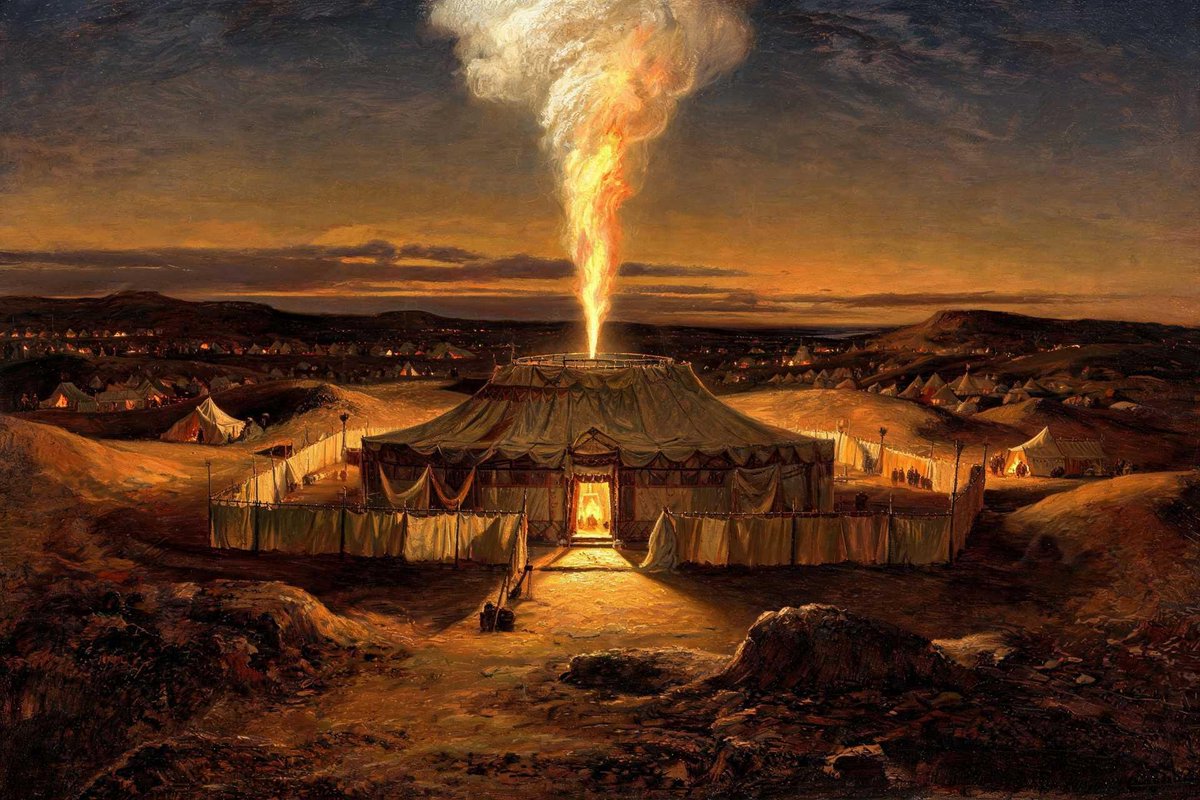
God gave Moses 50 chapters of instructions for a tent.

Fifty.

More space in the Bible is devoted to the design of the Tabernacle than to the creation of the universe.

That's not an accident.

Every measurement, material, and color was pointing to something, and once you see it, you can't unsee it.

A thread. 🧵Image
The reason for the Tabernacle is stated plainly:

Exodus 25:8 — "Let them make me a sanctuary, that I may dwell in their midst."

This is staggering.
The infinite God of the universe wanted to live among a wandering group of former slaves in a desert.

The Hebrew word מִשְׁכָּן (mishkan) means "dwelling place."

The entire structure exists to answer one question that runs through all of Scripture:

How can a holy God dwell among an unholy people without destroying them?

Everything in the design is an answer to that question.
There was only one entrance to the entire courtyard.

One gate. One way in. (Exodus 27:16)

Not multiple paths. Not "find your own door."

Every Israelite who wanted to approach God came through the same single entrance.

Centuries later, Jesus would say: "I am the door. If anyone enters by me, he will be saved." (John 10:9)

The architecture itself was teaching a truth long before it was spoken aloud: access to God comes through one appointed way, not many.Image
Read 11 tweets

Did Thread Reader help you today?

Support us! We are indie developers!


This site is made by just two indie developers on a laptop doing marketing, support and development! Read more about the story.

Become a Premium Member ($3/month or $30/year) and get exclusive features!

Become Premium

Don't want to be a Premium member but still want to support us?

Make a small donation by buying us coffee ($5) or help with server cost ($10)

Donate via Paypal

Or Donate anonymously using crypto!

Ethereum

0xfe58350B80634f60Fa6Dc149a72b4DFbc17D341E copy

Bitcoin

3ATGMxNzCUFzxpMCHL5sWSt4DVtS8UqXpi copy

Thank you for your support!

Follow Us!

:(