SemiAnalysis Profile picture
Jul 17 8 tweets 3 min read Read on X
Similar to the panic over DeepSeek R1, some uneducated people think Kimi K3’s use of linear attention (KDA) is bad for NVIDIA, HBM, DRAM, and networking because it has relatively lower KV-cache requirements. The opposite is true, and we explain why below. 👇️ 1/8🧵 Image
Kimi K3 is actually quite positive for NVIDIA, as large-model inference is where the NVL72 shines. Because K3 has more than 2.8 trillion parameters, it requires a large scale-up domain to store its weights. 2/8🧵 Image
Secondly, although Kimi Delta Attention has up to 10× lower networking requirements for KV-cache transfers, its large weights require even more network bandwidth to implement an optimization called WideEP, which spreads the weights across different GPUs. 3/8🧵 Image
WideEP distributes the 896 experts across many GPUs so that each GPU’s HBM contains only a small number of experts, optimizing per-token memory usage and compute utilization. 4/8🧵 Image
The unfortunate downside of the WideEP optimization is that it consumes a tremendous amount of network bandwidth. WideEP is highly optimized for rack-scale systems like the GB200/GB300 NVL72, whose copper backplane provides 18× more bandwidth than comparable DGX B200 systems. 5/8🧵Image
Furthermore, since the weights occupy more than 1.5 TB of HBM capacity, the KV cache for K3’s KDA and Gated MLA will need to be offloaded to CPU DDR5 and NVMe, even at relatively low user concurrency, because little space remains in HBM. 6/8🧵
Kimi themselves have stated that optimal K3 inferencing will require a rack witha n large scale up domain with at least 64 chips. 7/8🧵 Image
Lastly, Jevons’ Paradox means that making attention more efficient will drive wider AI adoption, which will ultimately require more GPUs, HBM, DRAM, and networking—not less. 8/8🧵

• • •

Missing some Tweet in this thread? You can try to force a refresh

 

Keep Current with SemiAnalysis

SemiAnalysis Profile picture

Stay in touch and get notified when new unrolls are available from this author!

Read all threads

This Thread may be Removed Anytime!

PDF

Twitter may remove this content at anytime! Save it as PDF for later use!

Try unrolling a thread yourself!

how to unroll video
  1. Follow @ThreadReaderApp to mention us!

  2. From a Twitter thread mention us with a keyword "unroll"
@threadreaderapp unroll

Practice here first or read more on our help page!

More from @SemiAnalysis_

Jul 18
Similar to DeepSeek in January 2025, Panicans may think that the AI networking switch TAM will massively shrink because Kimi K3 uses KDA Attention, which reduces KV-transfer networking bandwidth by up to 10x. But the opposite is true, as we explain below. 👇️ 1/8🧵 Image
While it is true that Kimi K3 uses Kimi Delta Linear Attention (KDA) in 3 out of every 4 layers and that KDA reduces KV-cache transfer bandwidth by up to 10x compared with comparable full global-attention models, the important missing piece is that Kimi K3 requires WideEP to serve. 2/8🧵Image
Because Kimi K3 has 2.8 trillion parameters, even at MXFP4, each forward pass will require 1.5 TB of HBM bandwidth. This means that, even with spec decode, serving it profitably at a reasonable level of interactivity requires aggregating many chips together over a high-bandwidth network, such as the GB300 NVL72. 3/8🧵
Read 8 tweets
Jul 18
MASSIVE DELAY ALERT TO ORACLE’S STARGATE SITE AND BLOOM ENERGY🚨🚨

Oracle’s Project Jupiter behind-the-meter datacenter project in New Mexico that plans to use Bloom Energy is at risk of a 1-2 year delay due to permitting and pipeline building blockers. (1/8)🧵 Image
As we continue to monitor the status of datacenter delays, whether they are real, whether they are fake... some are out and out delayed because of -> building gas pipelines and receiving permits for power generation equipment. (2/8)
Oracle's proposed 2.45 GW Project Jupiter site in New Mexico can't run at any meaningful capacity until a 17 mile pipeline (the Green Chile Pipeline) connecting the El Paso Natural Gas (EPNG) system to a delivery meter station is constructed. Oracle switched from turbines to Bloom Energy fuel cells earlier this year — but fuel cells run on pipeline gas too. All details below👇️ (3/8)Image
Read 8 tweets
Jul 13
On Feb 28th 2026, the United States launched Operation “Epic Fury” against Iran.

Markets and media were caught off guard, but careful and diligent observers were hardly surprised.

The signals sat in plain sight for weeks, you just had to know where to look. A thread on OSINT — and why we run some of our research the same way. (1/10)🧵Image
Before the first strike ever came down on Tehran, OSINT accounts right here on this platform were tracking the military buildup in the Middle East in near real time.

Here for example one could see how leading up to the 28th, 333 (at a minimum) C-5 and C-17 transport aircraft flights were recorded leaving US bases towards the Middle East theater. (2/10)

x.com/ArmchairAdml/s…
Additionally, here one could see how U.S. F-22 Raptor stealth fighters were amassing at the Israeli Uvda Air Base, with Patriot missile components being set up on site, and new tarmacs being constructed. (3/10)

Read 10 tweets
Jul 7
TSMC’s moat is bigger than PPA, EUV, or yield. It is the EDA/IP ecosystem wrapped around the fab. (1/8)🧵 Image
TSMC’s Open Innovation Platform has turned Synopsys, Cadence, Arm, Rambus, Alphawave, and dozens of IP vendors into a pre-validated tape-out network. And that moat is measurable. (2/8)
TSMC’s certified Silicon IP library grew from 3K items in 2010 to 93K in 2025. 31x growth. (3/8)
Read 8 tweets
Jul 6
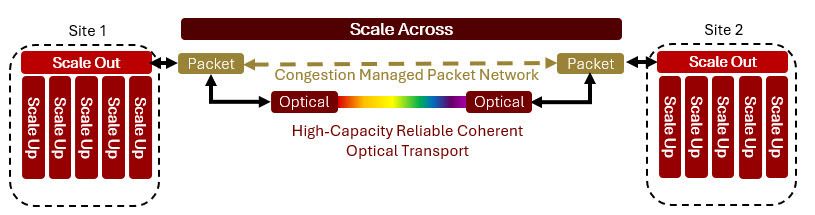
With the recent surge in AI mega clusters, reaching hundreds of thousands to millions of AI accelerators, cloud providers encountered a new set of challenges that forced them to run chip interconnect at a new scale: interconnecting multiple datacenters together. This is called scale-across. (1/7)🧵Image
Scale-across has been widely popularized by Nvidia last year, but is now often used imprecisely as a generic term to talk almost about any Datacenter interconnect network. To make it short, scale-across refers to backend datacenter interconnect networks that are used to connect multiple datacenters all together to form a single, coherent cluster. (2/7)Image
The main confusion comes from the fact that scale across can use the same network equipment as for traditional datacenter interconnect. Indeed, as interconnections often reach a few kilometers minimum, operators can use ZR/ZR+ coherent pluggables and Optical Line Systems, which can use amplifiers and passive (AWG) or active (WSS) multiplexers. (3/7)Image
Read 7 tweets
Jul 5
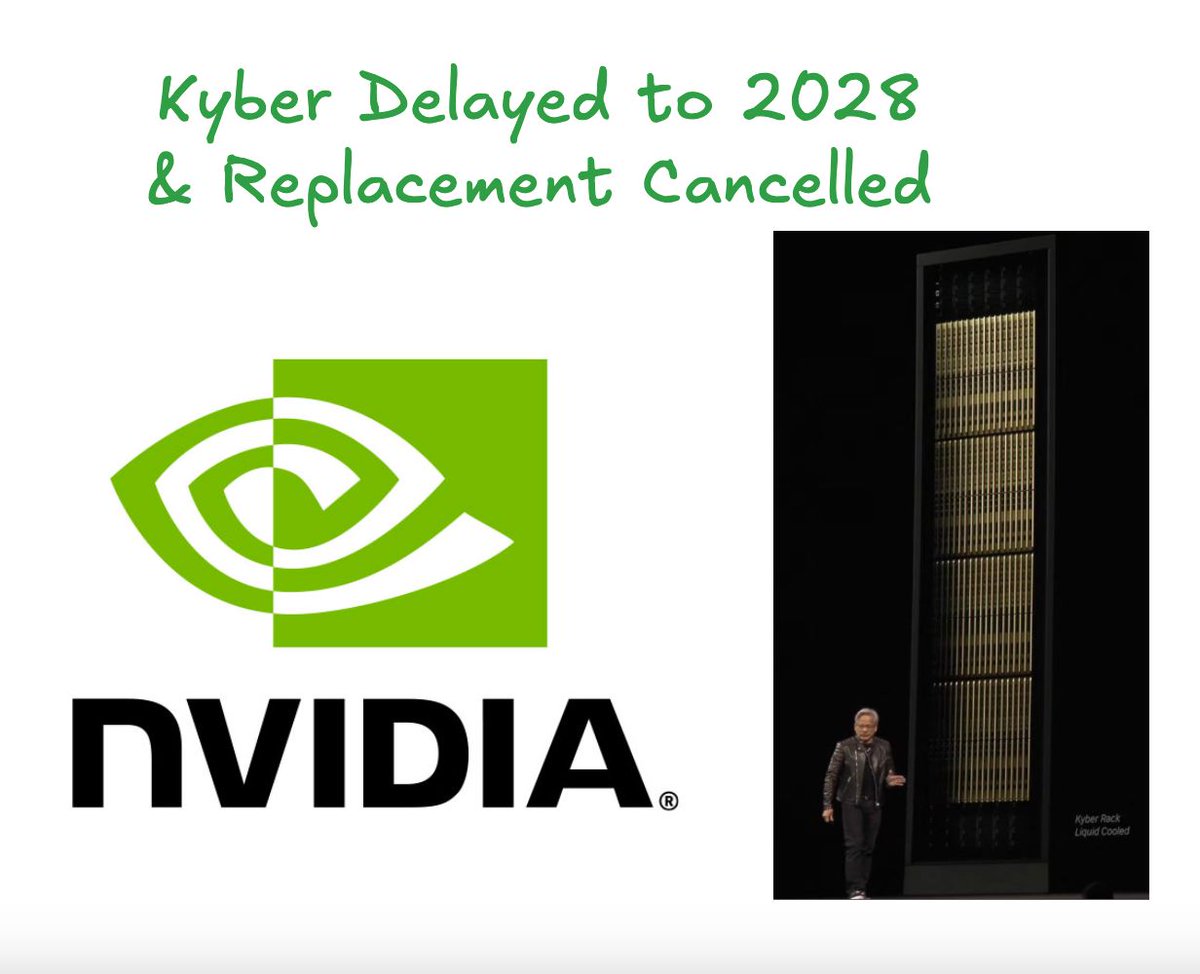
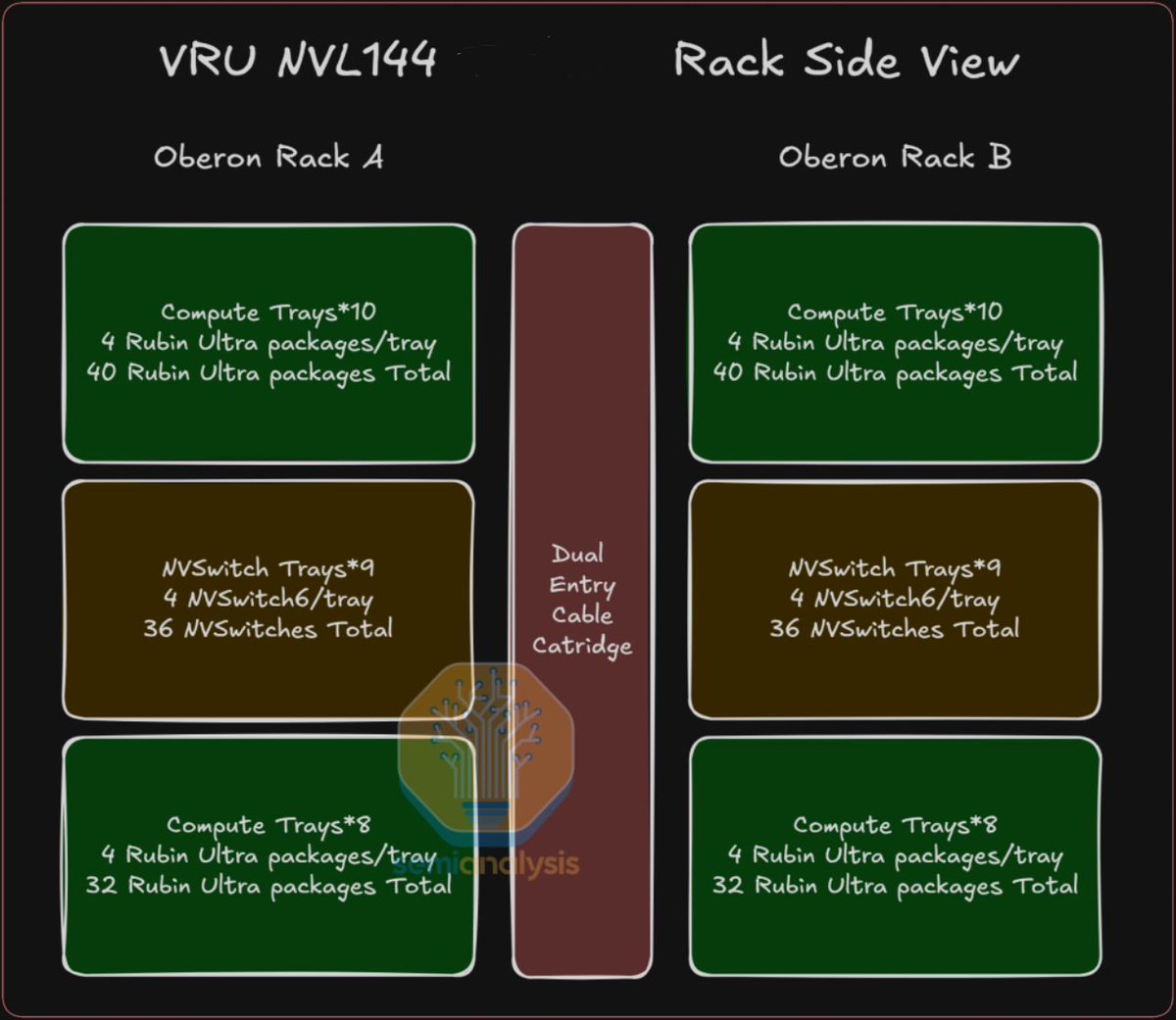
MASSIVE DELAY: Just 3 months after Jensen demoed Kyber NVL144 at GTC, it has faced major setbacks and has been delayed by more than 12 months, pushing it back to 2028. Below, we explain why Kyber has faced massive delays and why NVIDIA’s NVL72x2 back-to-back rack architecture was also cancelled, leaving Rubin Ultra with a limited scale-up domain. 👇️ 1/6🧵Image
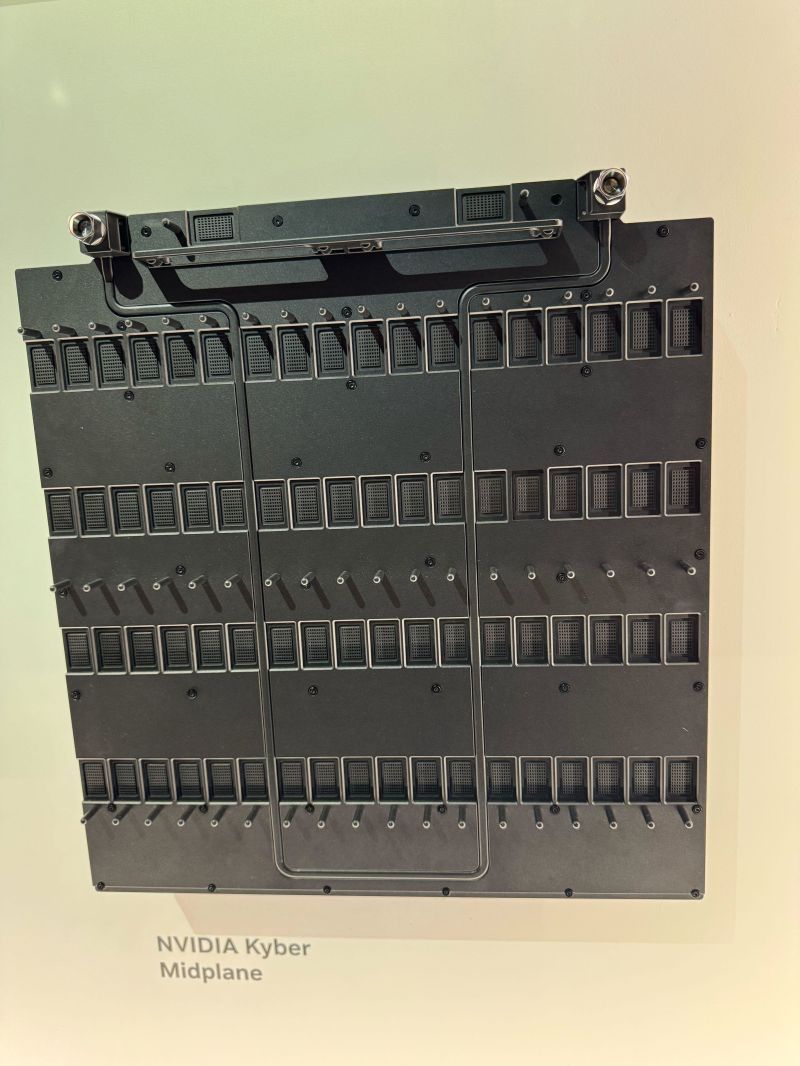
Kyber NVL144 rack architecture has been delayed to 2028 as the PCB midplane remains challenging from a manufacturability standpoint. NVL576, which connects 8x Oberon racks over CPO between the NVSwitches, is also likely delayed or restricted to small volumes given the current challenges with CPO. 2/6🧵Image
NVL72x2 back-to-back rack architecture was the new proposed architecture NVIDIA was developing as an alternative to Kyber. It was designed to increase the pure-copper NVLink scale-up world size by placing two Oberon racks back-to-back. However, it has since been cancelled due to heavy pushback from CSPs and hyperscalers over its odd design and heavy operational burden. 3/6🧵Image
Read 6 tweets

Did Thread Reader help you today?

Support us! We are indie developers!


This site is made by just two indie developers on a laptop doing marketing, support and development! Read more about the story.

Become a Premium Member ($3/month or $30/year) and get exclusive features!

Become Premium

Don't want to be a Premium member but still want to support us?

Make a small donation by buying us coffee ($5) or help with server cost ($10)

Donate via Paypal

Or Donate anonymously using crypto!

Ethereum

0xfe58350B80634f60Fa6Dc149a72b4DFbc17D341E copy

Bitcoin

3ATGMxNzCUFzxpMCHL5sWSt4DVtS8UqXpi copy

Thank you for your support!

Follow Us!

:(