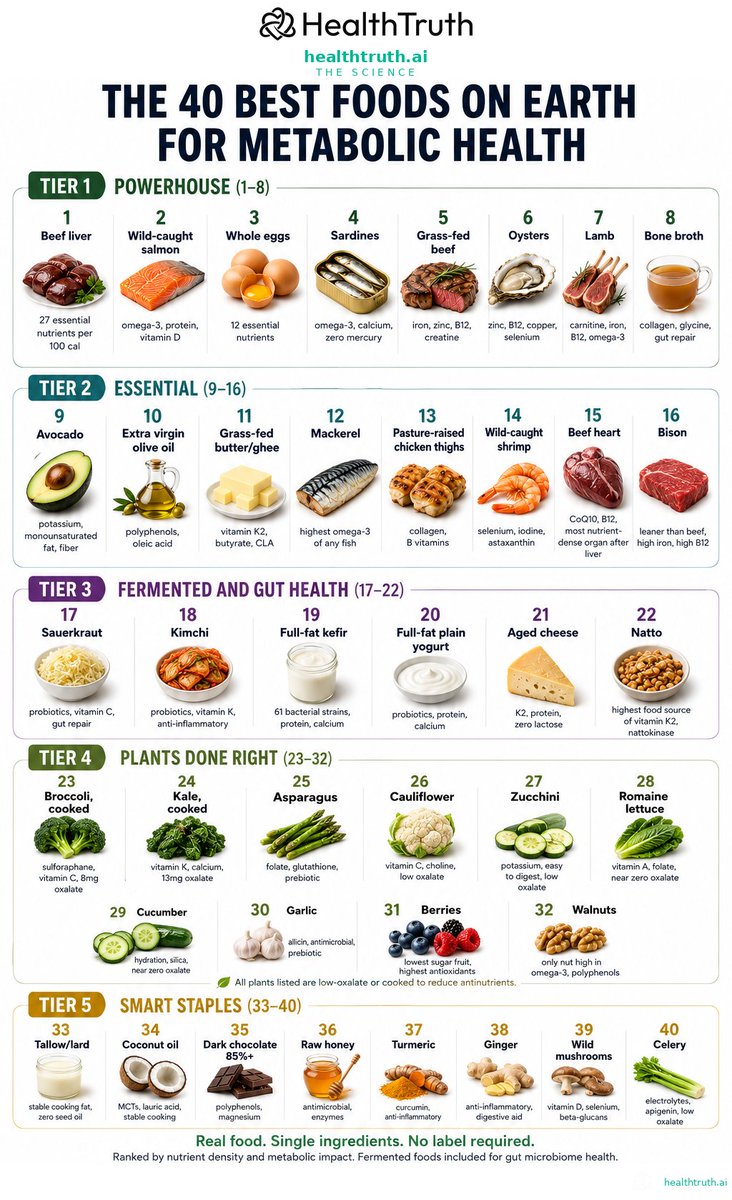
I posted the 20 best foods on earth. Many people saw it. The reply section exploded.
The carnivores said I included too many vegetables. The plant-based crowd said I included too much meat. Someone told me spinach was poisoning people. Someone else told me I should be in jail for recommending beef liver.
I listened to all of it. Went back to the data. This is Version 2. 40 foods. Updated.
Spinach is gone. Fermented foods are in. Organ meats expanded. Every plant on this list is low-oxalate or cooked to reduce antinutrients.
No tribe won. The science won. 🧵
The carnivores said I included too many vegetables. The plant-based crowd said I included too much meat. Someone told me spinach was poisoning people. Someone else told me I should be in jail for recommending beef liver.
I listened to all of it. Went back to the data. This is Version 2. 40 foods. Updated.
Spinach is gone. Fermented foods are in. Organ meats expanded. Every plant on this list is low-oxalate or cooked to reduce antinutrients.
No tribe won. The science won. 🧵
This pyramid has been around for years. Most health professionals know about it. Almost none of them will share it with their patients.
Why? Because food is the most controversial topic in medicine. More divisive than statins. More political than vaccines. A doctor who tells you to eat more red meat risks their reputation. A doctor who tells you to cut carbohydrates contradicts the dietary guidelines. A doctor who says seed oils are a problem contradicts every processed food company advertising during the Super Bowl.
So they say nothing. They hand you a pamphlet from 1992 and move on to the prescription pad.
Why? Because food is the most controversial topic in medicine. More divisive than statins. More political than vaccines. A doctor who tells you to eat more red meat risks their reputation. A doctor who tells you to cut carbohydrates contradicts the dietary guidelines. A doctor who says seed oils are a problem contradicts every processed food company advertising during the Super Bowl.
So they say nothing. They hand you a pamphlet from 1992 and move on to the prescription pad.
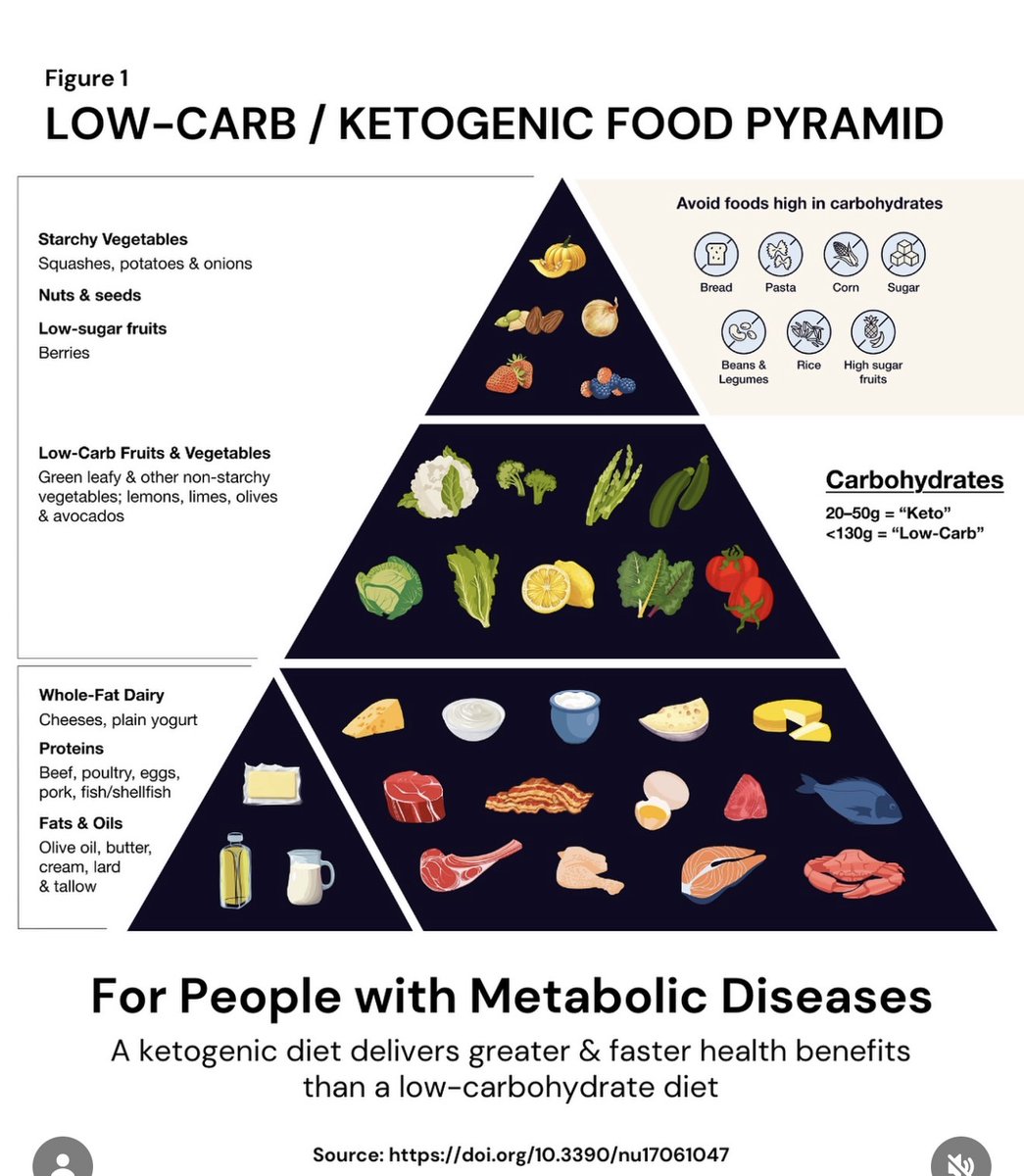
The pyramid is simple. The base is protein, fat, and whole-fat dairy. Animal foods. The foundation.
The middle is low-carb vegetables and fruits. Real plants. Not processed plant products.
The top is the smallest portion. Starchy vegetables, nuts, seeds, berries. The foods with the most carbohydrate load get the least space.
And outside the pyramid entirely: bread, pasta, corn, sugar, rice, beans, high-sugar fruits. The foods the USDA told you to build your diet around for 50 years.
The middle is low-carb vegetables and fruits. Real plants. Not processed plant products.
The top is the smallest portion. Starchy vegetables, nuts, seeds, berries. The foods with the most carbohydrate load get the least space.
And outside the pyramid entirely: bread, pasta, corn, sugar, rice, beans, high-sugar fruits. The foods the USDA told you to build your diet around for 50 years.
Here is why this matters metabolically.
Every food you eat triggers an insulin response. The higher the glycemic impact, the harder your pancreas has to work. Do that for 20 years and you get insulin resistance. Do it for 30 years and you get Type 2 diabetes. Do it for 40 years and you get heart disease, Alzheimer's, and cancer.
93.4% of Americans are metabolically unhealthy. They followed the food pyramid. They ate the whole grains. They drank the orange juice. They avoided the red meat and the eggs and the butter.
The foods at the base of this pyramid are the ones with the lowest glycemic impact. The ones outside the pyramid are the ones driving the metabolic disease epidemic.
That is not a coincidence.
Every food you eat triggers an insulin response. The higher the glycemic impact, the harder your pancreas has to work. Do that for 20 years and you get insulin resistance. Do it for 30 years and you get Type 2 diabetes. Do it for 40 years and you get heart disease, Alzheimer's, and cancer.
93.4% of Americans are metabolically unhealthy. They followed the food pyramid. They ate the whole grains. They drank the orange juice. They avoided the red meat and the eggs and the butter.
The foods at the base of this pyramid are the ones with the lowest glycemic impact. The ones outside the pyramid are the ones driving the metabolic disease epidemic.
That is not a coincidence.
The Top 40 is not a diet. It is a menu of options.
If you are keto, everything on this list works for you. If you are paleo, the same. If you are carnivore, Tiers 1 and 2 are your world. If you eat plants, Tier 4 is built for you with the oxalate and lectin risks already removed.
The point was never to tell you what tribe to join. The point is to give you 40 foods that are metabolically safe, nutrient dense, and ancestrally proven regardless of what you call your diet.
Real food does not need a label. And it does not need a tribe.
If you are keto, everything on this list works for you. If you are paleo, the same. If you are carnivore, Tiers 1 and 2 are your world. If you eat plants, Tier 4 is built for you with the oxalate and lectin risks already removed.
The point was never to tell you what tribe to join. The point is to give you 40 foods that are metabolically safe, nutrient dense, and ancestrally proven regardless of what you call your diet.
Real food does not need a label. And it does not need a tribe.
What changed from Version 1 to Version 2.
Spinach removed. 970mg of oxalate per 100g. For kidney stone formers, that is a real risk. Replaced with kale (13mg), romaine (near zero), and zucchini (near zero).
Fermented foods added. Sauerkraut, kimchi, kefir, natto. Your gut microbiome is Pillar 3 of the 7 Pillars of Root Cause Health. You cannot fix metabolic health without fixing the gut.
Organ meats expanded. Beef heart added for CoQ10. Liver stays at number 1 because nothing on earth matches 27 essential nutrients per 100 calories.
Every plant on the list is now flagged as low-oxalate or marked as "cooked to reduce antinutrients." Because dose and preparation matter more than the food itself.
You asked for this. I listened.
Spinach removed. 970mg of oxalate per 100g. For kidney stone formers, that is a real risk. Replaced with kale (13mg), romaine (near zero), and zucchini (near zero).
Fermented foods added. Sauerkraut, kimchi, kefir, natto. Your gut microbiome is Pillar 3 of the 7 Pillars of Root Cause Health. You cannot fix metabolic health without fixing the gut.
Organ meats expanded. Beef heart added for CoQ10. Liver stays at number 1 because nothing on earth matches 27 essential nutrients per 100 calories.
Every plant on the list is now flagged as low-oxalate or marked as "cooked to reduce antinutrients." Because dose and preparation matter more than the food itself.
You asked for this. I listened.
Your doctor spent 8 years in medical school. They received an average of 19.6 hours of nutrition education across all 8 years.
19.6 hours. On the single most important input to your metabolic health.
Then they entered a system where the food companies fund the research, the dietary guidelines, and the medical education. Where a cardiologist can prescribe a statin in 7 minutes but cannot tell you which foods lower your fasting insulin.
They are not bad doctors. They are products of a system that was never designed to teach them what actually makes people healthy.
You have to learn this yourself. This list is a starting point.
19.6 hours. On the single most important input to your metabolic health.
Then they entered a system where the food companies fund the research, the dietary guidelines, and the medical education. Where a cardiologist can prescribe a statin in 7 minutes but cannot tell you which foods lower your fasting insulin.
They are not bad doctors. They are products of a system that was never designed to teach them what actually makes people healthy.
You have to learn this yourself. This list is a starting point.
40 foods. Five tiers. Zero processed ingredients. Zero tribal allegiance.
Keto, paleo, carnivore, Mediterranean. Stop arguing about the label. Start eating from this list. Your fasting insulin, your inflammation, your gut, and your metabolic health will tell you what is working.
The science does not care what you call your diet. It cares what you put in your body.
The truth heals.
Co-founders, Neo | HealthTruth
Dr. Philip Ovadia, Cardiac Surgeon @ifixhearts
Dr. Aseem Malhotra, Cardiologist @DrAseemMalhotra
Dr. Robert Cywes, Metabolic Surgeon @carbaddictiondr
Prof. Tim Noakes, Head of Science @ProfTimNoakes
Keto, paleo, carnivore, Mediterranean. Stop arguing about the label. Start eating from this list. Your fasting insulin, your inflammation, your gut, and your metabolic health will tell you what is working.
The science does not care what you call your diet. It cares what you put in your body.
The truth heals.
Co-founders, Neo | HealthTruth
Dr. Philip Ovadia, Cardiac Surgeon @ifixhearts
Dr. Aseem Malhotra, Cardiologist @DrAseemMalhotra
Dr. Robert Cywes, Metabolic Surgeon @carbaddictiondr
Prof. Tim Noakes, Head of Science @ProfTimNoakes
The healthy pyramid to reverse metabolic disease, type 2 diabetes, insulin resistance, obesity etc

• • •
Missing some Tweet in this thread? You can try to
force a refresh