1/ Next Thursday, I will be delivering the Susan Shirk lecture at UC San Diego’s annual China conference.
2/ The question I was asked to address in the lecture is “Can the US and China Build a Stable Great-Power Relationship?”
3/ The good news is that the answer is yes. The bad news is that history shows that such an accomplishment is unlikely.
4/ But as a congenital optimist, I will emphasize the positives about the recent summit in Beijing between Presidents Xi Jinping and Donald Trump in which they declared a US-China relationship premised on “constructive strategic stability” and the prospect for the September 24 summit when Xi comes to Washington.
5/ The event is open to the public. See the link below to register.
2/ In 2021, I published an essay titled: Will America’s Green Future Be Red? It predicted that the world’s ambitious clean energy transition would be driven by China. Specifically, it stated my bet that for the next decade and as far beyond as any eye can see, the leading manufacturer, exporter, and user of green technologies would be China.
1/ As the 2026 World AI Conference opens in Shanghai today, to set the stage for China’s President Xi Jinping’s address that will feature China as the champion of AI for the world, one of China’s AI companies—Moonshot—released a Moon Shock.
2/ See this morning’s @Axios “1 big thing.” In its headline: “China AI surges, rivalry intensifies.” axios.com/2026/07/17/chi…
3/ @Axios notes that Moonshot’s Kimi K3 “dazzled developers, jolted Silicon Valley and reset the AI race overnight.”
3/ The question she failed to address is: who is the “key enabler” of Ukraine’s war with Russia? Who is the key supplier of the critical parts for Ukraine’s drones that Zelensky now hails as Ukraine’s best hope for peace?
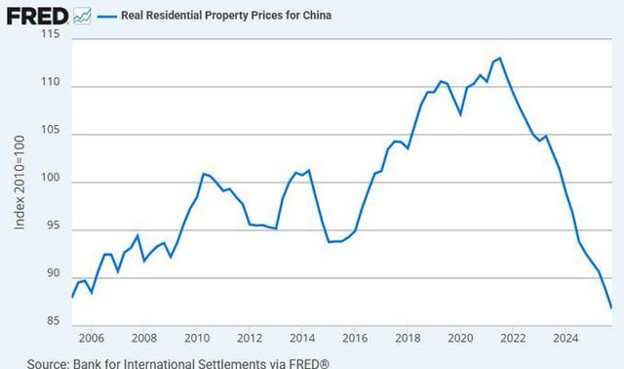
2/ Which Chinese asset market has posted negative returns over the last 20 years—a period of unmatched meteoric Chinese economic and business growth?
3/ Answer: property. As of this month, China’s property market has erased nearly 20 years of appreciation (inflation adjusted). That means Chinese real estate investors would have made a better return over the last 20 years stuffing cash under their mattress. Most importantly, at the height of the bubble about 70% of Chinese household wealth was concentrated in real estate.