This ad-free page was gifted by @threadreaderapp
Glenn Profile picture
Aug 31, 2025 5 tweets 2 min read Read on X
Scholars once worried that China's gender ratio imbalance would lead to a generation of surplus men, fueling crime, chaos, and even war.

What we got instead was ... this.
Certain China watchers busy penning missives on how this Paw-temkin Village is merely the latest example of the country's addiction to construction, penchant for capital misallocation and "politically entrenched elites" blocking efforts at structural reforms.
Chairman Xi declares, "Houses are for Humans, Not for Felines" and announces "Three Red Meows" regulations:

▪️ Moratorium of two cat-years on new construction
▪️ Catnip shall not exceed 25% of daily caloric intake
▪️ Kitty litter area capped at 10% of gross living space
Dude designed his own cat-themed McDonald’s logo.

The level of detail and dedication to the craft here is insane. Image
This is full-on embrace of Shanzhai/maker culture. Image

Image
Image

• • •

Missing some Tweet in this thread? You can try to force a refresh

 

Keep Current with Glenn

Glenn Profile picture

Stay in touch and get notified when new unrolls are available from this author!

Read all threads

This Thread may be Removed Anytime!

PDF

Twitter may remove this content at anytime! Save it as PDF for later use!

Try unrolling a thread yourself!

how to unroll video
  1. Follow @ThreadReaderApp to mention us!

  2. From a Twitter thread mention us with a keyword "unroll"
@threadreaderapp unroll

Practice here first or read more on our help page!

More from @GlennLuk

Mar 19
Seriously hard to comprehend how someone can juxtapose these two sets of thoughts in one’s brain at the same time.

Thought #1: That trying to achieve energy sovereignty is an intelligent goal for oil-importing countries …
… Thought #2: That HSR in China — which has displaced huge volumes of gasoline and diesel usage in the world’s largest oil-importing nation by electrifying transport — was the numero uno sign of “bad capital misallocation”
Oh and kerosene / jet fuel usage as well.

Meanwhile, China is going ahead and building — at scale, to be clear — infrastructure that can synthesize hydrocarbons from renewables.
Read 7 tweets
Feb 8
This is something that many folks still don’t understand — or stubbornly refuse to acknowledge.

China is moving away from coal-fired generation to renewables because it is less expensive to do so. Coal will account for less than half of power generation today, down from ~80% just 15 years ago.

The key to its renewables and related electrification boom was lowering its production cost below fossil fuels.
Recently enacted policies like RPS now mandate a minimum amount of renewables-source power for heavy industry.

New datacenters must be built with at least 80% renewables sourced power.
The key to this inflection point was economics: Driving down the manufacturing and deployment cost of the entire supply chain and key enabling technologies, from solar cells to wind turbines to battery storage to high-voltage transformers to robotics and machinery for installation and maintenance.

And since cost/performance gap continues to widen (renewables cost ↘️ while extraction costs of fossil fuels ↗️) the pace of transition to renewables will not slow down, but accelerate.
Read 11 tweets
Dec 7, 2025
Because:

(1) it's actually ~57% today (2025)
(2) it was ~81% in 2011
(3) at the current trajectory it is headed to sub-20% over the next decade

China has found a way to grow its economy without incremental emissions, which have plateaued.

This may not be especially titilating for Robin, but I think it is exciting for policymakers in many countries, especially developing ones for whom lack of access to fossil fuels has historically been a growth constraint.
(1) Robin's chart doesn't have a source, and I don't know how he's calculating 65%.

What I do know is that China's power grid will generate ~10.6 PWh in 2025 and solar/wind/hydro/nuclear will account for ~4.6 PWh. This is up from 10.1 PWh and 3.4 PWh, respectively, in 2024.
My suspicion here, given that this is a monthly series, is that Robin is drawing from the NBS monthly data series which he may not know excludes small-scale plants.

These figures are adjusted for in the annual numbers.

Read 11 tweets
Nov 19, 2025
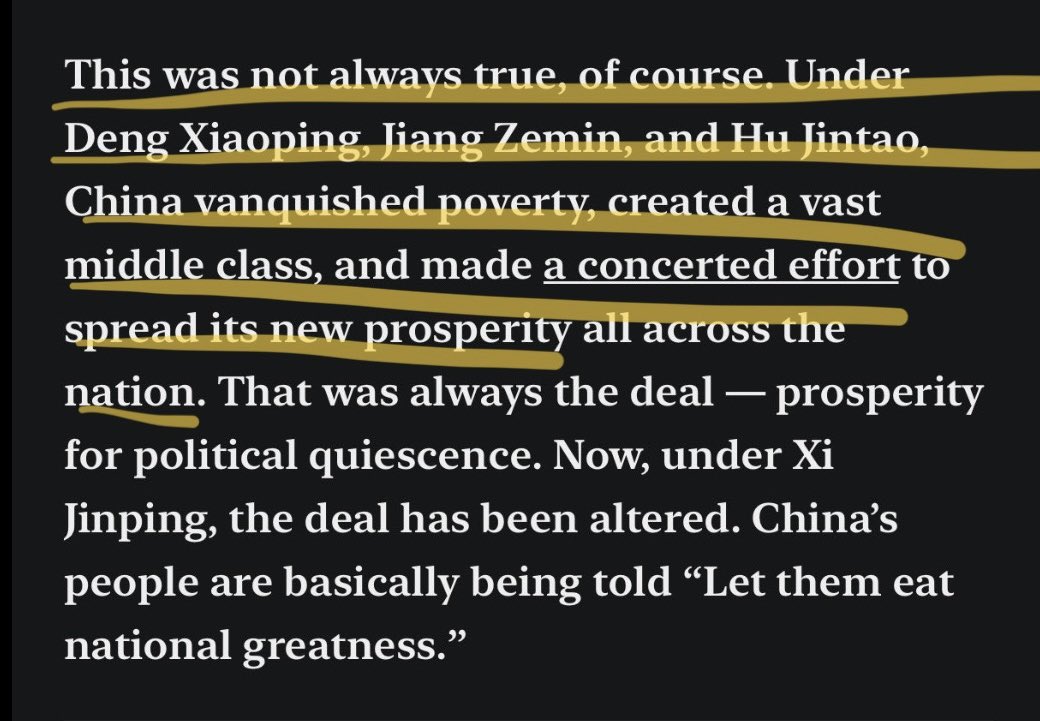
Nice tale, but one not supported by data measuring socioeconomic inequality.

Gini coefficient for wages peaked in the late 2000s under Hu.

For a broader version incorporating capital income, it did not peak until 2019 when multi-year efforts to rein in (i) corruption and (ii) uneven land appreciation started to take effect.Image
Gini coefficient for wages peaked in 2008.

See this 🧵 from last year + follow-on discussion below explaining how.
Gini coefficient incorporating wealth effect (my own analysis) peaked in 2019 👇.

In the following posts I will also explain why and provide further context.
Read 11 tweets
Nov 1, 2025
There are multiple potential explanations for why trade between China and certain developing countries like Morocco are growing robustly beyond the narrowminded explanation Robin offers below (and consistently, in other threads).

Indeed, the most obvious one is that this is simply a continuation of a multi-decade trend of increasing trade between the two countries.

Often the most obvious explanation is the correct one, and I think that is the case with Morocco (and developing economies in general) as I will explain here in this 🧵.
To prove his "transshipment" hypothesis at this level, Robin needs to provide more than just unsupported assertions.

The obvious approach would be just looking at the key categories that the U.S. imports from China and compare to the large import growth areas in a country like Morocco.

OEC is a nice place to start.Image
Image
Cursory review of recent growth drivers suggests minimal correlation between the categories that are driving export growth in Morocco (cars, cranes, iron blocks) vs. declines in the U.S. (packaged medicaments, telephones and computers). Image
Image
Read 9 tweets
Oct 31, 2025
Free cash flow is a measure after capital expenditures and incorporates fluctuations in working capital.

Since founding, BYD's modus operandi has been to re-allocate every dollar of operating cashflow + as much capital as it can raise — as non-dilutively as possible — to support the needs of a rapidly growing business.

Frankly, it is financially illiterate to describe re-investment back into a growing business as "losses". Negative cashflow is a cashflow item and — especially if related to CapEx and working capital fluctuations (which I will address below) — is conceptually different from "losses" which is an income statement term.
A better approach is to consider how much long-term capital the company has raised an compare it to the scale of operating capacity that capital has enabled.

We can look at this from BYD's latest balance sheet, which I have summarized here: Image
To date, BYD has taken in a total of ¥340B in debt and equity funding.

This number includes ~¥82B of ST/LT borrowings and ¥258B of equity (or equity-like) funding.

The equity funding includes ¥107B of "undistributed profit" which is similar in concept to retained earnings (we'll get back to this point in a bit).Image
Read 13 tweets

Did Thread Reader help you today?

Support us! We are indie developers!


This site is made by just two indie developers on a laptop doing marketing, support and development! Read more about the story.

Become a Premium Member ($3/month or $30/year) and get exclusive features!

Become Premium

Don't want to be a Premium member but still want to support us?

Make a small donation by buying us coffee ($5) or help with server cost ($10)

Donate via Paypal

Or Donate anonymously using crypto!

Ethereum

0xfe58350B80634f60Fa6Dc149a72b4DFbc17D341E copy

Bitcoin

3ATGMxNzCUFzxpMCHL5sWSt4DVtS8UqXpi copy

Thank you for your support!

Follow Us!

:(