Michael Brasher Profile picture
Civil War author and historian, veteran, long-time tech "nerd." Writing a regimental history of my great-grandfather's regiment, the 2nd Mississippi Infantry.
Jul 2, 2025 4 tweets 10 min read
1/4 Confederate Command Crisis at Gettysburg - A Day 2 Summary of the Battle of Gettysburg - July 1-3, 1863

[Author's Notes: Davis's Brigade and the 2nd Mississippi were relatively inactive on July 2nd; primarily trying to reorganize and recover from the tremendous losses they had suffered at the Railroad Cut the previous day. The only bright spot during the 2nd of July was when the 11th Mississippi rejoined the decimated brigade, at least increasing the morale of the men somewhat. So, this is the "20,000 ft view" of the overall action on July 2nd].

The second day at Gettysburg exposed fundamental flaws in Confederate command structure and decision-making as Robert E. Lee's Army of Northern Virginia attempted to capitalize on their July 1st tactical success. Operating without cavalry reconnaissance, hampered by unclear orders, and facing unprecedented coordination challenges, Confederate commanders found themselves executing a complex battle plan while virtually blind to Union defensive preparations. The day's failures stemmed not from individual incompetence but from systemic breakdown of Lee's traditional command system when confronted with the scale and complexity of the new three-corps coordination against well-positioned Union forces.

Stuart's cavalry absence left Lee operating in what Clausewitz termed the "fog of war," while personality conflicts between Lee and Longstreet, Hill's illness-induced passivity, and Ewell's cautious interpretation of discretionary orders created a perfect storm of command dysfunction that doomed the Confederate offensive.

Morning reconnaissance and strategic uncertainty

The day began with Lee facing critical intelligence gaps that would plague Confederate decision-making throughout July 2nd. Lee had not heard from J.E.B. Stuart's cavalry, leaving him without his army's "eyes and ears" at the most crucial moment. As Longstreet noted in his memoirs, when he reported to Lee's headquarters while "stars were shining brightly" on the morning of July 2nd, "General Lee was not ready with his plans. He had not heard from his cavalry, nor of the movements of the enemy further than the information from a dispatch captured during the night."

This intelligence failure had profound consequences for Confederate planning. Early morning reconnaissance reported that the Round Tops and southern end of Cemetery Ridge were unoccupied, but this information was already outdated by dawn when Union forces had extended their defensive line along Cemetery Ridge and anchored it at Little Round Top. Lee was making strategic decisions based on incomplete and rapidly changing battlefield intelligence.

Lee's strategic objectives remained unchanged from his broader Pennsylvania campaign goals: achieve a decisive victory on Northern soil that would force a negotiated end to the war. Following the July 1st success, Lee was determined to maintain the initiative and seize the high ground south of Gettysburg, particularly Cemetery Hill, which dominated Union supply lines and the road to Washington. However, his assessment of Union positions was critically flawed due to the absence of adequate cavalry reconnaissance.

The morning also revealed the first signs of command discord. Longstreet fundamentally disagreed with Lee's offensive strategy, advocating instead for a "defensive-offensive" approach. Longstreet argued the army should maneuver around the Union left flank and interpose itself between Meade's army and Washington, forcing the Union to attack Confederate defensive positions. Lee rejected this counsel, determined to retain the initiative and confident in his troops' capabilities, but the strategic disagreement created tension that would affect the day's operations.

Midday preparations and mounting delays

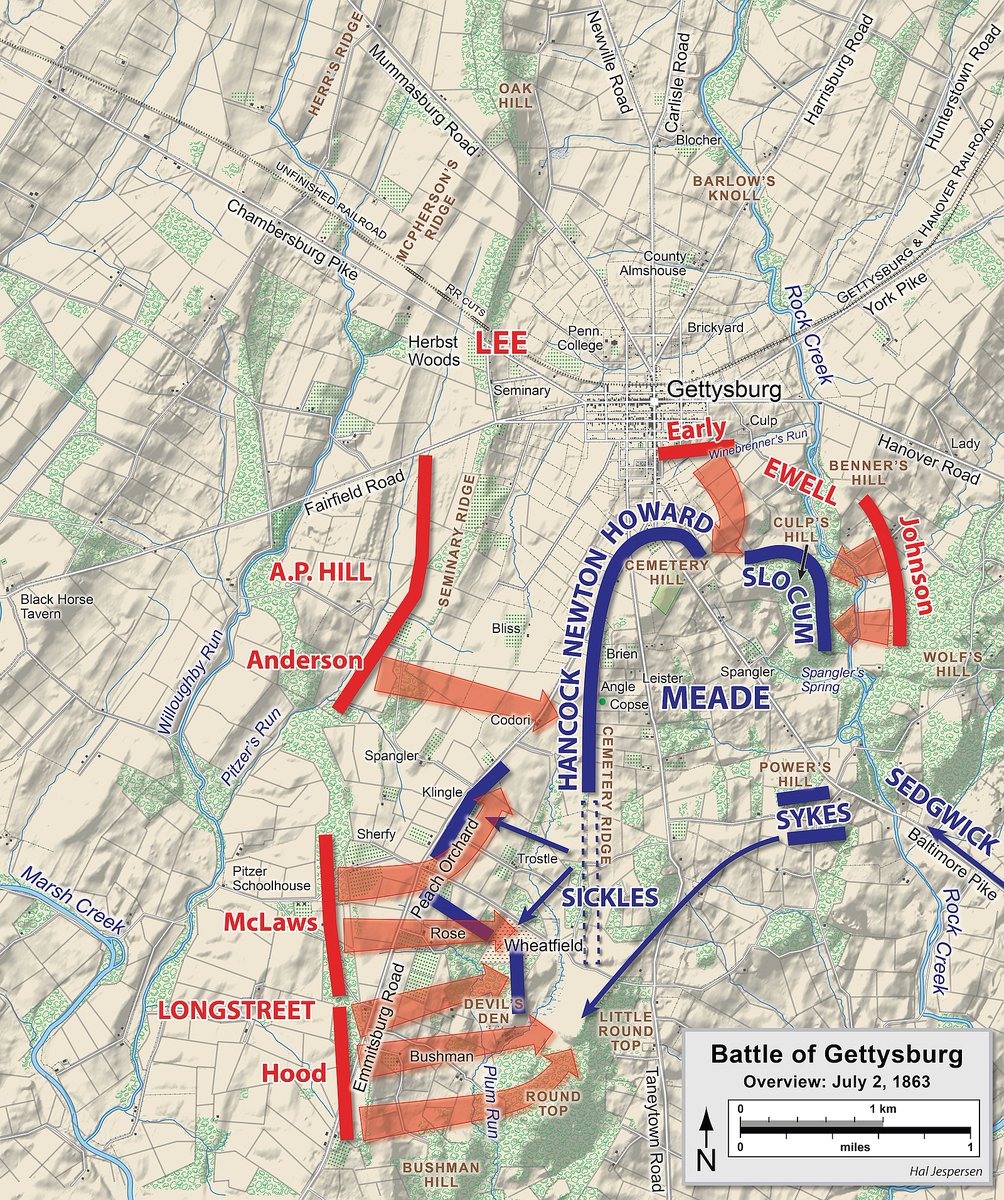
By 11:00 AM, Lee had finalized his battle plan for coordinated attacks on both Union flanks. Longstreet's First Corps would conduct the primary assault against the Union left flank in an oblique attack designed to roll up the federal line. Simultaneously, Ewell's Second Corps would demonstrate against Cemetery and Culp Hills from the north, escalating to full assault if practicable. Hill's Third Corps would support with Anderson's Division extending Longstreet's attack northward along Cemetery Ridge.

The plan's sophistication masked fundamental coordination challenges. Lee's traditional command style relied on discretionary orders and minimal staff coordination—a system that had worked effectively with Stonewall Jackson but proved inadequate for managing three corps commanders with varying experience levels and tactical philosophies.

Critical delays began accumulating during midday preparations. Contrary to post-war mythology alleging a "sunrise order," Lee actually issued attack orders around 11:00 AM. The real delays resulted from operational necessities: Longstreet requested permission to await Law's Brigade arrival, and his forces required a circuitous approach march to avoid detection by Union signal stations on Little Round Top. This countermarch consumed precious hours, pushing attack preparations into mid-afternoon.

Meanwhile, A.P. Hill's chronic illness significantly limited his participation in July 2nd operations. Hill remained largely behind the lines during the battle, creating a command vacuum in Third Corps that would contribute to coordination failures later in the day. His diminished leadership meant division commanders operated with limited oversight, and the corps that had performed brilliantly under Hill's previous aggressive leadership now functioned as separate divisions rather than a cohesive unit.

Afternoon assault and coordination breakdown

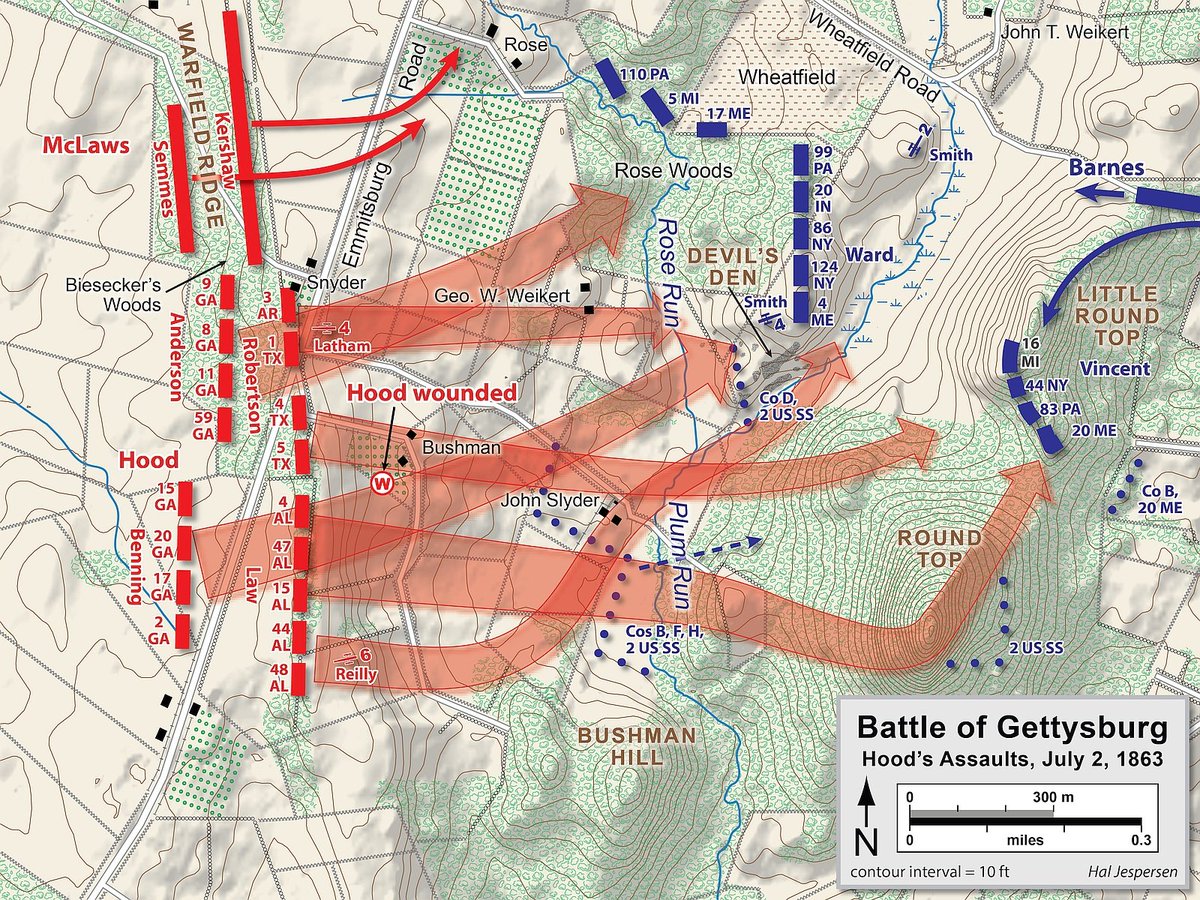
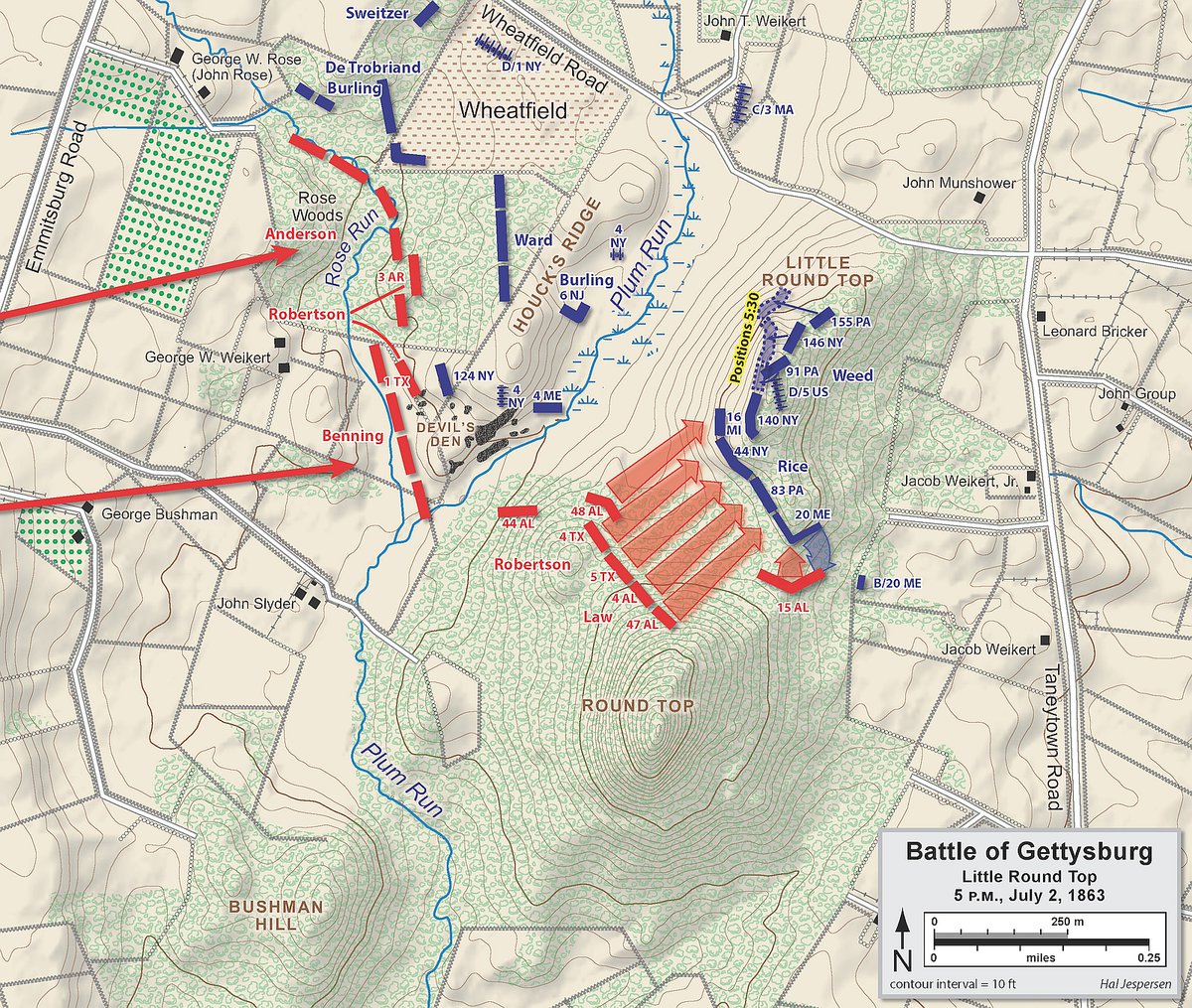
Longstreet's assault began around 4:00 PM with Hood's Division attacking the Union left flank. Despite his strategic reservations, Longstreet executed the tactical plan professionally. Hood's brigades achieved initial success at Devil's Den but faced fierce resistance at Little Round Top, where Vincent's Brigade and the 20th Maine successfully defended the strategic height. The Confederate failure to secure Little Round Top would prove catastrophic for the overall battle plan.

At 4:30 PM, McLaws' Division joined the attack against the Wheatfield and Peach Orchard, where Union III Corps had advanced to an exposed salient. Kershaw's, Semmes', Barksdale's, and Wofford's brigades achieved dramatic tactical success, effectively destroying Sickles' III Corps as a combat organization. The Wheatfield changed hands multiple times during intense fighting, while Confederate forces captured the Peach Orchard and pressed toward Cemetery Ridge.

However, Union forces exploited their interior lines advantage. Meade rushed approximately 20,000 reinforcements from other sectors faster than Confederate attacks could develop, demonstrating the fundamental weakness in Lee's en echelon concept. The sequential nature of attacks allowed Union commanders to shift forces piecemeal rather than being forced to defend everywhere simultaneously.

The breakdown of Confederate coordination became apparent when Anderson's Division attacked around 6:00 PM. Hill's Third Corps was supposed to extend Longstreet's assault northward, but poor timing and execution undermined the plan. Anderson's five brigades attacked piecemeal rather than simultaneously, with Wilcox's Alabama Brigade leading, followed by Perry's, Wright's, Posey's, and Mahone's brigades in sequence.

Wright's Georgia Brigade achieved the most successful Confederate penetration of the day, breaking through Union lines and temporarily seizing section of Cemetery Ridge crest near the Angle. Wright's Georgians captured artillery pieces and reached the stone wall positions but were forced to withdraw due to lack of support from flanking brigades. Critically, Mahone's Virginia Brigade refused orders to advance, while Posey's Mississippi Brigade made minimal progress, undermining Wright's achievements.

Evening attacks and command isolation

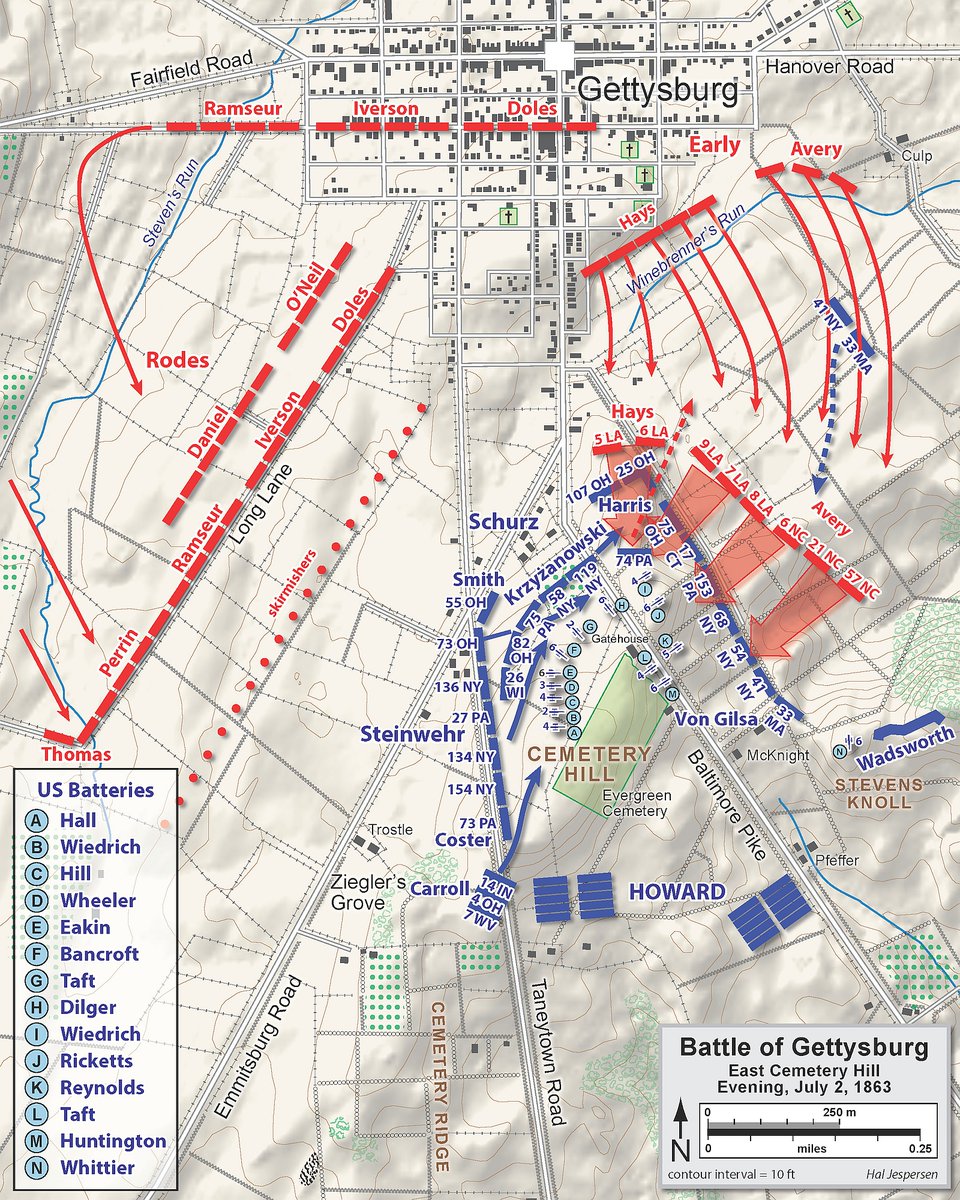
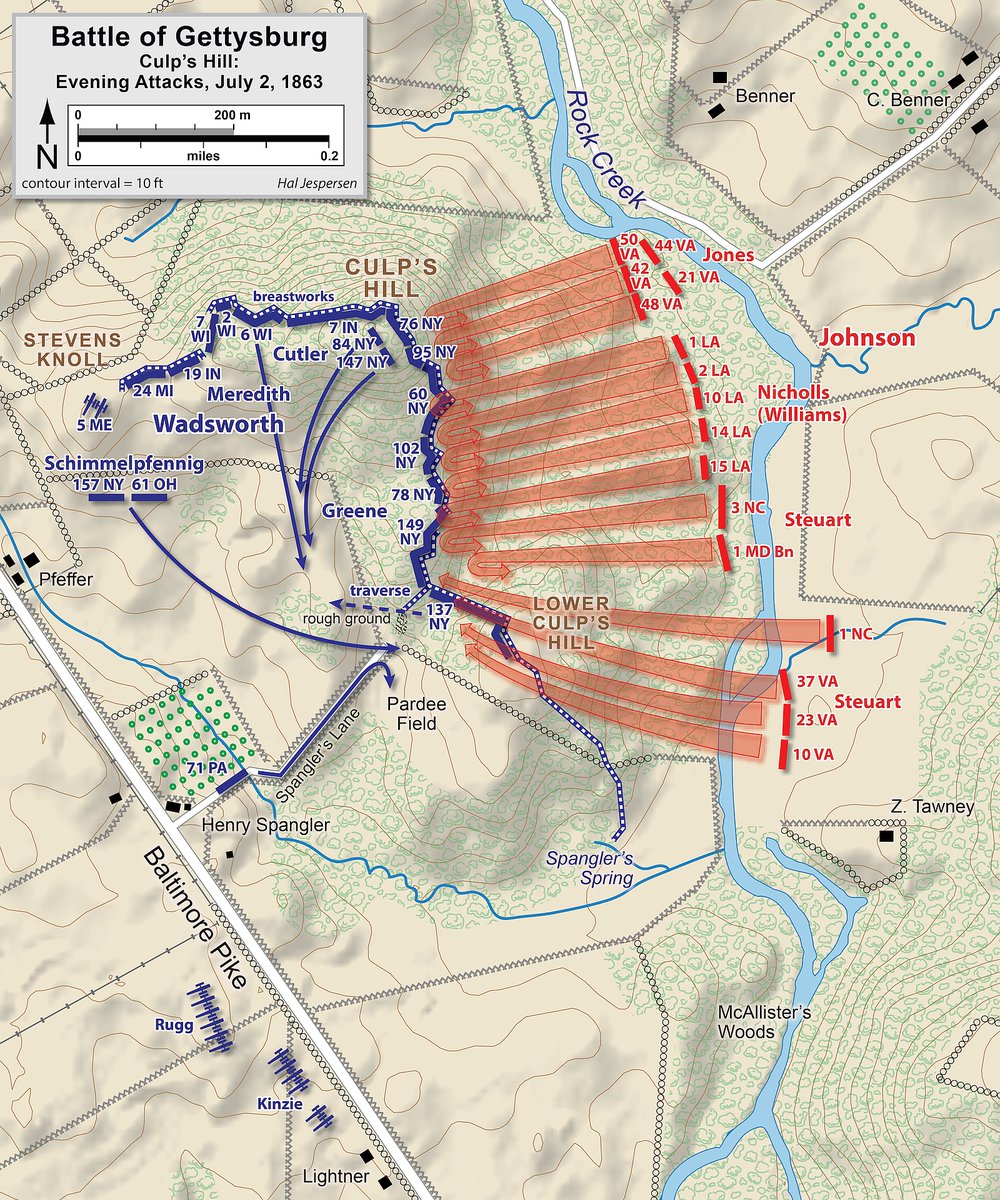
Ewell's Second Corps operations beginning around 7:00 PM revealed the complete breakdown of Confederate coordination. Despite being ordered to coordinate with Longstreet's assault, Ewell's attacks were poorly timed and inadequately supported. Johnson's Division attacked Culp's Hill while Early's Division assaulted East Cemetery Hill, but both attacks came too late to support the main effort and faced well-prepared Union positions.

Johnson's attack on Culp's Hill began with artillery preparation from Benner's Hill, but counter-battery fire proved devastating to Confederate positions. The 19-year-old "Boy Major" Joseph Latimer was mortally wounded during the artillery duel, symbolizing the high cost of inadequate preparation. Johnson's brigades gained foothold in abandoned Union positions but failed to dislodge Greene's XII Corps brigade from their main defensive line despite fighting that continued until 11:00 PM.

Early's assault on Cemetery Hill briefly reached Union artillery positions near Baltimore Pike, but Union reinforcements from I and XI Corps quickly repelled the attack. Colonel Avery was mortally wounded during the assault, and Rodes' Division failed to provide adequate support despite being alerted for cooperation.

Throughout the evening attacks, Lee maintained minimal contact with his corps commanders, visiting none of their positions during the battle. Unlike his previous battles where he worked closely with subordinates, Lee was operating with a fragmented command structure that lacked effective coordination mechanisms. Staff officers functioned more as message carriers rather than operational coordinators, and no system existed for real-time coordination between corps.

The fog of war experience

Primary sources reveal the extent of Confederate command uncertainty throughout July 2nd. Lee's official report acknowledging the army was "much embarrassed by the absence of the cavalry" understated the intelligence crisis. Contemporary accounts show Confederate commanders operating with fragmentary information about Union positions and movements.

Ewell faced particular command confusion regarding discretionary orders. Lee's instruction to take Cemetery Hill "if practicable" while avoiding general engagement contained an inherent contradiction that paralyzed decisive action. Contemporary staff accounts reveal the communication breakdowns between corps commanders and Lee's headquarters that prevented effective coordination.

Combat soldiers experienced their own fog of war challenges. Private Robert Augustus Moore of the 17th Mississippi described the confusion during Barksdale's Brigade assault, while Edwin Kerrison of the 2nd South Carolina wrote his sister about the "vicious fighting in the Peach Orchard and Wheatfield" where "the regiment had lost more than half its men."

Command assessment and strategic failure

The Confederate failure on July 2nd resulted from systemic command problems rather than individual incompetence. Lee's traditional command style—providing general guidance while allowing subordinates tactical flexibility—proved inadequate for coordinating three corps in a sophisticated attack plan. The loss of Stonewall Jackson at Chancellorsville had eliminated Lee's most aggressive and intuitive subordinate, while the army's reorganization from two to three corps created new coordination challenges.

Colonel E.P. Alexander, one of the most analytically minded Confederate officers, identified the core problem: "The 3d question relates to the lack of coordination between the attacks of the 2d July; and a similar lack of coordination is equally patent in the attacks on the 3d." The en echelon attack concept was sound in theory but impossible to execute effectively without proper coordination mechanisms.

Confederate casualties for July 2nd totaled approximately 6,800-7,000 killed, wounded, and missing, representing 30-40% casualties in the attacking divisions. Despite achieving local tactical successes—capturing Devil's Den, portions of the Wheatfield, and the Peach Orchard—the Confederates failed to secure decisive objectives like Little Round Top, Cemetery Ridge, or Cemetery Hill.

Conclusion

July 2nd at Gettysburg marked a turning point where the Confederate army's informal command style proved inadequate for the scale and complexity of this Civil War battle. Lee's army possessed the tactical skill to achieve remarkable local successes but lacked the command structure to coordinate these individual achievements into a strategic victory. The absence of Stuart's cavalry, breakdown of corps coordination, and Lee's isolation from tactical execution created conditions where Confederate tactical brilliance could not overcome operational failures.

The day revealed that modern warfare required more than individual courage and tactical excellence—it demanded systematic coordination, effective intelligence, and unified command that the Confederate newly revised army structure just could not provide. The "fog of war" that enveloped Confederate commanders on July 2nd was as much self-imposed through inadequate command systems as it was imposed by enemy action, setting the stage for the final tragedy of Pickett's Charge on July 3rd when Lee would attempt once more to achieve through tactical audacity what strategic coordination had failed to accomplish.

Maps by Hal Jespersen, cwmaps.comImage
Image
Image
Image
2/4 Image
Image
Image
Image
Mar 24, 2025 4 tweets 12 min read
1/3 OTD 163-years ago, the Battle of Kernstown, Virginia (Jackson's Valley Campaign) (a 🧵)

The Battle of Kernstown: A Bloody Nose for Jackson
March 23, 1862

Stonewall Jackson's Shenandoah Valley Campaign of 1862 stands as one of the most brilliant military operations in American history. His masterful use of interior lines to outmaneuver and defeat numerically superior Union forces showcases tactical genius rarely matched in the annals of warfare. Yet this legendary campaign began with an inauspicious debut. At Kernstown on March 23, 1862, Jackson's first battle as an independent commander resulted in tactical defeat—though one that would yield strategic dividends far exceeding anything the Confederate commander could have anticipated.

The Making of "Stonewall"

Thomas Jonathan Jackson emerged from relative obscurity during the First Battle of Manassas. There, as Confederate lines wavered under Union pressure, Brigadier General Barnard E. Bee rallied his men with the now-immortal words: "There is Jackson standing like a stone wall." This utterance not only steadied Confederate troops but bestowed upon Jackson the nickname that would follow him into legend.

Following First Manassas, Jackson received promotion to Major-General and command of the Valley District—one of three districts constituting Joseph E. Johnston's Department of Northern Virginia. His assignment carried enormous strategic implications.

The Shenandoah's Strategic Significance

The Shenandoah Valley represented prime military real estate for both Union and Confederate forces. Nestled between the Blue Ridge Mountains to the east and the Appalachians proper to the west, this fertile region served as a vital Confederate breadbasket. Its strongly secessionist population provided willing support for Southern armies operating in Virginia.

More critically, the Valley offered a sheltered invasion corridor extending well north of Washington, D.C. Confederate forces moving "down" the Valley could potentially sever the capital's supply lines or even strike Washington from an unexpected direction. Union leadership remained acutely aware of this threat—a fear later validated when Lieutenant General Jubal Early executed precisely such a movement in 1864.

For Union forces, the Valley could likewise serve as an invasion route, though with less dramatic potential. Federal troops debouching from the southern Valley would still find themselves north of Richmond, though potentially positioned between the Confederate capital and forces defending northern approaches.

Jackson Takes Command

Jackson's initial command consisted of just 1,500 militia—a force wholly inadequate to his mission. His requests for reinforcement brought the vaunted Stonewall Brigade (now commanded by Brigadier General Richard B. Garnett), Colonel Turner Ashby's cavalry, and 6,000 troops under Brigadier General William W. "Blizzards" Loring. These latter forces, recently defeated by Major General George B. McClellan in Western Virginia, arrived demoralized and poorly officered.

With his approximately 10,000-man force, Jackson moved "up" the Valley, reaching the Potomac where he damaged a dam on the Chesapeake and Ohio Canal. After capturing Bath, he turned south, taking Romney without resistance and thereby positioning his force between Federal troops in Maryland and Western Virginia.

Jackson's decision to garrison Loring's Division in the bleak, inhospitable environment of Romney provoked a near-mutiny. Loring appealed directly to the Confederate Secretary of War, who—in flagrant violation of military protocol—authorized Loring's withdrawal without consulting Jackson. Furious at this undermining of his authority, Jackson immediately tendered his resignation, relenting only after receiving a formal apology engineered through the intervention of General Johnston and Virginia Governor Letcher.

Strategic Developments: March 1862

On March 7, 1862, Johnston withdrew Confederate forces from Manassas to positions south of the Rappahannock. His decision likely reflected growing concern over Major General Nathaniel Banks' V Corps, now 20,000 strong, concentrating opposite Harpers Ferry. With Loring's Division transferred elsewhere, Jackson found himself outnumbered 5-to-1. An aggressive Federal advance might overwhelm Jackson's small force, placing Johnston's entire position in jeopardy.

The anticipated Federal offensive began March 11. Banks occupied Winchester unopposed the following day as Jackson withdrew to Strasburg. On March 17—coinciding with McClellan's embarkation for the Peninsula—Banks detached Brigadier General James Shields' 9,000-man division to pursue Jackson up the Valley.

Shields encountered only light resistance from Ashby's cavalry as Jackson continued his retreat. After advancing to Woodstock and meeting minimal opposition, Shields reported to Banks that the Valley stood clear of Confederate forces. This welcome assessment enabled Banks to begin transferring troops to McClellan's Peninsula operation—precisely the outcome Jackson could not permit.

The Eve of Battle

On March 22 at 4:00 PM, Ashby's cavalry probed Federal positions south of Winchester. A vigorous artillery barrage and cavalry skirmishing ensued. When Shields arrived with reinforcements, he suffered a wound, and Ashby subsequently withdrew.

Colonel Nathan Kimball, commanding Shields' 1st Brigade, received orders to pursue Ashby at first light on March 23. Dawn skirmishing commenced as ordered, with Ashby—now reinforced by infantry—exchanging volleys with Kimball's men until the Federal advance compelled Confederate withdrawal around 8:00 AM. Kimball then occupied the commanding terrain of Pritchard's Hill north of Kernstown and awaited developments.

Ashby reported to Jackson that Union forces numbered no more than 3,000 men—an assessment that, while accurate regarding engaged forces, fatally overlooked two additional Federal infantry brigades uncommitted during the previous day's action. In reality, Shields commanded 7,000 troops against Jackson's 4,200.

The Battle Unfolds

Sullivan's Brigade moved up during the morning to anchor Kimball's left flank. When word arrived from the wounded Shields ordering an immediate advance, Kimball pointed out enemy infantry deploying south of town and requested clarification. Meanwhile, Jackson pushed forward elements that drove back the Union skirmish line before retiring to defensive positions south of Kernstown.

At 10:00 AM, Shields dispatched detailed instructions prescribing not merely that Kimball advance, but precisely how to execute the movement. Kimball later wrote with remarkable restraint that, "Convinced that the General did not comprehend the situation... I determined to remain on the defensive..." Shields responded by bringing forward Tyler's Brigade, though it remained distant when Jackson initiated his main attack.

By 1:00 PM, Jackson had deployed his entire force. Observing the formidable Union position, he resolved on a flanking attack. While Burk's Brigade and Ashby's cavalry demonstrated before Kernstown, Garnett and Fulkerson would execute the decisive flanking movement. This operation commenced at 2:00 PM, with fierce fighting erupting along the front while the flanking brigades maneuvered toward a stone wall running northwest-southeast.

Kimball, detecting the flanking movement, directed Tyler's Brigade toward the same stone wall. Though Confederates reached the position first and deployed skirmishers beyond it, Tyler's advance drove back these elements. For several hours, bitter fighting raged around the stone wall. Confederate forces maintained their position but could not advance beyond it, while Union troops proved unable to dislodge them.

Both commanders committed their reserves. Burk's and Kimball's Brigades disengaged from their firefight before Kernstown to reinforce their respective sides at the stone wall. Sullivan's Brigade assumed the positions vacated by Kimball, skirmishing with Ashby's cavalry.

Though both sides deployed three infantry brigades, the Federal formations substantially outnumbered their Confederate counterparts. This numerical advantage gradually told in the struggle for the stone wall, as Jackson's men yielded ground under relentless pressure.

The decisive moment arrived when three regiments from Kimball's Brigade and two from Sullivan's launched a coordinated assault on the stone wall. This attack coincided with Garnett's Stonewall Brigade exhausting its ammunition. At 6:00 PM, Garnett ordered withdrawal—directly contravening Jackson's explicit orders to stand. This retrograde movement exposed Fulkerson's flank, compelling him to follow suit.

Though badly beaten, Confederate forces maintained cohesion until nightfall, preventing effective Union pursuit. Jackson executed a night withdrawal. Southern losses totaled 718—nearly 20% of their engaged force—while Shields' Division suffered 590 casualties, less than 10% of their strength.

Strategic Implications

By any tactical measure, Kernstown represents a clear Confederate defeat. Yet viewed through the strategic lens, Jackson's decision to attack—despite the likelihood of failure—reveals tactical defeat transformed into strategic victory.

Jackson's dual objectives encompassed defending the Valley and, more importantly, fixing as many Union troops as possible to improve Confederate odds elsewhere in Virginia. His earlier maneuvers before Banks' advance had temporarily achieved both aims.

But what options remained when Banks began detaching troops to reinforce McClellan on the Peninsula? Jackson could have continued maneuvering before Shields' 7,000 men as effectively as he had against Banks' 20,000. This approach, however, would have surrendered both strategic objectives. The Union would have neutralized Jackson with marginally superior numbers while retaining control of much of the Valley.

To reclaim the Valley and draw Union forces back into this theater required defeating Shields. To convince Federal commanders that he posed a threat worthy of substantial reinforcement demanded offensive action. Only by attacking could Jackson satisfy both criteria, making the battle—whatever its immediate outcome—a strategic necessity.

Though Jackson failed to defeat Shields tactically, the strategic consequences proved momentous. Shields, unable to conceive that Jackson would attack with inferior numbers, concluded he faced a force at least equal to his own. He immediately adopted a defensive posture and urgently requested reinforcements. The division at Harpers Ferry moved to bolster Shields. A division earmarked for the Peninsula was diverted to Western Virginia.

Most significantly, McDowell's 40,000-strong I Corps at Fredericksburg—originally slated to join McClellan's offensive—remained fixed in place to protect Washington. This role was to have been filled by Banks, freeing McDowell to advance on Richmond from the north. Weeks later, as Joseph Johnston struggled to find sufficient forces to oppose McClellan on the Peninsula, the absence of McDowell's 40,000 men approaching from another direction proved decisive.

The Battle of Kernstown thus yielded consequences far transcending its immediate tactical outcome. Union commanders' timidity in the face of Jackson's audacity may well have cost them Richmond—and possibly the opportunity to restore the Union in 1862.

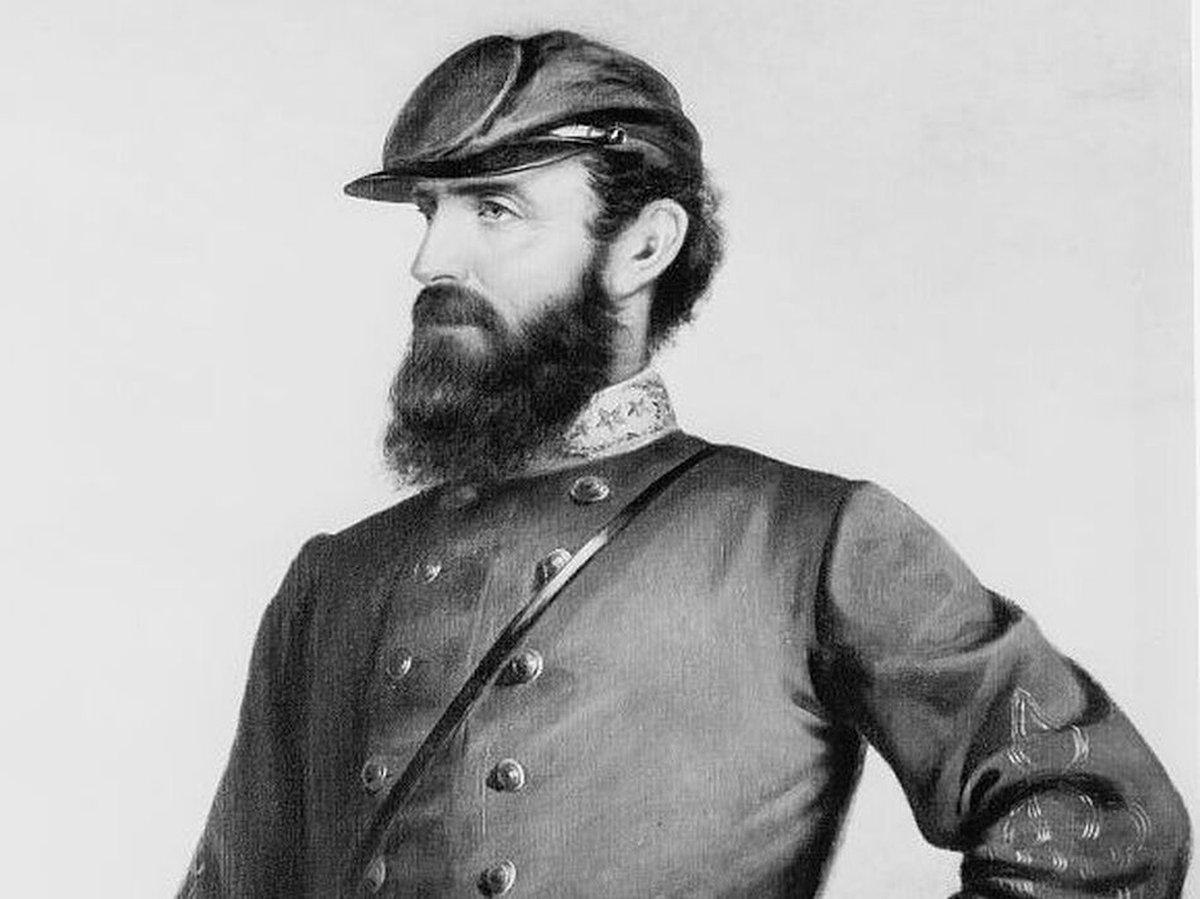
Graphics: 1) Strategic Map of the Shenandoah Valley Campaign of 1862; 2) Major General Thomas J. "Stonewall" Jackson; 3) Brigadier General James Shields; 4) Colonel Nathan KimballImage
Image
Image
Image
2/3 Shenandoah Valley 1862 Battles Map and Discussion

This map illustrates the strategic brilliance of Jackson's Valley Campaign through both its geographical features and battle markers. The Shenandoah Valley is clearly depicted as a corridor running northeast to southwest between two mountain ranges: the Blue Ridge Mountains to the east and the Massanutten and Allegheny Mountains to the west. This topography was crucial to Jackson's operations.

Several key geographical features stand out:

The Valley's orientation - Notice how the Shenandoah River flows northeastward, creating a natural invasion corridor. This meant that Confederate forces moving "down" the Valley (northward) could potentially threaten Washington D.C., while Union forces moving "up" the Valley would be heading away from Richmond.

Mountain passes - The map shows several key gaps through the Blue Ridge Mountains (dotted red railroad lines), which allowed Jackson to threaten Union forces on the eastern side or retreat to safety as needed.

The battle locations - The map highlights both Union and Confederate victories with star markers.

Kernstown (March 23) appears as a blue star indicating Union tactical victory, while later engagements like Front Royal (May 23), Winchester (May 25), Cross Keys and Port Republic (June 8-9) are marked as Confederate victories.

Transportation networks - The red lines showing roads and dotted red lines showing railroads illustrate Jackson's ability to move rapidly through interior lines. Notice how Winchester sits at a critical road junction, explaining its strategic importance.

The map effectively demonstrates Jackson's operational area spanning from Harpers Ferry in the north to Staunton in the south - approximately 120 miles of territory. This extensive area allowed Jackson to conduct what military historians now call "economy of force" operations, tying down multiple Union armies with his single small force.

Following the Battle of Kernstown, you can trace Jackson's subsequent movements through the Valley, which included his famous "foot cavalry" marches that enabled him to strike with surprising speed against isolated Union forces. The clustering of battle markers in May-June shows how Jackson accelerated his operational tempo as the campaign progressed.

The map also reveals McDowell's position to the east, illustrating why the Union high command was so concerned about Jackson's movements - he constantly threatened to emerge from the Valley through the Blue Ridge gaps and strike either McDowell's flank or Washington itself.

This geographical understanding helps explain why the Kernstown battle, despite being a tactical defeat, achieved Jackson's strategic aims. By remaining active in the Valley, he forced Union commanders to focus their attention here rather than reinforcing McClellan's Peninsula Campaign.Image
Mar 19, 2025 5 tweets 11 min read
Part 1/4 - OTD 160-years ago - The Battle of Bentonville, NC, March 19-21, 1865 (continued from yesterday - a thread 🧵)

The Three Days of Battle

The Battle of Bentonville: Day One (March 19, 1865)

By March 18, Johnston had selected his battlefield at Bentonville and began deploying his forces. The terrain offered several advantages for the outnumbered Confederates. The area featured dense woods, marshy ground, and limited approach routes, restricting the Union army's ability to fully utilize its superior numbers. Johnston positioned his army along the Goldsboro Road, with Lieutenant General Alexander Stewart's Army of Tennessee corps and Hardee's corps concealed in the woods north of the road, while Major General Robert Hoke's division blocked the road itself.

Johnston's plan was straightforward but ambitious: he would block Slocum's advance with Hoke's division while Stewart's and Hardee's troops would launch a surprise attack from the north, hopefully crushing Slocum's left flank and driving the Federals back in confusion. Meanwhile, Hampton's cavalry would screen against Howard's more distant Right Wing.

The morning of March 19 began with bright sunshine, creating a deceptively peaceful atmosphere. Sherman, believing Johnston remained far to the north near Raleigh, had already departed to join Howard's wing, leaving Slocum to advance with the Left Wing. When Slocum's lead elements encountered Confederate resistance, they initially believed they faced only cavalry and minor infantry detachments—a severe miscalculation.

Around noon, Brigadier General William P. Carlin's division of the XIV Corps advanced to develop what they presumed to be a small enemy force. Instead, they marched directly into Johnston's trap. At approximately 2:45 p.m., Johnston unleashed his main assault. As recorded in the Official Records, the Confederate attack fell with tremendous force upon Carlin's unsuspecting division. The official report of Brigadier General James D. Morgan stated:

"The enemy attacked in force at 2:30 p.m., but our troops rallied and held their ground."

This understated assessment belied the severity of the situation. In reality, the Confederate assault overwhelmed Carlin's division, capturing two cannons and sending Union troops fleeing in disorder. The intensity of the Confederate attack is evident in the report of Colonel Harrison C. Hobart of the 21st Wisconsin:

"The enemy appeared suddenly in our front in heavy force... Their line of battle extended beyond our left, and they advanced rapidly, with terrific yells. The regiments on my left gave way in confusion."

The collapse of Carlin's division created a dangerous situation for Slocum's entire wing. However, the Union forces soon stabilized their position along a ridge near the farm of Reddick Morris, where Morgan's division held firm against repeated Confederate assaults. The arrival of the XX Corps under Brigadier General Alpheus S. Williams further reinforced the Union line.

By late afternoon, Slocum had established a strong defensive position in the shape of an inverted "V," with both flanks refused and well-supported by artillery. Johnston continued to launch attacks throughout the remainder of the day, particularly against the Union left flank, but failed to achieve the decisive breakthrough he needed.

Among these attacks was a notable charge by the remnants of the Army of Tennessee across an open cotton field—an action later memorialized as "The Last Grand Charge of the Army of Tennessee." This poignant episode, where diminished Confederate regiments advanced with parade-ground precision despite withering fire, is detailed separately (in a “sidebar” post) as it represents the final major offensive action by this storied Confederate army.

As darkness fell, both armies entrenched their positions. The first day's fighting ended with mixed results. Johnston had achieved tactical surprise and inflicted approximately 1,200 casualties on Slocum's wing, but had failed to destroy the Union force before reinforcements could arrive. Union Brigadier General William Cogswell's brigade of the XX Corps had arrived at a critical moment, helping to secure the Federal line and preventing Johnston from exploiting his initial success.

The Battle Continues: Day Two (March 20, 1865)

The second day of battle saw a significant shift in the strategic situation. During the night, Sherman received urgent messages from Slocum reporting the encounter with Johnston's entire army. Surprised but adaptable, Sherman immediately ordered Howard's Right Wing to march toward Bentonville to reinforce Slocum. As Howard's leading elements approached the battlefield by midday on March 20, the balance of forces tipped decisively against Johnston.

Johnston, recognizing the changing circumstances, altered his strategy from offense to defense. He withdrew Hoke's division from its advanced position and established a new defensive line in the shape of a "V" with the apex pointing toward the Union position. This configuration allowed Johnston to protect his only escape route—a bridge over Mill Creek—while maintaining the ability to resist Sherman's now-united army.

The second day saw limited combat, primarily consisting of skirmishing and artillery exchanges as both sides adjusted their positions. Sherman, now present on the battlefield, chose not to launch a general assault against Johnston's entrenched position. As Sherman later wrote in his memoirs:

"I had no wish to drive him [Johnston] from his position, for he would have been compelled to retire to Raleigh, and could there have been reinforced; so that I rather wanted him to remain at Bentonville until Schofield and Terry could reach Goldsboro."

Johnston, for his part, maintained his defensive posture, hoping Sherman might attempt a frontal assault against his prepared positions. According to Johnston's post-war writings, he believed such an assault would result in heavy Union casualties and potentially restore Confederate morale. When no such assault materialized, Johnston began preparing for an eventual withdrawal.

Day Three and Mower's Charge (March 21, 1865)

The final day of battle produced the most dramatic moment of the engagement. While Sherman continued to avoid a general assault, Major General Joseph A. Mower, commanding a division of the XVII Corps on the Union right flank, received permission to conduct a "reconnaissance in force" against the Confederate left.

What began as a reconnaissance quickly transformed into something far more significant. Around noon, Mower's division pushed through difficult swampy terrain and unexpectedly broke through the Confederate flank. Within moments, Mower's troops had advanced to within half a mile of Johnston's headquarters and the vital Mill Creek bridge—the Confederates' only escape route.

This critical moment is vividly described in the Official Records. According to Confederate General Hardee's report:

"The enemy advanced with vigor, but were met with a determined counterattack."

The severity of the situation compelled Hardee to personally lead a counterattack, utilizing any available troops, including the 8th Texas Cavalry. In this desperate action, Hardee's 16-year-old son, Willie, was mortally wounded while charging with the Texas cavalry. After fierce fighting, the Confederates successfully repelled Mower's advance, preserving their escape route.

Sherman, upon learning of Mower's unauthorized advance, ordered him to withdraw to his original position. This decision has been debated by historians ever since, as Mower's attack—had it been reinforced—might have trapped Johnston's entire army. Sherman later explained his reasoning:

"I checked Mower's pursuit, as I did not want to drive Johnston's army into Raleigh... I thought he would retreat during the night."

Sherman's prediction proved correct. Having narrowly escaped disaster, Johnston ordered a withdrawal during the night of March 21-22. By morning, the Confederate army had crossed Mill Creek and was retreating toward Smithfield.

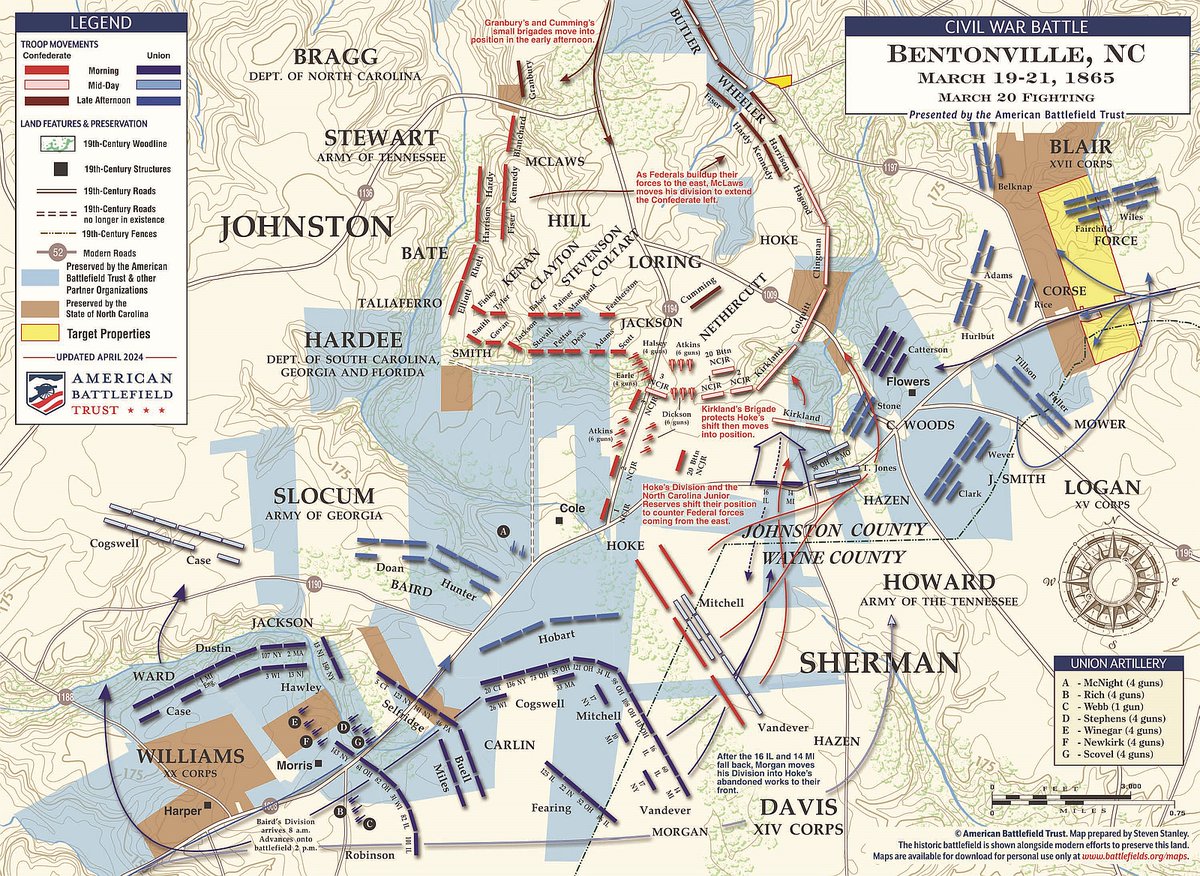
Graphics: 1) March 19th Overview Map of Major Confederate Attacks; 2) Day One Detailed Tactical Map – March 19; 3) Day Two Detailed Tactical Map – March 20; 4) Day Three Tactical Map – March 21Image
Image
Image
Image
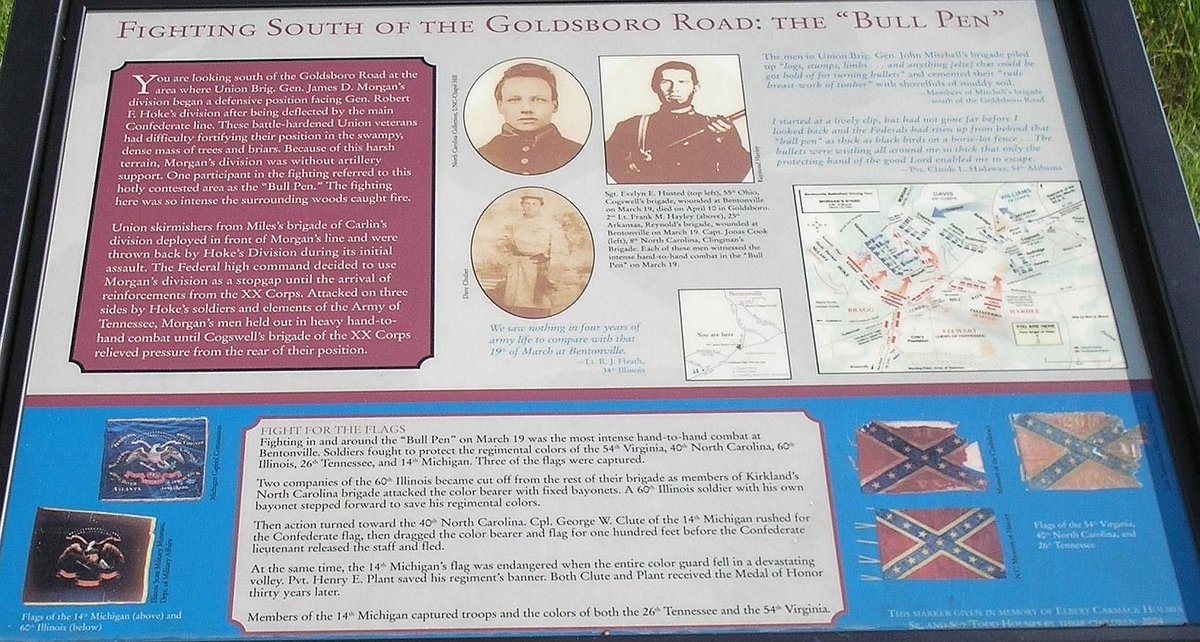
Part 2/4: Battle of Bentonville Historical Markers: 1) Bentonville Battlefield; 2) Confederate Line Crossing the Goldsboro Road; 3) Fighting South of the Goldsboro Road; 4) Confederate High Tide MarkerImage
Image
Image
Image
Feb 7, 2025 7 tweets 18 min read
Part 2 - Breaching the Confederate Line: The Fall of Fort Donelson, February 14-16, 1862 (a thread 🧵).

1/7 I know I'm jumping the gun from a calendar standpoint by posting the continuation of the Henry - Donelson Campaign today, but I'm doing it by "popular demand." (OK, to be totally truthful, I had one person requesting me to post the 2nd part with respect to Fort Donelson, so that's why).

Confederate Options after the Fall of Fort Henry

For Johnston, the fall of Fort Henry was a disaster. His left under Bishop (Major General) Leonidas Polk had been severed from his center with the destruction of the railroad bridge over the Tennessee. What options lay open for the Confederacy in the west with the way open into their rear and Grant certain to move on Fort Donelson?

General Pierre Gustave Toutant (P.G.T.) Beauregard had just arrived in the West. He proposed that Johnston concentrate his forces at Fort Donelson, crush Grant and then deal with Buell. Johnston refused to contemplate this move which could mean the loss of Nashville and Clarksville. Clarksville was the second largest ironworks in the South, while Nashville, besides having weapon foundries, was also a rural center with access to thousands of acres of food and fodder. Uncovering the city to Buell's advance might place Johnston, after his fight with Grant, with a large Union army across his line of retreat.

Another option would be to give up Fort Donelson and Columbus, creating a new line echeloned back from Nashville. The idea of retreat was tentatively accepted by Johnston, and Beauregard was given the job of conducting the withdrawal from Kentucky into Tennessee. But Johnston, despite his reputation as the greatest living soldier, got hopelessly confused between one plan and the other.

Although he had resolved not to attack Grant at Donelson and he felt that the fort's capture was merely a matter of time, Johnston wished to delay Grant for as long as possible. He sent as many units as were immediately available to Fort Donelson with the view to opposing Grant while it was practical, and then slipping away as had the garrison of Fort Henry. It was the product of poor military thinking and was the first step towards a debacle.

As a series of brigades entered Fort Donelson, one after the other, the leadership changed a number of times. Brigadier generals, each one with seniority over the last, entered the fort, Bushrod Johnson, Simon Buckner, Gideon Pillow and finally John B. Floyd. The last commander, Floyd, arrived on the morning of February 14th, eight days after the fall of Fort Henry.

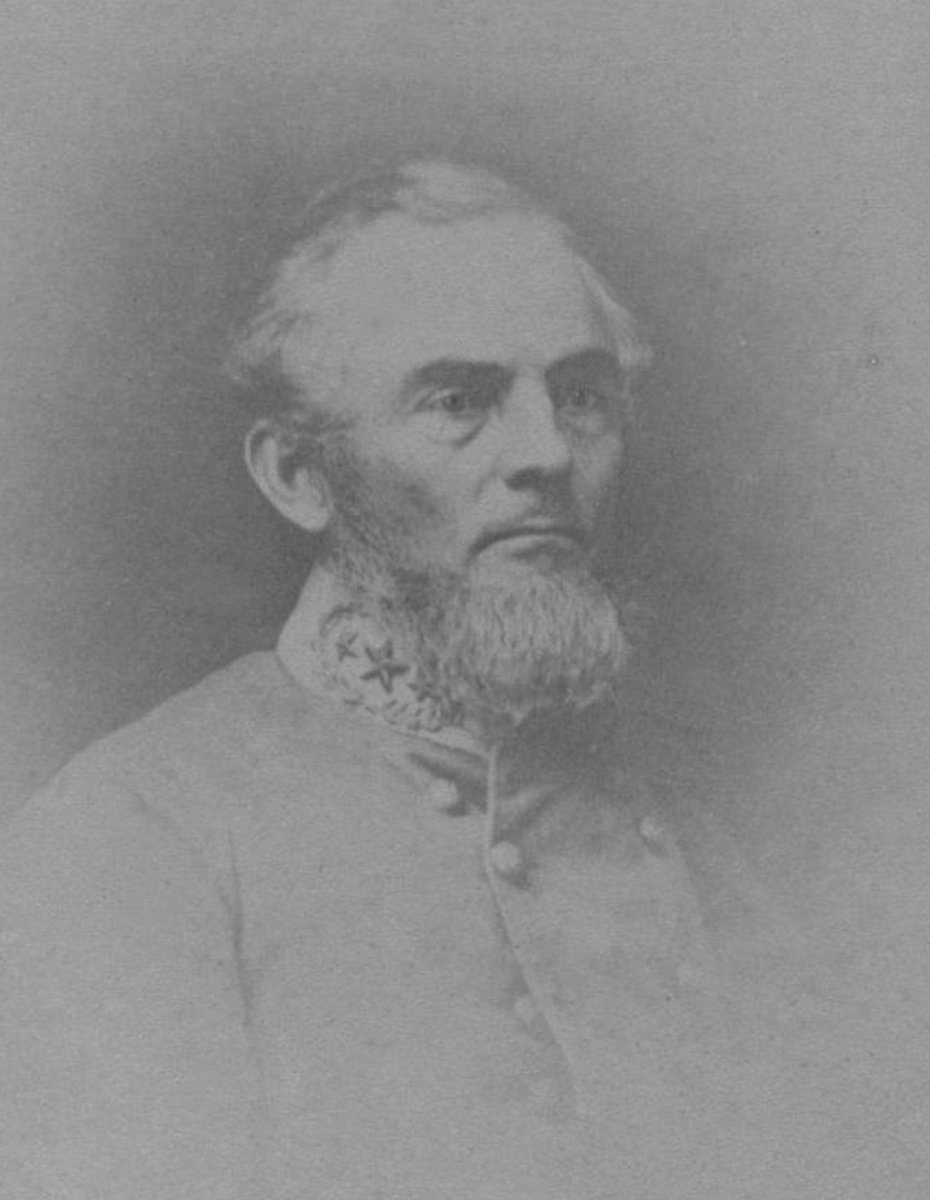
Graphics: 1) Brig. Gen. Bushrod Johnson; 2) Brig. Gen. Simon B. Buckner; 3) Brig. Gen. Gideon Pillow; 4) Brig. Gen. John B. Floyd.Image
Image
Image
Image
Grant Moves on Fort Donelson

2/7 Grant had originally intended to have taken Fort Donelson by the eighth, but the strength of the position had delayed him. An initial reconnaissance on the seventh suggested that the wisest course of action would be to wait for the gunboats which had to make the circuitous journey down the Tennessee River to the Ohio and back up the Cumberland. In fact, after consultation with Halleck who promised 10,000 reinforcements within the week, Grant decided to allow Commodore Foote to have his ironclads repaired at Cairo.

Having received his first reinforcements by February 12th, Grant decided to make a move from Fort Henry across to the Cumberland. 2500 men were left on the Tennessee in what remained of the waterlogged fort while 10,000 men were being transported by water. With the remaining 15,000, Grant hiked overland and by midafternoon he had begun the investment of Fort Donelson. Initially the lines were loose, McClernand's Division guarding the south and C.F. Smith's the north. As Grant settled down west of the fort, the noise of gunfire across the water signaled the arrival of the gunboats.

In discussion with Foote, Grant requested a demonstration against the fort on the morning of the 13th. Before this could be started, McClernand launched a local attack against orders. It was bloodily repulsed. McClernand was an aspiring politician with little ability to match his ambition. Grant was to be plagued by McClernand's insubordination and grandstanding for over a year until, at Vicksburg, the ex-congressman overstepped the line, and Grant was able to sack him.

As McClernand' s attack was ending, the gunboat Carondelet steamed into view and began firing at the fort. Fort Donelson was better sited than Fort Henry had been. There were two batteries, the upper one being at the top of a hundred-foot cliff and the lower one being dug into the cliff halfway down. The upper battery consisted of two 32-pound carronades and a 128-pound rifle while the lower one was made up of eight 32-pound guns and a 10-inch Columbiad. Only the two larger guns could be expected to damage the ironclads.

Sure enough, as the Carondelet steamed towards the fort it managed to fire off 139 rounds and was undamaged until a solid 128-pound shot pierced the armor plate and entered the engine room. The Carondelet withdrew, as at Fort Henry the Confederate gunners had won the first round.

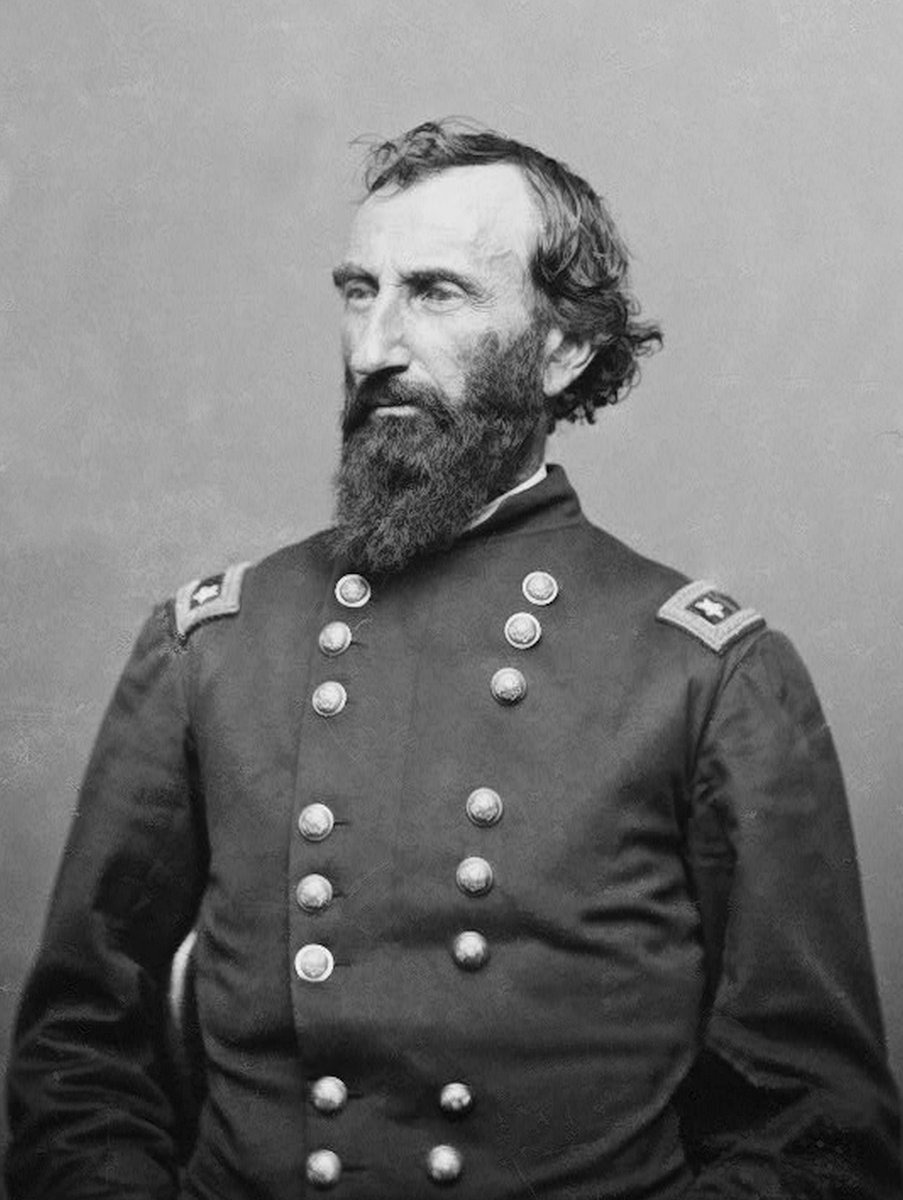
Along with the arrival of the gunboats came Grant's reinforcements. A new division was established and was placed under the command of Brigadier General Lew Wallace. Wallace's Division was placed on the western side of Fort Donelson, between the divisions of Smith and McClernand. Up until this moment the Union lines around the fort had been incomplete. From the morning of February 14th, Fort Donelson was completely invested.

Just before the siege lines were extended Floyd brought his Confederate brigade within the works, seemingly anxious to be the last to enter the trap. And a trap it certainly was. With Grant reinforced to 27,000 and possessing the gun boats, the likelihood of the Confederates escaping from Donelson, much less holding it, became remote. This was not some medieval fortress, stocked with enough provisions to last a season. Fort Donelson in the proper sense consisted of the two batteries, the surrounding earthworks were strong, but not impregnable. Most importantly the fort lacked food and fodder for the 17,000 men in the trenches.

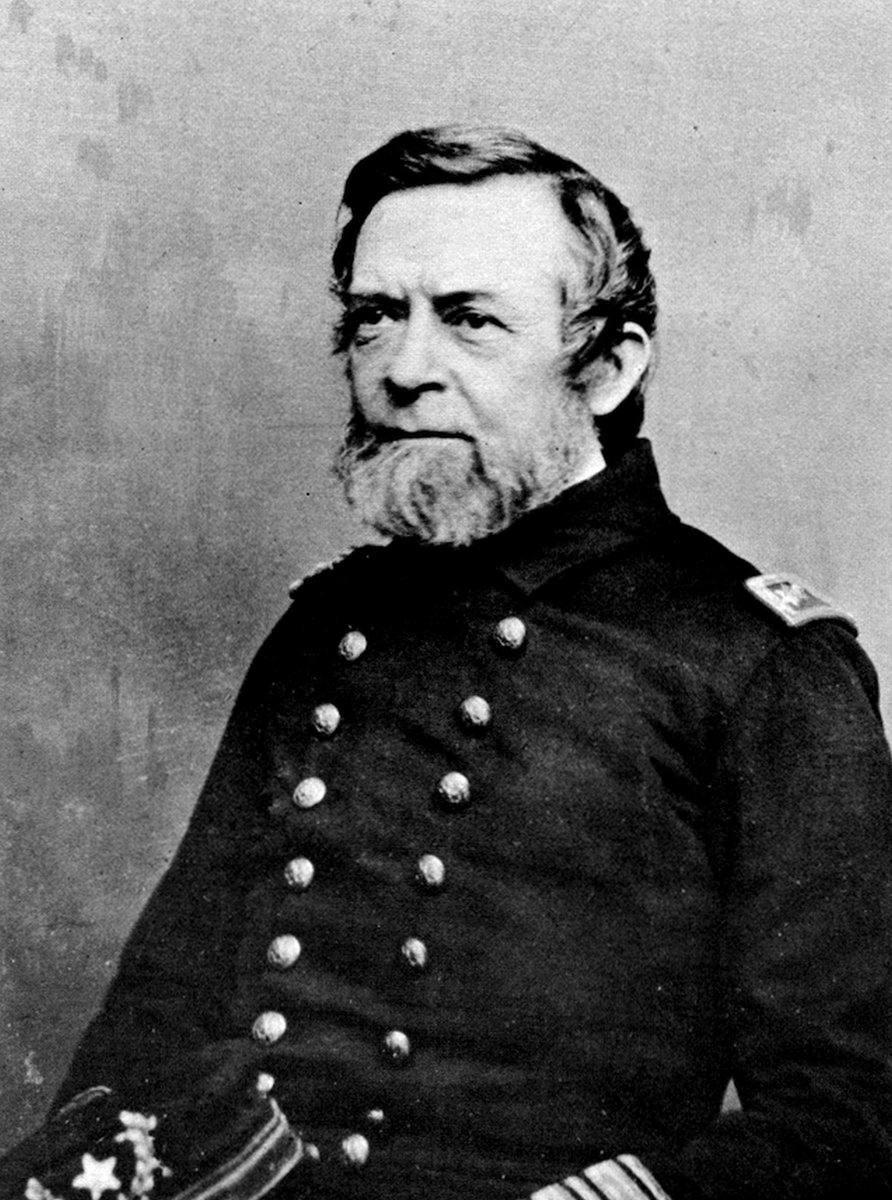
Graphics: 1) General U. S. Grant; 2) Commodore Andrew H. Foote; 2) General John A. McClernand.Image
Image
Image
Jul 8, 2023 6 tweets 3 min read
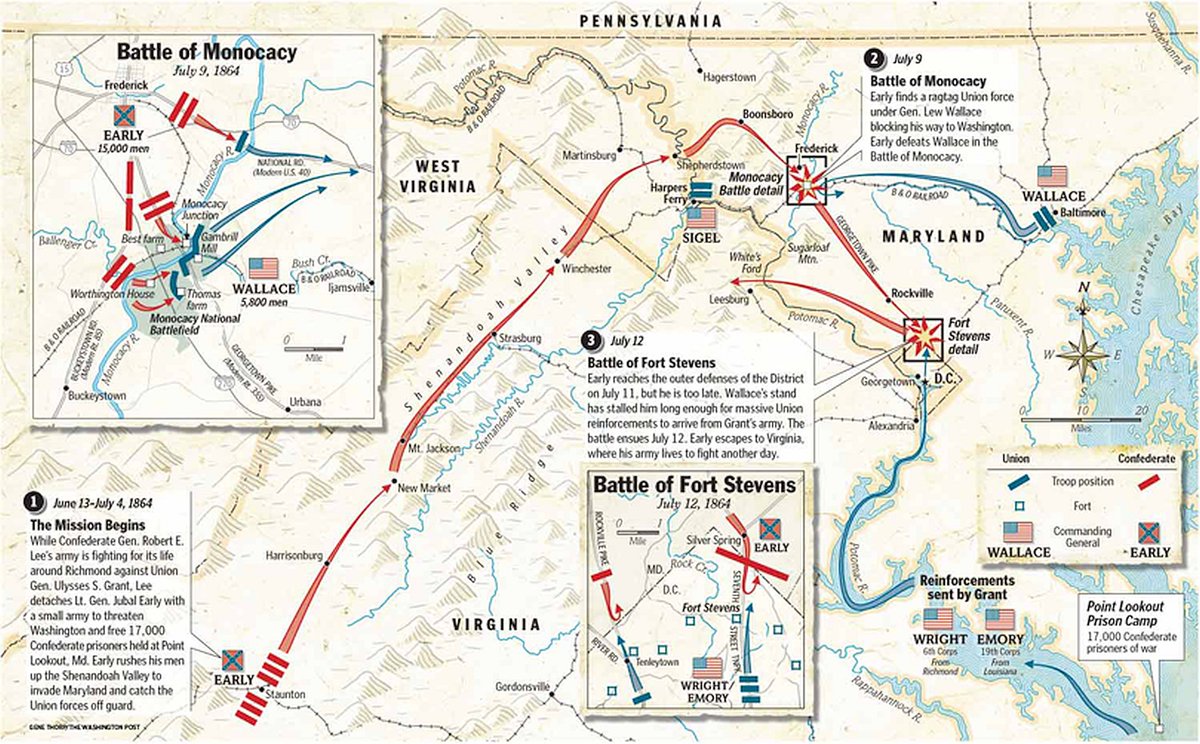
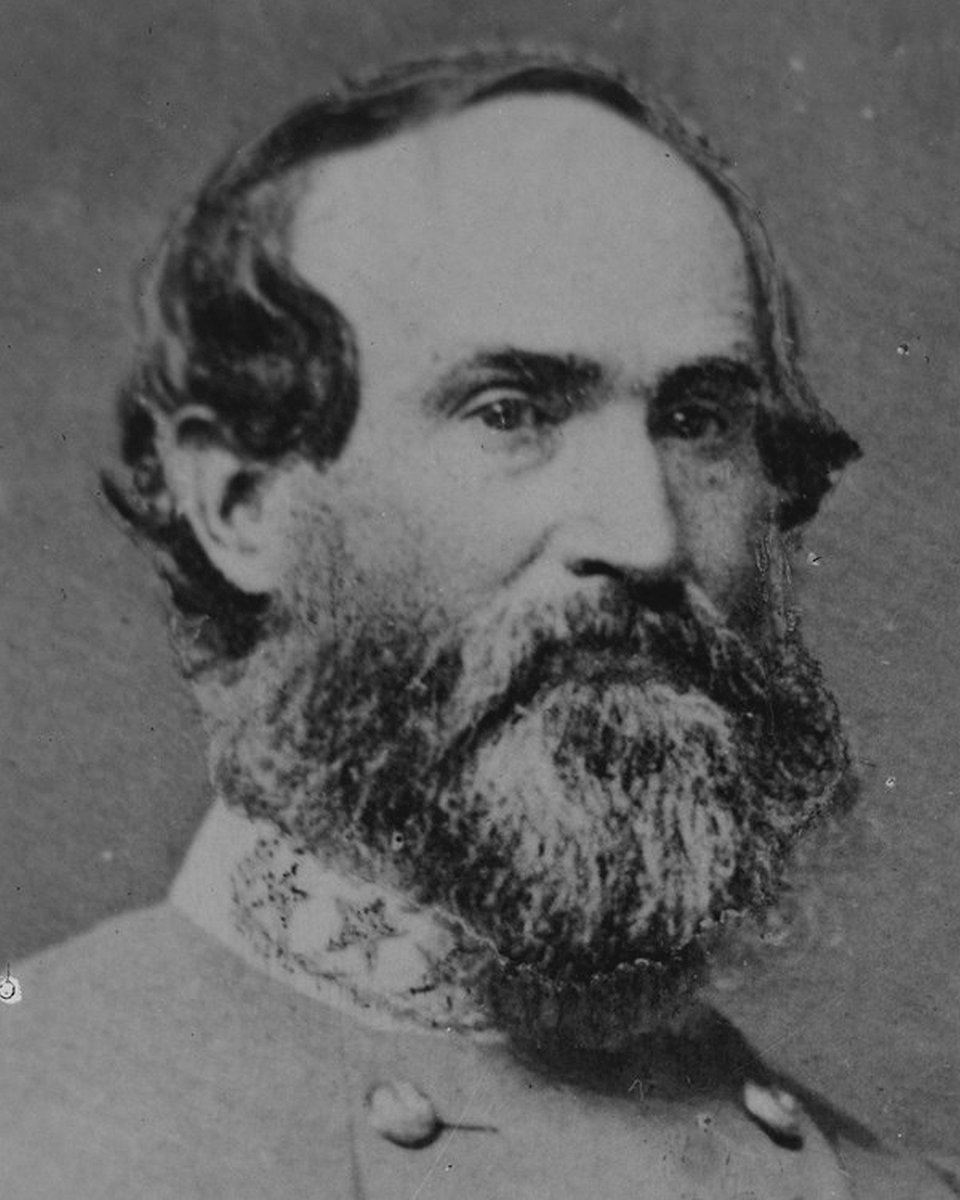
1/6 Tomorrow is the 159th anniversary of the "Battle that Saved Washington," the battle of Monocacy, MD. After marching north through the Shenandoah Valley from Lynchburg, the Confederate Valley Army of Lt. Gen. Jubal A. Early (which was in reality Early's much Image
Image
Image
2/6 reduced II Corps, Army of Northen Virginia) sidestepped the Federal garrison at Harpers Ferry and crossed the Potomac River at Shepherdstown into Maryland on July 5-6. On July 9, 1864, a makeshift Union force under Maj. Gen. Lew Wallace (yes, the Image