Jason Profile picture
Options trader since 2008. I write about trading and options markets for @Optionshawk. Accept the risk and take the trade. 4x Marathon finisher.
Jul 19 9 tweets 2 min read
VVIX Divergences - The Hidden Edge in Options Trading

🧵 When VVIX moves opposite to VIX, something BIG is about to happen

These divergences predict major volatility shifts 3-7 days early
Here's how to spot them and profit 👇

1/ What is a VVIX divergence?

When VIX and VVIX move in opposite directions

Bullish divergence: VIX rising, VVIX falling = Fear exhausting

Bearish divergence: VIX falling, VVIX rising = Complacency ending

Both signal regime changes 2/ Bullish divergence (SHORT volatility signal):

VIX: 35 → 40 → 42 (rising) VVIX: 115 → 105 → 95 (falling)

Translation: VIX rising but traders STOPPING hedging

This is exhaustion. VIX about to peak and reverse.
Jul 7 6 tweets 3 min read
Whats the Dispersion Index and why should you care for your stock market trades?

The Cboe S&P 500 Dispersion Index (DSPX) measures how much the stocks inside the S&P 500 are expected to move differently from each other over the next 30 days.

A simple way to explain this to a kid or novice would be think of it like a classroom race...

Imagine your class is running a race:

👉The VIX (the “fear index”) is like asking: “How fast or slow will the whole class average be?”

👉The DSPX is like asking: “How spread out will the finish times be between the fastest kid and the slowest kid?”

If everyone finishes close together, dispersion is low.
If some kids win by a lot and others finish way behind, dispersion is high.

🧵🧵1) 2) What DSPX actually looks at

DSPX uses option prices on:

👉The S&P 500 index (the whole group), and

👉Individual S&P 500 stocks (the kids in the class)

From those prices, it figures out how much extra movement the market expects in single stocks beyond the movement of the whole index.

👉High DSPX → The market expects big winners and big losers; lots of stock-by-stock differences. That’s usually when there’s more “opportunity” (and risk) for stock pickers.

👉Low DSPX → Most stocks are expected to move together, up or down. That’s more of an “index” world where picking individual stocks matters less.
Aug 31, 2024 7 tweets 3 min read
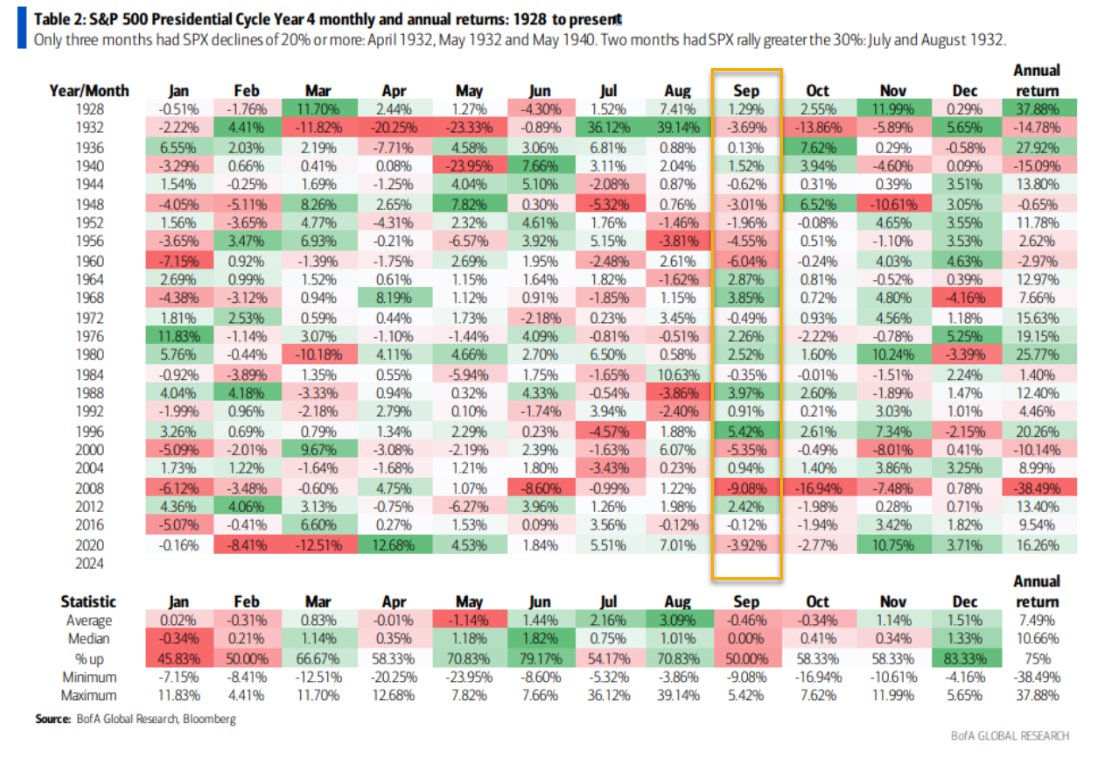
I love the fact that everyone suddenly seems aware that $SPY September #seasonality is weak.

Yes it usually can be but tends to be better in Presidential election years. You actually may be fairly shocked to see what could be coming in September. Here's the proof below in my thread: 👇🧵 I use market seasonality as a roadmap and discuss it all the time. I specifically remember being quite bearish last year during September and nailing the down move. However September has now been down 4 straight years (and sizably as can see below)

Sept returns for $SPX:
2020: -3.9%
2021: -4.8%
2022: -9.2%
2023: -5.4%

As we know trends do persist often but when everyone expects the same outcome, especially after 4 straight years seeing the same thing.. I'm not sure I am willing to bet on it.
Aug 2, 2024 6 tweets 2 min read
Alot of people asking what caused the stock market selloff.. here's the answer.

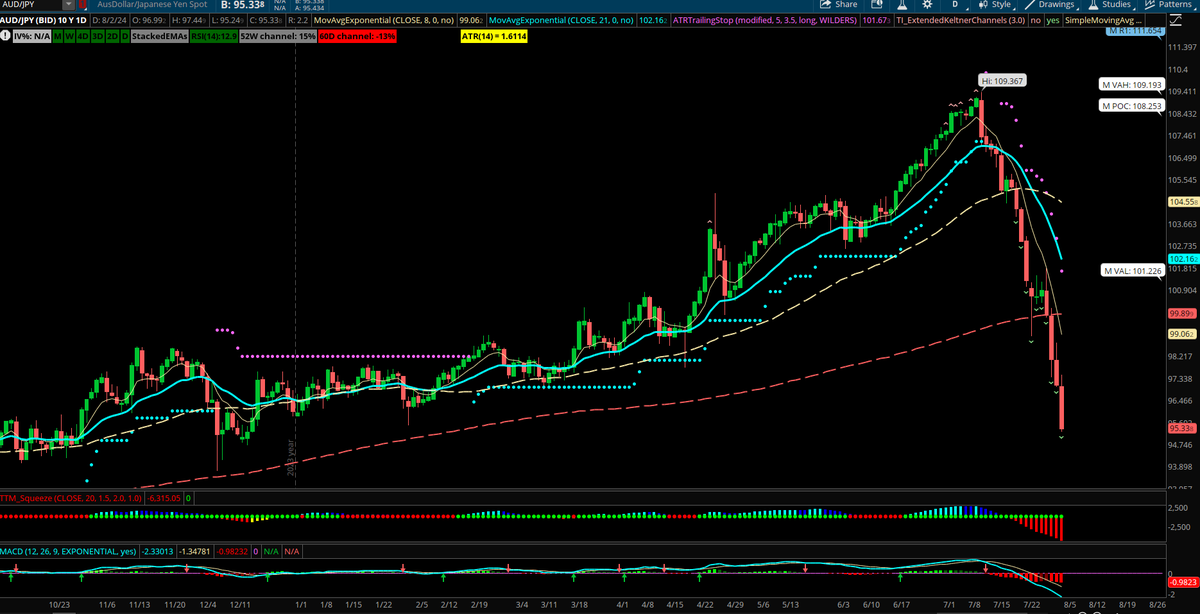
Its never just one reason with this type of move, more of a domino effect that has been brewing. But you can point to the Yen 'carry trade' as the culprit.

Just look at the Aussie/Yen pair.. gave up the whole years gain.

Explanation in thread below👇 🧵Image Let's break it down in a simple way using the lemonade stand example:

1. Borrowing Cheaply in Japan: Imagine you can borrow lemons from your friend in Japan at a very low cost. This is because Japan has very low-interest rates. So, you take advantage of these cheap lemons.