Chief Economist of @ADB_HQ.
Managed by Chief Economist Albert Park and his team. RT ≠ endorsement
Follow on LinkedIn: https://t.co/VQVUpN9a08
Mar 5 • 8 tweets • 8 min read
🧵1/8: The current conflict in the Middle East has reintroduced significant geopolitical risk into the global economic outlook. Our Macroeconomic Research Division at ADB has taken swift action to assess the potential implications for Asia.
While Asia’s direct trade exposure to the Middle East is limited, the potential spillovers through energy markets, disrupted shipping, and financial conditions could be significant. Asia is particularly exposed to heightened geopolitical uncertainty and oil price volatility. Our team is closely monitoring developments and assessing implications for the region’s resilience.
🧵2/8: Why is Asia especially exposed to the conflict in the Middle East?
➡️Most economies in the region are net importers of oil and natural gas. Net energy imports exceeded 2% of GDP in many Asian economies during 2022-24, implying that even moderate increases in oil prices could generate measurable impacts on inflation and incomes.
➡️ Asia is the primary destination for hydrocarbons transported through the Strait of Hormuz. Roughly four-fifths of crude oil and liquefied natural gas (LNG) transiting the Strait ultimately flows to Asian markets, and about 20% of global trade in oil and LNG passes through the Strait.
➡️ Disruptions to shipping routes or aviation corridors can transmit quickly to production costs, exports, and tourism activity. Protracted and more severe supply chain disruptions could lead to more persistent negative effects, including on prices, investor confidence, and growth momentum.
Mar 4, 2022 • 6 tweets • 2 min read
An increasing number of journalists have asked us for analysis on the impact of the Russia-Ukraine war on Asia’s economies. This is how my economics team and I see it at this moment in time, with recognition that the situation is moving fast and our analysis may change. 🧵
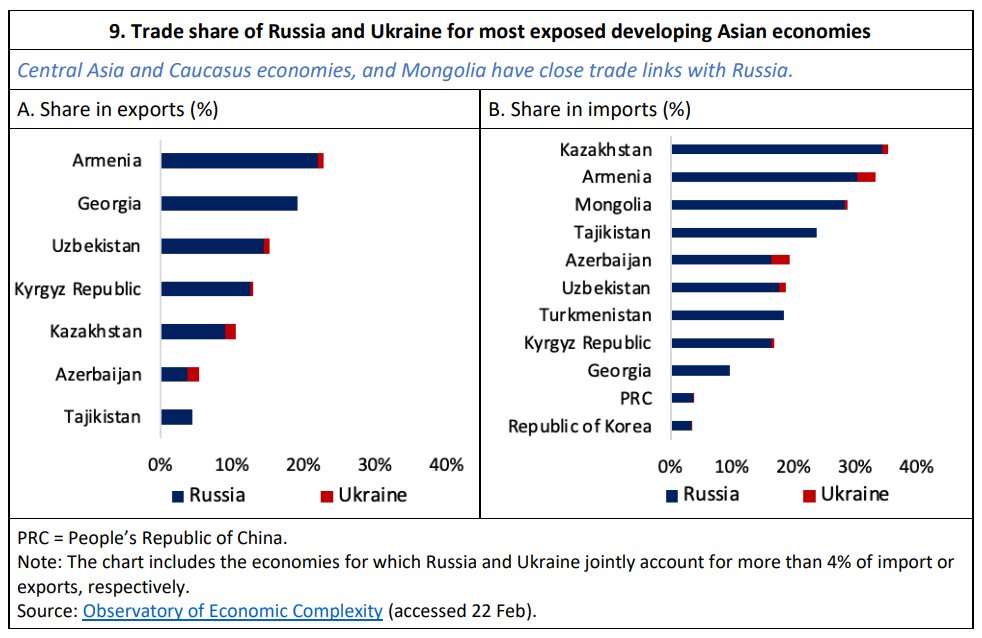
The impact of the Russia-Ukraine war on Asia’s overall trade is expected to be limited, as Russia and Ukraine account for only 2.5% of Asia’s imports and 1.5% of Asia’s exports. Developing Asia also accounts for only 5% of FDI in Russia.