Anna Riedl Profile picture
Cognitive Sovereignty. Autopoiethics. Rationality under Radical Uncertainty. Collective Intelligence. Information Design. Meaning Lab. Iron.
Jun 24, 2025 6 tweets 2 min read
This is called “game denial”.
Yet the game is always on.

Examples of game denial: free immigration for all, communism, universal basic income, everyone is equal, unconditional pacifism, a lot of feminism.

(Yet pure “game acceptance” is equally wrong, of course.)

What is “game denial”?

(1/6) “Life is a game.
Since we inhabit a world of limited resour­ces, our daily lives are full of zero-sum interactions where one party walks away with a prize while ano­ther leaves the table empty-handed; games with winners and losers. If you and I want the same spouse, the game is on. If you and I want the same job, the game is on. If you want to argue against this way of seeing the world, the game is on. There is no denying it, even when you do.”
(2/6)
Oct 29, 2024 7 tweets 4 min read
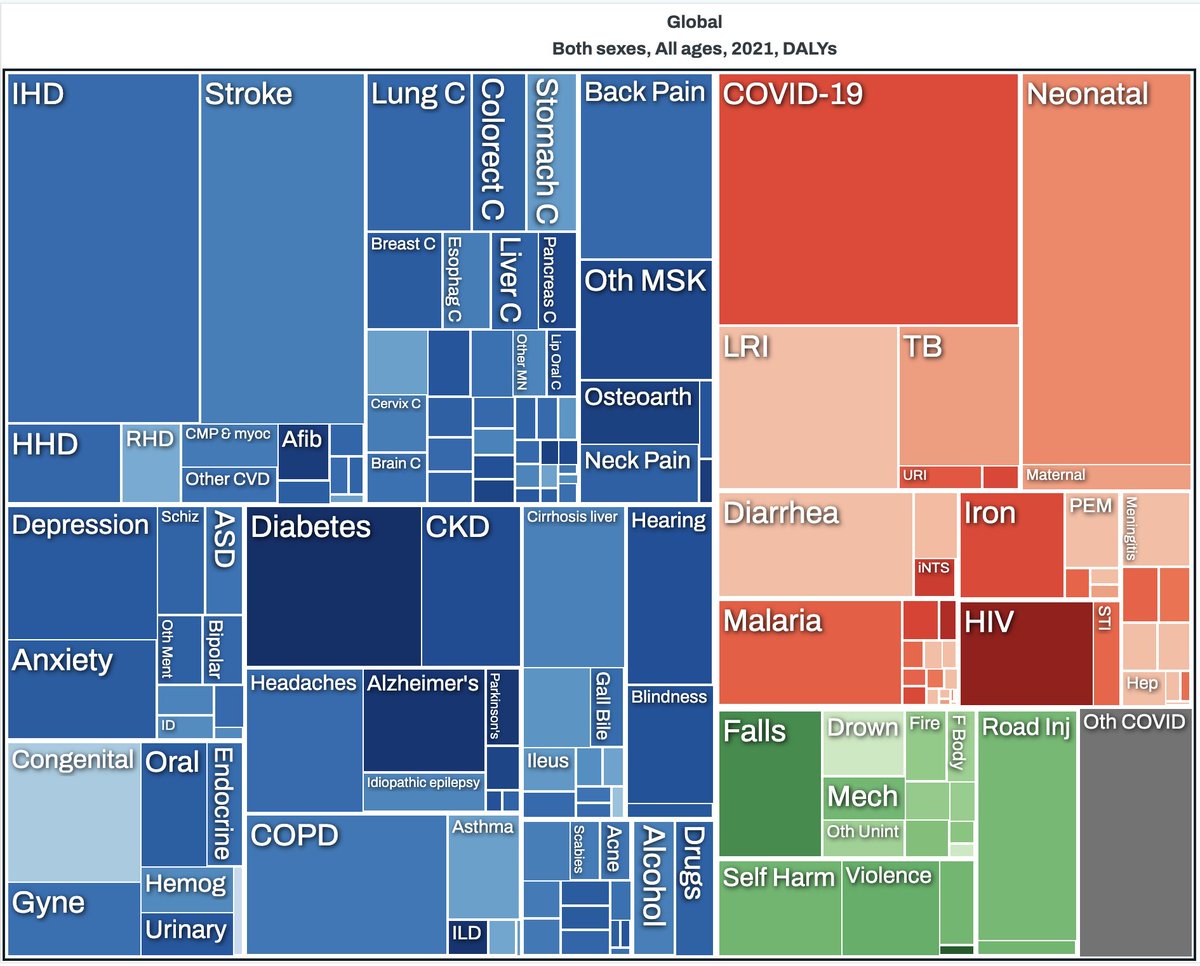
Eliminating back & neck pain might not sound important, so looking at the data might surprise you. While we have all heard of the prevalence of diabetes and heart disease, we are often ignorant of the "global burden of disease" of other causes.

Let's look at the data 🧵
1/7 Image Firstly, what is the "global burden of disease" and what are "DALYs"?
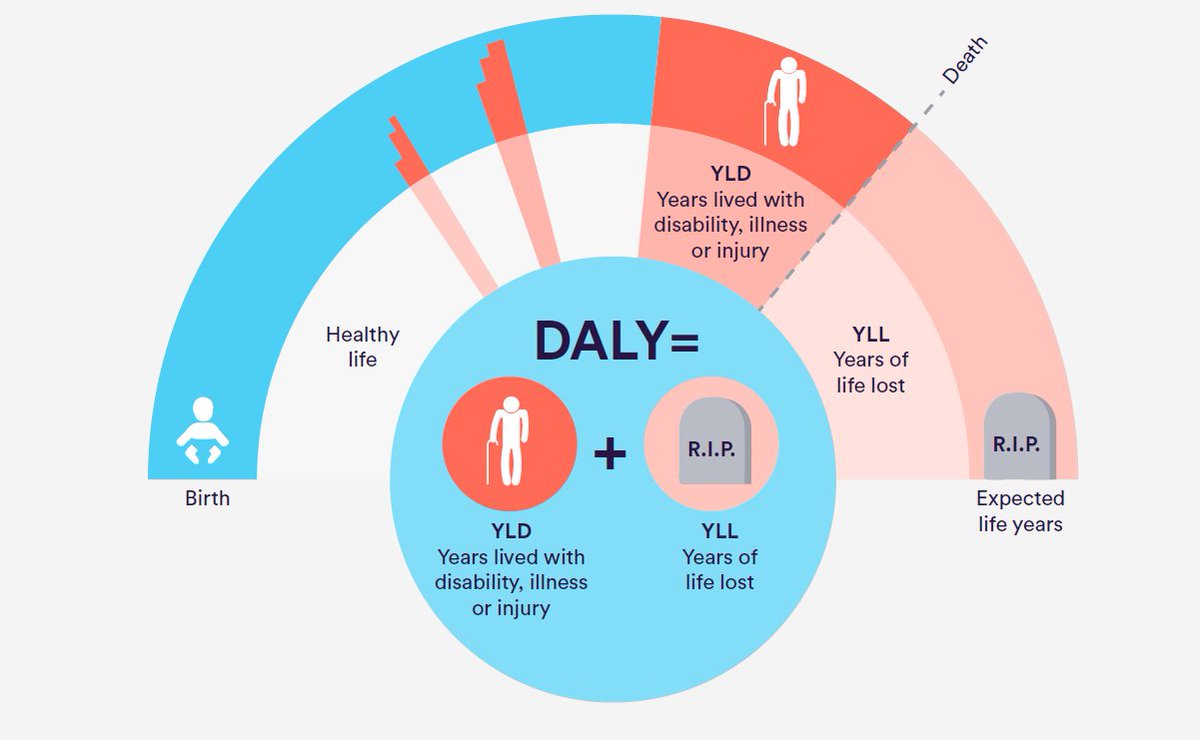
DALYs measure "how bad a disease is". The metric combines years of life lost (YLL) and years lived with the disease (YLD). DALY means "disability-adjusted life year".

The "global burden of disease" can then quantify how bad different diseases are for the global health of humanity. So, what are the total DALYs for humanity from neck and back pain?

2/7Image
Oct 12, 2024 4 tweets 3 min read
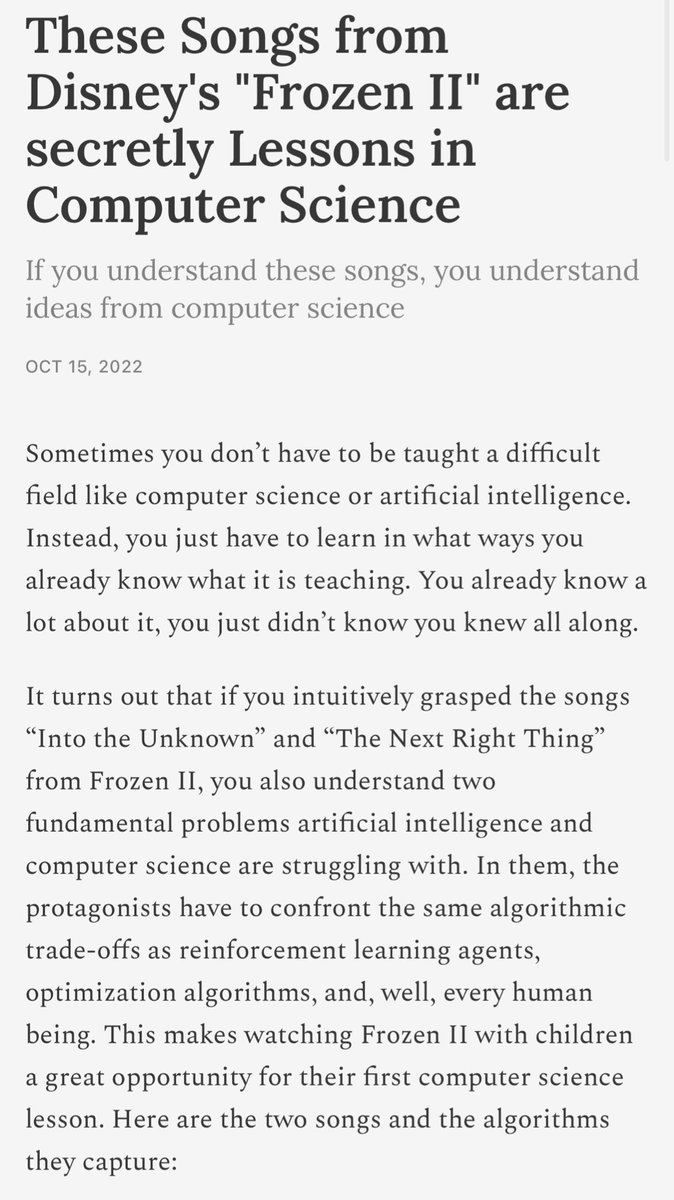
Glad to see both Frozen 2 songs that are secretly teaching computer science, made it into the top 30 of this music theory expert’s list. A delightful ranking of Disney songs.

Here’s how to turn the (next) time you watch Frozen 2 with your kids into a first lesson on algorithms 🧵 (1/4)Image 1. “Into the Unknown”: Explore-Exploit Tradeoff
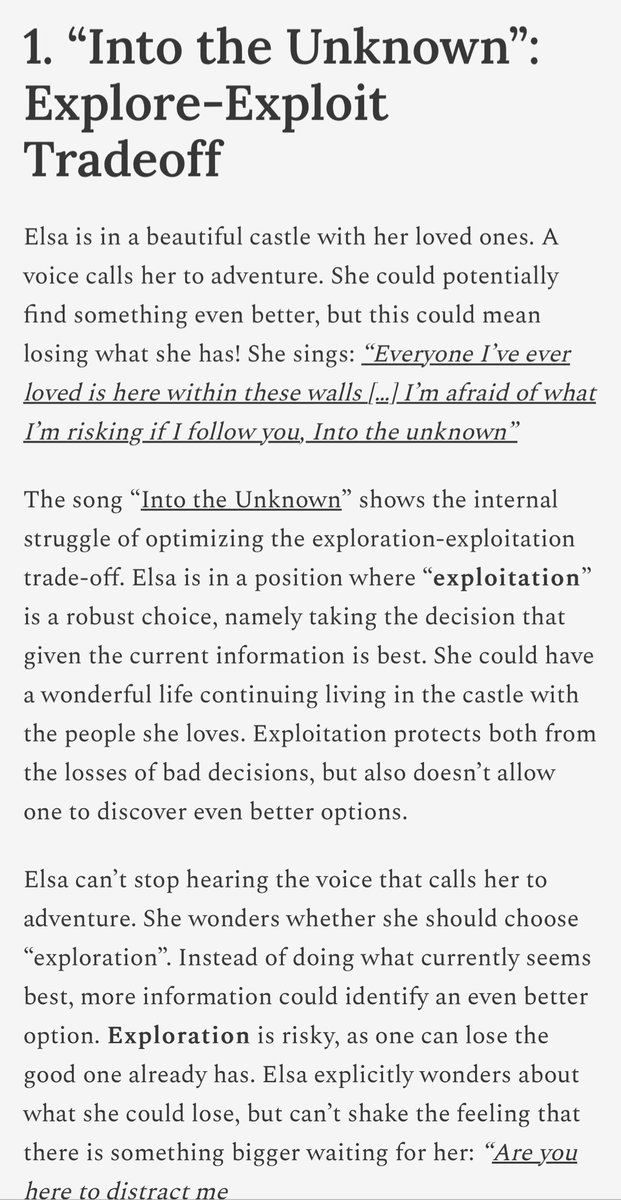
Elsa is in a beautiful castle with her loved ones. A voice calls her to adventure. She could potentially find something even better, but this could mean losing what she has! She sings: “Everyone I’ve ever loved is here within these walls […] I’m afraid of what I’m risking if I follow you, Into the unknown”
The song “Into the Unknown” shows the internal struggle of optimizing the exploration-exploitation trade-off…

(2/4)Image
Aug 3, 2024 9 tweets 7 min read
Do you want to learn more about complexity science?
Here are eight plus resources:

(Links in the last tweet of the thread!)

1.) The Map of the Complexity Sciences by @complexcase and @GerritsLasse gives an excellent historical overview of scholars, intellectual traditions, themes, and topics of study. The full map also contains clickable links.Image 2.) The Santa Fe Institute @sfiscience
- offers online courses and tutorials by their researchers on @ComplexExplorer
- and makes the best work in the complexity science available in print by @SFIPress.

In 2024 they published "Foundational Papers in Complexity Science" in four Volumes: "This project maps the development of complex-systems science through eighty-nine revolutionary works originally published between 1922 and 2000. Curated by SFI President David C. Krakauer, each seminal paper is introduced and placed into its historical context, with enduring insights discussed by leading contemporary complexity scientists." Volume III and IV will be available to order later in 2024.Image
Image
Jul 22, 2022 15 tweets 7 min read
Here are 14 images to better understand cognitive science visually 🧵

(From a lecture I gave for @pgmid's BrainInspired discord community) 1. The SLOAN Foundation report (1978) described the state of cognitive science research to "discover principles whereby intelligent entities interact with their environments".

= most commonly used visual representation

More e.g. in Miller (2003) & Gardner (1987) Image