Basil Halperin Profile picture
Assistant professor of economics @UVA; Past lives: PhD @MITEcon, @Uber, @AQRCapital, @UChicago
Jan 3 18 tweets 5 min read
Some takes on this piece, which I want to interpret as "optimal taxation in an AK economy": 1. In a baseline AK economy, consumption taxation still dominates capital taxation!(!!!)

See Korinek and Lockwood (2025) for a direct statement of this
youtube.com/watch?v=i2qpFg…
data.nber.org/data-appendix/…
Nov 5, 2025 7 tweets 2 min read
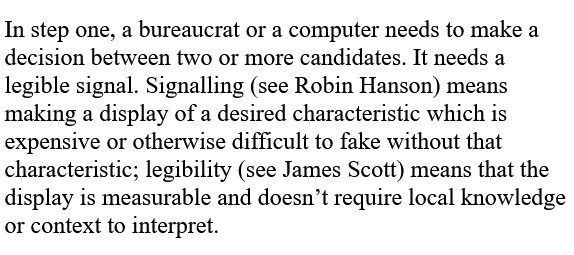
"There is a four-step process which has infected and hollowed out the entirety of modern society. It affects everything from school and work to friendships and dating" ... Step 1: "A bureaucrat or a computer needs to make a decision between two or more candidates. It needs a legible signal." Image
Jun 2, 2025 15 tweets 8 min read
How substitutable are humans & compute in AI research -- "will we get bottlenecked by compute" -- is a key question for AI-2027-type scenarios

@whitfill_parker and @cherylwoooo have interesting new work estimating that elasticity of substitution:
Image The motivation here is like:
(1) doing AI research requires both 'labor' + tinkering with models ( = compute)
(2) AI researchers are working on automating the labor component: replacing human labor with AI labor
...
May 2, 2025 7 tweets 3 min read
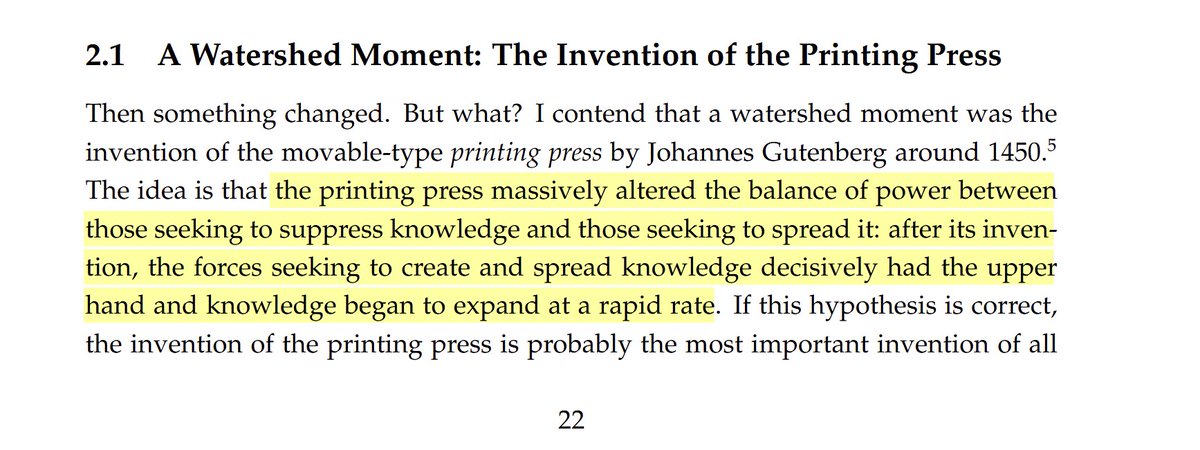
Jon Steinsson's textbook draft also has an interesting defense of the view that the printing press was the "watershed" invention for the Industrial Revolution Image The main argument is that the main hindrance to scientific progress historically was elite suppression, and the printing press changed the balance of power
Also:
- printing press promoted literacy
- printing press led to Reformation (cf Henrich and Schulz) Image
Apr 15, 2025 6 tweets 3 min read
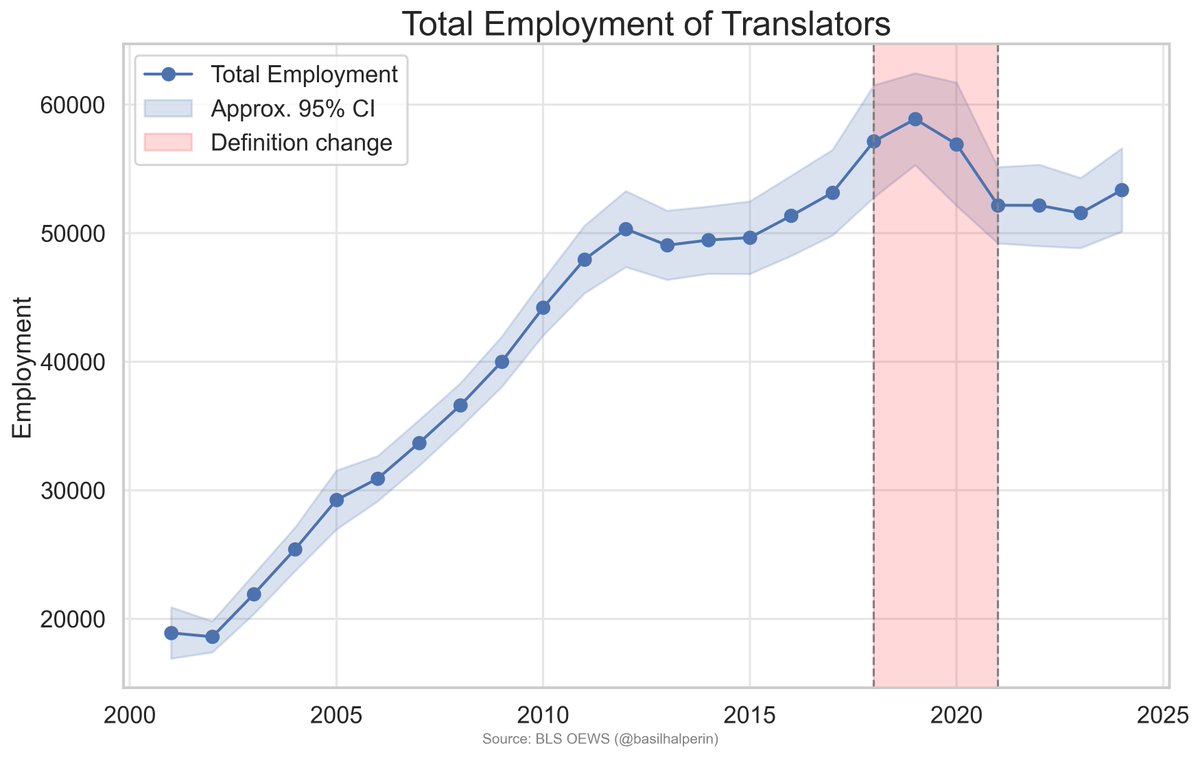
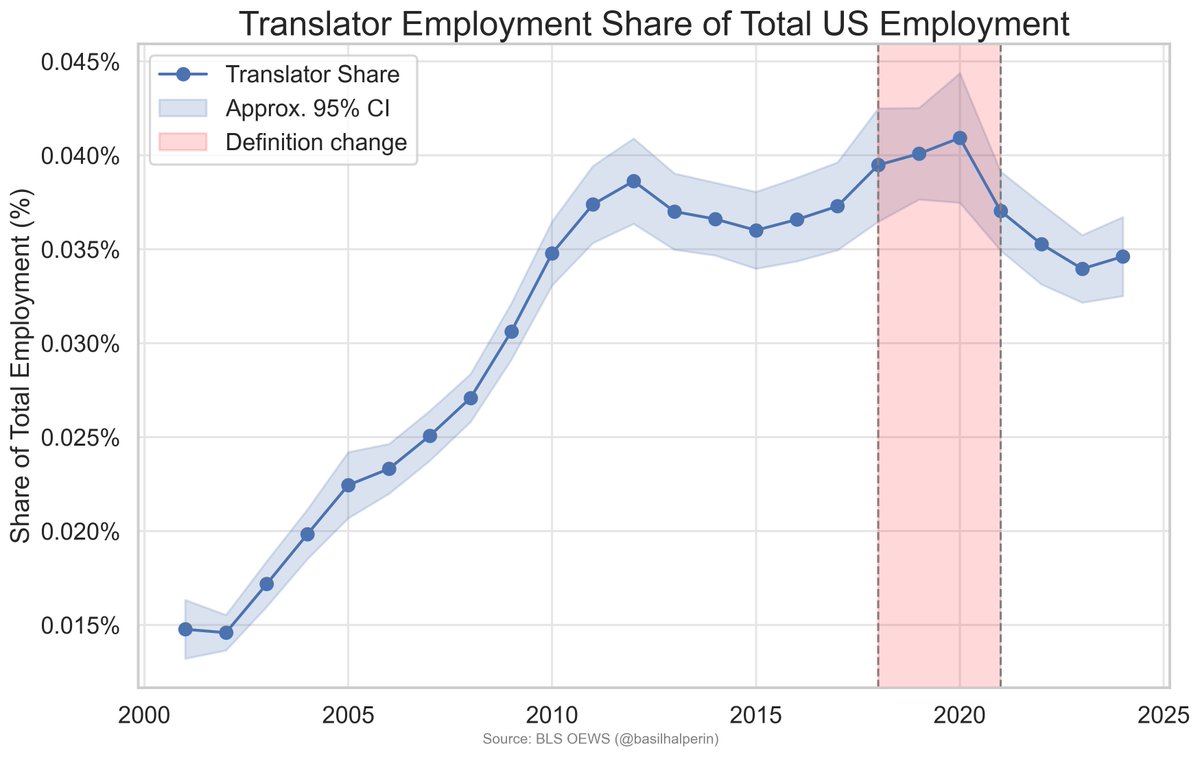
The BLS just released new OEWS data, so we can actually update this (it's an annual survey every May -- so this is 18 months of data post-ChatGPT, instead of 6 months)

From 2023 -> 2024:
(1) Translator real wages +0.8%
(2) Translator employment/employment share slightly up ⬆️ Image Or total employment in levels...

Unfortunately there was an occupation classification system transition starting in 2019 lasting through 2021, which makes historical comparisons inexact -- but the last few years are comparable, I believe Image
Dec 4, 2024 7 tweets 2 min read
1. How correlated are high-frequency FFR shocks across CME vs. Kalshi vs. Polymarket

2. Event long-short index on Taiwan invasion risk ("what does the market think about Taiwan invasion risk"), I would be sorely tempted to coauthor on this one 3. Kalshi/Polymarket have markets on tax policy changes => clean tax shock measure?
Nov 19, 2024 6 tweets 2 min read
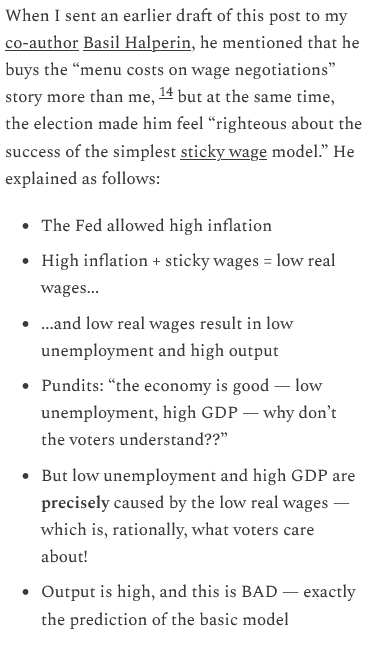
Tentative takeaways for macro theory, based on Zach's empirics showing wage growth has been uniformly weak in the recent episode:

1. Basic sticky wage theory looks extremely good? Image 2. Relatedly (and again tentatively): an update against *downward* nominal wage rigidity -- the idea that nominal wages are asymmetrically rigid downward, but not upward
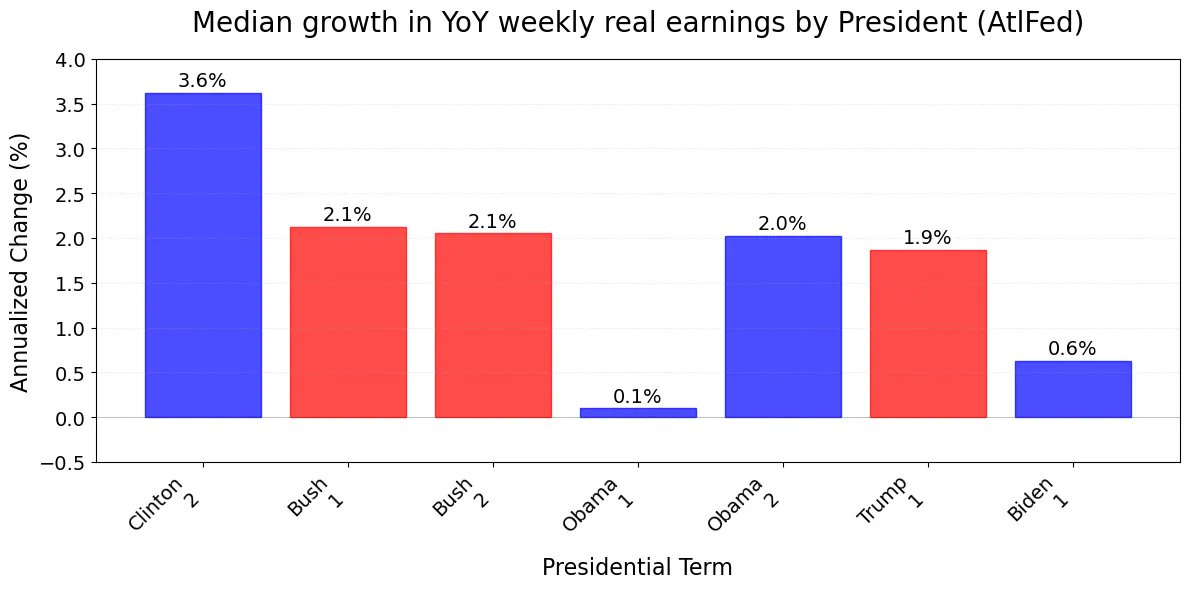
- seems like wages have been rigid upward too
- would be very curious if someone digs (or has dug) into this Image
Nov 12, 2024 6 tweets 3 min read
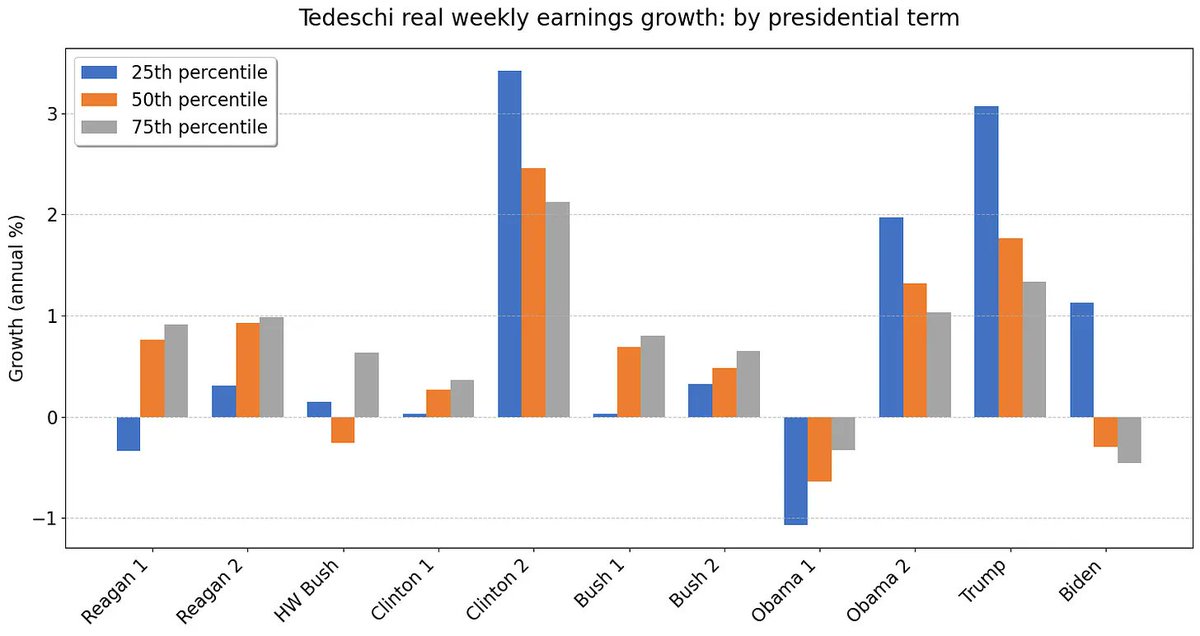
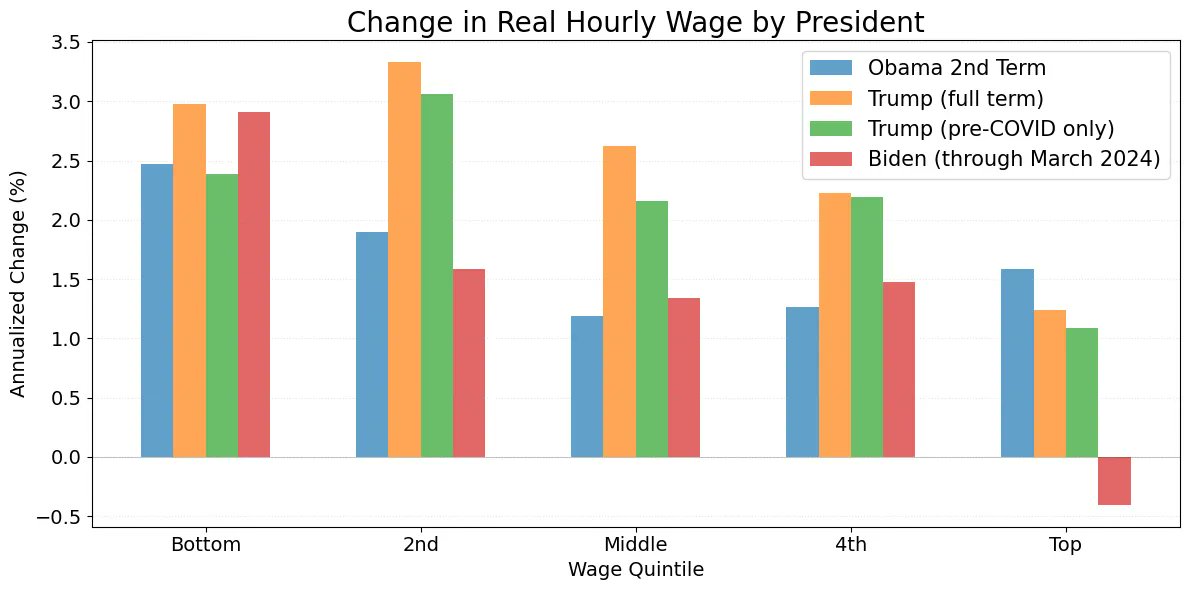
This is THE analysis of wages/income under Biden-Powell

TLDR: growth has been... historically weak (this is not normative -- just the numbers)

File under: blog posts that could be papers (and BPEA or someone should really conscript Zach to turn it into a paper) Image Point 1: In no part of the income distribution did wages grow faster while Biden was president than they did 2012-2020 (!), in the raw data and especially with a composition adjustment Image
Image
Nov 6, 2024 15 tweets 5 min read
Here's something completely unrelated everyone should discuss:

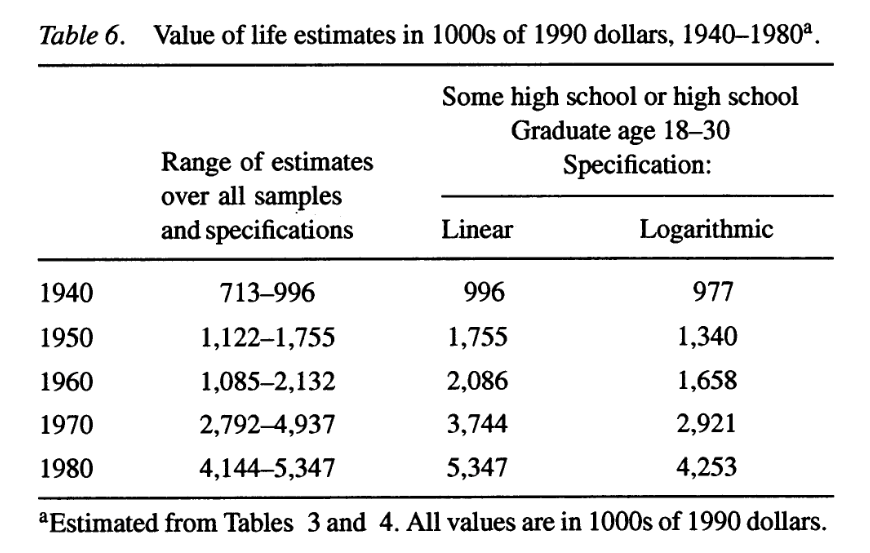
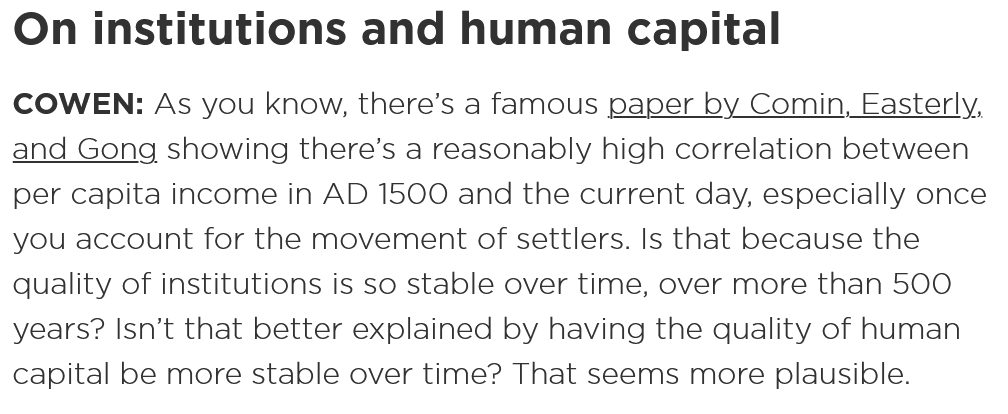
How much of the gap between rich and poor countries is due to human capital: people in rich countries simply have more/better education? I had thought the consensus was: human capital differences cannot explain that much of the variation in GDP per capita across countries
Oct 17, 2024 8 tweets 4 min read
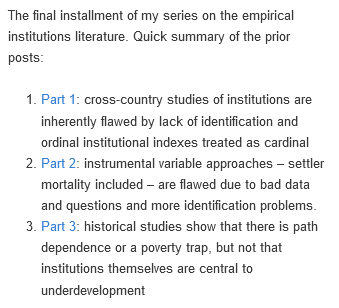
The best *constructively* critical piece to read on Acemoglu-Johnson-Robinson is "The Skeptic's Guide to Institutions" series from Dietz Vollrath:

The series is great precisely because -- Vollrath writes from the perspective of a 'skeptical fan' of the literature Image
Image
Part 2 of the series discusses AJR 2001. He discusses four critiques:
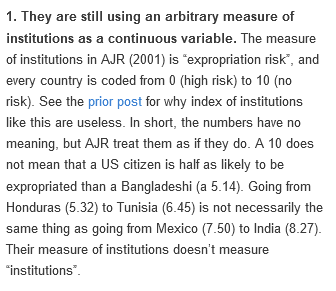
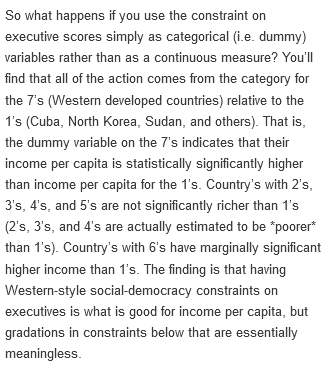


1. The measure of institutions should be a categorical, not continuous, variable: "A 10 doesn't mean that a US citizen is half as likely to be expropriated than a Bangladeshi (a 5.14)" growthecon.wordpress.com/2014/11/20/the…Image
Image
Jul 26, 2024 25 tweets 9 min read
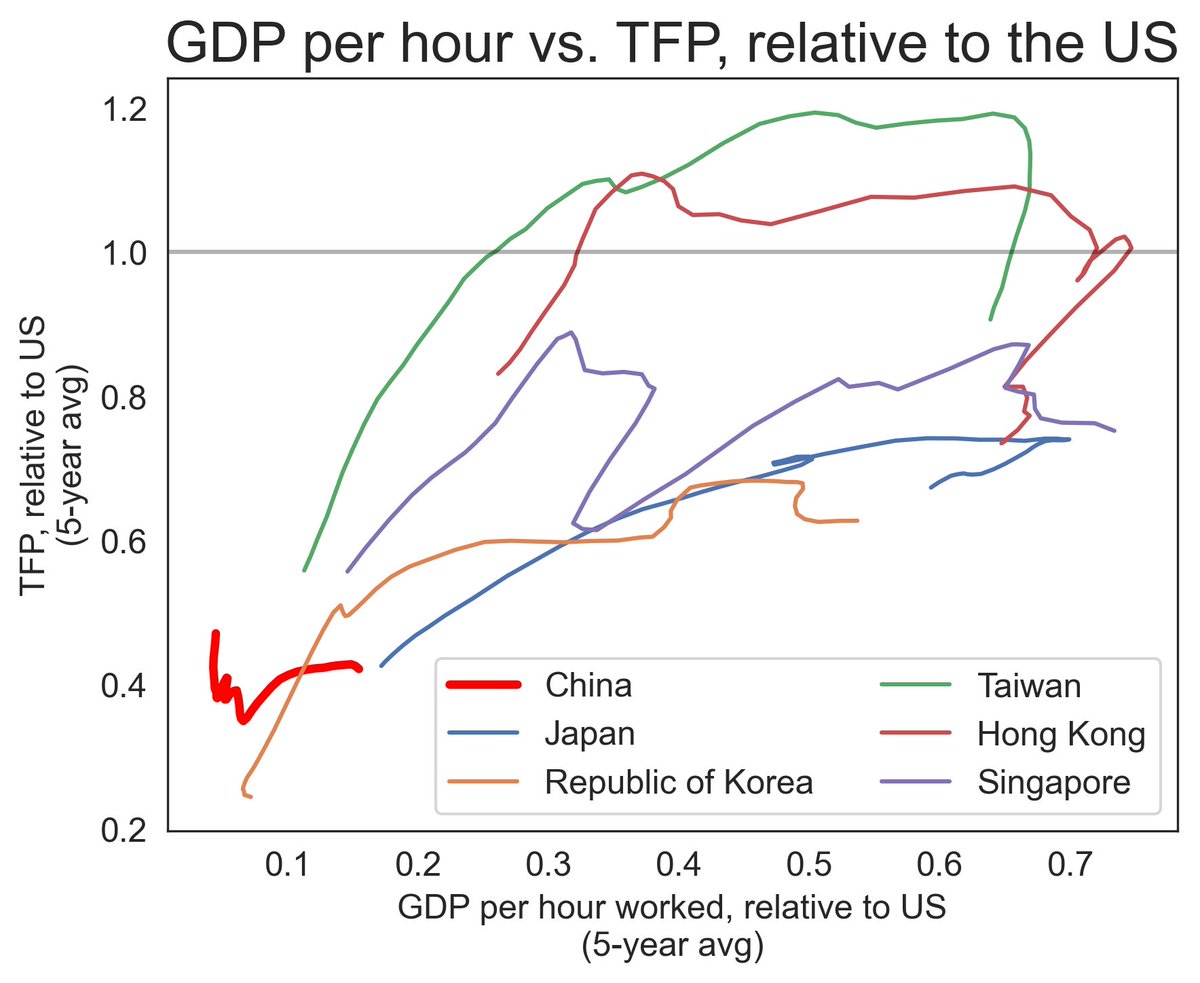
How much of Chinese growth is *TFP growth* vs ‘merely’ Solow catch-up growth?

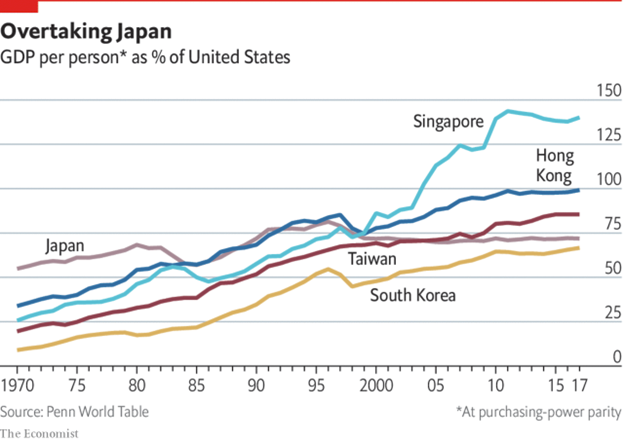
A mini lit review, for the purpose of attracting real experts to correct my errors 🤠 Image The natural background to the China question is the lit on the rapid growth of Japan + the East Asian Tigers (Hong Kong, Singapore, South Korea, Taiwan), on which I recently gave an opinionated summary
Jul 10, 2024 25 tweets 5 min read
I think the Solow/neoclassical model is overrated *for explaining catch-up growth and convergence*

Some thoughts, as a prelude to a thread on Chinese growth accounting: Let me frame the argument against Solow by appealing to the debate over the rapid growth of East Asian Tigers (Hong Kong, Singapore, South Korea, Taiwan) from 1960-2000: Image
Jun 7, 2024 22 tweets 4 min read
Miscellaneous things I learned in [econ] grad school:

1. The returns to experience are high(er than I thought)
- Someone who has studied a single topic for a decade or two or three really does know a LOT about that topic One way you can see this: the way experienced faculty have seemingly photographic memories of subsections of papers and interactions in seminars from years ago --

In the same way that experienced NBA/chess players can have photographic memories of games:
Jan 10, 2023 16 tweets 5 min read
AGI and the EMH: what does the market tell us about AI timelines?

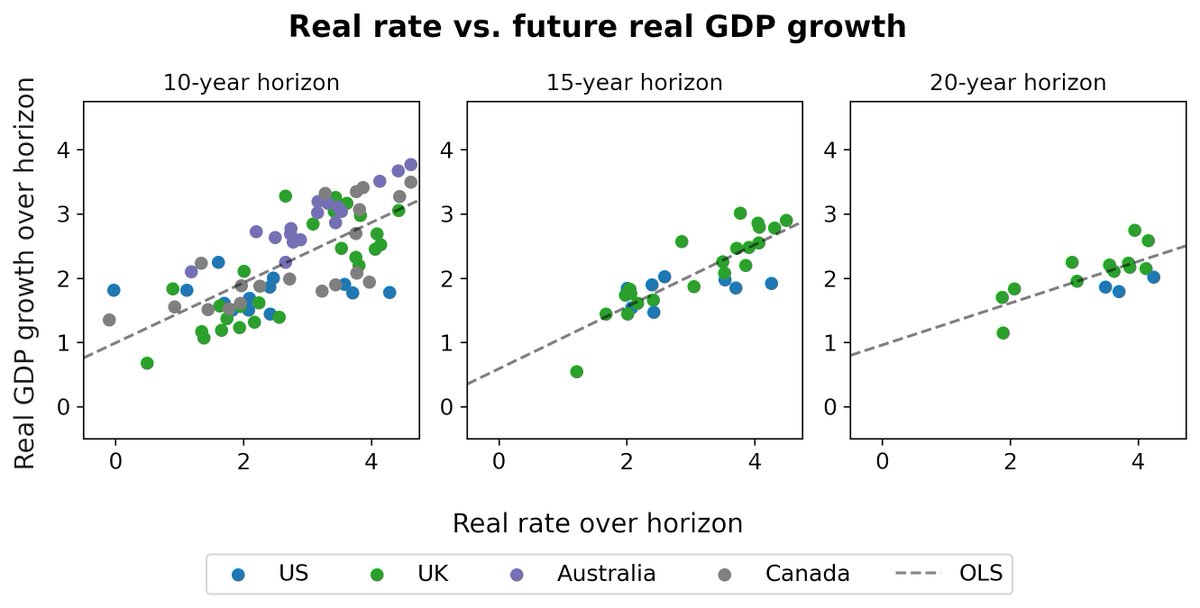
TLDR: Markets are not putting much probability on the development of transformative AI (aligned or unaligned!) in the next 30-50 years – as evidenced by low *real interest rates*

forum.effectivealtruism.org/posts/8c7Lycgt… This thread is based on new work with @ZMazlish and @tmychow, full post here:
forum.effectivealtruism.org/posts/8c7Lycgt…

We show *real interest rates* would be high if markets were expecting transformative AI

But long-term real rates are low!