Brad Spellberg Profile picture
CMO Los Angeles General Medical Center, hospitalist, infectious diseases expert, researcher
Apr 25, 2025 10 tweets 2 min read
@jakescottMD Hi @iPhoOzZ, I just sent you a detailed email response. Thank you for asking this very important question, which affords me the opportunity to offer one of my trademark antibiotic rants. Oooh, feels good, haven't done one of these in a while! Ok...strap in, here we go... The answer to this question offers yet another ringing condemnation of the standard guideline process that specialty societies use. It is yet another example of specialty egos run amok and another example of why new guideline methods are needed. @Wiki_Guidelines is the future.
Dec 13, 2024 5 tweets 2 min read
I know this is confusing, but PCT hasnt been studied in RCTs as a DIAGNOSTIC test. It was studied as a PROGNOSTIC BIOMARKER. Several implications.

1) We don't use PCT to diagnose anything. It's not to Dx bacterial vs. viral PNA. Sensitivity/specificity are not really relevant. 2) The use is to determine when it is potentially safe to stop abx therapy. It MAY be useful to not start Abx therapy in the first place, in not sick pts (outpatients). But clear that it can rise 24 h after presentation. So in sick pts it can't be used up front to withhold.
Aug 6, 2024 13 tweets 3 min read
Okay by popular demand, as requested, another ID/abx rant.
Let's talk abx "spectrum of activity" vs. selecting for resistance. Does it make sense to use PCN rather than amp or amox to "reduce selection for resistance"?
Nope.
I know. Confusing. All antibiotics select for resistance. And they don't just select for resistance among bacterial strains that the clinical micro lab tells us are "susceptible" to the abx. Susceptibility is a clinical not ecological construct; seeks to predict which abx is more likely to cure dz.
Jul 13, 2024 13 tweets 3 min read
3 daily rants in one week? A new record!

It's a fair question. And the answer is, no. Even in immune suppressed patients there is no evidence that cidal vs. static means anything. Why? First let's start with what static/cidal mean. I know it seems intuitively obvious. Cidal means the abx kills and static means the abx stops replication but doesn't kill bacteria, right? And you need to kill bacteria in compromised hosts, so you gotta use cidal abx right? Wrong.
Jul 11, 2024 25 tweets 4 min read
Okay @radiokeller, you asked for a combo Abx therapy rant, so here it comes (I guess Im taking requests now! ;)).
There are 3 philosophical reasons to use combination Abx therapy (see my Mandell chapter for this discussion in detail). But they all apply differently to difft dzs. 1) To prevent emergence of abx resistance
2) To improve outcomes by giving 2 active abx instead of 1, believing that 2 more effective than 1
3) To enable broader empiric Tx than is possible for 1 abx alone, with plan to narrow when organism known.

For which are each appropriate?
Jul 10, 2024 5 tweets 2 min read
I guess it's time for my daily rant. Im old enough to remember when this first negative day of culture nonsense started.
Back in the bad old days of the cretaceous era, when I was an ID fellow and rode the brontosaurus to work... The endocarditis guidelines gave total durations of therapy. They didn't start the clock from the first day of negative blood cultures.
Why did this change????
I remember the literal trigger. It was the fungal mafia. They put out the first Candida guidelines, which invented
Jul 7, 2024 5 tweets 1 min read
It's a good question, and sadly the science around this has never been fully developed. These organisms do not colonize healthy people in most community settings--but many studies over decades have shown they begin to colonize people in hospital starting at around 48-72 h. Why colonization happens in hospital and not in most community settings has not been really answered to any satisfaction. Certainly the presence of foreign bodies in hospital (ivs, ET tubes, urinary catheters, etc) plays a role. Density of abx use, selecting these R pathogens out
Jul 1, 2024 6 tweets 1 min read
Fair nuff. How about we start a string, people can modify/add?
CAP: Viral most common. Of bacteria, S. pneumo, Mycoplasma, Hemophilus, Chlamydophila, Moraxella
In endemic areas, cocci, histo, paracocci
Post influenza, or necrotizing, S. aureus
EtOH/aspiration, Enterobacterales VAP/Healthcare Associated: GNB, including non fermenters, less common S. aureus

Pseudomonas can be community onset if existing structural lung disease, especially if known colonization
Apr 26, 2024 7 tweets 4 min read
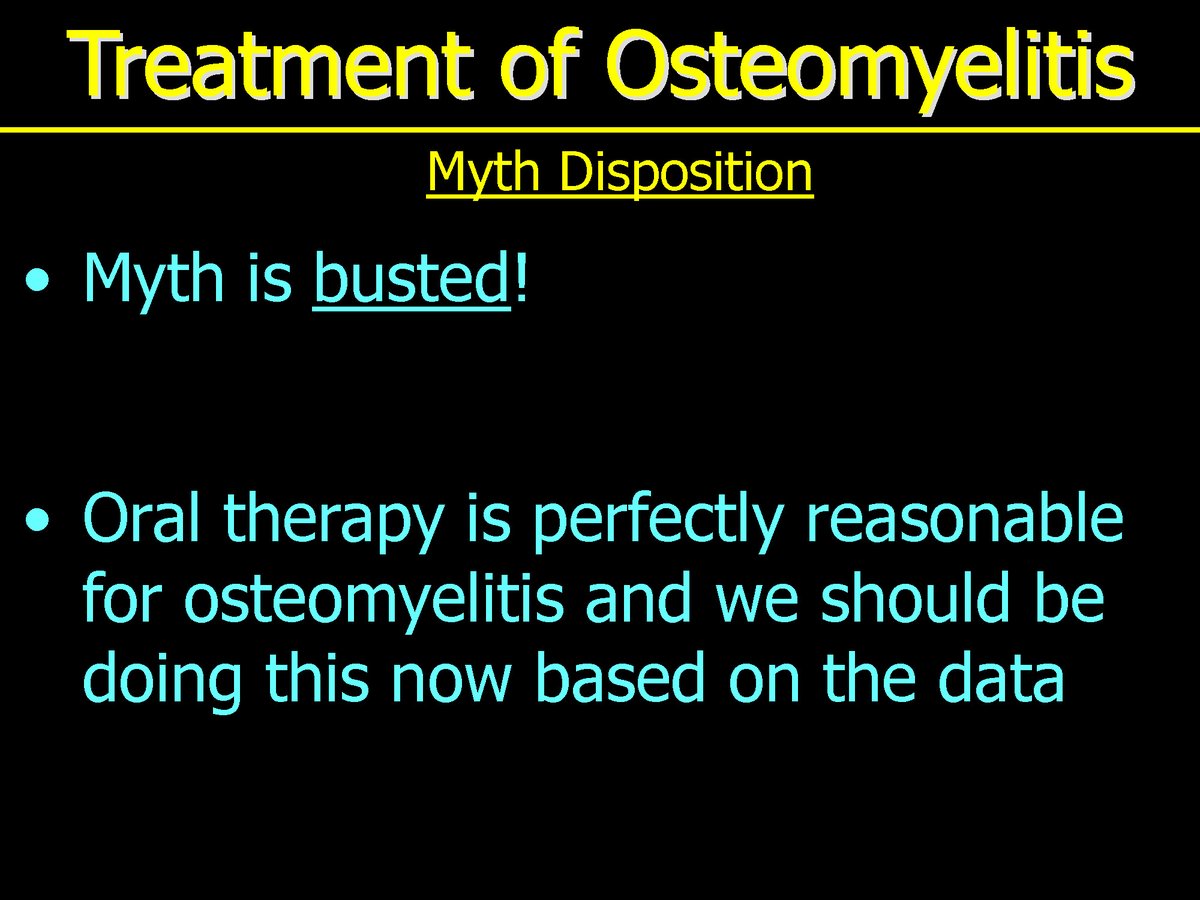
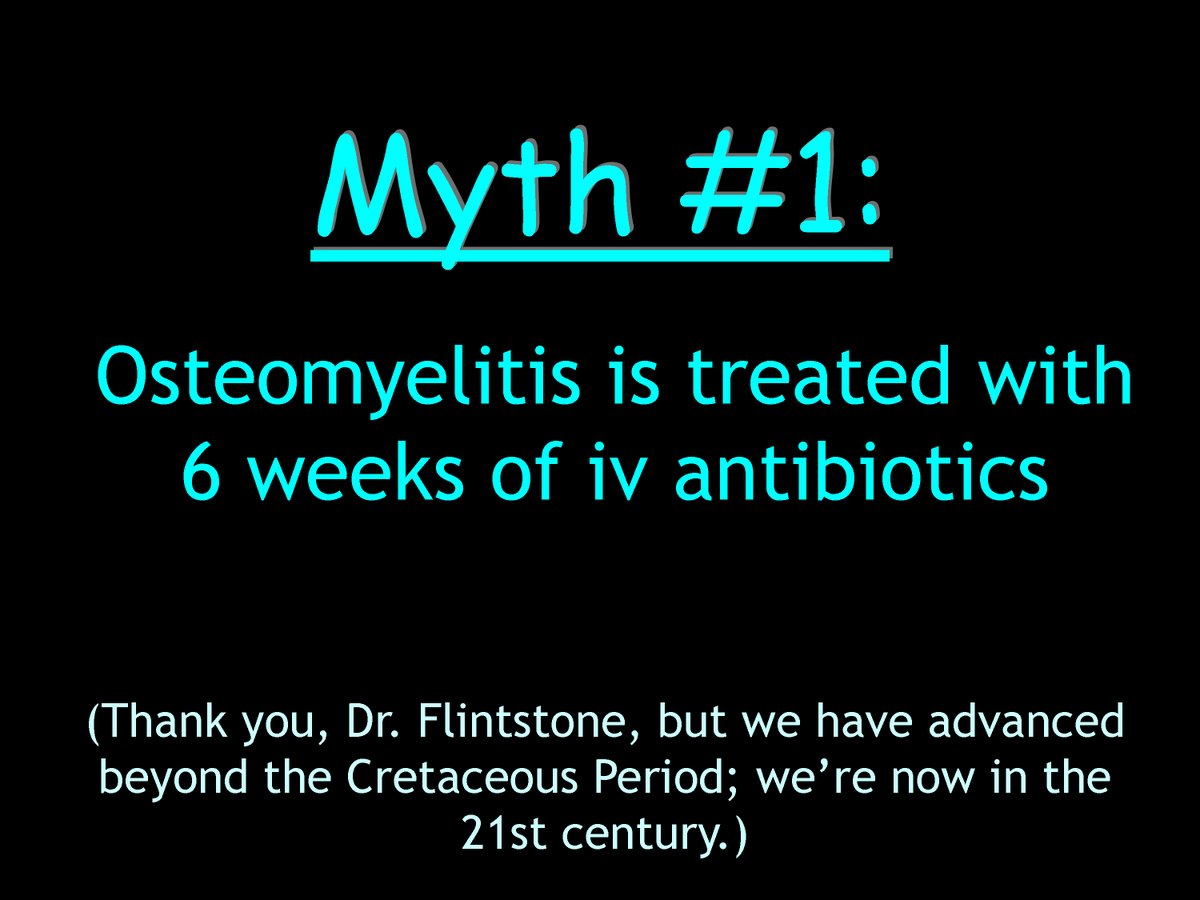
Digging through old files for data, I ran across this talk, developed in 2005. Yes, I actually gave this talk on several occasions staring in '06. For those who have wondered, yes, I've always been like this--it's congenital, not acquired, dementia with psychotic features. Image Yes, I began treating osteo orally in 2005, and considered the myth of IV only for osteo busted. Numerous colleagues told me I was insane and practicing below the standard of care medicine. To whit, I cop to the former, but history has vindicated me on the latter.
Image
Image
Jan 6, 2024 16 tweets 4 min read
Next time you're irritated by FDA endpoint for cUTI RCTs, consider the endpoint for ABSSSI RCTs. Cessation of lesion spread at 72 h. Yes, an abx is purported proven effective for skin infxn if lesion remains the same size after 3 d of abx Tx. This is a long string, so settle in. How can this be? How can an abx that does not actually shrink a skin lesion after 3 full days of Tx be successful therapy? And, don't we want to know if the infection eventually resolves. Or, I don't know, the patient lives? This has stuck in my craw since the guidance came out.
Dec 26, 2022 5 tweets 1 min read
I tried to do that in the Principles of Anti-Infective Therapy chapter in the Mandell text. 10 sequential principles which, if followed, help optimize abx usage.

1) Before picking abx, start with an accurate differential diagnosis
2) Only give abx when they will improve outcome 3) When 1 and 2 are met (DDx includes infection caused by bacteria & pts outcome can be improved by abx), give empiric Tx targeting bacteria causing the diseases in the differential
4) In critically ill patients, use a lower threshold for starting empiric Tx
May 26, 2022 12 tweets 4 min read
Soon to wrap up another go around on ID consult service, and some observations to share. Some may be controversial, but things humming along and the team running like a well-oiled machine, thought I'd begin a dialogue. 2 major observations, with detail for both. 1) The old trope of fellow/resident/student lumbering along with a 10 min formal pt presentation followed by 30 minutes of attending pontification is passe and needs to be retired. That's not medicine in 21st century, and I don't even think it's good for learning.