Jesus was a Middle Eastern Jew. So were these people for 2,500 years before him, and for two thousand years after.
Chapter One: Before There Was a "Middle East"
[Image: Rabbeinu Yosef Chaim, the "Ben Ish Chai" — photographed at age 26, decades before he would go on to lead Baghdad Jewry for fifty years, until his death in 1909]
Look at this face. The long black beard, the ornate turban, the sharp gaze. This is not a portrait of some exotic figure from a faraway place. This is a young man who would go on to spend fifty years at the head of a community thousands of years old — a community that existed before there was even a concept called "the Middle East," and long before the word "Zionism" was ever written.
The caption beneath the original photograph gives him a title worth pausing on: Reish Galuta d'Bavel — "Head of the Exile of Babylon." The very same title, carried across seven centuries, that you're about to meet again below.
2,500 Years Before the Word "Zionism" Was Written
When Jerusalem burned in 586 BCE, and the exiles of Judah were led to Babylon, Babylon became the center of Jewish thought for a thousand years. The Babylonian Talmud was composed there. In the academies of Sura and Pumbedita — the two central centers of learning for world Jewry, on the banks of the Euphrates — sat the Geonim: the supreme spiritual leadership for all of world Jewry. When a Jewish community anywhere on earth found itself grappling with a question of religious law, it sent that question to Babylon, and received back a responsum — a detailed answer that itself became a body of religious literature.
A Lord's Procession
Alongside the Geonim stood a separate institution: the Exilarch — a political leader whose authority the Caliph himself formally recognized. What did this actually look like? We have a remarkable account, and it doesn't even come from a Jewish source. Benjamin of Tudela, a Spanish-Jewish traveler, visited Baghdad in 1168 and documented the moment when the Exilarch — called by Muslims "our lord, son of King David" — presented himself before the Caliph:
"The procession of the Exilarch would wind its way along the festive streets of Baghdad. The community's leader wore garments embroidered in silk, with a white turban studded with precious stones. He had a retinue of horsemen, and at the head of the procession, a herald cried out: 'Make way for the lord, son of David.' When the procession reached the palace courtyard, the Caliph would stand to receive the Exilarch, seating him on a throne facing his own."
Benjamin of Tudela notes that at that time, about 40,000 Jews lived in Baghdad.
A Cord That Was Never Cut
Throughout all those centuries, the Jews of Babylon maintained an unbroken connection to the Land of Israel. In 1853, a group of immigrants from Iraq founded their own synagogue in the Old City of Jerusalem. And perhaps the most touching story of all: when Rabbeinu Yosef Chaim — the very man pictured above — returned in 1869 from a pilgrimage to the Land of Israel, he did not come back empty-handed. He brought sacks of soil from the Holy Land and scattered them across the floor of the synagogue where he prayed in Baghdad.
This Was Not a Utopia — But It Also Wasn't What People Assume
To say there were only golden years would be a lie. But the unbroken thread — 2,500 years of communal, economic, and spiritual continuity — is exactly what's missing from the story most Americans know. "We didn't know there were Jews from Iraq." They're right that they didn't know. Because no one ever told them.
Jews of Babylon (2/3)
Chapter Two: The Torah That Came Out of Baghdad
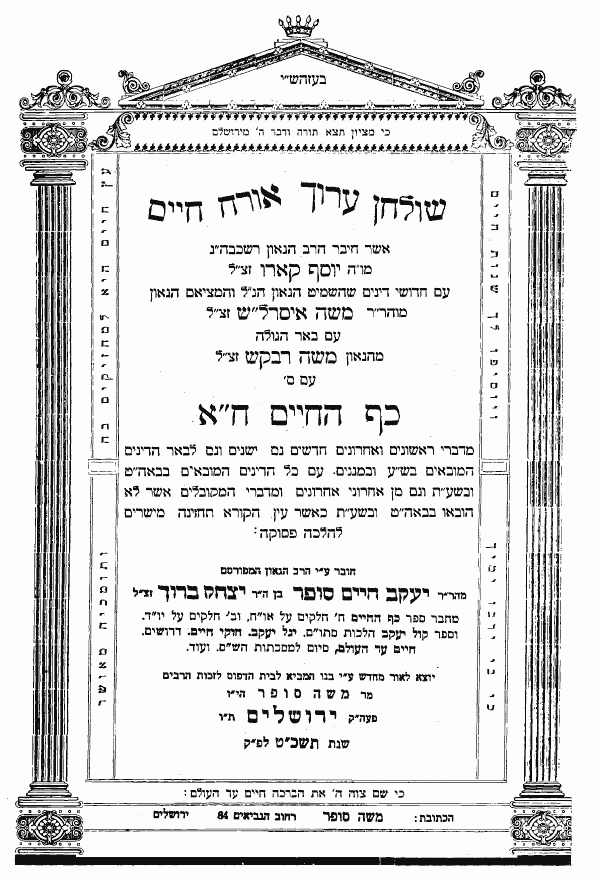
[Image: The title page of Kaf HaChaim, the edition published by Moshe Sofer — son of Rabbi Yaakov Chaim Sofer — in Jerusalem]
[Image: An old poster, framed with olive-branch ornamentation and a line from the Lamentations liturgy: "Fortunate is the eye that beheld all these." Fourteen faces — white beards, turbans, embroidered skullcaps]
Here is another image. An old poster, bordered in olive branches, with a line from the traditional lament for the destroyed Temple: "Fortunate is the eye that beheld all these." Fourteen faces — white beards, turbans, embroidered skullcaps. These are not statesmen. These are the sages.
At the center: Rabbeinu Yosef Chaim, the Ben Ish Chai. Around him: his students, his sons, and those who carried his legacy forward. Among them is a name that won't mean much if you're American — but means everything if you're a Sephardic Jew (using the term the way it's used across the Middle East and North Africa, not only for those descended from medieval Spain): Rabbi Yaakov Chaim Sofer.
This Story Begins in a Schoolhouse, Not a Pogrom
In late-nineteenth-century Baghdad stood a Torah academy called Midrash Beit Zilkha — yes, the same Zilkha family that built the first branch-banking network in the Arab world. They didn't just accumulate wealth. They invested it in Torah. At this academy studied a boy named Yaakov Chaim, son of a humble Torah scribe, who received personal ordination from the Ben Ish Chai himself.
In 1904, Yaakov Chaim Sofer immigrated to Jerusalem. Not fleeing. Not expelled. Immigrating, by choice.
Forty Years of a Single Labor
In Jerusalem's Beit Yisrael neighborhood, Rabbi Yaakov Chaim sat for forty years and wrote. The result: Kaf HaChaim — ten volumes of Jewish legal rulings. Look at the title page: this is a book reprinted by the author's own son, Moshe Sofer, who carried his father's work forward "for the merit of the many." Three generations — the father in Baghdad, the son in Jerusalem, and the great-grandson who later founded an entire yeshiva bearing his name — all part of one unbroken chain.
This is a book that Rabbi Ovadia Yosef himself edited and revised in a later edition. It's a book that Israel's current Sephardic Chief Rabbi, Rabbi Yitzhak Yosef, still cites as foundational.
Recognition That Crossed Communities — Before There Was Even a State
Beneath the author's name on the title page are printed rabbinic endorsements. Who signed them? Not only leading figures of Middle Eastern Jewry. Also, Rabbi Chaim Berlin, a well-known Ashkenazi rabbi of Jerusalem. Also, a rabbi who had served, in turn, in Moscow and then in Chicago before settling in Safed.
Before there was a State of Israel — before anyone spoke of "Ashkenazi" and "Sephardic" as competing political categories — the Torah that came out of Baghdad was already speaking to the whole house of Israel.
From Baghdad to Jerusalem, from 1904 to today: this isn't history. It's a living chain of transmission.