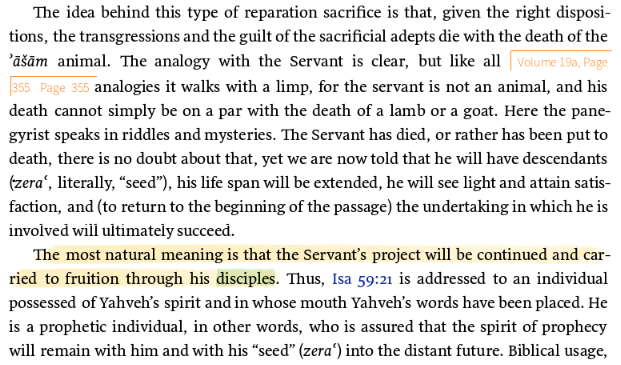
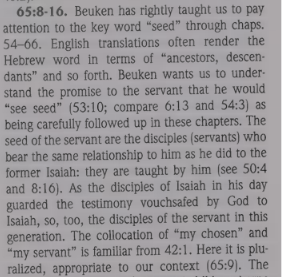
🧵Mainstream scholars and commentaries on the "seed" in Isa. 53:10.
Rather than see the "seed" as biological kids, most Isaian scholars view them as being the "disciples" and "servants" of the Servant. Examples:
Joseph Blenkinsopp, Isaiah 40-55 (YUP, 2002), 355.
Christopher Seitz, The New Interpreter's Bible VI (Abingdon Press, 1994), 543.
Mar 8 • 14 tweets • 8 min read
🧵 Resurrection by Reassembly in Ancient Judaism.
The resurrection by reassembly was the ancient Jewish view of resurrection. It says that in the resurrection, God will recollect and then revive all the parts, material elements and/or particles that used to compose that person's body as before. An analogy is this: imagine a pocket watch stops working, and so the watchmaker takes it, disassembles it so that we no longer have a watch, tinkers with the parts, and then puts those parts back together again just the way they were before it was disassembled. In this example, the watch, when reassembled, is the original watch and not just a copy of it.
The resurrection is not merely the soul informing matter, nor is the awakened body merely a copy or replica of the original. In the resurrection, though, God will radically transform our bodies (qualitatively) following the reassembly.
Isaiah 26:19 (8th-6th century BC): "Your dead shall live; their corpses shall rise. Those who dwell in the dust will awake and shout for joy! For your dew is a radiant dew, and the earth will give birth to those long dead."
It is the very corpses lying in the earth that will awaken. The material continuity between the deceased and risen body is plain. This in contrast to the soul configuring new matter, or the awakened body being merely a copy or replica of the original. Moreover, the imagery of corpses dwelling in the dust is multivalent, indicating in one sense the body’s disassembly via decomposition. The resurrection reverses this, implying a reassembly.
The conquest of death in Isaiah 25:6-9 suggests that the resurrection in 26:19 concerns the resurrection of individuals, even if it also symbolizes national restoration. Moreover, the imagery (the dew causing the earth to bring forth, etc.) makes much sense on a reading that includes a literal resurrection. Whatever the originally intended emphasis lied, the imagery is clearly of resurrection and influenced later Jewish conceptions of resurrection.
Nov 3, 2024 • 29 tweets • 5 min read
🧵Almost all of the post-apostolic Church, until St. Augustine ~500 AD, held to election after the consideration of merits through foreknowledge. I will show specific examples of this, and then at the end I provide admissions by St. Augustine's followers and Calvinists to this.
"After the shepherd had examined the rods of all, he said to me, “I told you that this tree clingeth to life. Seeth thou,” said he, “how many repented and were saved?” “I see, Sir,” say I. “It is,” saith he, “that you may see the abundant compassion of the Lord, how great and ...
Jun 11, 2024 • 69 tweets • 14 min read
🧵 on why Josephus is a good source on Jesus.
Background information: Josephus is the only first century historian who lived in and wrote about Palestine whose writings survive. He is the only first century extra-Biblical writer that one may expect to write about Jesus.
Josephus knew people who had info on Jesus independent of Christian claims, such as Ananus II (the son of the Ananus who interrogated Jesus in John 18), and the "principal men" who educated him just 18 years after Jesus' indictment by a group that he also calls "principal men."
Apr 25, 2024 • 24 tweets • 5 min read
This thread summarizes primary Jewish objections to Jesus as the Servant in Isaiah 52:13-53:12 and rebuts them. I'm open to critiques.
To summarize the Jewish case: first, Isaiah, outside of the four Servant Songs, consistently calls collective Israel God's Servant ...
... e.g., Isa. 43:10. Second, Isa. 49:3, which is in the second Servant Songs, identifies the Servant as Israel. Third, the nations from Isa. 52:15 speak in Isa. 53:1-11, given the lexical connections between 52:15 and 53:1, as well as the seamlessness between the two verses.