Western Hegemony Enjoyer Profile picture
A Canadian who loudly comments on American (and global) politics. — Слава Україні, עם ישראל חי, and God Save the King
Dec 18, 2024 6 tweets 3 min read
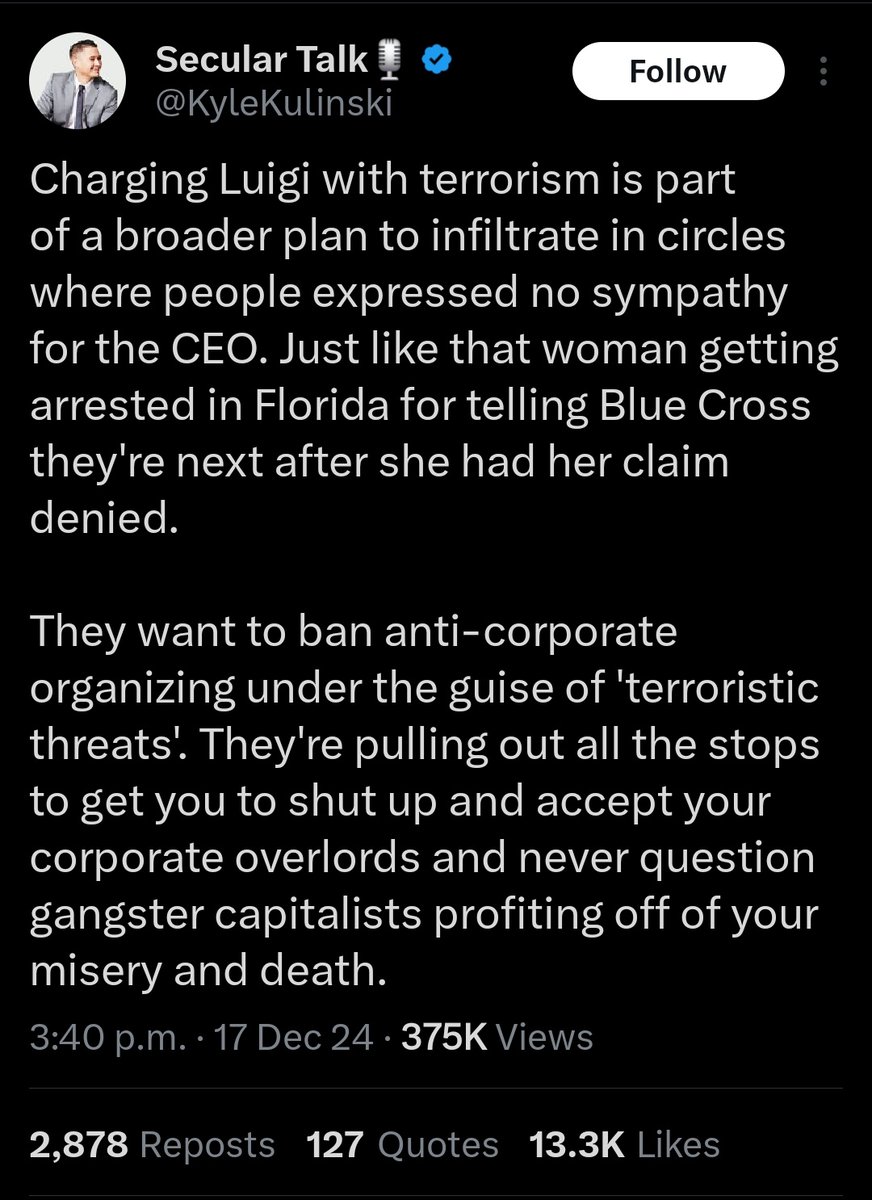
Shooting someone in the head isn't "anti-corporate organizing," you psychopathic nerd. It is political violence - i.e. TERRORISM.

Make no mistake, this logic and rhetoric is fundamentally incompatible with democracy - it is politics by alternative means.

It is fascism. Image The court may find Mangione not sound of mind, and the terror enhancement may not stick. But make no mistake, the reason Kyle and his friends support the murder is because they perceive it as having terroristic value.
Oct 11, 2024 4 tweets 6 min read
NOTES ON COATES

I have yet to read his book, but I have gotten passing glances of his views through brief clips of his recent media appearances, and - based on the slap-dash manner in which Coates informed his understanding of the topic himself - I think that this shred of experience with his claims entitles me to speak on their fundamental bankruptcy.

To put it simply, Ta Nehisi Coates treats Palestinians (and Israelis) as empty vessels, devoid of historical context, and seeks to explain their motivations and actions through the prism of a crude, universalist morality play.

The problem is, as many critics of Israel rightly point out, history didn't begin on October 7. It wasn't a contextless (and thereby purely "rational") response to contemporary conditions. The type of violence we witnessed that day, and the ideologies and pathologies that motivated them, long predate the conditions that justify their use in the eyes of the Western moral tourist.

Coates' describes the conditions in Gaza as akin to an "open-air jail," a rendition on the "concentration camp" theme that is regularly deployed by antizionists for over a decade (last I recall, Auschwitz had no designer malls, lavish villas, luxury cars or fine dining). But, even if we accept Coates' portrayal, if such violence is rooted in these contemporary conditions, how did the 2005 disengagement and subsequent blockade - the presumptive justification for October 7 Coates uses - inform the 1929 pogrom in Hebron? The exact same type of extreme violence was used there, on the same targets, but there was no Zionist state, no "open-air prison," and no "oppression" (at least, not of Arabs by Jews). Rather, the power relations were largely reversed - the Hebron pogrom was an act committed against a marginalized Jewish minority that was long subject to the whims of an Arab-dominated society.

Despite the apparent historical isolation from one another, and the fundamental role reversal vis-a-vis power relations that has occured since, there are ideological and psychological through-lines that connect and, in part, explain these two disparate events.

They share in the same antisemitic chauvinism; the same majoritarian urge to put the Jew back into their "place;" the same determination to establish a fascistic political monopoly in Palestine, to be dominated by a genocidal Islamist clique; and similar support for atrocities against Jews, rooted in the popular belief of Jews' position as the "natural inferiors" of gentiles.

This reality - that the violence stems from reactionary ideology and the psychology of chauvinism - is clearly an uncomfortable one, at least for those who see themselves as "anti-racist." In order to avoid these contradictions, Coates ignores history entirerly - the histories of Palestinians and Jews and the wider Arab and Muslim worlds - so he can thus ignore the real social determinants of violence.

By casting off the yoke of historical location, Coates is freed to treat Palestinians as "noble savages," as embodied symbols whose purpose is serve as agents for dismantling the sources of Coates' own very Western and alien grievances. Palestinian's violence isn't really a "rational response" for Coates, at all - not in the manner he described, at least. Rather, this violence, and its purported basis, are merely objects of projection, vehicles of fantasy purpose-built for attacking Western society, "white" "colonial" oppression - and, most deeply, for striking out at the Jews.

(Cont'd, 1/x) The fundamentally Judeaophobic bent of Coates analysis (and apparent personal convictions) is evidenced by his treatment of Jews as almost "Palestinians-in-reverse," rather than as humans with similar responses to social conditions. For if Coates felt that Jews could be justified in a like manner to gentiles regarding the use of righteous violence, he would have to concede not only that the entire Zionist project is rational, but that its *worst excesses* are similarly justified. If he were consistent, he'd be a vile Jewish extremist of the highest order - he would be Kahane Coates.

Using Coates' "rational response to oppression" frame, does Hebron not justify Deir Yassin and Tantura? Do the many expulsions from Iraq and Yemen and Egypt (and...) not justify the Nakba many times over? Does the Farhud and the Mawza exile and the widespread collaboration of the Arab world with the Nazi project not justify a permanent, genocidal war footing by the Jewish state against its many longstanding oppressors?

Using Coates insane revanchism, one could conceivably justify Ben Gvir incinerating millions of Baghdadis under the heat of thermonuclear war, all on the basis of his family's (ongoing) dispossession by the apartheid Iraqi state - a dispossession that was reified and upheld by Iraqi law as recently as 2005.

Obviously, Coates does not support or seek to justify even the most benign and humane acts of the Israeli state, nevermind its transformation into a genocidal death-machine - indeed, he considers the Jewish state's wholesale destruction to be a moral imperative, and he considers the millions of Jews who would be inevitably displaced as less than an afterthought.

In his interview on CBS, he refused to grapple with the "right" of Jewish people to self-determination by stating bluntly that "Israel does exist," and that states don't derive their legitimacy from "rights," but through might. The problem here is his views are that the state *ought not to exist,* and by avoiding the question he avoids having to grapple with the claims and rights that Jews have, equal to those of Palestinians, to life, liberty, and human dignity. It's worth noting here that his construction of the basis of state legitimacy is both incorrect and self-contradicting, insofar as a) peoples' rights to self-determination is an established premise of international relations, and b) this right to self-determination underlies the legitimate and just Palestinian national cause he purportedly supports.

Coates cannot admit that Jews and Palestinians (and Arabs and Muslims) have real histories - rather than merely being the moralistic caricatures he prefers to traffick in - because it would expose his preference to one side as being not the product of his urge to "give voice to the voiceless," but as an expression of his own base and vulgar tribalism.

Because his false universalism is just another bigoted particularism wrapped up in moral sophistry and idpol jargon, Coates is unable to give us any meaningfully "just" solution to the conflict (it bears noting that he doesn't even see this as a "conflict, at all). Rather, all Coates can give us is an endless cycle of violence, premised on a romantic and reactionary understanding of the past, and an unending, irrational sense of grievance that overrides both naked self-interest and morality alike. For if we accept that the crimes of October 7 were justified, and we took that justification to its logical endpoint, we must accept that even the most barbaric responses to it are likewise justified. What we are left with here is the philosophy of the blood-feud.

(Cont'd, 2/x)
May 11, 2024 8 tweets 7 min read
WHERE IS BUNDISM?

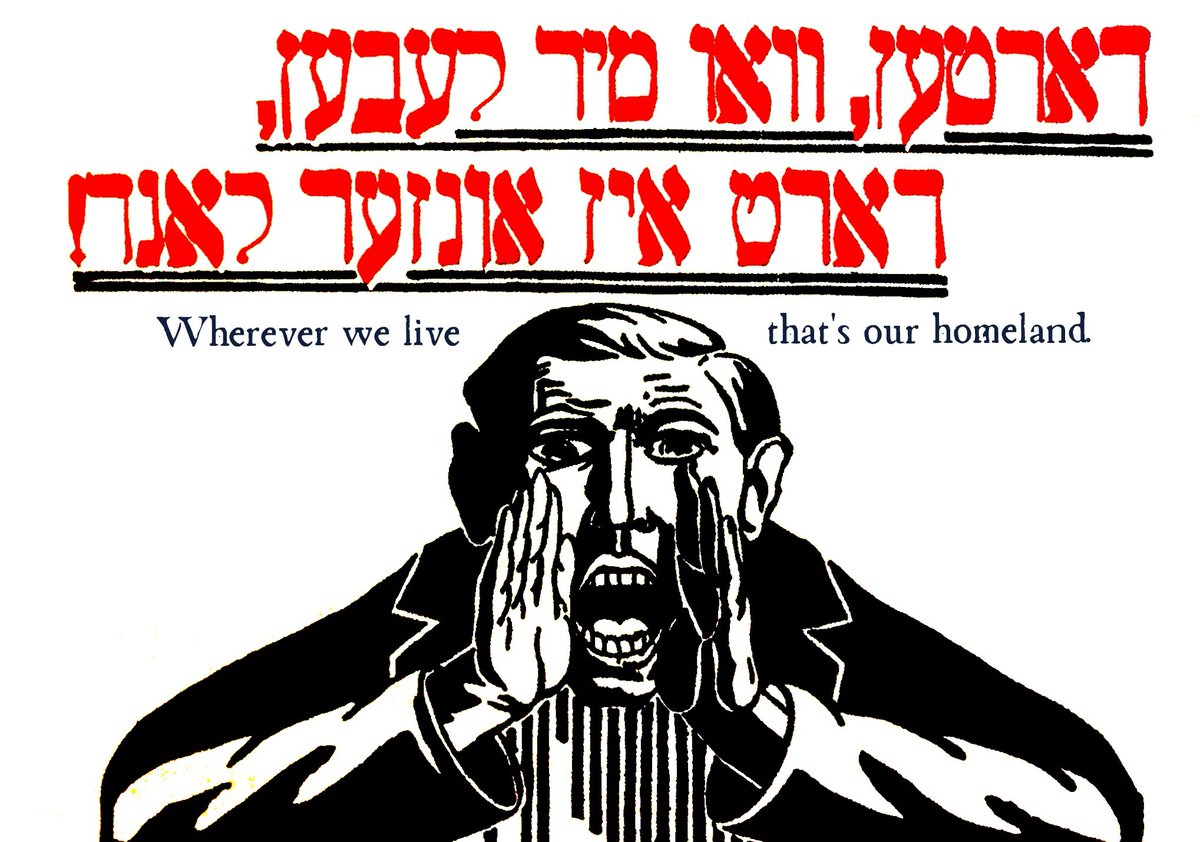
I like it when Jewish antizionists bring up Bundism. "Wherever we live is our homeland," or so says that overplayed and irritating poster. "Jews should rely on solidarity/mutual aid/the beneficience of the (Gentile) world." Zionism is "ethnonationalism" - it's a tawdry and disturbing relic of the 20th century, something that must be excised for the moral-historical actualisation of the world-spirit. As though Zionism stands as the barrier to the end of history itself - the last obstacle to humanity's eschatological fulfillment.

I like it when they bring up Bundism because when we recall it, when we conciously grapple with the pre-state diasporic political condition and its ultimate collapse, we reinstill the lesson of Zionism - that is, the lesson of its historical neccesity.

Where is Bundism? Bundism is beyond moribund; Bundism is anachromism; Bundism is a false response to a question that was answered decades ago.

(Cont'd, 1/x)Image QUESTIONS AND ANSWERS

Bundism and Zionism are two answers of many to the question of framing Jewish communal identity and material existence in political terms. They describe ideas of Jewish communal durability and enfranchisement in the face of modernity and mass society, and amid the concomitantly developing political environments of the broader Gentile world. They are means of expressing Jewish social existence - ethnic, cultural, jurisprudential, religious, and linguistic - in its national form.

While Bundism's proponents historically recognized the national character of modern Jewish identity, Bundism is effectively an anti-nationalism. Its purpose is to create the political expression of Jewish identity in a way that is coherent and lasting in the diaspora. It denies the possibility of Jewish national reconstitution in a geographic sense, and it rejects the notion of Jewish sovereignty - Jewish self-determination among the nations.

Bundism, in effect, insists we be ruled by the majorities of our erstwhile-dispersed habitiations. Bundism demands our self-determination, our material condition, and our very existential continuity be subject to the whims of the Gentile world.

Indeed - miraculously, painstakingly - Jewish identity and communal cohesion persisted for almost two millenia in diaspora. It survived crusades, inquisition, enslavement, exclusion, coercion, mass murder, forced conversion, and countless humiliations at the hands of Afro-Eurasia's many fine, noble Peoples: as if by an act of God - or a curse of history.

But what of our Jewish existence today? Where is Bundism!

Bundism, in a word, failed. It was a paradoxical non-answer to a pressing condition that found its culmination and release in the middle of the 20th century. To understand the fate of Bundism, we must first ask: where are the Jews of Afro-Eurasia, of that great, old landmass in the center of the world?

They have been pushed into the sea.

(Cont'd, 2/x)
Apr 30, 2024 11 tweets 16 min read
THIS. ISN'T. JOURNALISM.

When I communicate - on this app, in real life, or god-forbid I were to enjoy some degree of success in media - I don't pretend to be a "journalist."

Sure, I write - a lot, maybe too much - but in my writings I don't feign reporter neutrality, or abuse the imprimatur of a news organization from which such reporting ought to derive. No, I'm an editorialist, a polemicist, and a dollar-store philosopher. That's who I am, that's what I do, and that's as it should be.

But we live in the Post-Truth era, one in which the old rules of journalistic integrity have lost their vigor under the weight of institutional erosion, technological innovation, and the untrammelled exchange of information this technology enables. The objectivity of the reporter has been substituted for the zeal of the committed activist, and the dry framing of facts has been replaced by the colorful world of commentary.

Now, there is critical value in commentary, and the impassioned activist is a character vital to the function of the democratic system, but - in increasingly blurring these lines - we risk undermining the finding of fact itself, an outcome that can only foster further institutional disintegration and the rise of authoritarian politics.

(Cont'd, 1/x) SHIFTING SANDS

As media landscapes shifted, from conventional and print-heavy, to cable news and the 24-hour cycle, to the emergence of online publishing, blogging, and finally social media as we know it today, various innovations took place with respect to the collection, curation, and dissemination of information on a mass basis.

Some of them I've discussed before in "The Machine of Hate:"¹ diminishing editorial infrastructure due to technological innovation and budgetary constraints; increasing reliance on "short-forming," and the informational flattening effect this has; and, most significantly, the dissolution of elite institutional gatekeeping in an efficacious manner - that is, the so-called "democratization" of media.

These changes can't be said to be intrinsically negative or postive, as such - rather, these changes need to be understood within the social-informational environment within which they continue to evolve.

(Cont'd, 2/x)
Jan 2, 2024 5 tweets 10 min read
THE MACHINE OF HATE, AND THE WEST'S COMPLICITY IN OUR OWN DESTRUCTION

This will probably sound trite, but as I watched the transphobic hysteria wash over our culture the last couple years, I could feel that this was just the beginning of a process of social unravelling. People I had known, people who had been largely indifferent to social questions and dismissive of politics, were suddenly negatively politicized and radicalized against this perceived social threat. It had an almost orchestrated character, seemingly arising from nowhere and taking our politics by storm. And that character, that sudden and ubiquitous and virulent manner in which it arose, can only be understood as the product of a unique feature of our contemporary informational ecosystem, the social-media-mediated grievance factory, what could be called the "Machine of Hate."

One need only consider the emergence of social media as the primary source of Western information distribution to understand how this happened. Traditional mass media - television, radio, print - is passive, unidirectional, and elite-dominated, by its very nature. The infrastructural needs to operate a publishing house or a broadcast network mean that they cannot be opened and closed at whim - certainly not by individuals with no capital or credibility. They require substantial dedicated and professional bodies of staff to handle operations and to produce journalistic content worthy of distribution. In most Western countries, minimum content standards provide a floor for informational quality - regulators control broadcast licensing, and as a result the obligations of media organizations to broadcast standards puts a greater onus on journalistic fidelity than is imposed on the regular speech of everyday citizens. Journalists as a profession remained largely self-regulating, gatekeeping access to influence through norms of conduct that determined success and enabled trust from the public and among peers in the field. And, as the dominate players in the world of information, media companies had the resources to enforce robust journalistic standards - major networks and newspapers could maintain large regional bureaus to verify information on the ground and multiple editorial eschelons to ensure the accuracy of reporting.

As such - while conventional media could still be abused and manipulated to dishonest ends - there were protections and norms that ensured the minimum discursive health of the informational environment. But with the emergence of new technology - first the internet in general, and then social media specifically - the capacity for conventional media to maintain these standards would be severely compromised as their dominance as gatekeepers of information eroded.

(Continued, 1/x) Initially, the internet appeared - rightly so - to be a means of "democratizing" information: the very act of reaching a wide audience was now in the hands of anyone with the will and a modem, all without the imposition of the reigning journalistic culture found at conventional media organizations. But, initially, these pioneers of internet media were constrained by similar limitations: online publishing was a largely self-directed and often complex process, requiring web-hosting services and some know-how, and the reliance on word-of-mouth exposure and fixed, explicitly "journalistic" mediums - dedicated websites and blogs - meant that there remained a degree of expectation regarding credibility that would, to some extent, determine success and failure in the market. What's more, this media remained largely passive, with content producers publishing their works and consumers having little input beyond the comment section. The line between journalistic speech and regular speech, although blurring, held.

The emergence of social media would change all of that. Seeing its early expression in the form of message boards and online forums, social media enabled the emergence of a live, active online discursive space that enabled individuals to spread their ideas and opinions with little overhead or oversight. Although initially niche, these forums were overtaken by early social platforms that would make the use of such active, multidirectional information systems ubiquitous among the broader public. Gatekeeping became impossible, and the line between publisher and consumer blurred. The expectation on the accuracy of the information waned, but the general credulity of the audience remained. And the line between speech as expressed by journalistic media - subject to editorial standards and oversight - and by individuals (generally understood to be unrestrained) functionally disappeared.

These social media apparatuses varied widely in their layout, structure and purposes, but generally they share a common goal - facilitating the ease of movement of symbols, images and ideas between individuals and large groups, with algorithmic incentivization for content that would appeal to the largest number of users so as to maximise usage (and therefore profitability). This incentive structure would lead to increasingly negative social outcomes - a product of the greater saleability of exploitative, manipulative, and grievance-oriented content, coupled with the systemic efficacy of "virality" in spreading content in a manner that actively benefits the social media companies' goal of capture ever-increasing amounts of consumer use-time. The natural result has been the balkanization of social groups, the exageration of social conflict, and the subsequent increase in inter-group antagonism this produces - put simply, an increase in hate.

With the emergence of this new informational ecosystem, hate now had a robust and pliant informational infrastructure, in the form of untramelled and exploitative social media networks; a ready supply of opportunistic malignant actors, ready to peddle any form of hate or hysteria or hoax for personal profit (what SK refers to as the "grifter industrial complex" in the attached post below); and a growing audience that was seemingly *addicted* to outrage, self-victimization, and animosity towards an "other," any other, whatever vessel for their grievance they could find. The interplay between platform, propagandist, and audience served as a positive feedback loop - further enthralling viewers, intensifying platform malformation, and increasingly incenting bad actors to push the bounds of incitement further towards a radicalizing, totalizing, media-induced mania.

(Continued, 2/x)
Dec 20, 2023 6 tweets 6 min read
This episode, of a Black woman assaulted at a holiday party by purportedly pro-Palestine protestors in Michigan, really goes to show just how the tolerance and growth of political intimidation and dehumanization in one domain can't be contained - it metastasizes in society. There are many well-intentioned people who worry almost monomaniacally about right-wing extremism, while passively looking away from its mirror image on the left. I want to discuss why this false dichotomization is analytically misleading and politically dangerous.

ILLIBERAL POLITICS

Regardless of their supposed political orientation, extremist movements can be roughly defined as those that bear a single-minded committment to a rigid ideological position, one which is held by its proponents to be wholly and uniquely correct, and that this uniqueness entitles the movment to pursue its aims without regard to the rights of non-adherents to political self-determination. The extremist rejects deliberative processes with their opponents, and substitutes it with aggressive pursuit of ideological dominance. In a word, this form of political chauvinism can be best described as fundamentally illiberal.

In the above example of extremist political agitation, the aggressive "pro-Palestine" party-crash protest, its illiberal character is exposed by two features of their protest tactics: 1) the stifling of opposing viewpoints through illegitimate discursive means (ranging from relatively benign non-productive badgering, to physical intimidation and violence); and 2) asserting the unilateral capacity to grievously disturb the public peace by interjecting themselves into any scenario without regard to the public use rights of other indivduals or groups. This second tactic is designed to frustrate their opponents capacity to freely associate, which demonstrates the movement's capacity to operate unhindered by norms of political decency or legal restraint - that is, as a display of subversive antisocial power. 

Whether it occurs at the holiday party in Michigan's 13th district, or the steps of the U.S. capitol on January 7th, acts of public intimidation are antithetical to the survival of a free society. Extremist, rejectionist, and authoritarian political movements that dispense with dialogue and instead rely on unyielding demagoguery inevitably disregard and abuse the rights of both individuals and the free society. Thus, the so-called left or rightward orientation of a given illiberal movement is irrelevant, little more than romantic window-dressing covering functionally identical outlets of collective narcissitic fervor. Such movements are inherently expansionistic, both in the domestic sphere and abroad, and they find their ultimate and most corrosive expression in political violence. 1/ THE VORACIOUS APPETITE OF POLITICAL VIOLENCE

Political violence doesn't simply impede on the lives of individuals, and its practitioners don't suffice with it when they've subsumed theIR first set of political adversaries. The social compact is fractured by every violent instance, inviting more opportunistic and antisocial actors to behave in kind. The severity of violence escalates, and lone-wolf acts are committed on the extemist margins of movements. The virulence of these illiberal vanguards is magnified in the information space, where public discourse is increasingly dominated by the loudest and most provocative interlocutors and communities. What's more, the rejectionist nature of these movements means that public discourse is increasingly fractured into disparate and alienated echochambers, strengthening illiberal organization and weakening the discursive power of those still committed to the free society.

Ultimately, subject to ideological infighting and growing political inefficacy, core social institutions fragment and become inoperable, and the state's legitimacy is called into question due to its increasing loss of the monopoly on violence. Any for the public to exersize a check on the growing extremism in society becomes increasingly marginal. Anarchy grows, and extremists of all forms - far-right, far left, Islamist, and any other chauvinstic neofascist varietal - come into open competition. There also occurs a cross-influencing between seemingly- incompatible extremist groups and ideas; chaotic drifting of individuals and groups between extremist subcultures; and the episodic opportunistic alliance between otherwise antagonistic entities.

With all social institutions enfeebled and unable to resist, with a large mass of the public politically alienated and fearful, and with a large mobilized subsection of society available to compose a violent political cadre, the potential for the emergence of an authoritarian figure or entity that can consolidate control increases. The last flicker of the free society is on the edge of extinguishment. 2/