Dr Singularity Profile picture
Futurist. AGI/ASI by 2030. Posting about AI,AGI,ASI, Singularity, Post Scarcity, LEV,tech & sci progress. 300 000BC - 2029 = Dark Ages. 2030 - Golden Age Begins
Jan 9 4 tweets 2 min read
insane

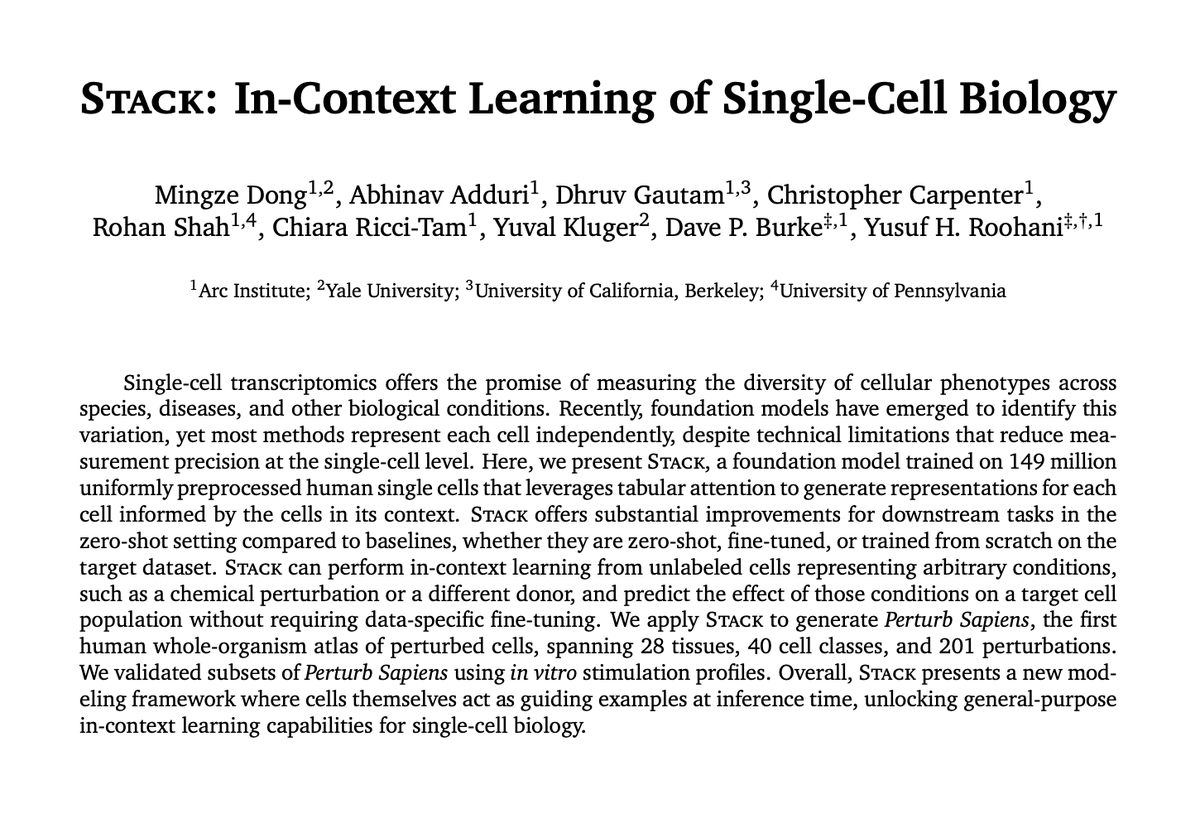
This new paper is basically saying

Cells can now be "prompted" like LLMs.

STACK is a foundation model for biology trained on 149 million human single cells.

Instead of treating each cell in isolation, it understands cells in context, like how tokens make sense inside a sentence. At inference time, cells teach the model how to think about new cells.

Why this is a big deal

Most single cell models = "Here’s one cell, guess what it is."
STACK = "Here’s a whole neighborhood of cells, now predict what happens if I perturb them."

It can:
Learn new biological conditions on the fly

Predict effects of chemical perturbations

Generalize across donors, tissues, and diseases

Work zero shot, straight out of the box

This is in context learning, but for human biology.👀

The insane part - They used it to create Perturb Sapiens:

First whole human atlas of perturbed cells
28 tissues
40 cell classes
201 perturbations

That’s a simulation layer for the human body. This is how biological world models begin.

This is huge bio/accImage biorxiv.org/content/10.648…
Jan 9 8 tweets 2 min read
wow

biotech Singularity vibes. probably the biggest AI/biotech breakthrough of this year (so far)

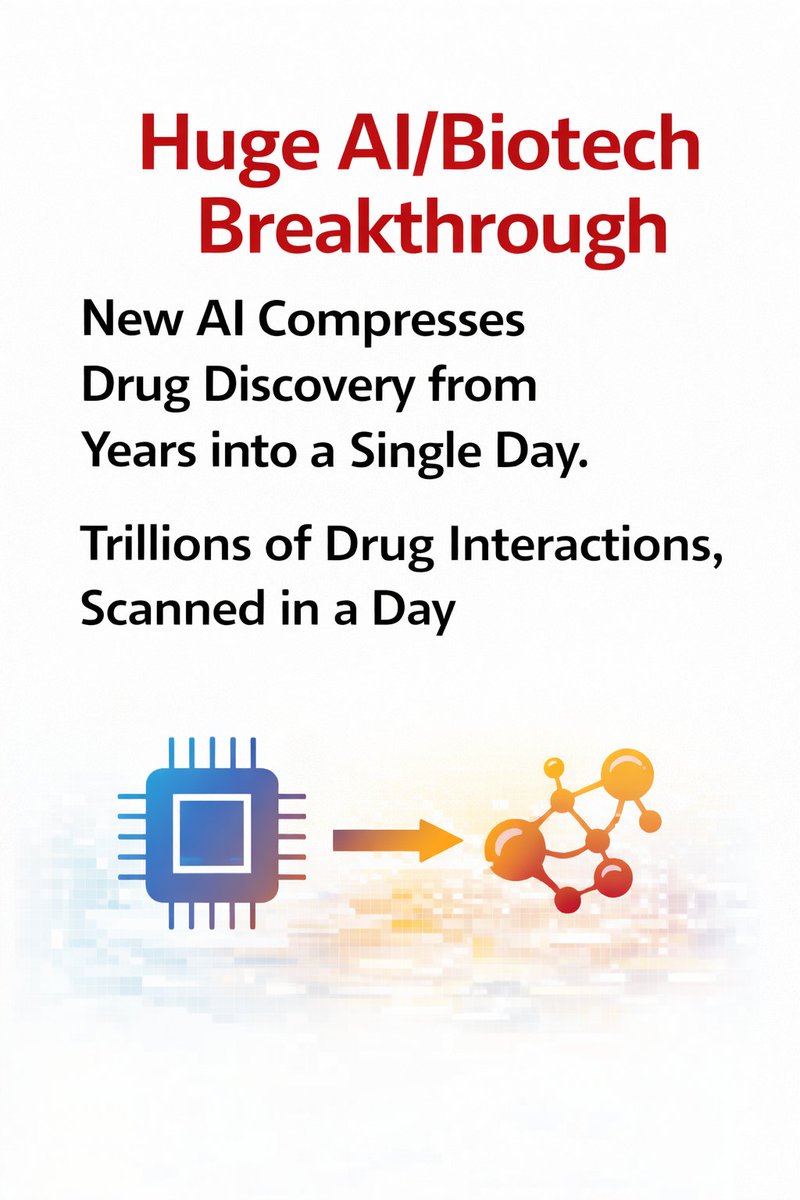
New AI Compresses Drug Discovery from Years into a Single Day. Trillions of Drug Interactions, Scanned in a Day 👀

we're getting there (curing all diseases and reaching LEV)

2026 barely started

Researchers have unveiled DrugCLIP, a new AI method that reinvents how we search for potential drug molecules.

Traditional virtual screening, where computers test huge chemical libraries to see which molecules might bind to a disease related protein is painfully slow and costly.

Chinese researchers developed new AI - DrugCLIP that can screen millions to billions of protein molecule pairs orders of magnitude faster than standard computational docking, trimming weeks/months of computing into hours.

Instead of trying to predict exact binding strengths, it trains two neural encoders (one for proteins, one for molecules) to map them into a shared space where 'good matches' are easy to find, basically reinventing virtual screening as a dense retrieval task.

It works even with little labeled data. Because of how it learns from patterns of known pairs, DrugCLIP doesn’t need huge amounts of experimental binding scores to get effective (making it practical even for understudied targets).

Instead of brute force simulations to test every molecule against every target, DrugCLIP lets AI instantly spotlight the most promising leads across whole genomes worth of protein targets, game changer for faster drug discovery.Image paper science.org/doi/10.1126/sc…
Nov 9, 2025 5 tweets 2 min read
China is developing pills to extend human life to 150 years

Lonvi Biosciences, a Shenzhen startup developing anti aging pills from grape seed extract (PCC1), a compound shown in mice to kill "zombie cells" and extend lifespan by up to 64%.

Its CTO, Lyu Qinghua, predicts that "within 5–10 years, nobody will get cancer."

The anti aging industry is accelerating. The U.S., China, the EU, Japan, and South Korea are significantly increasing their investments to understand and cure aging.

Aging will be curable by the 2030s.Image source nytimes.com/2025/11/08/wor…
Nov 8, 2025 4 tweets 2 min read
This is pretty amazing

Scientists May Have Found a Way to Rejuvenate the Immune System. New pill is Reversing Immune Aging in Humans in just few weeks. 👀

Swiss biotech Amazentis SA just showed exciting clinical results for its longevity compound Mitopure, a purified form of urolithin A, the so called "youth molecule".

In a 4 week human trial, participants taking Mitopure showed rejuvenated immune cells with a younger metabolic signature and stronger cellular activity.

The supplement was safe, well tolerated, and previously shown to boost muscle strength in older adults.

Scientists believe it may help counteract immune aging by promoting mitochondrial renewal, hinting at one of the most promising anti aging breakthroughs yet.

Few days ago skin and heart now immune system.

We will be able to rejuvenate all parts of human body by 2030s.Image source sciencealert.com/longevity-supp…
Oct 31, 2025 4 tweets 1 min read
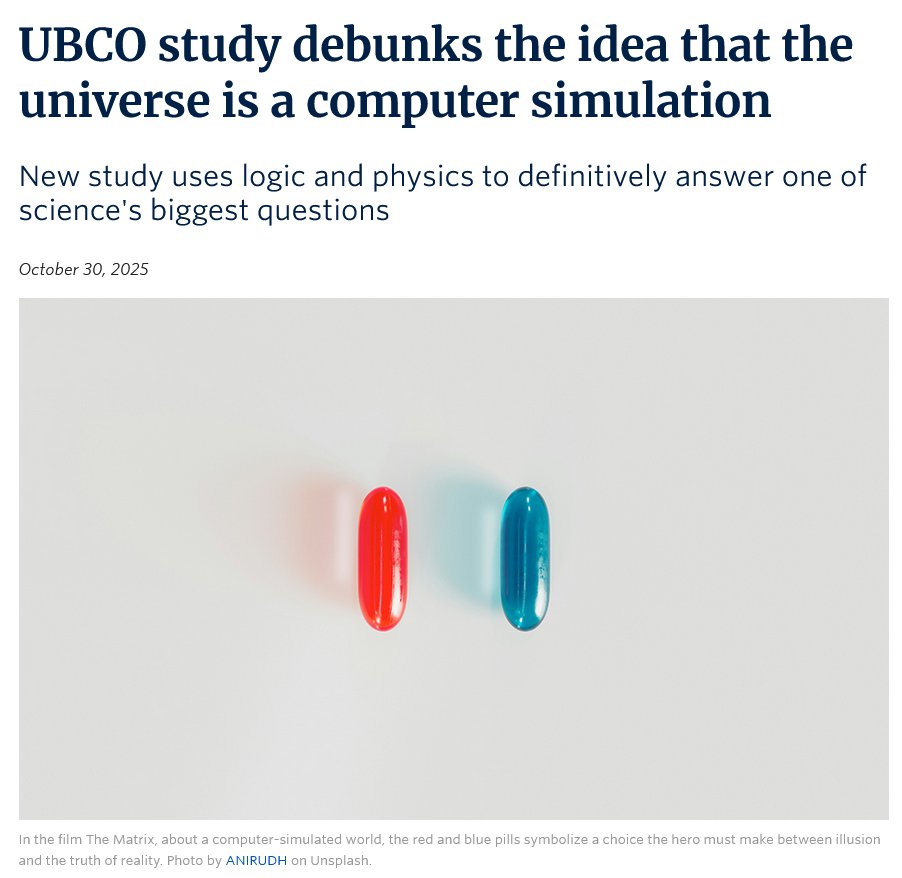
Researchers have mathematically proven that the universe cannot be a computer simulation.

Their paper in the Journal of Holography Applications in Physics shows that reality operates on principles beyond computation.

Using Gödel’s incompleteness theorem, they argue that no algorithmic or computational system can fully describe the universe, because some truths, so called "Gödelian truths" require non algorithmic understanding, a form of reasoning that no computer or simulation can reproduce.

Since all simulations are inherently algorithmic, and the fundamental nature of reality is non algorithmic, the researchers conclude that the universe cannot be, and could never be a simulation.Image source news.ok.ubc.ca/2025/10/30/ubc…
Sep 11, 2025 7 tweets 2 min read
This may be the biggest AI/health breakthrough of the year 🤯

New AI can cook up cures for cancer and heals at the cellular level.

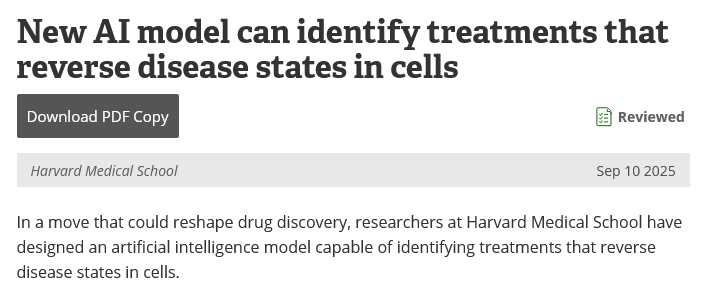
Harvard scientists just developed a potential game changer for medicine: PDGrapher, a free AI model that doesn’t just find drug targets, it figures out treatments that reverse disease states in cells.

"The tool identifies the best single or combined targets for treatments that correct the disease process."

Instead of the old trial and error method of testing one protein at a time, PDGrapher uses graph neural networks to map the entire cellular network, pinpoint the key drivers of disease, and suggest the best single or combo treatments to restore health.

Tested on 19 datasets across 11 cancers, it rediscovered known drug targets, uncovered new ones like KDR and TOP2A, and outperformed other AI tools with up to 35% better accuracy and 25× faster results.

What it means:

faster drug discovery,
smarter personalized medicine,
breakthroughs for hard to treat diseases like cancer, Parkinson’s, and Alzheimer’s. From just one AI tool.Image "Because PDGrapher identifies cause-effect biological drivers of disease, it could help researchers understand why certain drug combinations work - offering new biological insights that could propel biomedical discovery even further."
Sep 9, 2025 4 tweets 2 min read
Big AI/science news

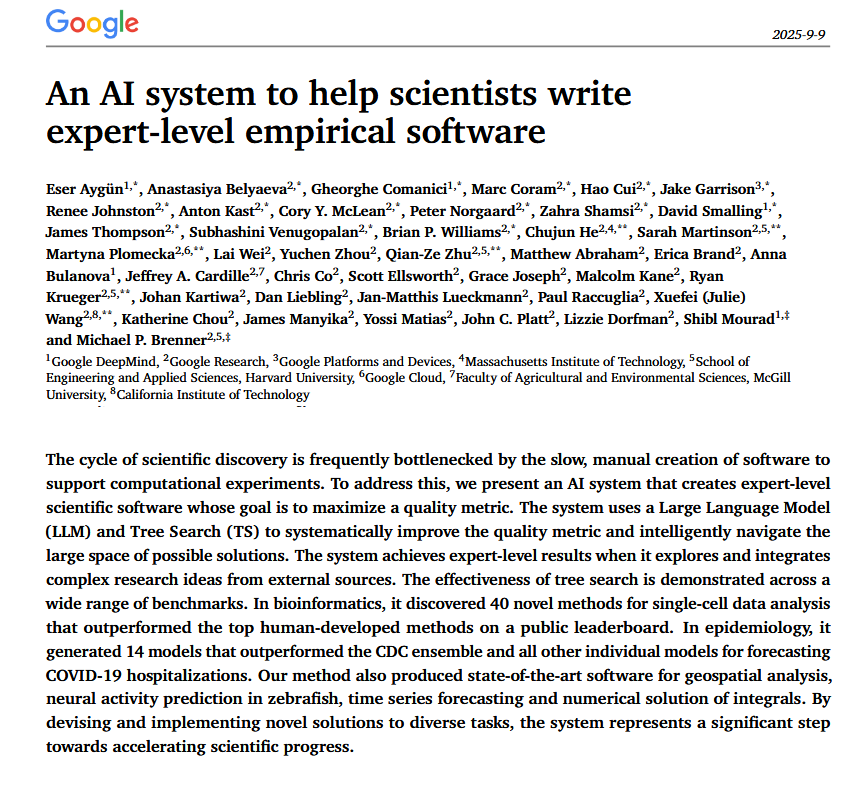
New amazing AI from Google can write expert level science software, and can do it 100x - 1000x faster than humans.

AI science acceleration

Researchers developed an AI system that can write expert level scientific software to speed up discoveries.

It combines a large language model with tree search to explore ideas and improve results.

The AI created 40 new bioinformatics methods that beat human designed ones, 14 epidemiology models that outperformed the CDC’s COVID-19 forecasts, and produced state of the art tools in areas like geospatial analysis, neuroscience, time series forecasting, and math.

And this is just the beginning.Image paper arxiv.org/pdf/2509.06503
Aug 4, 2025 4 tweets 2 min read
Another insane Breakthrough - AI discovers new laws of physics

"Researchers at Emory University in Atlanta did something unusual. They trained a AI to discover new physics"

"The team achieved this unique feat by feeding their AI system experimental data from a mysterious state of matter called dusty plasma, a hot, electrically charged gas filled with tiny dust particles. The scientists then watched as the AI revealed surprisingly accurate descriptions of strange forces that were never fully understood before."

Unlike typical AI used for prediction, this system learned from real world 3D observations of particle motion and revealed previously unknown, non reciprocal forces with over 99% accuracy.

It even corrected long standing errors in plasma theory, such as how a particle’s charge relates to size and how forces decay with distance.

What makes this advance unique is that the AI model:

1. It worked with small datasets thanks to built in physical rules (like drag and gravity),

2. Ran on a desktop computer, not a supercomputer,

3. And produced a universal framework for exploring many particle systems, from industrial materials to biological cells.

This new study shows AI can move beyond data analysis into true scientific discovery, helping uncover hidden laws of nature.

(AI) Insanity is compounding quicklyImage "We showed that we can use AI to discover new physics. Our AI method is not a black box: we understand how and why it works. The framework it provides is also universal. It could potentially be applied to other many-body systems to open new routes to discovery," said Justin Burton, one of the study authors.
Jul 26, 2025 4 tweets 1 min read
Insane AI news

A new paper introduces ASI-ARCH, a fully automated AI research loop that can independently discover superior neural network architectures, outpacing human designed models.

Unlike traditional methods limited by human trial and error, ASI-ARCH connects LLM based agents ("Researcher," "Engineer," and "Analyst") in a self improving cycle, powered by memory and computation.

In over 1,700 experiments using 20,000 GPU hours, it uncovered 106 record setting linear attention models, proving that architecture discovery can now scale with compute, not human intuition.👀

We're talking here about self improving AI research loop that rapidly accelerates architectural discovery and design🤯 paper arxiv.org/pdf/2507.18074
Jul 24, 2025 5 tweets 2 min read
Another Huge, insane cancer Breakthrough

A new AI based method can produce specially designed proteins in just a few weeks that can arm the T cells in the body's immune system to attack and kill cancer cells

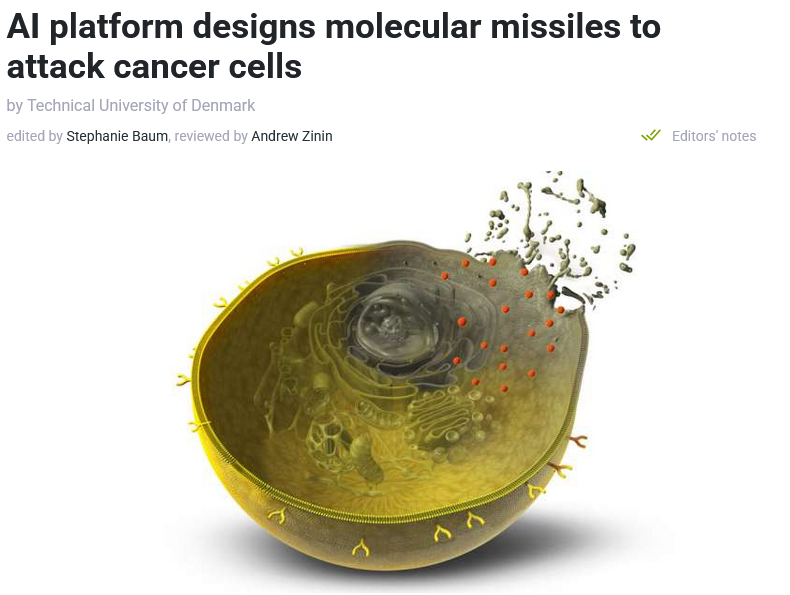
Researchers from the Technical University of Denmark and the Scripps Research Institute have developed an advanced AI platform that rapidly designs protein based therapies to arm a patient's immune system against cancer, a major leap in precision medicine.

Published in Science, the study shows for the first time that it’s possible to design proteins entirely in a computer to redirect T cells toward cancer cells via pMHC molecules, reducing the discovery timeline from YEARS! to just 4–6 weeks.

Using this method, the team created “IMPAC-T” cells, engineered T cells that successfully killed cancer cells in lab tests.

One key example was a protein targeting NY-ESO-1, a marker found in many cancers. The platform also proved effective in designing custom treatments for a melanoma patient, demonstrating its potential for personalized therapies.

The innovation includes a virtual safety screening, allowing scientists to predict and eliminate dangerous side effects before lab testing.Image source medicalxpress.com/news/2025-07-a…
Mar 12, 2025 5 tweets 1 min read
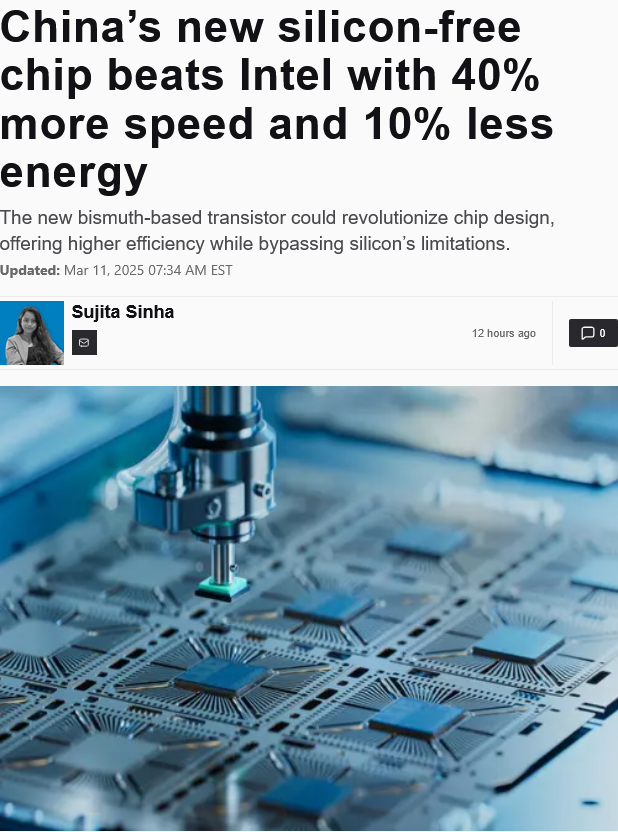
China’s new silicon free chip beats Intel with 40% more speed and 10% less energy

"The new bismuth-based transistor could revolutionize chip design, offering higher efficiency while bypassing silicon’s limitations."

“It is the fastest, most efficient transistor ever,” say engineers.

Led by physical chemistry professor Peng Hailin, the research team believes their approach represents a fundamental shift in semiconductor technology.
👀Image source: interestingengineering.com/innovation/chi…
Jan 19, 2025 7 tweets 2 min read
HUGE Anti-Aging / Longevity Breakthrough

Scientists restore 'Youthful' enzyme activity to combat aging

"CCM Biosciences has developed groundbreaking compounds that activate the enzyme SIRT3, potentially reversing age related cellular decline."

'They outperform existing treatments and will enter clinical trials in 2025 to target Alzheimer’s, Parkinson’s, and other age related diseases.'

I’ll say it again because it’s crucial—clinical trials are happening this year.

"These first in class compounds restore the enzyme’s activity to levels comparable to those of youthful cells, offering substantial potential for clinical applications in treating age related disorders"
“Efforts have been underway for decades to activate signaling pathways regulated by sirtuins to combat age related disorders, but prior efforts have encountered significant hurdles. The discoveries by CCM Biosciences pertaining to the design of drug candidates that can activate the major mitochondrial pathways regulated by sirtuins, along with the clinical development plan for evaluation of efficacy as well as safety of these drug candidates, revitalize this area of drug development.” - said Dr. Michael Pollak, Professor of Medicine, Oncology, and Pharmacology at McGill UniversityImage "These first in class compounds restore the enzyme’s activity to levels comparable to those of youthful cells, offering substantial potential for clinical applications in treating age related disorders"
Jan 16, 2025 5 tweets 2 min read
This is HUGE

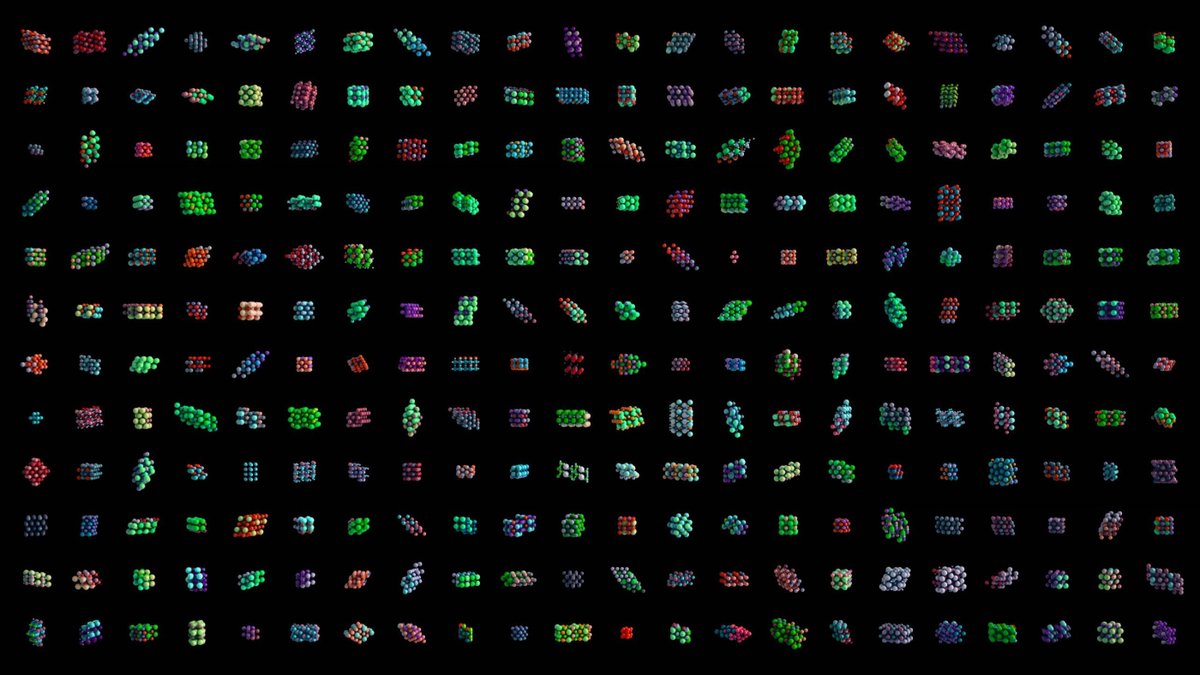
Microsoft researchers introduced MatterGen, a model that can discover new materials tailored to specific needs - like efficient solar cells or CO2 recycling -advancing progress beyond trial and error experiments.

MatterGen, a generative AI tool that tackles materials discovery from a different angle. Instead of screening the candidates, it directly generates novel materials given prompts of the design requirements for an application. It can generate materials with desired chemistry, mechanical, electronic, or magnetic properties, as well as combinations of different constraints. MatterGen enables a new paradigm of generative AI-assisted materials design that allows for efficient exploration of materials, going beyond the limited set of known ones.Image source: microsoft.com/en-us/research…
Jan 8, 2025 5 tweets 2 min read
This is HUGE. Probably the biggest breakthrough of this year so far.

Thanks to this development we will be able to extend our lifespans.

Computational biologists develop AI that predicts inner workings of cells

"Using a new artificial intelligence method, researchers at Columbia University Vagelos College of Physicians and Surgeons can accurately predict the activity of genes within any human cell, essentially revealing the cell's inner mechanisms. The system, described in Nature, could transform the way scientists work to understand everything from cancer to genetic diseases."

"Predictive generalizable computational models allow to uncover biological processes in a fast and accurate way. These methods can effectively conduct large-scale computational experiments, boosting and guiding traditional experimental approaches," says Raul Rabadan, professor of systems biology and senior author of the new paper.

"Having the ability to accurately predict a cell's activities would transform our understanding of fundamental biological processes,"

"It would turn biology from a science that describes seemingly random processes into one that can predict the underlying systems that govern cell behavior."Image "Having the ability to accurately predict a cell's activities would transform our understanding of fundamental biological processes,"