The central hub for crime cinema. A deep dive into cinema’s underworld.
Apr 23 • 4 tweets • 4 min read
In Heat, much of Al Pacino’s off the wall performance comes from Vincent Hanna being a high functioning cocaine user. Offscreen he’s secretly “chipping cocaine” - taking small, intermittent hits to stay sharp and on the ball, as Pacino explains in his autobiography Sonny Boy.
“Hanna had problems as a human being, problems in his life. He was volatile and edgy and apt to go crazy. He was also chipping cocaine, and I sort of based my entire character on that. We shot a scene where I went into a club, and you actually saw my character taking a hit of coke before he enters. For some reason, Michael kept that scene out of the film.”
And Michael Mann had good reason for cutting it. In the scene (which take place within the sequence below), Hanna snorts coke off the blade of a dagger; a highly charged, symbolic image. The dagger is a primitive, lethal tool that fits Hanna’s self-image as a hunter of men. It suggests that the cocaine use isn’t recreational, but tactical; a technique he uses to sharpen his senses for the hunt.
Mann felt this image would send “too strong a message” and draw attention to the drug use itself, rather than Hanna’s drive and the professional rivalry between him and McCauley. However, the cocaine use is still hinted at in the film…(1/3)
In the scene below, when McCauley (De Niro) and Nate (Voight) are going over files on Hanna, Voight says Hanna was "working Narcotics before that" and had "some problems". But it’s never explained what those problems were.
In Heat 2, the prequel novel the upcoming film is based on, those “problems” are explored in much more detail. It traces the drug use back to military-issued dextroamphetamine during Vietnam, and presents it as a deep, functional dependence - one that's highly destructive to him personally but still gives him that competitive edge over the targets he’s pursuing.
As Pacino has said, “It was almost a technique that he used as a detective, and it worked for him.” (2/3)
Apr 11 • 9 tweets • 9 min read
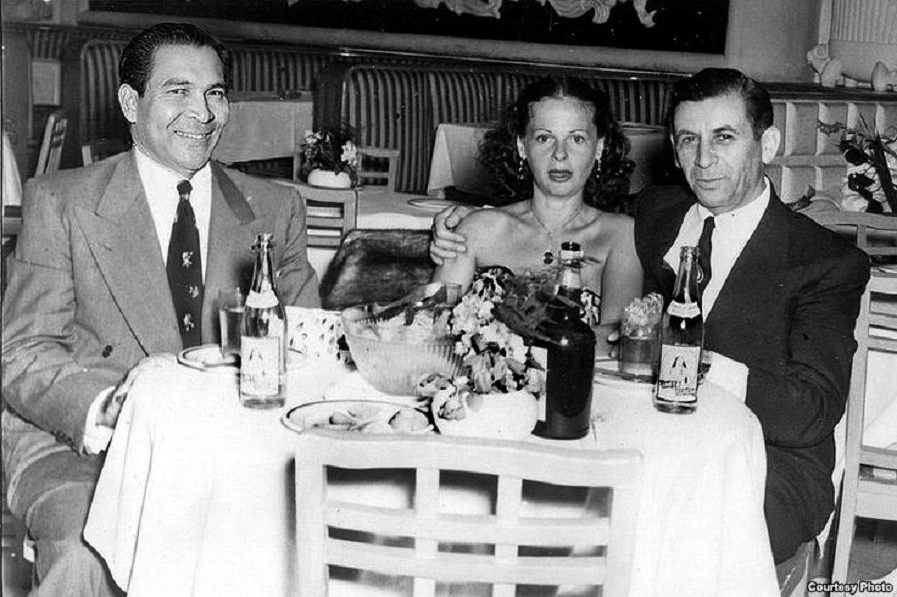
In The Godfather Part II, the villain Hyman Roth was inspired by the real-life Jewish gangster Meyer Lansky - one of the most powerful criminals in the history of America. A man the US Justice Department once described as the “financial genius of organized crime.”
He was a quiet strategist who helped turn the mafia into a modern business empire. Known as “the Mob’s Accountant,” he built his reputation on gambling, money laundering, and financial cunning rather than brute force.
From Prohibition-era rackets in New York to the casinos of pre-Castro Cuba, Lansky helped shape the mob’s rise into a transnational force. He was rarely the man in the spotlight, but behind the scenes, he was one of the most cunning and ruthless criminal minds of the 20th century - which made him the perfect real-life model for the archrival to Michael Corleone....🧵 (1/8)
Meyer Lansky was born Meyer Suchowlański on July 4, 1902, in Belarus. In 1911, he and his family immigrated to the United States and settled on Manhattan’s Lower East Side. He left school after eighth grade and worked as a mechanic, much like the Heymen Roth did. This was referenced in The Godfather Part II, where the young Hyman is discovered working as a car mechanic by Peter Clemenza. The scene was edited out of the final cut, but you can watch it below.
In the scene, Vito asks Hyman for his full name, and he answers, “Suchowsky,” a nod to Meyer Lansky’s real birth name. Vito then offers to give him “a better name” and asks, “Who’s the greatest man to you in the whole world?” Hyman replies, “Arnold Rothstein.”
Hence the name Hyman Roth — a direct reference to Lansky’s admiration for Rothstein, who was the man who mentored him in the criminal underworld. Arnold Rothstein was a notorious American gambler, bootlegger, and underworld fixer, who was accused of fixing the 1919 World Series, an event that became known as the Black Sox Scandal.
The film also nods to this later when Roth says to Michael, “I loved baseball ever since Rothstein fixed the World Series in 1919.” (2/8)