Antinomy πŸš©πŸ“š πŸŽ„πŸŽ Profile picture
Marxist Humanist (Hegelian Marxist). Internationalist. Free πŸ‡΅πŸ‡Έ. Read Marx's Paris Manuscripts, Dunayevskaya's Marxism & Freedom, and Lefebvre's DiaMat.
Dec 28, 2025 β€’ 12 tweets β€’ 2 min read
@thomas_sense8 @vampiremarxist So, Hegel's Absolute Idea isn't a universal for any type of thing (e.g. dog, humans, oak trees, planets, and so on) . Hegel's Absolute Idea is the universal for the entirety of reality itself. It is both the formal structure of reality and the final end of reality. 1/ @thomas_sense8 @vampiremarxist The formal structure of reality isn't something that can be reduced to reality's parts anymore than a human being can be reduced to organs, cells, bones, etc. You can only understand organs, cells, bones, and other human parts in the light of the whole structure of human being.2/
Sep 17, 2025 β€’ 11 tweets β€’ 2 min read
One of the key points of Hegel's Intro in his Science of Logic is his critique of Kant's understanding of formal logic. Kant thinks formal logic works with the forms of inferences & categories but merely receives content from experience without knowing things-in-themselves. 1/ Hegel's problem with Kant's view of formal logic is that Kant makes three assumptions: (1)the rigid dichotomy between the subject and things-in-themselves. (2) Kant assumes that ultimately formal logic is dependent on experience for determining its content. 2/
Jul 3, 2025 β€’ 22 tweets β€’ 4 min read
🧡Here's a thread on commodity from Marx's POV. For Marx a commodity's true nature is its social form with the dual character, use-value and exchange value, he calls the Value-Form. The value-form of a commodity is its value being expressed in relation to other commodities. 1/ Marx introduces an important distinction between Natural Form and Value Form. Every product of labor has a natural form regardless of whether or not it is a commodity because a natural form of a product is just its use-value for other people's needs. 2/
Feb 28, 2025 β€’ 5 tweets β€’ 1 min read
The proletariat is not a homogeneous, undifferentiated, and abstract universal. It is a concrete universal refracting itself into a rainbow particular modalities (of race, gender, nationality, and so on) that the universal alienated class is lived and experienced through. The self-sublation of the concrete universal class emancipates these particular modalities from the universal class, but preserves and elevates them to a higher universal, a new humanity initially latent within the universal class, that gives them new life and meaning.
Jan 13, 2025 β€’ 6 tweets β€’ 2 min read
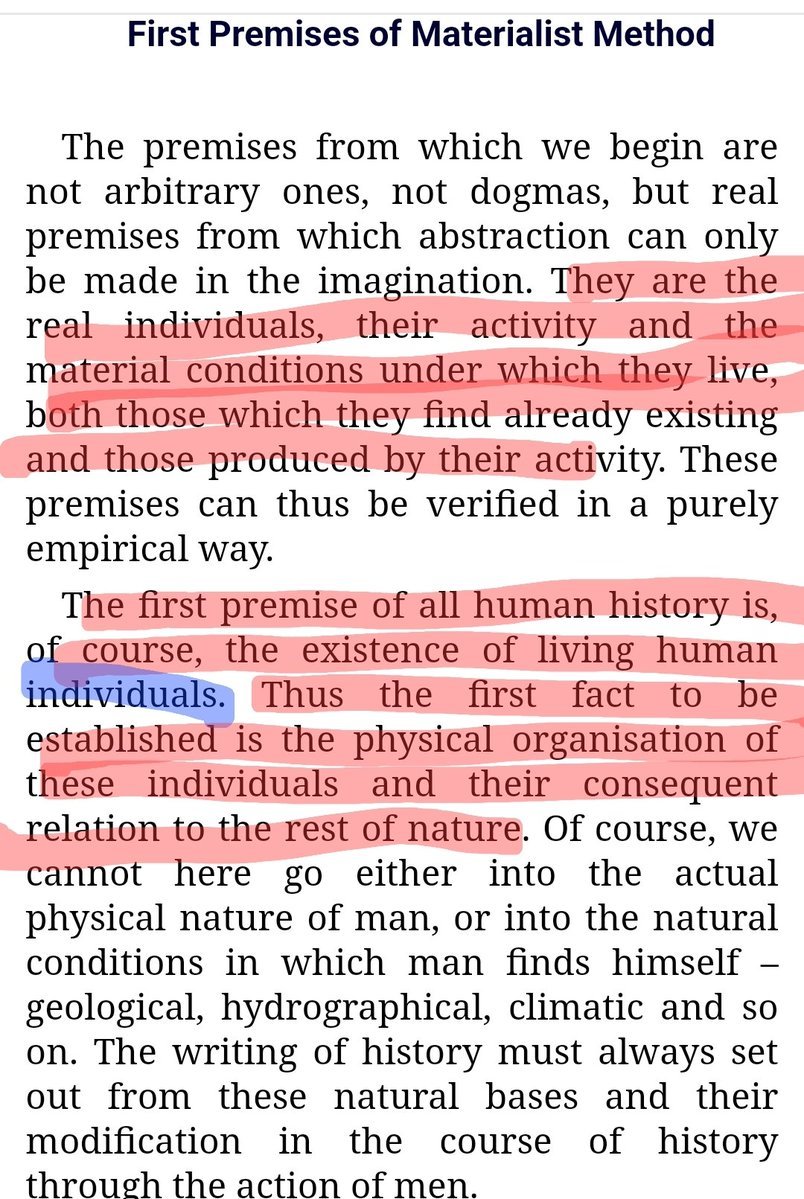
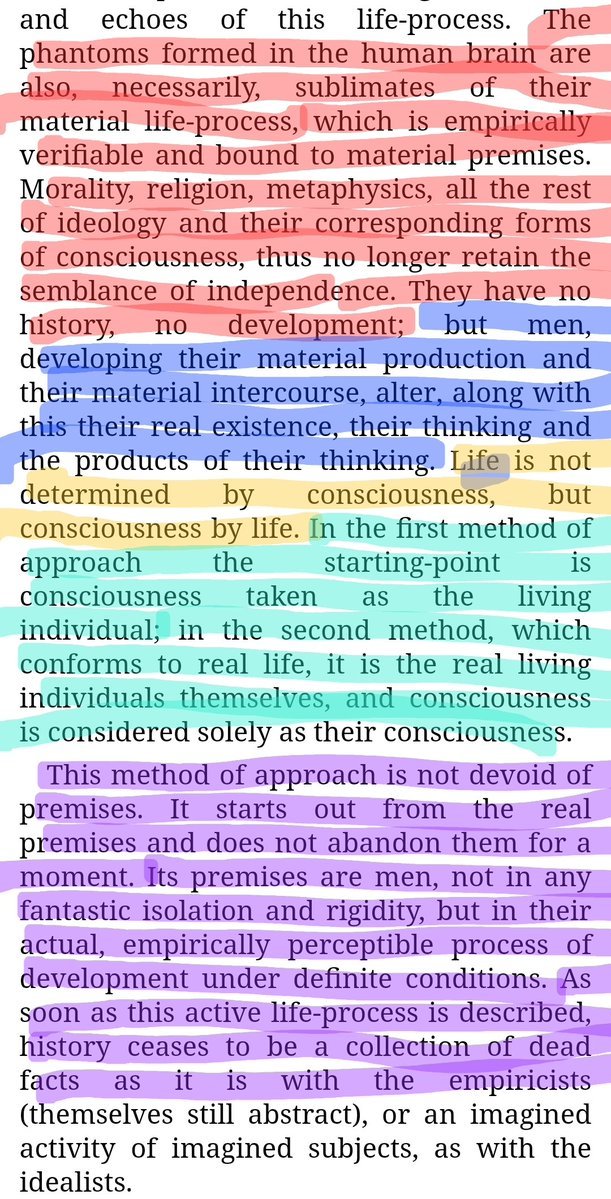
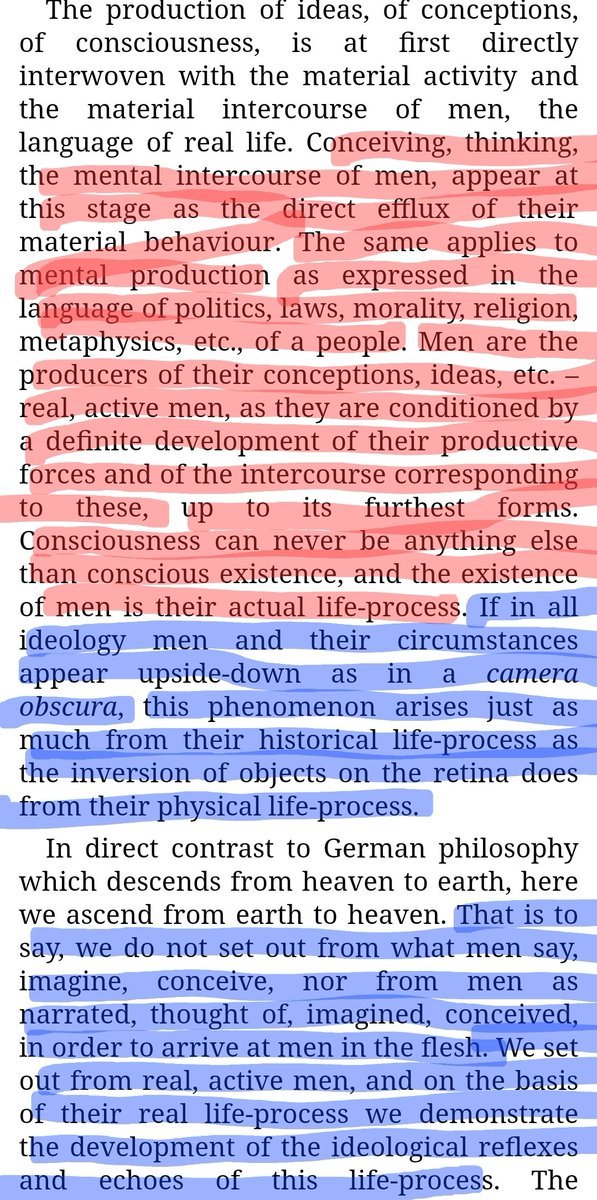
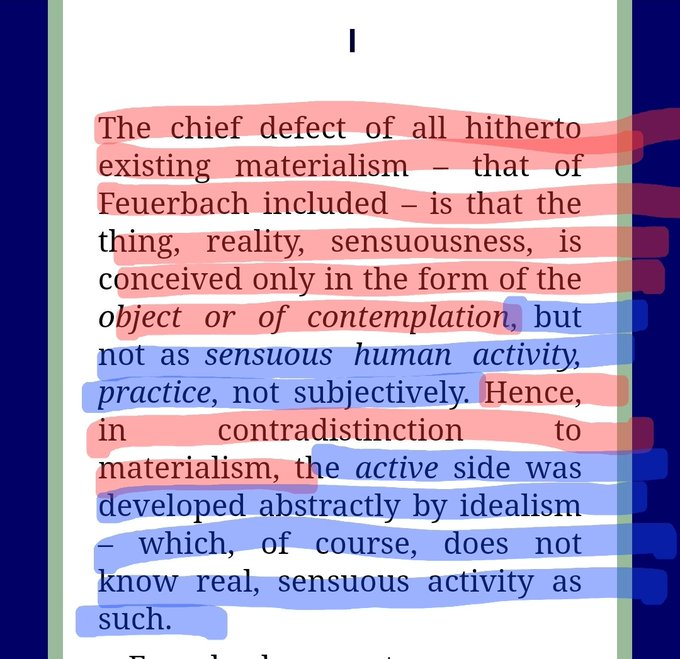
Marx's materialism affirms that real, living, and active individuals have the power produce ideas, religion, philosophy, and so on through shaping their material world. The opposite is a fetishism of attributing objectivity & independent power to ideas as having power over us. Image
Image
Image
Image
An ideology is a fetishism of attributing false objectivity and power to ideas, values, narratives, religion, and philosophy such that they dominate our activities. Dispelling the power of ideology is to discover their origin in real, living, active individuals who created them.
Dec 19, 2024 β€’ 5 tweets β€’ 1 min read
Marx's critique of capitalism is an internal critique that begins with taking capitalism at face value but works out its own logic to show it produces its own antithesis that transcends capitalism. Many socialists, however, have an external/ahistorical critique of capitalism. What's funny is that many socialists begin criticizing capitalism as unjust and unfree according to some transhistorical moral standard, but Marx begins with accepting the moral standard of capitalism of free voluntary exchange but shows that capitalism falls short of it.
Apr 20, 2024 β€’ 8 tweets β€’ 2 min read
🧡Marx doesn't have a universal definition of the state across all times. However, he offers an analysis of a *bourgeois* state in the context of bourgeois society. A bourgeois society is defined by the division between civil society and the state. The latter purports....1/ To represent the universal or common interest of society as a whole regardless of class distinctions. However, according to Marx, this purported universality of the bourgeois state is a pretense, a false universality, because it is an alienated expression of civil society. 2/